
Quick Read
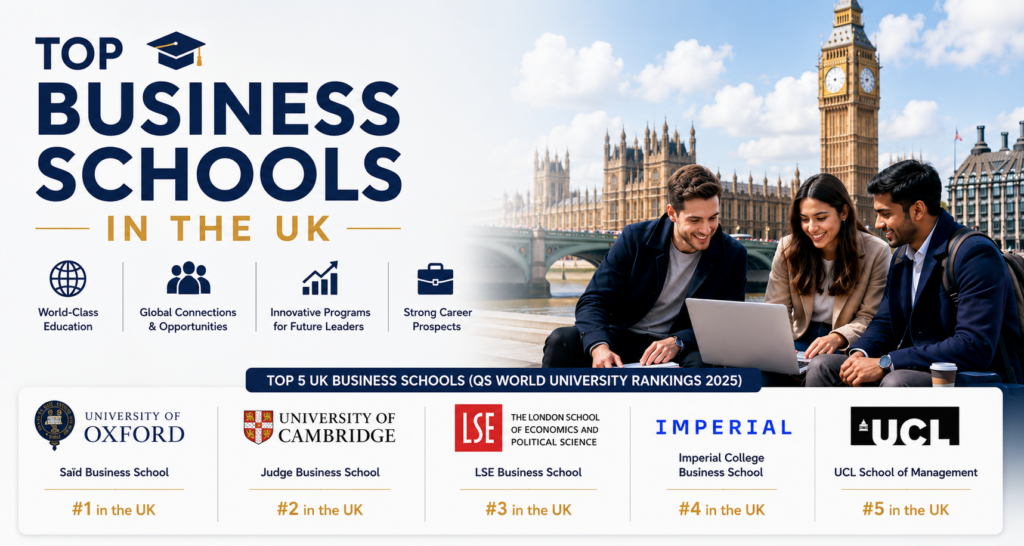
- Four UK universities rank in the top 11 globally for Business and Management (QS 2026).
- Annual fees at top UK business schools range from Rs. 29 lakh to Rs. 1.56 crore (£23,000–£123,950).
- Most UK Master’s programs are one year long, saving a full year of tuition and living costs.
- From 1 January 2027, the Graduate Route visa will be reduced to 18 months for bachelor’s and master’s graduates. Students applying before 31 December 2026 still receive the full 2-year period.
Top Business Schools in UK for Indian Students: QS Rankings and Fees
| Business School | QS Business Rank 2026 | Key Programs | Fees (INR approx.) | Acceptance Rate |
| London Business School | #6 (MBA globally) | MBA (15–21 month flexible exit), MiM | Rs. 1.56 crore (MBA) / Rs. 67 lakh (MiM) | ~20% |
| University of Oxford – Saïd Business School | #2 (MSc Finance globally, QS 2026); #12 (MBA globally, QS 2026) | MBA, MSc Financial Economics | Rs. 88 lakh–1.03 crore | ~20% |
| University of Cambridge – Judge Business School | #7 (QS Global MBA 2026) | MBA, MPhil Management | Rs. 82–94 lakh | ~15% |
| Imperial College Business School | #19 | MSc Business Analytics, MSc Finance, MSc Management | Rs. 45–55 lakh (approx.) | ~25% (approx.) |
| UCL School of Management | Top 20 | MSc Management, MSc Entrepreneurship | Rs. 53.8 lakh (MSc Management, £42,700) | ~8–10% (approx.) |
| Warwick Business School | Top 30 | MBA, MSc Finance, MSc Business | Rs. 44–75 lakh (MSc: Rs. 44–57 lakh; MBA: Rs. 75 lakh / £59,500) | ~30% (approx.) |
| Alliance Manchester Business School | Top 30–35 | MBA, MSc International Business | Rs. 29–48 lakh | ~35% (approx.) |
| University of Edinburgh Business School | Top 35–40 | MBA, MSc Finance | Rs. 29–44 lakh | ~35%(approx.) |
| King’s Business School | Top 35 | MSc Management, MSc International Business | Rs. 32–44 lakh | ~35% (approx.) |
| Cranfield School of Management | Top 50 | MBA, MSc Leadership | Rs. 51–63 lakh (approx.) | ~40% (approx.) |
| London School of Economics (LSE) | #7 MSc Finance globally | MSc Finance, MSc Accounting & Finance | Rs. 64.26 lakh (£51,000) | ~6–8% (approx.) |
Exchange rate used: Rs. 126 per GBP (May 2026). Verify the current rate before finalizing your budget.

Choose your dream country
 UK
UK
 USA
USA
 Germany
 Australia
 Ireland
 Canada
 UAE
UAE
 France
 Sweden
 Italy
Italy
 Other
Other
When do you want to study abroad?
What's your highest level of education?
Have you completed Class 12th?
What was your Class 12 CGPA/percentage?
Are you a student or a parent/guardian?
What do you want to study?
Select your current city
How Leap will help you

Personalised University Shortlist

Express Applications with Quicker Admits

End-to-End Application Support
My insight: LBS, Oxford, and Cambridge acceptance rates hover around 15–20% and are genuinely competitive. If your GMAT is below 680 or your undergraduate score is below 65–70%, apply to Warwick, Manchester, or Edinburgh as primary targets, not fallback options. They deliver strong career outcomes and are respected by global employers.
School-by-School Breakdown: Best Business Schools in UK
London Business School: Top-Ranked MBA Among Top Business Schools in UK
London Business School ranks #4 globally in the Financial Times Global MBA Ranking 2026, the highest-ranked UK MBA program. In QS Global MBA Rankings 2026, LBS sits at #6 globally. The program builds its 15–21 month MBA for professionals with significant work experience. The average intake has 5+ years.
| Detail | Figure |
| MBA tuition (2026 intake) | Rs. 1.56 crore (£123,950) |
| MiM tuition (2026 intake) | Rs. 67 lakh (£52,950) |
| Average GMAT | 708 |
| Min. work experience (MBA) | 2 years (average: 5 years) |
| Class size | 485 students |
| Post-MBA median salary (UK) | Rs. 1.13 crore (£90,000) |
The Master's in Management (MiM) at Rs. 67 lakh (£52,950) is LBS's route for students without work experience. Strong placement record in consulting and finance.
Oxford Saïd Business School: Ranked #1 Globally for MSc Finance
Oxford Saïd holds the QS #2 global ranking for MSc Finance in 2026, behind HEC Paris, which overtook it this year. For the MBA, it ranks #12 globally in QS 2026, up from #19 in 2025.
| Detail | Figure |
| MBA tuition | Rs. 88 lakh–1.03 crore (£70,000–£82,000) |
| Average GMAT | 690–710 |
| Standout program | MSc Financial Economics (investment banking, asset management) |
| Unique option | Oxford 1+1 MBA: combines an MBA with a second Oxford Masters |
Source: QS Business Masters Rankings 2026: Finance
Cambridge Judge Business School: One-Year MBA Among Top B Schools in UK
Cambridge Judge offers a 12-month MBA with a class size of around 180, significantly smaller than LBS, which means more faculty access and tighter peer cohorts.
| Detail | Figure |
| MBA tuition | Rs. 82–94 lakh (£65,000–£75,000) |
| Average GMAT | 680–700 |
| Indian students | Consistently one of the top 3 nationalities in the class |
Imperial College Business School: Best for Tech and Finance Intersection
Imperial is the strongest choice if you are an engineer or quantitative professional targeting fintech, investment banking, or business analytics roles in London.
| Detail | Figure |
| MSc Business Analytics fees | Rs. 45–55 lakh (£36,000–£44,000) |
| MSc Finance fees | Rs. 45–55 lakh (£36,000–£44,000) |
| Average GMAT | 660–680 |
| Median post-graduation salary | Rs. 69–88 lakh (£55,000–£70,000) |
| Entry requirement | Strong quantitative background: engineering, math, economics |
My insight: Imperial is one of the most popular choices for Indian students from engineering backgrounds, particularly IITians and students with high CGPA from Tier 1 colleges. Technically strong profiles have a higher conversion rate here than at LBS or Oxford.
Warwick Business School: High-Ranked Programs Outside London
Warwick holds triple accreditation (AACSB, EQUIS, AMBA). Warwick is the most practical high-value option for Indian students seeking a highly ranked program with fees below Rs. 65 lakh.
| Detail | Figure |
| Full-time MBA fees | Rs. 54–60 lakh (£43,000–£48,000) |
| MSc Finance fees | Rs. 35–42 lakh (£28,000–£33,000) |
| MSc Business fees | Rs. 32–38 lakh (£25,000–£30,000) |
| Campus | Coventry is 1.5 hrs from London. Living costs 25–30% lower than in London. |
Alliance Manchester Business School: Best Value MBA Among Top Business Schools in UK
Manchester is the largest campus-based business school in the UK. It accepts MBA students with 2+ years of experience, which makes it accessible earlier in your career than LBS or Oxford.
| Detail | Figure |
| Full-time MBA fees | Rs. 38–48 lakh (£30,000–£38,000) |
| MSc International Business fees | Rs. 29–35 lakh (£23,000–£28,000) |
| Manchester living costs | Rs. 9–11 lakh/year (£7,000–£9,000), significantly lower than London |
UCL School of Management: Best London Option for Fresh Graduates Among Top Business Schools in UK
UCL School of Management is based in Canary Wharf, directly in London's financial district, 10 minutes from HSBC, Barclays, Citigroup, and KPMG. Its MSc Management is a pre-experience program that does not require a GMAT or GRE, making it one of the most accessible top business schools in the UK for Indian undergraduates applying straight from a bachelor's degree.
| Detail | Figure |
| MSc Management fees (2026 intake) | Rs. 53.8 lakh (£42,700) |
| Duration | 12 months full-time |
| Work experience required | Not required; internships or project work strengthen the application |
| GMAT/GRE | Not required; an optional 600+ GMAT or 310+ GRE can support weaker academic profiles |
| Academic requirement | Upper Second Class honours or equivalent (65%+ for Indian students) |
| IELTS minimum | 7.0 overall (no section below 6.5) |
| Pathways | Corporate (any background) or Finance (accounting/economics background) |
| Acceptance rate | Approximately 15–20%; around 1,600 applicants compete for 120–130 seats |
| Median post-graduation salary | Rs. 63 lakh (£50,000) in consulting, finance, and technology |
My insight: UCL's Canary Wharf location is a real advantage, not a marketing talking point. The school runs employer networking events with financial district firms during the program itself. For Indian students targeting London finance or consulting without work experience, UCL often delivers better recruitment access than Manchester or Edinburgh, even though its fees are higher.
University of Edinburgh Business School: Triple-Accredited, Lower-Cost MBA Among Top Business Schools in UK
The University of Edinburgh Business School holds triple accreditation (AACSB, EQUIS, AMBA) and is part of the Russell Group, the UK's equivalent of the Ivy League in terms of research standing. Edinburgh, as a city, is 35–40% cheaper to live in than London, which brings the total all-in program cost well below most London competitors.
| Detail | Figure |
| Full-time MBA fees (2026) | Rs. 57.2 lakh (£45,410) |
| MSc Finance fees (approx.) | Rs. 39–44 lakh (£31,000–£35,000) |
| MSc Management fees (approx.) | Rs. 35–39 lakh (£28,000–£31,000) |
| Work experience required (MBA) | Minimum 3 years in a managerial or leadership role |
| IELTS minimum | 7.0 |
| Edinburgh living costs | Rs. 7–9 lakh/year (£5,500–£7,000) significantly cheaper than London |
| MBA specialization tracks | Finance, Entrepreneurship, Strategy, or Sustainability |
| India-specific scholarship | India Merit Scholarship: Rs. 6.3 lakh (£5,000) |
For Indian students targeting an accredited MBA without spending Rs. 80 lakh or more, Edinburgh is the most practical high-value option in this list. The total all-in cost, including living, sits around Rs. 65–75 lakh for the full program, roughly half of what LBS or Oxford costs.
My insight: Edinburgh gets underestimated because it is not in London. The Russell Group membership and triple accreditation are highly regarded by Indian employers in consulting and banking. Students who pursue the MBA at Edinburgh and return to India typically secure senior roles at the same firms as LBS and Warwick MBA graduates, but with a significantly lower total investment.
King's Business School: Top-Ranked for International Management Among Top Business Schools in UK
King's Business School sits on the Strand in central London and is part of King's College London, ranked in the QS World University Rankings 2026 top 40 globally. KBS achieved triple accreditation (AACSB, EQUIS, AMBA) in 2023. Its MSc International Management is the flagship pre-experience program and the most relevant choice for Indian students targeting international business, management consulting, or cross-border operation roles.
| Detail | Figure |
| MSc International Management fees | Rs. 51 lakh (£40,450) |
| Duration | 12 months full-time |
| Work experience required | Not required |
| GMAT/GRE | Not required; a strong optional score supports weaker academic profiles |
| Academic requirement | High 2:1 equivalent (65%+ for Indian students, all subjects accepted) |
| IELTS minimum | 7.0 (TOEFL 100+ also accepted) |
| Graduate employability | 93.2% of KBS graduates are in graduate-level roles or postgraduate study within 6 months |
| Top hiring sectors | Consulting, Finance, Marketing, International Operations |
My insight: King's is the most underrated top business school in the UK for Indian applicants. Students often overlook its QS top-40 global ranking and triple accreditation because they focus on Imperial and UCL for London-based MSc programs. The King's MSc International Management delivers strong placement outcomes for Indian students targeting international business or management consulting, and it costs Rs. 10–13 lakh less than UCL's MSc Management.
LSE (London School of Economics): Top UK Business School for MSc Finance
LSE's Department of Finance ranks #7 globally for MSc Finance (QS Business Masters Rankings 2026) and #1 in the UK for finance study (Good University Guide 2026). For Indian students targeting investment banking, asset management, or financial economics, LSE is a direct competitor to Oxford Saïd, often preferred by applicants with a strong quantitative or economics background.
| Detail | Figure |
|---|---|
| MSc Finance fees (2026–27) | Rs. 64.26 lakh (£51,000) |
| MSc Finance & Economics fees | Rs. 64.26 lakh (£51,000) |
| Duration | 10 months full-time |
| GMAT/GRE | Required for all non-UK graduates (GMAT strongly preferred) |
| Academic requirement | First-class or high 2:1 equivalent; 75%+ for Indian students |
| IELTS minimum | 7.0 overall (7.0 in each component) |
| Key programs | MSc Finance, MSc Finance & Economics, MSc Accounting & Finance |
| QS MSc Finance rank | #7 globally (2026) |
| Top hiring sectors | Investment banking, asset management, consulting, fintech |
Source: LSE MSc Finance official page; QS Business Masters Rankings 2026
Exchange rate used: Rs. 126 per GBP (May 2026). Verify the current rate before finalising your budget.
My insight: LSE is the strongest choice for Indian students with an economics or STEM undergraduate degree who want to specialise in financial markets. The 10-month program moves faster than Oxford Saïd's 12-month MBA and is more quantitative in structure. Indian applicants from IITs and Delhi University economics departments consistently perform well here. One caution: LSE does not offer the same generalist MBA experience as LBS or Cambridge Judge. If your goal is a career change into consulting or general management, Oxford Saïd or LBS serves you better. If your target is a buy-side or investment banking role, LSE's Finance department gives you a direct runway.
Top Business Schools in UK by Specialization
Picking by specialization, not just overall rank, gives you better placement outcomes in your target sector.
| Specialization | Top Business Schools in UK |
| MBA (General Management) | LBS, Oxford Saïd, Cambridge Judge, Warwick |
| MSc Finance / FinTech | Oxford Saïd, Imperial, LSE, Warwick |
| MSc Business Analytics | Imperial, Warwick, Manchester, UCL |
| MSc International Business | Manchester, King's, Edinburgh, Nottingham |
| MSc Management (MiM) | LBS, Warwick, Imperial, UCL |
| MBA in Healthcare Management | Manchester, Cranfield, Birmingham |
| MBA Without Work Experience | Warwick, Manchester, Birmingham |
Admission Requirements for Top Business Schools in UK: Indian Students 2026-27
| Requirement | Details | India-Specific Notes |
| Undergraduate Degree | 3-year or 4-year bachelor's | 3-year degrees are accepted at most UK schools; confirm with each school |
| Academic Score | 60–75% or 6.5–8.5 CGPA | LBS and Oxford expect 70%+ from Tier 1 colleges |
| English Language | IELTS 6.5–7.5; TOEFL 100–110 | Class 12 board results do not waive this |
| GMAT/GRE | 640–720 GMAT across top schools | MBA without GMAT possible at select schools |
| Work Experience | 2–5 years for MBA; 0–1 year for MSc | MiM/MSc programs accept fresh graduates |
| SOP | 500–1,000 words | Clearly explain your India-to-UK career rationale |
| LORs | 2–3 referees | For an MSc, academic letters of recommendation (LORs) are acceptable, while professional letters of recommendation are preferred for an MBA. |
| Transcripts | Marksheets and a degree certificate | Provisional certificate accepted for final-year students |
| Application Fee | Rs.6,300–12,600 (£50–£100) per school | Some schools offer waivers; apply directly to check |
GMAT vs GRE at Top Business Schools in UK
Most top business schools in the UK accept both. LBS, Oxford, and Cambridge show a historical preference for GMAT in MBA programs. For MSc programs, the GRE is equally valid and often preferred by engineering applicants.
- LBS MBA average GMAT: 708
- Cambridge Judge MBA average: 690
- Imperial MSc average: 660–680
- GRE equivalent to 700 GMAT: approximately 320–325
My insight: The real issue is not GMAT vs. GRE; it is your score. A 700+ GMAT or 320+ GRE meets the threshold at most top schools for Indian applicants. If you are below a 660 on the GMAT or 310 on the GRE, retake it before applying to LBS or Oxford. A stronger score also directly improves your scholarship prospects.
Full Cost Breakdown for Indian Students at Best Business Schools in UK (2026-27)
Total cost = tuition + accommodation + food + transport + IHS + books. Here is the realistic breakdown of total cost of studying at top business schools in UK.
| Cost Component | London (per year) | Outside London (per year) |
| Tuition Masters | Rs. 45–55 lakh | Rs. 29–42 lakh |
| Tuition MBA | Rs. 82 lakh–1.56 crore | Rs. 38–60 lakh |
| Accommodation | Rs. 11–15 lakh | Rs. 8–10 lakh |
| Food and groceries | Rs. 3–5 lakh | Rs. 2.5–4 lakh |
| Transport | Rs. 2–2.5 lakh | Rs. 1–1.5 lakh |
| Immigration Health Surcharge (IHS) | Rs. 97,776/year (£776/year) | Rs. 97,776/year (£776/year) |
| Books and materials | Rs. 0.6–1.3 lakh | Rs. 0.6–1 lakh |
| Total (Masters) | Rs. 63–80 lakh | Rs. 42–59 lakh |
| Total (MBA) | Rs. 1 crore–1.81 crore | Rs. 50–78 lakh |
For a detailed cost breakdown: Cost of MS in UK for Indian Students 2026
Scholarships at Top Business Schools in UK for Indian Students
Most school-level scholarships are awarded automatically at the time of admission; you do not apply separately. External scholarships require standalone applications.
| Scholarship | Amount (INR approx.) | Eligibility |
| Chevening Scholarship | Full tuition + Rs. 10–13 lakh stipend | 1-year Master's; 2 years' work experience required |
| Commonwealth Scholarship | Full funding | Commonwealth citizens are highly competitive |
| LBS Ajay Arora Scholarship | Rs. 63 lakh (£50,000) | Indian students on the LBS MBA specifically |
| LBS Merit Scholarship | Rs. 10–32 lakh (partial) | MBA and MiM applicants |
| Oxford Weidenfeld-Hoffmann | Full tuition + stipend | DPhil and select Master's; leadership focus |
| Warwick Excellence Scholarship | Rs. 5–10 lakh | Merit-based; high GMAT scores |
| UCL Global Masters Scholarship | Rs. 10–15 lakh | UCL-specific; merit-based |
| Chevening (India-specific) | Full funding | Indian passport holders |
For the full list: Top Scholarships in UK for Indian Students
My insight: Chevening applications open in August and close in November. Most Indian students miss the deadline entirely because they start researching in January. If you are targeting a September 2027 entry, the Chevening window opens in August 2026. Mark it now.
UK Student Visa Process for Indian Applicants at Top B Schools in UK
Key Costs (Updated April 2026)
| Fee | Amount |
| Visa application fee (from India) | Rs. 70,308 (£558) increased from £524 on April 8, 2026 |
| Immigration Health Surcharge (IHS) | Rs. 97,800 per year of study (£776/year) paid upfront for full visa duration |
| Priority processing (optional) | Rs. 63,000 extra (£500) for 5-day decision |
A 1-year Master's visa is typically issued for approximately 13 months (course end date plus 4 months). Since IHS is charged per year of visa permission rounded up, you pay for 2 years upfront: Rs. 1.96 lakh (£1,552).
Financial Proof Requirement for Top Business Schools in UK
UKVI requires you to show funds for your first year's tuition plus the following maintenance amounts, held for 28 consecutive days before applying:
- London: Rs. 17.34 lakh (£13,761)
- Outside London: Rs. 13.28 lakh (£10,539)
Note: Maintenance thresholds increased from November 2025. London: £1,529/month × 9 months = £13,761. Outside London: £1,171/month × 9 months = £10,539. Figures converted at Rs. 126/GBP. Source: UKCISA.
Document Checklist for Top Business Schools in UK
| Document | India-Specific Notes |
| Valid passport | Must cover the full course duration |
| CAS number | 14-digit reference from your university; apply only after receiving this |
| IELTS/TOEFL scorecard | Original required; must match the university's minimum |
| Bank statements | 28-day continuous holding period; balance must not dip |
| Mark sheets | Class 10, Class 12, and undergraduate transcripts |
| Degree or provisional certificate | Provisional certificate accepted for recent graduates |
| TB test certificate | Mandatory for Indian passport holders; book early, 1–2 week wait in most cities |
| Scholarship letter (if applicable) | Official award letter from the scholarship body |
For updated fees: UK Student Visa Fee Update 2026
My insight: The TB test is the step that most Indian applicants leave too late. Approved clinics in cities like Pune and Chennai have 1–2 week appointment backlogs. Book it as soon as you accept your university offer, not when you start assembling visa documents.
Career Outcomes and Salaries After Top UK Business Schools
Salary outcomes vary significantly by program and city. All figures below are in GBP (median) from published employment reports, converted at Rs.126/GBP.
| Program | Median UK Salary (GBP) | Median UK Salary (INR) | Top Hiring Sectors |
| LBS MBA | £90,000 | Rs.1.13 crore | Consulting, Finance, Tech |
| Oxford Saïd MBA | £80,000–£95,000 | Rs.1.01–1.20 crore | Finance, Consulting, PE |
| Imperial MSc Finance | £55,000–£70,000 | Rs.69–88 lakh | Investment Banking, FinTech |
| Warwick MSc Business | £40,000–£55,000 | Rs.50–69 lakh | FMCG, Consulting, Operations |
| Manchester MBA | £50,000–£65,000 | Rs.63–82 lakh | Manufacturing, Consulting, Tech |
Exchange rate: Rs.126/GBP (May 2026). Individual outcomes vary by experience, sector, and role.
Graduate Route Visa: What Changes in 2027
| Graduation Year | Graduate Route Duration |
| Before January 2027 | 2 years (current rule) |
| January 2027 onward taught Master's/Bachelor's | 18 months (confirmed change) |
| PhD graduates | 3 years (unchanged) |
If you start in September 2026 and graduate in 2027, you get 18 months. Begin your UK job search before graduation, not after you land.
My insight: The Graduate Route is the most underused asset Indian students hold. Many return to India immediately after graduation, when 6–12 months of UK work experience would substantially increase both their salary trajectory and long-term career options. With 18 months from 2027, job-search prep needs to begin in your final semester.
What to Do When Things Go Wrong
- GMAT below 640: Do not rush. UK MBA programs without GMAT exist, but for top schools, a low score is a real barrier. Retake and target the next intake. A stronger score also directly improves scholarship odds.
- Visa rejected: Get the refusal letter and identify the exact reason. The three most common causes for Indian applicants are fund documentation not showing a continuous 28-day balance, unclear financial source, and missing TB test certificate. Reapplication with corrected documents is processed in the same 3-week window. Contact your university's international admissions office immediately.
- Scholarship deadline missed: School-level scholarships run with Round 1 deadlines (October–November). Missing the Round 1 cuts off most scholarship options, even if you get admission in Round 2. Plan from August.
- Conditional offer with IELTS shortfall: If you submitted 6.5 and your offer requires 7.0, you have two options: retake IELTS before the May–June enrollment deadline or ask the admissions office about a pre-sessional English program. Both are workable. Act immediately; do not wait.
3 Takeaways for Indian Students Researching Top Business Schools in UK
- Apply to the right program type for your experience level. Fresh graduates belong in MSc and MiM programs. Professionals with 3–5+ years belong in MBA programs. Applying to the wrong category wastes time and application fees, and the schools will not make exceptions.
- Start 12 months early and mark August for Chevening. Chevening opens in August and closes in November. LBS and Oxford Round 1 deadlines fall in October–November. Students who begin researching in January for September entry routinely miss both windows.
- Plan your post-study UK career before you graduate, not after. From January 2027, taught Master's graduates will get 18 months on the Graduate Route, not 2 years. Six to twelve months of UK work experience before returning to India adds measurably to salary trajectory and employer recognition.
Have questions about the top business schools in the UK? Book a free session with a LeapScholar counselor.
Frequently Asked Questions About Top Business Schools in UK for Indian Students
-
What are the top business programs for undergraduates in the UK?
The top undergraduate business programs in the UK are BSc Accounting and Finance at Warwick Business School, BSc Management at the London School of Economics, BSc Business Administration at the University of Bath, BSc Business and Management at the University of Exeter, and BSc Business Management at King's Business School. All run 3 years, accept students straight from Class 12, and have graduate employment rates above 90%.
-
Do UK business school degrees help get a job in India?
Degrees from LBS, Oxford, Cambridge, and Imperial are well-recognized by Indian employers in consulting, investment banking, FMCG, and technology. Median India-return salaries for top UK MBA graduates range from Rs. 25–50 lakh per year, with senior consulting and banking roles going higher. From January 2027, the Graduate Route for taught Master's graduates gives 18 months in the UK before you have to decide, which is enough time to gain UK work experience if you plan early.
-
What is the best business school in the UK?
London Business School ranks #1 in the UK for MBA globally (FT Rankings 2025), with an average GMAT of 708 and a median post-MBA salary of Rs.1.13 crore (£90,000). Oxford Saïd ranks #1 globally for MSc Finance. The "best" depends on your program type: LBS for MBA and Imperial or Warwick for pre-experience Master’s.
-
What are the best UK universities for business undergraduate studies?
The best UK universities for business undergraduates include Warwick Business School (BSc Accounting and Finance), London School of Economics (BSc Management), University of Bath (BSc Business Administration), and University of Exeter (BSc Business and Management). All are Russell Group or similar institutions with high graduate employment rates over 90%.
-
What are the top business schools in UK for MBA
The top business schools in the UK for MBA are London Business School (Rs.1.56 crore, 15–21 months), Oxford Saïd (Rs.88 lakh–1.03 crore, 12 months), Cambridge Judge (Rs.82–94 lakh, 12 months), Warwick Business School (Rs.54–60 lakh), and Alliance Manchester Business School (Rs.38–48 lakh). All require a minimum of 2–3 years of work experience.
-
What's the hardest business school to get into in the UK?
Oxford Saïd and Cambridge Judge are the hardest, each with acceptance rates around 15%. LBS MBA sits at approximately 20%, but the Indian applicant pool is large, making effective competition higher. UCL MSc Management accepts around 15% of its 1,600+ annual applicants despite having no GMAT requirement.
-
Which business schools in UK have the highest acceptance rate?
Among the listed UK business schools, the highest admission rates of 35-45% are seen at Edinburgh Business School, Alliance Manchester, and Cranfield School of Management. Warwick and King’s Business School take about 30-35% of candidates. Those acceptance rates still imply something; this is not an open-door program.
-
How do I apply to top business schools in the UK?
Applications go directly through each school's online portal; there is no centralized UK business school application system. You will need a GMAT or GRE score (for most MBA programs), IELTS 6.5–7.5, academic transcripts, 2 letters of recommendation, and a statement of purpose. MBA programs additionally require a CV showing work experience. Most schools run 2–3 application rounds between October and April for September entry.
-
Which top UK business schools don't require GMAT?
UCL School of Management's MSc Management does not require GMAT or GRE; an optional 600+ GMAT can strengthen a weaker academic profile but is not mandatory. King's Business School MSc International Management also does not require GMAT. Warwick Business School offers an MBA without GMAT for applicants with strong work experience and academic records. If you hold a GMAT below 640, target these three as your primary applications rather than LBS or Oxford, which historically prefer 680+ scores.








Have Questions? Get Guidance to reach your Dream University
Connect with India's finest counsellors and biggest study abroad community.
Get Guidance