
Quick Read
- Surgeons and medical specialists top Germany’s salary scale at over €200,000 (Rs.2.17 Cr+) gross a year.
- The 2026 EU Blue Card threshold is Rs.55.2 lakh, or Rs.50.0 lakh for shortage occupations.
- Indian professionals earn Germany’s highest median wage among all nationalities.
- A Blue Card offer converts to PR in 21 months with B1 German.
- The APS Certificate costs Rs.18,000 and is mandatory before any German university or visa step.
- Over 59,000 Indian students now study in Germany, DAAD’s highest count on record.
Top Highest Paying Jobs in Germany for Indian Students (2026)
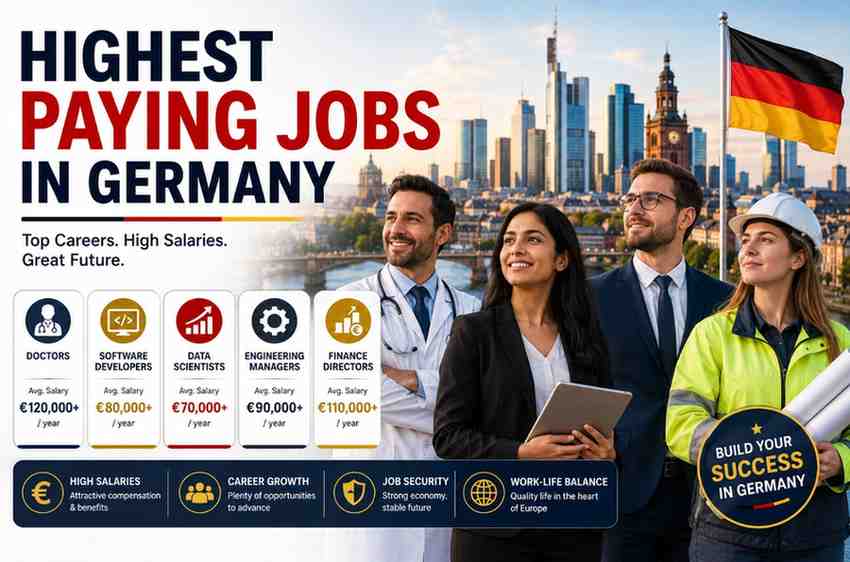
Munich and Frankfurt pay more than Berlin or Leipzig for the same role. Here are the highest paying jobs in Germany right now, ranked by ceiling salary.
| Job | What It Is | Salary Range (Gross) | In INR (Approx.) |
|---|---|---|---|
| Medical Specialists (Surgeons, Cardiologists) | Hospital and clinic specialists | €110,000 – €300,000+ | Rs.1.20 Cr – Rs.3.27 Cr+ |
| IT Managers & Software Architects | Lead tech strategy, software systems | €90,000 – €166,000 | Rs.98.0 lakh – Rs.1.81 Cr |
| Investment Bankers & Finance Experts | Banking, portfolio and risk roles, Frankfurt | €80,000 – €250,000+ | Rs.87.1 lakh – Rs.2.72 Cr+ |
| Engineering Managers (Automotive, Chemical) | Senior leadership in automotive/chemical/aerospace | €90,000 – €160,000 | Rs.98.0 lakh – Rs.1.74 Cr |
| Corporate & Patent Lawyers | Corporate or IP legal counsel | €80,000 – €150,000+ | Rs.87.1 lakh – Rs.1.63 Cr+ |
| Data Scientists & AI Specialists | AI, analytics, machine learning | €78,000 – €140,000 | Rs.84.9 lakh – Rs.1.52 Cr |
| Pilots & Aviation Professionals | Commercial pilots (e.g. Lufthansa) | €70,000 – €165,000 | Rs.76.2 lakh – Rs.1.80 Cr |
| Management Consultants | Strategy and operations advisory | €80,000 – €150,000 | Rs.87.1 lakh – Rs.1.63 Cr |
| Sales Directors (Tech & Engineering) | Senior B2B sales leadership | €80,000 – €150,000+ | Rs.87.1 lakh – Rs.1.63 Cr+ |
| Biotech & Pharma Researchers / R&D Managers | Scientific research, clinical programmes | €60,000 – €120,000 | Rs.65.3 lakh – Rs.1.31 Cr |

Choose your dream country
 UK
UK
 USA
USA
 Germany
 Australia
 Ireland
 Canada
 UAE
UAE
 France
 Sweden
 Italy
Italy
 Other
Other
When do you want to study abroad?
What's your highest level of education?
Have you completed Class 12th?
What was your Class 12 CGPA/percentage?
Are you a student or a parent/guardian?
What do you want to study?
Select your current city
How Leap will help you

Personalised University Shortlist

Express Applications with Quicker Admits

End-to-End Application Support
Sources: Surgeon and IT salary bands cross-checked against UE Germany's salary breakdown and Glassdoor Germany; average national wage benchmarks from Destatis via Trading Economics.
Before reading the ceilings, a caution on how these bands are earned. Describing what separates the engineers who reach them, a Senior Platform Engineer who contributed to LeapScholar's Germany guide, Eric Schüler, says: "The biggest difference between engineers who grow into senior or staff-level roles and those whose careers plateau is the ability to move from solving individual tasks to taking ownership of bigger problems and influencing solutions beyond their immediate responsibilities. Technical skills are only one part of career growth."
Counselor insight: Indian professionals in Germany aren't just keeping pace with these bands, they're outperforming them. A 2026 German Economic Institute (IW) study found Indian workers earned a median gross wage of €5,393/month (Rs.5.87 lakh/month) in 2024, the highest of any nationality in Germany, including German nationals themselves (€4,177/month). The reason: a third of Indian professionals aged 25-44 work in academic STEM roles, exactly the roles that top this table.
Highest Paying Jobs in Germany Without a Degree
You don't need a German university degree to earn well here.
- Skilled Trades (Handwerker): Electricians, plumbers, construction managers. €45,000 – €65,000 with experience.
- IT Roles via Practical Experience: Web developers, IT support specialists can qualify for the EU Blue Card with 3+ years of IT experience in the last 7 years, no degree required.
- Sales & Real Estate: Performance-based, top agents can match management-consultant salaries.
What “Highest Paying Jobs in Germany” Really Means: Gross vs In-Hand Salary
The highest paying jobs in Germany look bigger on paper than in your bank account. A big gross number means less once Germany's tax wedge applies.
- Income Tax: Progressive, 14% to 45%
- Social Security: ~19.7% of gross (health, pension, unemployment, long-term care), split between you and your employer
- Tax Class I (single professionals) pays the most; Class III/V benefits married couples with one primary earner
Net Salary Table (Tax Class I, Single)
| Gross Annual Salary | Net Monthly (EUR) | Net Monthly (Rs.) |
|---|---|---|
| €50,000 | ~€2,650 | ~Rs.2.89 lakh |
| €70,000 | ~€3,500 | ~Rs.3.81 lakh |
| €100,000 | ~€4,800 | ~Rs.5.23 lakh |
Source: Federal Statistical Office (Destatis) wage data; national average gross salary is approximately €4,701–€4,900/month (Rs.5.12 lakh – Rs.5.34 lakh) as of 2024-26, with the 2025 median at €53,900/year (Rs.58.7 lakh) per the StepStone Gehaltsreport.
Net is still not the number that matters most. Advising candidates on how to judge an offer, a Group Product Manager at SAP and contributor to LeapScholar's Germany guide, Harit Bhasin, says: "Don't just look at your gross salary. Think about your overall financial situation. How much tax will you pay? How much will you spend on rent, food, travel, insurance, vacations, and visiting family? At the end of the year, ask yourself, 'How much am I actually saving, and is that better than what I could save in India?"
EU Blue Card and Shortage Occupations: The Threshold Behind Every Highest Paying Job in Germany
This single number decides whether your job offer qualifies you for Germany's fastest visa route, and whether it counts among the highest paying jobs in Germany on paper.
| Category | 2026 Salary Threshold | In INR |
|---|---|---|
| Standard occupations | €50,700/year | Rs.55.2 lakh/year |
| Shortage occupations, recent graduates, qualifying IT specialists | €45,934.20/year | Rs.50.0 lakh/year |
Source: Make it in Germany, official EU Blue Card page, thresholds effective 1 January 2026.
Germany's Federal Employment Agency (Bundesagentur für Arbeit) currently classifies 163 shortage occupations, spanning IT, engineering, healthcare, and select skilled trades. If your role is on this list, you qualify at the lower threshold and often skip the priority check (Vorrangprüfung) altogether.
You also qualify for the lower threshold automatically if:
- You completed your degree within the last 3 years ("recent graduate" rule), or
- You're an IT specialist with 3+ years' relevant experience in the last 7 years, no degree needed.
Given how much rides on clearing that one number, it should shape the offer itself. As the same SAP Group Product Manager and guide contributor, Harit Bhasin, puts it: "If you're a student, don't focus only on getting the highest salary. First, make sure your salary is enough to qualify for a Blue Card. That's your starting point, because it allows you to continue working in Germany and later leads to permanent residency and citizenship."
Counselor insight: In 2024, Germany issued 56,252 EU Blue Cards, 72% of the EU's total, and 13,300 of them went to Indian citizens, more than any other nationality received in any single EU country that year, according to Eurostat's official residence permit statistics. If you're targeting the Blue Card route, you're following the single largest cohort of successful applicants, not a niche path.
Which Path Fits You: A Decision Framework for Germany’s Highest Paying Jobs
If you are a final-year B.Tech/M.Tech student graduating in 2027, targeting IT or Data Science roles: Your CGPA and DAAD's own data work in your favour, 60% of Indian students in Germany are already in Engineering (DAAD India, 2024/25 winter semester data). Start your MS in Computer Science shortlist now, and confirm your APS certificate timeline before your final semester ends.
If you're an MBA or Management graduate whose offer sits below the standard €50,700 threshold: Check if your role, or a shortage-adjacent title, qualifies for the €45,934.20 threshold. If not, negotiate the base salary before signing; a €3,000-€5,000 uplift is often achievable pre-signature, far harder after.
If your Indian degree isn't yet verified as "H+" on Anabin, or you don't have a job offer at all: You're a stronger fit for the Germany Opportunity Card (Chancenkarte) than the Blue Card. It lets you enter Germany, work part-time, and interview in person, which German employers respond to faster than remote applications from India.
Sector choice affects how much room you have to negotiate. On where demand currently sits, an Automotive Engineer in Ingolstadt who contributed to LeapScholar's Germany guide, Damanjit Singh, observes: "The German automotive sector is currently facing headwinds due to global economic shifts and competition from Asian markets. The strongest opportunities for international candidates right now lie in IT, AI and machine learning, and robotics and unmanned systems."
Documents You’ll Actually Need for Highest Paying Jobs in Germany
Every applicant chasing the highest paying jobs in Germany needs the same paper trail, regardless of sector.
| Document | Purpose | Indian-Specific Detail |
|---|---|---|
| APS Certificate | Verifies your academic credentials before any university or visa step | Issued by APS India (under the German Embassy, New Delhi); fee Rs.18,000; processing 3–8 weeks |
| Anabin database check | Confirms if your Indian university/degree is rated "H+" | Free; check directly on the KMK's Anabin portal before applying for Blue Card or Chancenkarte |
| ZAB Statement of Comparability | Needed if your degree isn't listed or needs formal comparability | Fee €208 (Rs.22,647); 2 weeks (Blue Card fast-track) to 3 months |
| Blocked account (Sperrkonto) | Proof of funds for job-seeker or student visa | Chancenkarte requires ~€13,092/year (Rs.14.25 lakh) or €1,091/month |
| Language certificate | IELTS, TOEFL, or German A1–C1 | Most Indian applicants use IELTS; Germany also accepts non-IELTS routes |
| dMAT (new, from Summer 2027 intake) | Aptitude test for Indian Master's applicants in Engineering, Commerce, or Business | Fee €150 (Rs.16,332); mandatory only for India, administered by g.a.s.t. |
| Signed employment contract meeting salary threshold | Core Blue Card eligibility document | Must explicitly state gross annual salary ≥ applicable threshold |
Applicants who filed before the system settled waited considerably longer. Recalling his own timeline, a Master's student in Operational Excellence at Hof University of Applied Sciences and a contributor to LeapScholar's Germany guide, Mahendra Wagh, says: "The student visa took about a month to process. The APS certificate took around 3 months, as the system was newly introduced at the time, though the timeline has since improved to a few weeks."
Your Month-by-Month Roadmap for Highest Paying Jobs in Germany
| Timeline | Action |
|---|---|
| Feb – Mar | Start Anabin check, register for APS using your provisional certificate |
| Apr – May | Indian final-semester results out; complete APS submission with final mark sheets |
| May – Jul | Apply for job seeker visa or Blue Card roles on Xing and StepStone; finalise language certificate |
| Jun – Aug | Sit TestAS/dMAT if your programme requires it; book your visa appointment |
| Sep – Oct | Move to Germany for the Winter semester or new job start |
| Ongoing (first 6 months in-role) | Track your Blue Card salary threshold at every appraisal; negotiate above the shortage-occupation floor |
On which platforms actually carry the search: LeapScholar's survey found 84% of respondents used LinkedIn, well ahead of StepStone (32%) and XING (16%). Describing how he combines them, a Simulation Engineer in the medical technology sector and contributor to LeapScholar's Germany guide, Raj Sinha, notes: "While active on LinkedIn for global professional networking, regional job portals such as Xing and Indeed are heavily utilized alongside LinkedIn for job hunting in Germany and broader Europe."
Which Cities and Sectors Have Highest Paying Jobs in Germany
- Munich: Highest salaries overall, especially in automotive and tech (BMW, Siemens headquarters)
- Frankfurt: Best for finance and banking roles
- Berlin: Largest startup ecosystem, strong for tech but slightly lower average pay than Munich
- Leipzig, Dresden ("Silicon Saxony"): High-tech jobs with rents roughly 50% lower than Munich, a real savings opportunity
From Job to PR to Citizenship
Landing one of the highest paying jobs in Germany is the hard part; the settlement route afterward is well-defined.
- Blue Card holders: Permanent residency (Niederlassungserlaubnis) in 21 months with B1 German, or 27 months without
- Standard employment route: Typically 5 years of pension contributions
- Citizenship: Since June 2024, Germany allows dual citizenship, so Indians naturalising after the required residence period no longer have to give up their Indian passport
Quantifying that trade, a Process Engineer in North Germany and TU Bergakademie Freiberg graduate who contributed to LeapScholar's Germany guide, Hemanth Kiran, puts it this way: "Dresden versus Munich is roughly €300 to €400 a month, which adds up to €7,200 to €9,600 across a two-year Master's. That's the second-largest lever in this entire guide."
3 Takeaways on Highest Paying Jobs in Germany
Landing one of the highest paying jobs in Germany comes down to three things:
- Confirm your exact salary threshold before accepting any offer, standard (€50,700) or shortage occupation (€45,934.20), since this single number decides your visa route.
- Start your APS certificate and Anabin check the day your results are declared, not after you have an offer; this is Indian applicants' single biggest timeline mistake.
- Target shortage occupations if your CGPA or profile is borderline; the lower threshold and waived priority check make these roles the most realistic entry point.
Verified by: LeapScholar's Germany counseling team, with hands-on experience guiding Indian students through APS certification, EU Blue Card applications, and the Chancenkarte process.
Have questions about landing a high-paying role in Germany? Book a free session with a LeapScholar counselor.
Frequently Asked Questions for Highest Paying Jobs in Germany
Can freshers get highest paying jobs in Germany right after graduation?
A Master's degree opens this door immediately. Indian freshers can enter as Junior Software Engineers (~€55,500) or Junior Investment Bankers (~€72,000). The "recent graduate" rule also qualifies you for the Blue Card's lower €45,934.20 threshold for 3 years after graduation.
Which German city offers the highest salaries?
Munich generally pays the most, especially in automotive, engineering, and tech, followed closely by Frankfurt for finance roles. Berlin offers lower average pay but the largest startup ecosystem and English-speaking job market, while Leipzig and Dresden offer lower salaries alongside significantly lower living costs.
What happens if my job offer is below the Blue Card threshold?
First, check whether your role qualifies as a shortage occupation, which clears you at the lower €45,934.20 threshold. If it doesn't qualify, renegotiate your base salary before signing, since post-signature raises to meet the threshold are far harder to secure once the contract is in place.
What is the average salary in Germany for Indian professionals?
Indian professionals earned a median gross wage of €5,393/month (Rs.5.87 lakh) in 2024, the highest of any nationality working in Germany, according to a German Economic Institute (IW) study. This is well above Germany's overall national median of roughly €4,013-4,490/month.
Can I get a highest paying jobs in Germany without a degree?
Skilled tradespeople like electricians and construction managers earn €45,000-€65,000 due to shortages, no university degree required. IT specialists with 3+ years of relevant experience in the last 7 years can also qualify for the EU Blue Card without a formal degree.
Are Indian degrees recognised for highest paying jobs in Germany?
Recognition depends on your university's rating on the Anabin database, an "H+" rating means full recognition. If your university isn't fully listed, you'll need a Statement of Comparability from ZAB (€208, Rs.22,647) before your Blue Card or job application can proceed smoothly.
What is the EU Blue Card salary threshold in 2026?
From 1 January 2026, it's €50,700/year (Rs.55.2 lakh) for standard roles, or €45,934.20/year (Rs.50.0 lakh) for shortage occupations and recent graduates, per the official Make it in Germany portal. This is a roughly 5% increase over 2025 levels, and the figure is reviewed every January.
Which job has the most scope in Germany for Indian professionals?
Engineering and IT offer the widest scope. Germany's Federal Employment Agency lists 163 shortage occupations, and software developers, data scientists, and electrical engineers dominate that list, making these the most secure, high-growth tracks for Indian applicants, especially given that 60% of Indian students already study engineering here.
What is the top 1 highest paying job in Germany?
Executive positions, CEOs and CFOs at large multinationals, often exceed €300,000 (Rs.3.27 Cr+) annually. In medicine, Chief Physicians (Chefärzte) are the top earners, frequently surpassing this figure with seniority, private practice income, and hospital leadership bonuses added on top of base pay.








Have Questions? Get Guidance to reach your Dream University
Connect with India's finest counsellors and biggest study abroad community.
Get Guidance