
Quick Read
- Russia student visa starts single-entry, then convert to multiple-entry annually.
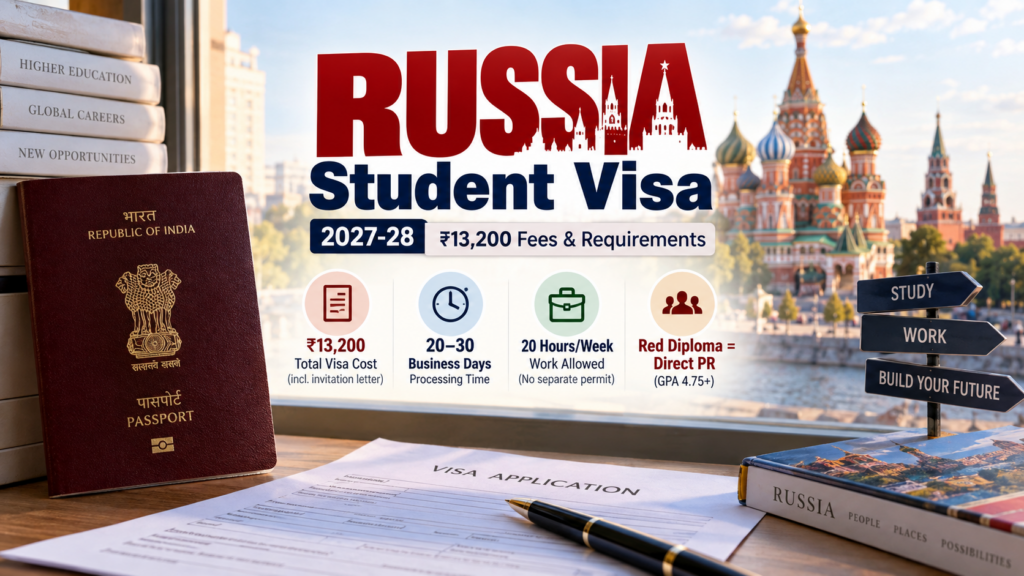
- Realistic total visa cost is ₹13,200, not the commonly quoted ₹8,700.
- Students can work 20 hours weekly without a separate work permit.
- Red diploma holders can skip straight to permanent residency.
Russia Student Visa: Single-Entry vs Multiple-Entry
Every Russia student visa application from India, whether you call it a Russia education visa or a study visa for Russia from India, starts the same way, no matter whether you’re headed for a 4-year Bachelor’s, a 2-year Master’s, or a 6-year MBBS.
| Stage | Visa Type | Validity | When It Applies |
| Initial entry | Single-entry student visa | 90 days | Issued in India before you travel |
| After arrival | Multiple-entry student visa | 1 year, renewable annually | Converted after GUVM registration in Russia |
| Full-course coverage | No single upfront visa | N/A | Even a 6-year MBBS renews the multiple-entry visa yearly, not once for the whole course |

Choose your dream country
 UK
UK
 USA
USA
 Germany
 Australia
 Ireland
 Canada
 UAE
UAE
 France
 Sweden
 Italy
Italy
 Other
Other
When do you want to study abroad?
What's your highest level of education?
Have you completed Class 12th?
What was your Class 12 CGPA/percentage?
Are you a student or a parent/guardian?
What do you want to study?
Select your current city
How Leap will help you

Personalised University Shortlist

Express Applications with Quicker Admits

End-to-End Application Support
That last row answers a genuinely common source of confusion: there is no such thing as a student visa Russia price for 6 years paid once. You budget for the initial visa, then a renewal each year you're enrolled.
Counselor insight: Students sometimes apply for a single-entry visa to save money, planning to "sort it out later." For any course longer than one term, this approach backfires, since you'll need the multiple-entry conversion regardless, and starting with the wrong visa type is a documented rejection reason.
Source: Embassy of Russia in India - Consular Affairs
One Thing to Rule Out First: The Unified e-Visa Doesn’t Cover Study
Russia's unified e-Visa, in effect nationwide since August 2023 and updated further through 2026 (now priced around $52, roughly ₹4,950; Russia sets this specific fee in USD for all nationalities, unlike the ruble-denominated student visa fees below), is a genuine simplification for tourism and some business travel, since it no longer requires an invitation letter. It does not extend to education.
A Russia student visa still requires the traditional paper application, a university-issued Invitation Letter through GUVM (the General Administration for Migration Issues), and in-person biometrics at a VFS Global centre. If you've seen "apply for Russia visa in 4 days" content recently, that's describing the e-Visa, not the process you'll actually go through.
Counselor insight: This distinction trips up more applicants than any document checklist item. Confirm with your university's international office that your invitation is a study-track GUVM invitation, not a generic e-Visa confirmation, before you assume you're done.
Currency note: this section uses an exchange rate of 1 USD = ₹95.19 because Russia itself prices the e-Visa in USD for applicants of all nationalities.
Eligibility Requirements for a Russia Student Visa
The Russian student visa requirements for Indian citizens and the broader Russia student visa rules that govern them are consistent regardless of degree level:
| Requirement | Detail |
| Passport validity | At least 18 months from your date of entry into Russia, with 2 blank pages |
| University admission | Confirmed offer from a Russian university, ideally NMC-approved if you're doing MBBS |
| Invitation Letter | Issued by GUVM, arranged by your university, not self-generated |
| Financial capacity | Proof of funds covering at least the first year's tuition and living costs |
| Medical fitness | General medical certificate plus a negative HIV test, taken within 3 months of applying |
| Academic qualification | Completed Class 12 (or equivalent) with required grades; NEET qualification if MBBS-bound |
If your target program is MBBS, an unrecognized or non-NMC-compliant university is one of the fastest ways to have your visa rejected outright, independent of how complete your paperwork is.
Counselor insight: Verify your university's NMC/NMC-equivalent status and your invitation letter's GUVM verification number before you spend on medicals or apostilles. Both are wasted money if the underlying admission isn't valid.
Documents Required for a Russia Student Visa Application
| Document | Requirement | India-Specific Detail |
| Visa application form | Completed online, printed, signed | Filed via the official Russian consular portal; this is the Russia student visa application form itself |
| Passport | Valid 18+ months, 2 blank pages | Photocopy of the data page also required |
| Photographs | 2 recent photos, 35mm x 45mm | White background |
| Invitation Letter (GUVM) | Original, arranged by your university | The single most scrutinized document in the file |
| Admission/offer letter | From your Russian university | Keep a digital and physical copy |
| Academic certificates | Class 10 and 12 marksheets and certificates | Must be apostilled by India's Ministry of External Affairs |
| Medical certificate | General fitness, from a registered doctor | Get it on letterhead close to your application date; older certificates are often rejected as stale |
| HIV test report | Negative, within 3 months of application | Use a government-recognized lab so the report is accepted without a repeat test |
| Financial proof | Recent bank statement | See the cost section below for how much |
If a scholarship or loan is filling part of the funding gap, is it possible to apply for a student loan for studying abroad, and what are the guarantor requirements that cover what lenders check before disbursing.
Counselor insight: The apostille step on Class 10/12 certificates is where Indian applicants lose the most calendar time, not the visa form itself. Start it the same week you accept your university offer.
Source: Ministry of External Affairs, Government of India - Attestation and Apostille Matters
Russia Student Visa Fees for Indian Students: The Real Total
Most guides answer "Russia student visa fees in Indian rupees" or "Russian student visa fees for Indian applicants" by quoting only the consular fee and VFS service charge and leave out the GUVM invitation letter cost, which is not optional.
| Fee Component | Standard Processing | Express Processing | Notes |
| Consular fee | ~₹6,500 | ~₹13,000 | Varies with the RUB-INR exchange rate |
| VFS Global service fee | ~₹2,200 | ~₹2,200 | Flat, mandatory per application |
| GUVM invitation letter (visa support) | ~₹4,500 | ~₹4,500 | Arranged through your university; frequently left out of "total cost" figures elsewhere |
| Realistic total | ~₹13,200 | ~₹19,700 | Excludes apostille, medicals, and translation costs |
Russia study visa costs for Indian applicants can climb further with document apostille (a few thousand rupees) and medical tests, so budget beyond just the visa fee.
Counselor insight: When a consultancy quotes "₹8,700 total," ask directly whether that includes the invitation letter. If it doesn't, your actual out-of-pocket cost is roughly 50% higher than the headline number.
Source: Business Standard - Russia visas for Indians: Fees, processing times & where to apply
Currency note: 1 RUB = ₹1.13 as of September 2026. Recheck the live rate at your nearest Russian Visa Application Centre before finalizing your budget.
How Much Bank Balance Is Required for a Russia Student Visa?
Russian authorities haven't published one official fixed figure, but the working standard is first-year tuition plus one year of living expenses.
Example calculation:
- First-year tuition: $5,000 (₹4,75,950)
- Living expenses: $400-500/month × 12 = $4,800-6,000 (₹4,56,912-₹5,71,140)
- Recommended bank balance: roughly $9,800-11,000 (₹9,32,862-₹10,47,090)
Counselor insight: Consular officers flag a large, sudden deposit made just before you apply far more than a modest, steady balance built up over months. If your family is arranging funds specifically for this application, do it at least 2-3 months ahead, not the week before.
Source: Figures reflect converging guidance across current Russia study visa guides; Russian authorities have not published one official minimum, so treat the figure as a planning estimate.
Currency note: this example uses USD, not RUB, because Russian universities and study-abroad guides conventionally benchmark international tuition and living costs in USD for a global audience, even though tuition is actually paid in rubles. 1 USD = ₹95.19.
How to Apply for a Russian Student Visa: Step by Step
If you're wondering how to get a student visa for Russia from India or are researching a Russian student visa from India more generally, here's the exact sequence:
| Step | Action |
| 1 | Secure admission and receive your official GUVM Invitation Letter, arranged by your university |
| 2 | Complete the electronic visa application form on the official Russian consular portal; print and sign it |
| 3 | Gather all documents, including apostilled academic certificates |
| 4 | Book your appointment at the nearest VFS Global Russia centre (established centres: Delhi, Mumbai, Chennai, Kolkata; check vfsglobal.com/rus for any newer additions) |
| 5 | Attend in person, submit documents and biometrics |
| 6 | Pay the consular fee, VFS service fee, and invitation letter cost |
| 7 | Track your application online and collect your passport with the visa stamped in |
Counselor insight: Book your VFS appointment slot as soon as your Invitation Letter arrives. Slots at busy centres like Delhi and Mumbai fill up faster during peak intake months (July-September).
Russia Student Visa Processing Time
The Russia study visa processing time for Indian students varies across sources, so treat any single number with caution:
- Commonly cited range: 20-30 business days for standard processing
- Faster estimates from some consular guidance: 5-15 business days once your Invitation Letter is ready
- Express processing: 3-5 business days at a higher fee, where available
Given this spread, apply 45-60 days before travel regardless of which estimate you've seen.
Note: Processing-time figures compiled from multiple current Russia visa-centre and journalism sources, which do not fully agree, confirm the exact current timeline at your assigned VFS Global Russia centre when you submit.
Arriving in Russia: Registration, Migration Card, and Working
Your visa isn't the finish line. Within 7 working days of arrival, you must register with the local GUVM office, a step your university's international office typically manages. Keep your Migration Card, issued on arrival, safe for this entire process; it's needed for registration and the later conversion to a multiple-entry visa.
Once enrolled, full-time students at state-accredited universities can work part-time without a separate work permit, a rule in place since 2020: up to 20 hours/week during term, full-time during official holidays, provided it doesn't affect academic standing.
PR in Russia After Study: What Changed
This is where most Russia student visa guides stop short, and it's worth knowing before you commit years to a Russian degree. Since January 1, 2023, Russia has run an education-based residency pathway with two routes:
- Temporary Residence Permit (TRP) during study: Available while you're still enrolled, valid for your entire study duration plus 180 days after graduation. It exempts you from annual visa renewal and lets you work without a separate permit. Within 3 years of graduation, TRP holders can apply for permanent residency without needing prior work experience.
- Red diploma fast-track: Graduates who finish with a "red diploma" (GPA 4.75+ on Russia's 5-point scale, an "excellent" thesis defense, and no "satisfactory" grades) can apply directly for permanent residency, bypassing the TRP step entirely. Processing takes roughly 4 months, and PR holders must spend at least 180 days per year in Russia to keep the status active.
Counselor insight: If a long-term stay in Russia is even a possibility for you, factor your GPA target into how you approach coursework from year one. The red-diploma threshold is specific and unforgiving of "satisfactory" grades late in the program.
Source: Fragomen - Russia: Temporary Residence Permit for Students
What to Do If Your Russia Student Visa Is Rejected
Rejections are usually fixable, and Russia doesn't publish an official rejection-rate statistic, so treat any consultancy's claimed Russia student visa success rate as a rough estimate rather than a guarantee. Russian embassy student visa requirements are strict on documentation accuracy, and common, well-documented rejection reasons include:
- Incomplete or mismatched documents (dates, spellings, passport numbers not matching across your NEET admit card, visa form, and admission letter)
- A faulty or unverifiable GUVM invitation letter
- An unrecognized or non-NMC-compliant university for MBBS applicants
- Financial proof that looks recently arranged rather than genuine (a large deposit right before applying)
- Applying for the wrong visa type, such as single-entry for a multi-year course
If you're rejected, the embassy states a reason. Correct that specific issue and reapply; a first rejection doesn't blacklist future applications.
Counselor insight: Before resubmitting, have someone outside your immediate application cross-check every name, date, and number across all your documents. Most second-attempt rejections come from a new, unrelated mismatch introduced during the fix.
3 Key Takeaways on Russia Student Visa
- Budget for the real cost, not the headline figure: the GUVM invitation letter adds roughly ₹4,500 that many cost breakdowns leave out of the total.
- A Russia student visa is never a one-time, multi-year purchase, even for a 6-year MBBS. It's an initial 90-day visa converted to a multiple-entry visa, renewed annually.
- Russia's unified e-Visa (in effect since 2023, updated through 2026) is for tourism and business, not study. Confirm you're on the traditional invitation-letter process before assuming a fast-track option applies to you.
Verified by: LeapScholar's Russia counselling team, with hands-on experience guiding Indian students through GUVM invitation letters, VFS Global visa applications, and post-arrival registration.
Have questions about your Russia student visa application? Book a free session with a LeapScholar counselor.
Frequently Asked Questions About Russia Student Visa
-
How do I apply for a Russian student visa from India?
Secure admission and a GUVM Invitation Letter from your university first, then complete the online visa application form, gather apostilled documents, book a VFS Global appointment, and submit your application with biometrics in person. You cannot complete this process fully online.
-
What is the Russia student visa cost for Indian applicants?
Budget roughly ₹13,200 for standard processing once you include the consular fee (~₹6,500), VFS service fee (~₹2,200), and the GUVM invitation letter (~₹4,500), which many cost breakdowns omit. This is the honest answer to "Russia study visa price" and "student visa for Russia from India fees": express processing runs closer to ₹19,700.
-
How much bank balance is required for a Russia student visa?
There's no fixed official figure. A safe estimate covers your first year's tuition plus 12 months of living costs, typically $9,800-11,000 (₹9,32,862-₹10,47,090) based on a $5,000 tuition example and $400-500/month living costs.
-
Is a private visa for Russia the same as a student visa?
No. A private visa (sometimes called a homestay visa) is for visiting a Russian citizen or resident, not for studying. If you're enrolling at a Russian university, you need the student visa category specifically, backed by a GUVM Invitation Letter from your institution, not a private individual's invitation.
-
What is the Russia student visa processing time?
Estimates vary by source: commonly cited standard processing is 20-30 business days, though some consular guidance cites 5-15 days once your Invitation Letter is ready; express processing runs 3-5 business days where available. Apply 45-60 days before travel regardless of which estimate applies to your case.
-
Is a Russia student visa valid for all 6 years of an MBBS program?
No. You'll hold an initial 90-day single-entry visa, then a multiple-entry visa valid for one year at a time, renewed annually for the full duration of your course, including a 6-year MBBS. There's no single upfront visa covering the whole program.
-
Can I work in Russia on a student visa?
Yes. Since 2020, full-time students at state-accredited Russian universities can work up to 20 hours per week during term and full-time during holidays, without needing a separate work permit.
-
Is an interview required for a Russia student visa?
Generally, no personal interview is required for Indian applicants. Decisions are based on the documents submitted, which is why document accuracy matters more than interview preparation here.
-
What is the Russia student visa success rate for Indian students?
Russia doesn't publish an official approval-rate statistic, but multiple education consultancies estimate 90-95% approval for complete, accurate applications. Most rejections trace back to documentation errors, not academic eligibility, so a well-prepared application has good odds.
-
What happens after I finish my studies in Russia? Can I get PR?
Yes, there are two options. Most students get their temporary residence permit while studying; it covers your course duration plus an extra 180 days, and after that you become eligible for PR within 3 years.
But if you're a high academic achiever, there's a shortcut: you can apply directly for permanent residency using a "red diploma" (which means a GPA of 4.75+ out of 5.0). This route skips the TRP step entirely.





Have Questions? Get Guidance to reach your Dream University
Connect with India's finest counsellors and biggest study abroad community.
Get Guidance