
Quick Read
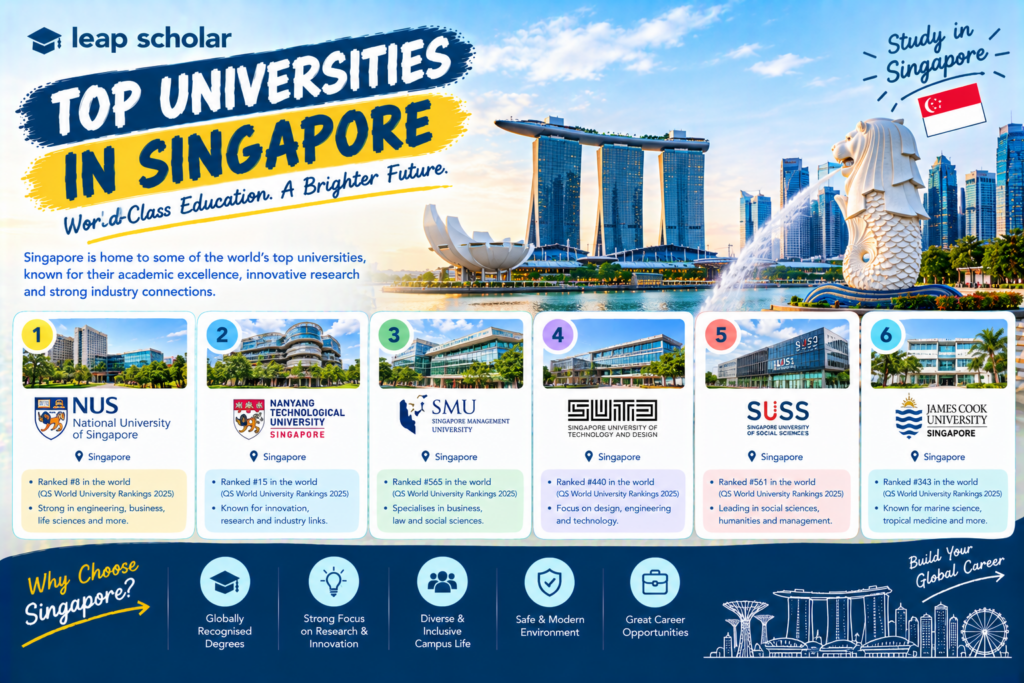
- NUS (QS #10) and NTU (QS #12) lead Singapore’s universities for 2027-28.
- 20 universities, public and private, are shortlisted here, fees shown in INR.
- Indian students pay the “All Other International Students” fee tier everywhere.
- SUTD and SMU posted the biggest QS 2027 jumps among local universities.
Universities and Institutes in Singapore: Where to Look
The table below is a quick-reference list of the top universities and colleges in Singapore for Indian applicants, covering the six public universities alongside well-known private institutions and branch campuses. The first six are Singapore’s degree-granting public universities; entries 7 to 20 are private institutes and branch campuses, several of them offering diplomas or partner-conferred degrees rather than their own university degree, so “top 20” here means the fuller shortlist Indian applicants search for, not 20 QS-ranked universities. Fees are shown per year, INR first with the SGD figure in brackets, at Rs. 75/SGD (verify the live rate before you budget). Public university fees reflect the “All Other International Students” tier with the MOE Tuition Grant, where applicable; private institution fees vary by programme and partner university, so treat these as a starting range.
| # | University | Type | QS World Rank 2027 | Approx. Annual Fee (INR) | Known For |
| 1 | National University of Singapore (NUS) | Public, autonomous | 10 | Rs. 16.1L – 29.8L (SGD 21,400 – 39,700) | Business, Computing, Engineering, Medicine |
| 2 | Nanyang Technological University (NTU) | Public, autonomous | 12 | Rs. 16.1L – 29.8L (SGD 21,400 – 39,700, program-dependent) | Engineering, Business, Data Science & AI |
| 3 | Singapore Management University (SMU) | Public, autonomous | =411 | Rs. 19.4L – 36.8L (SGD 25,800 – 49,100) | Business, Law, Accountancy, Information Systems |
| 4 | Singapore University of Technology and Design (SUTD) | Public, autonomous | 266 | Rs. 21.5L – 46.6L (SGD 28,700 – 62,076) | Architecture, Engineering Product Development, Design AI |
| 5 | Singapore Institute of Technology (SIT) | Public, autonomous | Not individually QS-ranked | Rs. 18.4L – 20.3L (SGD 24,500 – 27,050, check program) | Applied Engineering, Health Sciences, Food Tech, paid internships |
| 6 | Singapore University of Social Sciences (SUSS) | Public, autonomous | Not individually QS-ranked | Module-based, varies by course | Social Sciences, flexible and part-time degrees |
| 7 | LASALLE College of the Arts | Private | Not QS-ranked | Rs. 10L – 13.5L (approx. SGD 13,300 – 18,000) | Fine Arts, Design, Performing Arts |
| 8 | Nanyang Academy of Fine Arts (NAFA) | Private | Not QS-ranked | Rs. 10L – 13.5L (approx. SGD 13,300 – 18,000) | Fine Arts, Design, Media |
| 9 | INSEAD Asia Campus | Private, business school | Globally ranked separately for MBA | High (MBA-specific, check programme) | MBA, Executive Education |
| 10 | SIM Global Education | Private | Not QS-ranked | Rs. 7.5L – 15L (approx. SGD 10,000 – 20,000) | Business, Finance, partner degrees from UK/Australia |
| 11 | Kaplan Higher Education Academy, Singapore | Private | Not QS-ranked | Rs. 7.5L – 15L (approx. SGD 10,000 – 20,000) | Business, IT, Hospitality, Psychology |
| 12 | PSB Academy | Private | Not QS-ranked | Rs. 7.5L – 15L (approx. SGD 10,000 – 20,000) | Business, Psychology, Hospitality |
| 13 | Management Development Institute of Singapore (MDIS) | Private | Not QS-ranked | Rs. 6L – 13.5L (approx. SGD 8,000 – 18,000) | Business, Tourism, Engineering, Media |
| 14 | James Cook University Singapore (JCU) | Private, branch campus | Parent JCU Australia is QS-ranked | Rs. 18.75L – 26.25L (SGD 25,000 – 35,000) | Business, Psychology, IT, Education, Environmental Science |
| 15 | Curtin Singapore | Private, branch campus | Parent Curtin Australia is QS-ranked | Rs. 14L – 23L (approx. SGD 18,700 – 30,700) | Business, Engineering, Mass Communication |
| 16 | EHL Campus (Singapore) | Private | Specialist hospitality ranking | Higher (specialist programme) | International Hospitality Management |
| 17 | ESSEC Business School, Asia-Pacific | Private, business school | Globally ranked separately | Business-programme specific | Business, Management |
| 18 | TUM Asia (Technical University of Munich, Asia) | Private, with SIT/NUS partnerships | Parent TUM is QS-ranked | Engineering-programme specific | Industrial & Aerospace Engineering, Green Energy |
| 19 | Amity Global Institute, Singapore | Private | Not QS-ranked | Rs. 6L – 11L (approx. SGD 8,000 – 14,700) | Business, IT, Media |
| 20 | Dimensions International College | Private | Not QS-ranked | Rs. 5L – 10L (approx. SGD 6,700 – 13,300) | Foundation and pathway programmes, Business, Hospitality |
Source: QS World University Rankings 2027 (ranks); NUS, NTU, SMU and SUTD official tuition fee pages, AY2026/27-2027/28, and SIT’s AY2026 fee schedule (fees). Private-institution fees are aggregated from publicly listed programme fees and should be confirmed with each institution.
Counselor insight: If an exact acceptance rate matters to your shortlist, be aware that NUS, NTU, SMU and SUTD do not publish one. Treat “selectivity” as a function of your target course’s cut-off (A-Level/IB score, SAT/ACT band) rather than a single acceptance percentage, since none of the autonomous universities release that figure publicly.
The Top 5 Universities in Singapore, Explained
Here is a closer look at the five institutions Indian students shortlist most often, with details that go beyond the rank and fee you just saw above.
1. National University of Singapore (NUS)
NUS traces back to 1905, when it began as a medical school with 23 students; it is now Singapore’s oldest and biggest university by enrolment, which is also why it is often the answer to “which is the biggest university in Singapore.” For Indian applicants, NUS runs a two-tier international fee system: students who accept the MOE Tuition Grant (which comes with a 3-year work bond at a Singapore-registered company) pay noticeably less than those who decline it. NUS is consistently cited among the top universities in Singapore for computer science and engineering; in the QS World University Rankings by Subject 2026, it placed 2nd in the world for Civil & Structural Engineering and Materials Science, and 3rd for Chemical Engineering, Electrical & Electronic Engineering, and Mechanical, Aeronautical & Manufacturing Engineering. Popular choices for Indian students include Computing, Business Analytics and Biomedical Engineering, and the university runs dedicated scholarships for international undergraduates based on merit.
2. Nanyang Technological University (NTU)
NTU began as the Nanyang Technological Institute in 1981 and became a full university in 1991. It is widely regarded as one of the top universities in Singapore for engineering, particularly in materials science, where it ranks inside the global top five by subject. Beyond engineering, NTU has built out newer programmes in data science, AI and sustainable technology, and its business-computing double degree has recently ranked highest in Singapore for starting salaries. Student life at NTU centres on a sprawling green campus with over 100 student clubs, and its research strength spans biomedical sciences and digital technology, areas where it regularly earns global recognition alongside NUS.
3. Singapore Management University (SMU)
SMU is the one to shortlist if you are specifically searching for the top universities in Singapore for business: it is a specialised, city-campus university built around interactive, case-study-led teaching rather than large lecture halls. It posted the single biggest ranking recovery of any Singapore university this QS cycle, climbing 100 places to return to the global top 500 for the first time since 2020. SMU is organised into eight schools, including Accountancy, Law, Economics and Information Systems, and its School of Business draws its model from leading international business schools. For Indian students eyeing an MBA or a specialised master’s in finance, SMU is one of the strongest fits in Singapore outside of NUS and NTU.
4. Singapore University of Technology and Design (SUTD)
SUTD is Singapore’s fourth autonomous university, founded in 2009 in partnership with MIT to build its curriculum, and it recorded the largest single jump in this QS cycle: up 253 places to enter the global top 300 for the first time. SUTD has positioned itself as the world’s first “Design AI” university, weaving AI directly into design and technology coursework since announcing the strategic shift in January 2025. It is one of the universities Indian students look at for art and design in Singapore alongside hard engineering, through programmes like Architecture and Sustainable Design and Engineering Product Development, supported by hands-on facilities such as the SUTD FabLab.
5. Singapore Institute of Technology (SIT)
SIT is Singapore’s applied-learning university, built specifically around degrees that are hard to find elsewhere in the country: aircraft systems, infrastructure and land, food technology, and health sciences. Its signature feature is the Integrated Work Study Programme, which places students in paid, structured internships of 8 to 12 months as part of the degree itself, not as an optional add-on. SIT runs joint degrees with overseas partners including Newcastle University, University of Glasgow and TUM Asia, so some SIT graduates leave with a foreign university’s degree conferred through a Singapore-based programme. It does not appear as an individually ranked entry in the main QS World University Rankings, but it has become one of the more practical picks among local universities in Singapore for Indian students who want a direct line from classroom to job.
How to Choose: A Decision Framework
Ranking alone should not decide your shortlist. Weigh these three factors together:
- Budget: A grant-supported seat at NUS or NTU can cost less per year than a non-subsidised seat at SUTD or SMU. Check the “with MOE Tuition Grant” column before you compare across universities, and remember the 3-year bond that comes with it.
- Course strength over overall rank: NTU ranks behind NUS overall but can lead NUS in specific subjects like materials science; SUTD ranks far below both overall but is a stronger pick for design-led engineering. Compare subject rankings, not just the headline QS number.
- Format and pace: If you need a flexible, modular pace, SUSS is built for that. If you want a hands-on, internship-first degree, SIT is the closer fit. If you want the broadest range of subjects and the biggest alumni network, NUS remains the single biggest university in Singapore by student numbers.
Admission Requirements for Top Universities in Singapore
| Requirement | Details |
| Academic qualification | Completed 12 years of general education; Indian Class 12 (CBSE/ISC/state board), A-Levels or IB accepted |
| English proficiency | IELTS 6.0-7.0 or equivalent TOEFL/PTE score, depending on university and course |
| Undergraduate admission tests | SAT or ACT, required by some programmes |
| Postgraduate admission tests | GRE or GMAT, course-dependent |
| Application window (2027-28 intake) | Main August intake: applications typically open December 2026 to March 2027; confirm exact 2027-28 dates on each university’s official admissions page, as they had not all been published at the time of writing |
Student Visa for the 2027-28 Intake
Every international student needs a Student’s Pass to study in Singapore for more than 30 days, applied for through the Immigration and Checkpoints Authority (ICA) after you accept your offer. The visa itself costs SGD 90 in total: a non-refundable SGD 30 processing fee paid with your application, plus a SGD 60 issuance fee once ICA approves it (roughly Rs. 6,750 at Rs. 75/SGD), with a further SGD 30 if you need a Multiple Journey Visa.
For the full step-by-step process, document checklist and current visa fees, see our Singapore study visa guide and Singapore student visa fee breakdown.
Cost of Studying and Living in Singapore
Tuition is only part of the budget. Add living costs and the total annual spend for an Indian student at one of the six public universities, tuition with the MOE Tuition Grant plus food, accommodation and daily expenses, typically runs from about Rs. 24L to Rs. 40L a year, with NUS and NTU at the lower end and SUTD’s non-subsidised fee pushing the upper end higher.
For a full, programme-wise breakdown of fees with and without the MOE Tuition Grant, see our dedicated guide on the cost of studying in Singapore. For monthly rent, food and other living expenses, see our cost of living in Singapore breakdown, which is especially useful once you know which campus (and which part of the island) you will be based in.
Scholarships at Top Universities in Singapore
Several of the universities on this list run merit-based scholarships for Indian and other international students.
Three worth knowing by name:
- The NUS International Undergraduate Scholarship covers full tuition after the MOE Tuition Grant and is auto-considered for every international undergraduate application.
- The NTU Nanyang Scholarship covers full subsidised tuition plus a S6,500annuallivingallowanceanduptoS2,000 in accommodation support, open to international students including Indians.
- SINGA (Singapore International Graduate Award) covers full tuition plus a monthly stipend of up to S$3,200 for PhD study in Science or Engineering, with no work bond attached. All three are merit-based and competitive, and none covers application or visa fees.
For what else is currently open and how to apply, see our continuously updated scholarships in Singapore guide.
Average Salary and Job Prospects After Graduation
Singapore graduates in finance, technology and engineering typically see the strongest starting salaries, which is also why NUS and NTU lean so heavily into those subject areas. Most Indian graduates from Singapore’s universities start between S3,500andS5,000 a month (roughly Rs. 2.6L to Rs. 3.75L a month at Rs. 75/SGD), with banking, finance and tech roles trending toward the higher end and sometimes touching S$6,500 a month for strong profiles.
For a full profession-wise salary table and realistic job-market expectations for Indian graduates, see our average salary in Singapore guide and our breakdown of job opportunities in Singapore for Indians.
Counselor insight: Students who pick a university purely on QS rank sometimes overlook that SMU and SIT, despite being outside the global top 200, place graduates strongly in Singapore’s finance and engineering sectors respectively, because local employers weight the specific school-industry pipeline, not just the global rank.
MBA and Postgraduate Options at Top Universities in Singapore
If your interest is specifically postgraduate, our dedicated guides go deeper than this list can: see MBA colleges in Singapore for NUS, NTU, SMU and INSEAD options, and MS in Singapore if you are searching for the top universities in Singapore for MS computer science or engineering specifically.
3 Takeaways on Top Universities in Singapore
- Decide between NUS, NTU, SMU, SUTD, SIT or SUSS based on your course strength and budget tier, not just the overall QS rank.
- Factor in the MOE Tuition Grant and its 3-year bond before comparing fees across universities, since it changes your effective cost significantly.
- If your course is specialised (arts, hospitality, or a specific overseas degree), look seriously at the private and branch-campus options on this list rather than only the six public universities.
Comparing top universities in Singapore and not sure which one fits your profile and budget? Talk to a Leap Scholar counselor and get a shortlist matched to your course, fees and visa timeline.
Frequently Asked Questions About Top Universities in Singapore
-
What are the top 3 universities in Singapore?
NUS, NTU and SMU are the top three by the QS World University Rankings 2027, placed 10th, 12th and joint 411th globally. NUS and NTU cover the widest range of subjects, while SMU specialises in business, law and finance.
-
Is Singapore good for Indian students?
It works well for students who want an English-medium degree with strong global recognition and a short flight home. Living costs run higher than in India, so most Indian students weigh the MOE Tuition Grant and part-time work rules before committing.
-
Which is better, NUS or SMU?
NUS is the broader choice, stronger for engineering, computing and medicine, and ranked well above SMU in the QS 2027 list. SMU wins out for a focused business, law or finance degree taught through its smaller, case-study-driven campus.
-
What is the hardest university to get into in Singapore?
NUS and NTU are usually named the hardest to get into, since they draw the highest entry grades and the largest applicant pools among Singapore’s universities. Neither publishes an official acceptance rate, so this is based on cut-offs and demand rather than a confirmed figure.
-
Is NUS better than IIT?
In the QS World University Rankings 2027, NUS sits at 10th globally against IIT Delhi’s 118th, the highest-ranked IIT. That said, IITs remain extremely selective through JEE and carry strong domestic weight in engineering hiring, so the comparison depends on whether global rank or India-specific brand value matters more to you.
-
How many Indians get into NUS?
NUS does not publish admission or enrolment numbers by nationality, and no official acceptance-rate figure exists for international applicants. Treat any specific percentage you see elsewhere online as an unverified third-party estimate, not an NUS-confirmed number.
-
Is Singapore education better than India?
It depends on what you are comparing. Singapore’s public universities rank consistently higher on global tables like QS and lean heavily on industry exposure, while India’s IITs and IIMs are harder to enter and hold strong domestic brand recognition. Neither system comes out ahead on every measure.
-
What are the top universities in Singapore for engineering?
NUS and NTU lead for engineering, with NTU particularly strong in materials science and NUS ranking in the global top three for several engineering subjects. SUTD and SIT offer a more applied, project-based route into the field.
-
What are the top universities in Singapore for Masters?
NUS and NTU offer the widest spread of master’s programmes, especially in engineering, computing and data science, while SMU leads for a master’s in finance or management. Your best fit comes down to the specific field rather than the university’s overall rank.
-
Which are the top universities in Singapore for business?
SMU is purpose-built for business, law and accountancy, while NUS Business School and NTU’s Nanyang Business School also rank strongly, particularly for MBA and finance-focused master’s degrees. INSEAD’s Asia campus is the specialist choice for an MBA specifically.





Have Questions? Get Guidance to reach your Dream University
Connect with India's finest counsellors and biggest study abroad community.
Get Guidance