
Quick Read
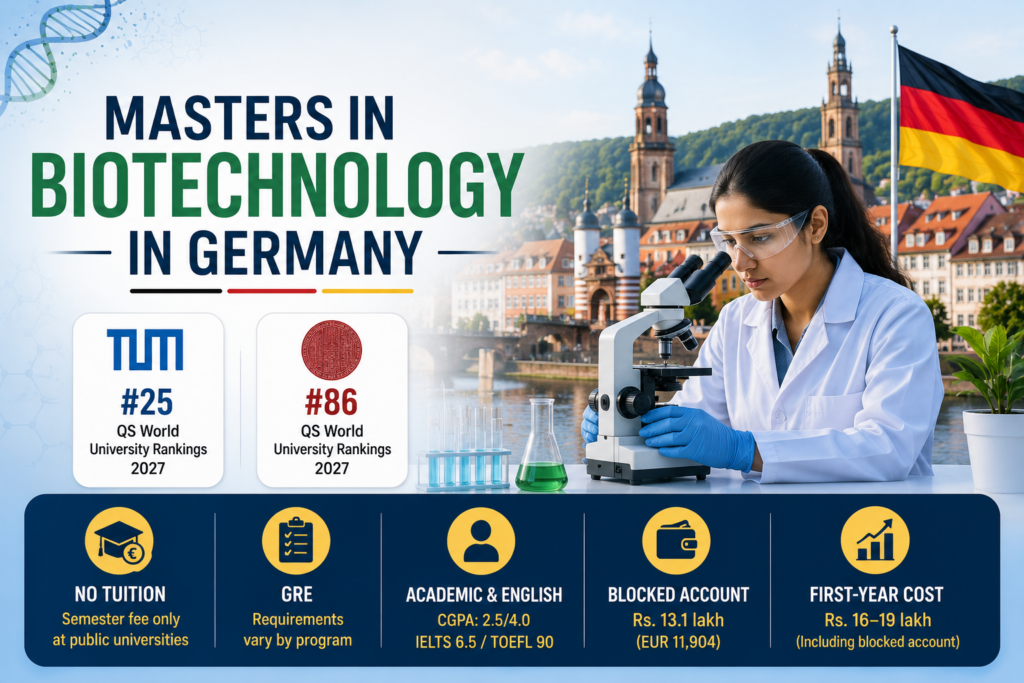
- Public universities charge no tuition for a masters degree in biotechnology, only a semester fee.
- TUM (#25) and Heidelberg (#86) lead Germany’s biotech rankings. In QS 2027.
- GRE requirements vary; check each program individually
- Indian students typically need a 2.5/4.0 CGPA and IELTS 6.5 or TOEFL 90.
- Blocked account: Rs.13.1 lakh (EUR 11,904) is mandatory before visa.
- Total first-year cost runs Rs. 16-19 lakh (Rs. 25-28 lakh for TUM, which charges non-EU tuition).
Top 10 Universities for Masters in Biotechnology in Germany
Here is the list of leading options for a masters in biotechnology in Germany with its QS rankings 2027 released:
| University | QS World Rank 2027 | Tuition Fee (per semester) | |
|---|---|---|---|
| Technical University of Munich (TUM) | Munich | #25 | EUR 4,000 tuition + ~EUR 150-200 contribution for Master’s programs, non-EU students, effective Winter 2024/25 (~Rs.4.5-4.7 lakh total per semester) |
| Heidelberg University | Heidelberg | #86 | EUR 1,500 tuition + EUR 170 (Rs.1,84,184 total) |
| RWTH Aachen University | Aachen | #104 | No tuition, EUR 320 contribution (Rs.35,293) |
| Technical University of Berlin | Berlin | #158 (8th in Germany) | No tuition, EUR 310 contribution (Rs.34,190) |
| TU Dresden | Dresden | #185 | No tuition, EUR 260 contribution (Rs.28,675) |
| University of Tübingen | Tübingen | #230 | EUR 1,500 tuition + EUR 175 (Rs.1,84,735) |
| University of Freiburg | Freiburg | #245 | EUR 1,500 + EUR 155 (Rs.1,82,530) |
| University of Göttingen | Göttingen | #261 | No tuition, EUR 260 contribution (Rs.28,675) |
| Goethe University Frankfurt | Frankfurt | #376 | No tuition, EUR 370 contribution (Rs.40,807) |
| University of Hohenheim | Stuttgart | #771-780 | EUR 1,500 tuition + EUR 170 (Rs.1,84,184) |
Sources: QS World University Rankings 2027; individual university pages.

Choose your dream country
 UK
UK
 USA
USA
 Germany
 Australia
 Ireland
 Canada
 UAE
UAE
 France
 Sweden
 Italy
Italy
 Other
Other
When do you want to study abroad?
What's your highest level of education?
Have you completed Class 12th?
What was your Class 12 CGPA/percentage?
Are you a student or a parent/guardian?
What do you want to study?
Select your current city
How Leap will help you

Personalised University Shortlist

Express Applications with Quicker Admits

End-to-End Application Support
Note: Baden-Württemberg (Heidelberg, Tübingen, Freiburg, Hohenheim) charges non-EU students EUR 1,500 per semester in tuition on top of the standard contribution. TUM (Bavaria) separately charges EUR 4,000-6,000 per semester tuition to newly-enrolling non-EU students since Winter Semester 2024/25; Molecular Biotechnology and Biology programs are not on TUM's tuition-free exemption list. Confirm the current amount with the university before budgeting.
Counselor insight: Students chase the QS number first and course fit second. Hohenheim ranks far lower than TUM overall, but for food or agricultural biotechnology, its course content and lab access will serve you better than a higher-ranked university that treats biotech as one module among many.
Top Specialisations for Masters in Biotechnology in Germany
Which university belongs on your shortlist depends more on specialization than overall rank. Here is how the field splits:
| Specialisation | Focus Area | Where It's Strongest |
|---|---|---|
| Molecular Biotechnology | Genetic engineering, protein design | TUM, Goethe University Frankfurt |
| Medical Biotechnology | Drug development, diagnostics | Heidelberg University |
| Industrial/Bioprocess Biotechnology | Bioprocess engineering, biomanufacturing | RWTH Aachen, TU Berlin |
| Agricultural/Food Biotechnology | Enzyme production, food microbiology | University of Hohenheim |
| Molecular Bioengineering | Nanoscale biotechnology, tissue engineering | TU Dresden |
| Molecular Life Sciences | Microbiology, genetics, structural biology | University of Göttingen |
Cost of a Masters Degree in Biotechnology in Germany for Indian Students
1. Fees Breakdown
| Cost Head | Amount (EUR) | Amount (INR) |
|---|---|---|
| Semester fee, public non-BW university | EUR 150-350 | Rs.16,544-38,602 |
| TUM Master's tuition, non-EU students | EUR 4,000-6,000/semester | Rs.4.4-6.6 lakh/semester |
| Semester fee, Baden-Württemberg university | EUR 1,650-1,700 | Rs.1,81,979-1,87,493 |
| Blocked account (mandatory, annual) | EUR 11,904 | Rs.13,12,892 |
| Public health insurance (monthly) | EUR 140-150 | Rs.15,441-16,544 |
| Uni-assist application (first program, +EUR 30 per extra) | EUR 75 | Rs.8,272 |
| Visa application fee | EUR 75 | Rs.8,272 |
Source:DAAD fees and financing overview
Find relevant Q&As on Germany fees and payment structure here →
Counselor insight: The blocked account is a legal minimum based on Germany's national average cost of living, not Munich or Heidelberg prices. Students who budget only that amount in Munich usually run short by month four, so add a buffer. This is separate from TUM's Master's tuition fee, which is a program cost, not a living-cost buffer.
2. Cost of Living
The cost of living depends heavily on where you study. A single person's monthly cost excluding rent in most German university towns sits close to the national average, with Munich well above it.
| City (University) | Monthly Cost Excl. Rent (EUR/INR) | Relative to National Average |
|---|---|---|
| Munich (TUM) | EUR 1,101 / Rs.1,21,429 | 11% higher |
| Heidelberg (Heidelberg University) | EUR 1,000-1,050 / Rs.1,10,290-1,15,805 | Slightly higher |
| Aachen (RWTH Aachen) | EUR 950-990 / Rs.1,04,776-1,09,187 | Below average |
| Berlin (TU Berlin) | EUR 992-1,050 / Rs.1,09,408-1,15,805 | Near average |
| Dresden (TU Dresden) | EUR 960-1,010 / Rs.1,05,878-1,11,393 | Below to near-average |
Source: Numbeo Cost of Living Index, 2026.
3. Scholarships Available for Indian Students
| Scholarship | Who It's For? |
|---|---|
| DAAD Scholarships | Graduate students across all subjects, including biotechnology, with strong academic records |
| Deutschlandstipendium | Students already enrolled at a German university with excellent grades or notable personal circumstances |
| Bayer Foundation Otto Bayer Fellowship | Master's and PhD students in natural sciences or pharmacy |
Eligibility for Masters in Biotechnology in Germany: CGPA, IELTS, and GRE Status
| Requirement | What Most Programs Ask For |
|---|---|
| Academic background | Bachelor's in biotechnology, biology, biochemistry, or a related field, ideally 180 ECTS credits |
| Minimum CGPA | 2.5 on a 4.0 scale, roughly 60-65% aggregate |
| English proficiency | IELTS 6.5 or TOEFL 90 for English-taught programs |
| GRE | Varies by university; Hohenheim's MSc Biotechnology doesn't ask for it, while RWTH Aachen's Biomedical Engineering still lists it |
| Subject-specific coursework | Some programs, including Hohenheim's, expect prior coursework in biochemistry, organic chemistry, or microbiology |
The difference between BSc Biotechnology and BTech Biotechnology backgrounds: German universities expect a three-year Bologna-equivalent bachelor's degree. A BSc in Biotechnology usually maps cleanly onto this. A BTech is a four-year engineering degree evaluated individually through Germany's ANABIN database; it's not a disqualifier, but you may need to show your coursework covered core biotech content.
This BSc/BTech distinction also decides your dMAT status for Summer 2027 intake onward. If your undergraduate degree is titled B.Sc. Biotechnology, you're typically outside the dMAT-affected fields list, since standalone science degrees don't automatically qualify. If it's a B.Tech in Biotechnology (an Engineering-titled degree), the requirement applies to you as part of APS verification. Check the exemption criteria against your exact degree title rather than assuming either way, since ANABIN's classification and APS India's dMAT field list don't always align.
Counselor insight: A CGPA just under 2.5/4.0 is not an automatic rejection everywhere. Some committees weigh your final two years' grades separately from your first year, so it's worth writing to the admissions office directly rather than ruling yourself out.
Find relevant Q&As on Germany admissions without IELTS.
Documents Required to Apply for Masters in Biotechnology in Germany
| Document | India-Specific Detail |
|---|---|
| Bachelor's degree certificate and provisional certificate | Original + English translation if issued in a regional language |
| Consolidated marksheet | Semester-wise or year-wise grades, not just final CGPA |
| uni-assist VPD/APS certification | Required for most Indian applicants; apply via APS India, budget 3-5 weeks |
| Statement of Purpose | Program-specific, not generic |
| Two to three Letters of Recommendation | At least one from a professor who taught you a core biotech subject |
| IELTS/TOEFL scorecard | Valid for two years from test date |
| Passport | Two blank pages, valid three months beyond intended stay |
| Blocked account confirmation | Needed at the visa stage, not the application stage |
Counselor insight: The APS certificate is the step Indian students underestimate most. It takes three to five weeks to process, and without it, German missions will not move your visa file forward.
Find relevant Q&As on Germany APS and admissions requirements here →
Visa and Blocked Account for Masters in Biotechnology in Germany
| Requirement | Detail |
|---|---|
| Visa type | National (D) visa, applied for at the German consulate in India |
| Blocked account | EUR 11,904/year (Rs.13,12,892), released at EUR 992/month on arrival |
| Visa application fee | EUR 75 (Rs.8,272) |
| Health insurance proof | Required at visa stage: EUR 140-150/month public cover |
| Processing time | 6-12 weeks; book your appointment as soon as you get an offer |
Counselor insight: The blocked account is a legal minimum based on national average living costs, not Munich or Heidelberg prices, so budget extra for an expensive city. Book your visa appointment the day you accept an offer; slots fill up fast in July-August, and late booking is the top cause of missed October intakes.
See our Germany study visa guide for the full step-by-step process.
When to Apply: Planning Calendar for Indian Students
Most masters in biotechnology programs in Germany run a Winter intake (October) with deadlines around mid-May to 15 June, and a smaller number accept Summer intake (April) applicants with a 15 January deadline. Mapped against a typical Indian academic year:
| Month (Indian academic year) | What to do? |
|---|---|
| November-December (final year, odd-semester exams) | Shortlist 6-8 universities and start IELTS/TOEFL prep |
| January-February | Take IELTS/TOEFL, request transcripts and LORs |
| March (even-semester exams begin) | Start uni-assist submission; do not wait for final results |
| April-May | Submit remaining applications before the May 15-June 15 window closes |
| June (results season) | Send updated final transcripts as soon as results are out |
| July-August | Accept offer, open blocked account, book visa appointment |
| September | Visa appointment, travel arrangements |
| October | The winter semester begins |
Counselor insight: Hohenheim recommends applying by 15 May, a month before its formal deadline, since visa processing afterward takes longer than expected. Treat the published deadline as the latest acceptable date, not the target.
If You Are Deciding Between Biotechnology Specialisations in Germany
If you are a final-year BTech Biotechnology student graduating in May 2027
Your engineering-heavy transcript fits industrial or bioprocess-focused programs at RWTH Aachen or TU Berlin. This is exactly the difference between BSc Biotechnology and BTech Biotechnology backgrounds that trips people up: start your uni-assist submission in March, before final results, since these universities accept conditional admission based on your latest transcript.
If you are a BSc Microbiology or Biochemistry graduate with one gap year
A research-oriented program like Heidelberg's Molecular Biosciences or Göttingen's Molecular Biology suits you better than an engineering-adjacent course. Use the gap year well: a research assistantship strengthens your SOP far more than a generic internship.
If you are a working professional with two to three years in pharma or biotech
Moving toward R&D, Hohenheim's agricultural biotechnology program or TUM's Medical Biotechnology track will value that experience, and some programs waive the informal "no gap after bachelor's" preference that trips up fresher applicants.
Make sure you know what proof of work experience German universities and visa officers actually expect before you apply.
What to Do If Your Application Goes Wrong
- Missed the uni-assist deadline: Some universities keep a rolling window open for non-restricted programs; email the international office directly.
- CGPA below the cutoff: Apply to a slightly less selective, still QS-listed university in the same specialization; a strong SOP and project work can offset a marginal gap.
- Final transcript delayed: Submit your latest marksheet with a registrar's letter confirming graduation date; most universities accept this conditionally.
- Visa appointment delayed past intake start: Contact the international office immediately. Many allow late arrival or a shift to the next intake instead of a fresh application.
Salary and Career Scope After an MSc in Biotechnology in Germany
Placement outcomes depend on specialization and city, but the picture is encouraging: Germany's biotech sector employs over 50,000 professionals across more than 700 companies.
| Role | Starting Salary (EUR, gross/year) | Starting Salary (INR, gross/year) |
|---|---|---|
| Biotechnologist | EUR 45,000-55,000 | Rs.49.6-60.7 lakh |
| Research Scientist | EUR 48,000-58,000 | Rs.52.9-64.0 lakh |
| Quality Control Analyst | EUR 44,000-54,000 | Rs.48.5-59.6 lakh |
Graduates get an 18-month post-study work visa to job-hunt without an employer lined up, and biotechnology roles often qualify for the EU Blue Card's reduced 2026 threshold of EUR 45,934 (Rs.50.7 lakh) for shortage occupations and recent graduates, against the standard EUR 50,700 (Rs.55.9 lakh).
Counselor insight: Medical and pharmaceutical biotechnology graduates from Heidelberg and TUM tend to get interview calls faster than industrial biotech graduates, since Germany's biggest employers hire more heavily from those specializations.
3 Key Takeaways
- Confirm your CGPA (2.5/4.0 minimum) and IELTS 6.5/TOEFL 90 scores before shortlisting, and check each program's GRE policy rather than assuming it applies.
- Budget Rs. 16-19 lakh for year one, including the Rs. 13.1 lakh blocked account, and add a buffer if Munich or Heidelberg is on your shortlist, for TUM specifically, add Rs. 8.8 lakh/year in tuition (EUR 4,000/semester, effective Winter 2024/25), taking the realistic total closer to Rs. 25-28 lakh.
- Start your uni-assist and APS documentation 10-12 months before your target intake, since APS processing alone can take five weeks.
Verified by: LeapScholar's Germany counseling team, with hands-on experience guiding Indian students through biotechnology admissions and visas.
Questions about a masters in biotechnology in Germany? Book a free session with a LeapScholar counselor.
Frequently Asked Questions About Masters in Biotechnology in Germany
Why choose a masters in biotechnology in Germany over other countries?
A major reason is that most public universities don't charge tuition, so your money goes toward living costs instead of fees, TUM is a notable exception, charging non-EU students tuition since Winter 2024/25 and you still get research names like Bayer, BioNTech, and Boehringer Ingelheim on your doorstep. Hard to match in the US, UK, or Australia to a similar degree.
What are the top universities for masters in biotechnology in Germany?
TUM, Heidelberg, RWTH Aachen, TU Berlin, and TU Dresden top the QS 2027 table. Don't rule out Hohenheim just because its overall rank is lower; for food or agricultural biotech, it's genuinely one of the better places to be in Germany.
Is the GRE required for masters in biotechnology in Germany?
It depends on where you're applying. Hohenheim's MSc Biotechnology doesn't ask for it, while RWTH Aachen's Biomedical Engineering still expects a GRE General Test. Please check the individual program page instead of making assumptions.
What CGPA do I need for a masters degree in biotechnology in Germany?
A 2.5 on a 4.0 scale is the baseline most programs use, which is roughly 60-65% in Indian grading terms. A few universities also want proof your undergraduate coursework covered biochemistry or molecular biology, not just biotechnology in name.
What do MSC biotechnology in Germany for Indian students' fees actually add up to?
Plan for between Rs. 16 and 19 lakh in year one at most tuition-free universities that includes the blocked account (the biggest chunk at Rs.13.1 lakh), semester fees from roughly Rs.33,000 to over Rs.3.7 lakh depending on the state, and health insurance running about Rs.15,000-16,500 a month. TUM is the exception: its Master's programs (including Biotechnology) now carry non-EU tuition of EUR 4,000-6,000/semester, pushing TUM's first-year total closer to Rs. 25-28 lakh. A comparison of biotechnology course fees in Germany across states is essentially a comparison of Baden-Württemberg and TUM versus all other tuition-free options.
Is biotechnology in demand in Germany?
Yes, it has been for a while. The sector has grown steadily over the past decade, with names like Bayer, BASF, and BioNTech recruiting straight out of university research programs, backed by R&D spending above 3% of GDP.
What is the average salary after a masters in biotechnology in Germany?
Most entry-level roles land between EUR 44,000 and EUR 58,000 gross a year, roughly Rs. 48.5-64 lakh. German tax and social security take a real bite, usually 35-40%, so take-home pay will be smaller than the headline figure.
What happens if I miss the uni-assist submission deadline?
Some programs, particularly non-restricted ones, quietly keep admissions open past the published date. Best move: email the international office directly rather than assuming you must wait a full year for the next intake.








Have Questions? Get Guidance to reach your Dream University
Connect with India's finest counsellors and biggest study abroad community.
Get Guidance