
Quick Read
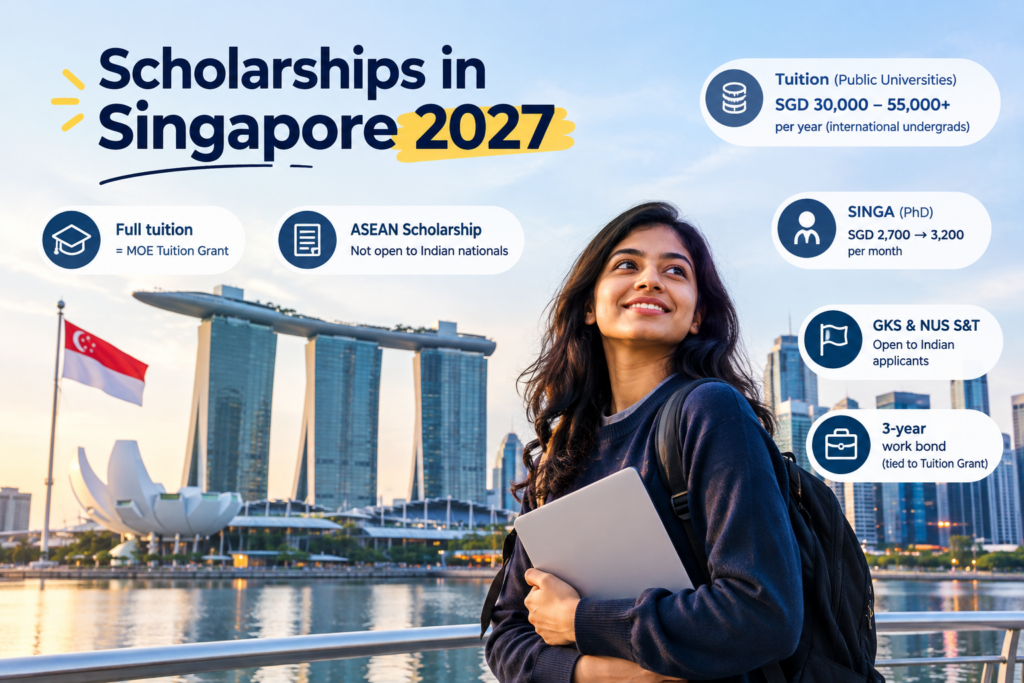
- Tuition at Singapore’s public universities runs SGD 30,000 to 55,000+ a year for international undergraduates.
- Every scholarship that says “full tuition” is actually built on top of the MOE Tuition Grant.
- The ASEAN Undergraduate Scholarship is not open to Indian nationals.
- SINGA covers a PhD study with a monthly stipend of SGD 2,700, rising to SGD 3,200.
- GKS and NUS’s Science & Technology Scholarship are open to Indian applicants specifically.
- Most scholarships in Singapore carry a 3-year work bond tied to the Tuition Grant.
What Scholarships in Singapore Actually Cover
Before comparing individual awards, one mechanic changes how every “full tuition” scholarship works: the MOE Tuition Grant. It subsidizes tuition for all admitted international students at NUS, NTU, SMU, SUTD, and SIT, scholarship or not, and most scholarships sit on top of it rather than replacing it. Taking the grant also means a three-year work bond with a Singapore-registered company, whether or not you hold a scholarship too.
| What | Detail |
|---|---|
| Who it applies to | All international students at NUS, NTU, SMU, SUTD, SIT |
| What it covers | Subsidises tuition fees down from the full international rate |
| Condition | 3-year work bond with a Singapore-registered company after graduation |
| Relationship to scholarships | Most scholarships require you to take the Tuition Grant, then cover remaining tuition and living costs |
If you want the full picture of what a scholarship actually needs to cover, the cost of studying in Singapore and the cost of living in Singapore lay out the real numbers behind that gap.
My insight: Students often read “full tuition scholarship” and assume there’s no catch. There usually is one, and it’s the bond, not the money. Decide early whether three years working in Singapore fits your plans, since turning down the Tuition Grant later isn’t simple.
Scholarships in Singapore for Indian Students: What You Can Actually Apply For
This area is where a lot of scholarship-listing pages get sloppy, listing every Singapore scholarship as though it’s open to everyone. It isn’t. Whether you can apply depends heavily on your nationality, and for Indian applicants, the shortlist looks different from what most blogs suggest.
| Scholarship | Open to Indian nationals? | Why |
|---|---|---|
| Dr. Goh Keng Swee (GKS) Scholarship | Yes | Covers 15 Asia-Pacific economies, including India included |
| NUS Science & Technology Undergraduate Scholarship | Yes | Open to citizens of Asian countries, India included |
| Nanyang Scholarship (NTU) | Yes | Open to all nationalities |
| Lee Kong Chian Scholars’ Programme (SMU) | Yes | Open to all nationalities |
| SUTD Rainmaker Scholarship | Yes | Open to international students generally |
| SINGA | Yes | Open to all nationalities for PhD study |
| ASEAN Undergraduate Scholarship | No | Restricted to citizens of ASEAN member states; India is not an ASEAN member |
That last row matters more than it might seem. A genuine Singapore scholarship for Indian students has to fall into one of the “open to all nationalities” or “Asian countries” categories above. If a listing tells you to apply for the ASEAN Scholarship as an Indian citizen, that’s simply incorrect information, and it’s worth not wasting an application cycle on it.
NUS Scholarship for Indian Students and Other University-Specific Awards
Each of Singapore’s major universities runs its own undergraduate scholarships, and how you apply differs more than the marketing pages suggest. A NUS scholarship for Indian students, like the Science & Technology award below, is automatically considered on admission; no separate form is needed. NTU and SMU work differently: both want a scholarship application alongside your admission form, so missing that step means missing the scholarship even if you’d have qualified academically.
| University | Flagship scholarship | Covers | Bond |
|---|---|---|---|
| National University of Singapore (NUS) | Science & Technology Undergraduate Scholarship | Full tuition + SGD 6,000/year living allowance (approx. ₹4.5 lakh) | 3 years, Singapore-based company |
| Nanyang Technological University (NTU) | Nanyang Scholarship | Full tuition + SGD 6,500/year (approx. ₹4.9 lakh) + travel/computer grant | None beyond standard Tuition Grant bond |
| Singapore Management University (SMU) | Lee Kong Chian Scholars’ Program | Full tuition + notebook grant + exchange/community project grants | None beyond standard Tuition Grant bond |
| Singapore University of Technology and Design (SUTD) | Rainmaker Scholarship | Full tuition + SGD 10,000/year (approx. ₹7.5 lakh) + travel grant | None beyond standard Tuition Grant bond |
My insight: Students chasing the biggest headline number often miss that NTU and SMU carry no scholarship-specific bond beyond the standard Tuition Grant terms, while GKS and some NUS awards add their own separate bond on top. Read the bond clause before the funding amount.
Postgraduate Scholarships in Singapore: SINGA and Beyond
For master’s and PhD applicants, fully funded scholarships are genuinely common in Singapore, especially for research degrees. The best known is SINGA, run jointly by A*STAR, NUS, NTU, SUTD, SMU, and SIT.
| Scholarship | Level | Stipend | Bond |
|---|---|---|---|
| SINGA | PhD | SGD 2,700, rising to SGD 3,200/month | None |
| NUS/NTU Research Scholarships | Master’s (Research) / PhD | Approx SGD 2,600-3,000/month | None |
| ADB-Japan Scholarship Program | Master’s | Covers tuition, stipend, travel, insurance | Return to home country after graduation |
What you need to know: SINGA’s monthly stipend is currently SGD 2,700, rising to SGD 3,200 (approx. ₹2.4 lakh) after the Qualifying Examination, not the lower SGD 2,000-2,500 range a few older listings still show. It also includes a one-time settling-in allowance and airfare grant, with no work bond.
One eligibility detail people miss: SINGA is for students studying in Singapore for the first time. If you’ve already studied at a Singapore tertiary institution, you’re not eligible, however strong your research profile is.
Scholarships in Singapore for African and ASEAN Students: What’s Actually Available
There isn’t a distinct, Singapore-government scholarship pipeline “for African students.” The scholarships already covered above are merit-based rather than region-restricted, so they extend to African applicants too, alongside one Africa-named award run by a business school on a Singapore campus. ASEAN nationals get a dedicated award Indian applicants don’t qualify for.
| Scholarship | Open to | Covers |
|---|---|---|
| SINGA | All nationalities, including African countries | Full PhD tuition + monthly stipend |
| Nanyang Scholarship (NTU) | All nationalities, including African countries | Full tuition + living allowance |
| INSEAD MBA ’75 Nelson Mandela Endowed Scholarship | Sub-Saharan African nationals specifically, studying at any INSEAD campus, including Singapore | Partial MBA funding |
| ASEAN Undergraduate Scholarship | Citizens of Brunei, Cambodia, Indonesia, Laos, Malaysia, Myanmar, Philippines, Thailand, Vietnam only | Full tuition + SGD 5,800/year living allowance (approx. ₹4.4 lakh) |
My insight: If you’re advising a mixed group of applicants, “open to all nationalities” scholarships (SINGA, Nanyang, Lee Kong Chian) are what actually cut across India, ASEAN, and Africa alike. Region-named scholarships are usually more restrictive than they sound, not less.
Singapore Scholarship Requirements: Documents and Eligibility
Once you know which scholarships you’re eligible for, the paperwork follows a fairly consistent pattern.
| Document | India-specific detail |
|---|---|
| Academic transcripts | Must be in English or accompanied by certified translation from your board or university |
| English proficiency scores | IELTS 6.5+ or TOEFL iBT 90+ is generally preferred; some scholarships waive this if your prior education was in English |
| Passport copy | Required for both scholarship and later Singapore student visa applications |
| Recommendation letters | 2-3 letters, typically from teachers or professors who know your academic work directly |
| Motivation letter / SOP | Should name the specific scholarship and connect your goals to it, not read as generic |
| Research proposal | Required for PhD/research scholarships like SINGA; align it with the host institution’s actual research areas |
Grades matter more here than elsewhere. Competitive scholarships expect strong Class 12 results for undergraduate awards or a first-class bachelor’s degree for research scholarships.
How to Get a Scholarship in Singapore: Timeline and Decision Framework
How you approach the process depends on your study level and runway.
If you’re a Class 12 student targeting the August 2027 intake
Start now. Your board exam results need to already be strong by the time you apply, not “on track to improve.”
If you’re researching an NUS scholarship for Indian students at master’s level
Check whether it needs a separate application form (NTU and SMU do) or is automatic on admission (most NUS undergraduate awards are). Missing that step is the most common reason strong applicants get skipped.
If you’re applying for SINGA or a PhD research scholarship
Your research proposal carries more weight than your test scores. SINGA doesn’t require GRE, IELTS, or TOEFL, so spend your prep time refining the proposal instead.
A Realistic Application Timeline for August 2027 Intake
It’s September 2026 as you’re reading this. NUS, NTU, and SMU all run undergraduate admission through one dominant August intake, so here’s what the actual calendar looks like, not a generic countdown.
| When | What to do |
|---|---|
| Now through September 2026 | Shortlist scholarships in Singapore matching your profile and nationality, verify eligibility on the official university page, and start drafting your motivation letter or research proposal |
| October 2026 | Application portals open at NUS, NTU, and SMU; sit English tests and request recommendation letters if you haven’t already |
| October 2026 – February/March 2027 | Submit your admission form and, for NTU and SMU, a separate scholarship application; deadlines are usually earlier for Medicine, Dentistry, Law, and Architecture |
| January – April 2027 | Selection interviews for shortlisted candidates; scholarship outcomes are typically decided in this window too |
| April – June 2027 | Most offers are released; confirm your offer and sort visa documentation |
| June – August 2027 | Finalize enrollment ahead of classes starting in early August |
SINGA and other PhD scholarships run on a different clock: A*STAR typically opens applications from August to December each year, so the window for 2027 PhD start is open right now, not eleven months out.
3 Key Takeaways on Scholarships in Singapore
- Nationality is the first filter, not grades. The ASEAN Undergraduate Scholarship shuts India out entirely, but GKS, NUS’s Science & Technology award, the Nanyang Scholarship, and SINGA are genuinely within reach for Indian applicants.
- Read the Tuition Grant clause before getting excited about a “full tuition” number. That three-year work bond comes with the grant itself, not the scholarship, so it follows you regardless of which specific award you hold.
- Don’t apply the same way twice. Most NUS undergraduate scholarships just need your admission form, NTU and SMU want a separate one, and for SINGA or another PhD scholarship, your research proposal does more work than your test scores ever will.
Verified by: LeapScholar’s Singapore admissions team, with hands-on experience guiding Indian students through university and scholarship applications for NUS, NTU, SMU, and SUTD.
Have questions about scholarships in Singapore? Book a free session with a LeapScholar counselor.
Frequently Asked Questions About Scholarships in Singapore
-
How can I get a scholarship in Singapore as an Indian student?
Start with scholarships that explicitly list India or “all nationalities” as eligible: GKS, NUS’s Science & Technology award, Nanyang Scholarship, or SINGA for PhD study. Most are considered automatically on admission, but NTU and SMU require a separate scholarship form. Strong Class 12 or degree results are the baseline; everything else, essays and recommendations, separates shortlisted candidates from the rest.
-
Is there a real Singapore scholarship for Indian students at the postgraduate level?
Yes, several. SINGA is the best known for PhD studies and doesn’t require GRE or English test scores, though a strong research background helps. NUS and NTU also run research scholarships for master’s-by-research and PhD candidates, open to India as much as anywhere else.
-
Is the ASEAN scholarship in Singapore open to Indian nationals?
No, and this is worth repeating since it’s commonly misreported: the ASEAN Undergraduate Scholarship is restricted to citizens of ASEAN member countries, and India isn’t one of them. This specific award isn’t an option for Indian applicants, no matter how strong the application.
-
What is a good NUS scholarship for Indian students at the undergraduate level?
The NUS Science & Technology Undergraduate Scholarship is the clearest fit, open to Asian country citizens, India included, applying to Computing, Engineering, or Science programs. It covers full tuition plus a living allowance and is automatically considered on undergraduate admission.
-
Do all scholarships in Singapore come with a work bond?
Most do, but the bond usually comes from the MOE Tuition Grant, not the scholarship itself: three years with a Singapore-registered company. Some university awards add nothing extra on top, while others, like GKS, attach their own separate bond terms.
-
What English test score do I need for scholarships in Singapore?
Most competitive scholarships expect IELTS 6.5 or above, or TOEFL iBT 90 or above, though requirements vary by university and program. Some universities waive this requirement if your prior schooling was entirely in English, but confirm directly with admissions rather than assuming.
-
Can I apply for multiple scholarships in Singapore at once?
Generally, yes, nothing stops you from putting in several applications. The one thing to watch for: read the fine print, because some funders won’t let you hold their award alongside another scholarship or fellowship unless they’ve signed off on it first. Skip that check and you could end up choosing between two offers you actually wanted.
-
What if my grades are good but not exceptional? Can I still get a scholarship in Singapore?
Harder, yes. Impossible, no. Committees like SMU’s for the Lee Kong Chian Program genuinely look at more than your transcript: leadership, co-curricular record, community involvement. A motivation letter that clearly explains why this scholarship, rather than any other, is particularly valuable when your grades are slightly below the ideal range.
-
When are scholarship deadlines for Singapore universities?
For the timeline mapped to real dates, see the application calendar above. In general, verify the current cycle on the university’s own admissions page each year rather than a third-party list, since dates shift slightly from one intake to the next.






Have Questions? Get Guidance to reach your Dream University
Connect with India's finest counsellors and biggest study abroad community.
Get Guidance