
Quick Read
- The University of Amsterdam publishes no university-wide acceptance rate.
- UvA offers places to roughly 75% of Economics and Business selection participants.
- The Business Administration English track currently has 500 first-year places.
- Most UvA programs admit anyone meeting the published requirements.
- Indian students needing a visa should apply by 1 April.
- UvA rejects IELTS Indicator, IELTS Online and TOEFL Home Edition.
What the University of Amsterdam Acceptance Rate Actually Is
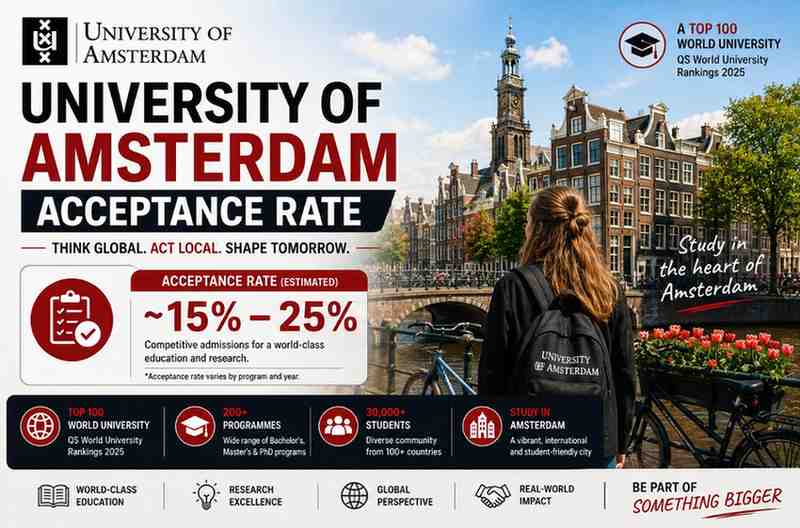
There is no official University of Amsterdam acceptance rate. UvA does not publish a university-wide figure, and the 4% number circulating on Indian study-abroad sites has no source behind it.
| Figure quoted | Where it appears | The problem with it |
|---|---|---|
| 4% | Two consultancy and accommodation sites | No source given. Presented as the headline rate |
| 4.3% | An Indian aggregator’s older page | No source. The same aggregator’s newer page states UvA publishes no rate |
| 51% | A university ranking site | Its own methodology note describes its figures as a rough guide |
| 10% to 50% | A travel-blog style guide | “Estimates”, no basis stated |
| 16% for Psychology | Same page | Invents 3,000 applications for 500 places |
| 10 to 15% for Communication Science | A rankings blog | No source |
| No figure | uva.nl | UvA’s actual position |

Choose your dream country
 UK
 USA
 Germany
 Australia
 Ireland
 Canada
 UAE
 France
 Sweden
 Italy
 Other
When do you want to study abroad?
What's your highest level of education?
Have you completed Class 12th?
What was your Class 12 CGPA/percentage?
Are you a student or a parent/guardian?
What do you want to study?
Select your current city
How Leap will help you

Personalised University Shortlist

Express Applications with Quicker Admits

End-to-End Application Support
Read that spread again. The same university, in the same year, is reported at 4% and at 51%. Both cannot be right, and neither is sourced to UvA.
Counselor insight: The 4% figure does real harm. Students cut UvA from a shortlist of six because they have read they have a one-in-twenty-five chance, and they never check what the university itself publishes. No Dutch research university operates at 4%. That number belongs to a different admissions culture entirely.
What UvA Publishes Instead of an Acceptance Rate
Here is the part no competing page reports. There may be no University of Amsterdam acceptance rate, but UvA does publish selection outcomes for the programs where selection genuinely happens.
On its business administration ranking numbers page, UvA states that in previous years, across its economics and business numerus fixus programs, it has been able to offer a place to approximately 75% of participants and that around 1,500 people took part in the selection test. The program’s own selection page states that the English track currently has a numerus fixus with 500 places available in the first year.
Note: UvA has reduced this cap recently (it was previously published as 750), and the figure is subject to annual revision. Always verify the current number directly on uva.nl before applying.
Those two figures are not a matched pair, so we are not going to turn them into a percentage: the 75% spans several economics and business programs, while the 750 applies to one track. But the direction is unambiguous. This is a capped, oversubscribed, English-taught program at UvA, and the university's published offer rate to people who completed the selection procedure is roughly three in four.
For comparison, some selective UvA master's programs publish their capacity outright. The MSc Information Studies pages state that the top 150 candidates on the ranking list will be admitted, with others placed on a waiting list.
Counselor insight: The number that matters is the offer rate to people who completed the selection procedure, not applications received. A large share of students who register never finish the selection activities, which is exactly why raw application counts make the odds look far worse than they are for anyone who actually turns up and completes the process.
Which University of Amsterdam Programs Are Actually Selective
Asking about the University of Amsterdam acceptance rate as a single number misses the distinction that decides your application: is your program capped or not?
For programs without a cap, Dutch admission is eligibility-based. Meet the published requirements and you are admitted. There is no ranking against other applicants.
For capped programs, selection runs through Selection and Placement in line with Ministry of Education, Culture and Science guidelines, with a 15 January deadline. UvA also runs other selective programs with their own procedures and different deadlines. At master's level, UvA states plainly that every program has its own entry requirements, application procedure and deadlines.
Counselor insight: Establish whether your program is capped before you plan anything else. That one fact moves your deadline by two and a half months, adds a selection procedure you must physically participate in, and removes your ability to defer. Every other date in your timeline depends on this one.
How UvA’s Ranking Numbers and Placement Offers Work
This stage is where most guides stop explaining things and where most Indian students make avoidable mistakes. Understanding the mechanics here matters far more to your outcome than any acceptance rate number, because the process is where places get lost after they have already been won.
Step 1: Not All Capped Programs Select the Same Way
Before anything else, check which selection method your target program uses. UvA does not apply one universal system across all numerus fixus programs.
Test-based selection with a three-group hybrid (e.g., Business Administration, Economics and Business Economics)
After you take the selection test, UvA splits all participants into three groups:
- Group 1 (top scorers): These candidates receive a ranking number based purely on their test performance. Score high enough and you are in this group with a strong position.
- Group 2 (the middle band): This group covers two-thirds of the remaining candidates after Group 1 is set aside. Here is the part students do not expect: ranking within this group is decided by an unweighted lottery. Your test score and grades do not determine your position. Everyone in this band draws a random number.
- Group 3 (the lowest scorers): The remaining one-third of candidates are ranked by test performance again.
What this process means practically: If you score in the middle range, preparation still gets you into contention, but your final position has a random element to it. This is not a reason to underprepare. It is a reason to aim for Group 1.
Pure unweighted lottery (e.g., Political Science English track)
Some programs skip the test entirely and use a straight lottery. Every applicant who registers by 15 January is assigned a random ranking number. Your grades, your school, and your predicted scores do not affect where you land. Registering on time is the only thing within your control.
Step 2: Your Ranking Number and What It Means
Every participant who completes the selection procedure receives a ranking number, visible in your Studielink account by 15 April. Lower is better.
- If your ranking number falls within the available places, you will receive a place offer by email and in Studielink on 15 April.
- If your number is higher than the available places, you go on a waiting list. Do not withdraw at this point. Places freed by students who decline pass down the ranking list from 15 April through to 1 August, and UvA itself says there is a real chance a spot will open up.
- If you do not take part in the selection activities at all, you do not receive a ranking number, and no place can follow. Participation is not optional.
Step 3: Accepting Your Offer (The Window Most People Miss)
Once you receive an offer, you have exactly 14 days to accept it in Studielink. That window does not extend for any reason.
- Offers arrive in mid-April, which for most Indian applicants lands right in the middle of final-semester exams.
- If you are waiting on a scholarship decision or a parent conversation, the offer does not wait for you. It lapses automatically.
- The right move, as UvA itself advises, is to accept the offer while those conversations continue. Accepting starts your visa and housing process and does not lock you in. You can withdraw in Studielink until 31 August.
The offer is valid only for the academic year in which you took the selection procedure. You cannot accept and defer to the following year.
Step 4: How Many Times Can You Try?
Selection attempts are limited, and this process catches reapplicants off guard.
- For Business Administration and most capped bachelor’s programs, you can participate in the selection procedure a maximum of two times, with one attempt per year.
- An attempt is counted if you have an active Studielink enrolment for that program after 15 January, even if you do not show up for the test.
- Withdrawing your enrolment before 16 January does not count as an attempt, so if your plans change early, you can exit without using one.
- If you fail your final school exams after registering, you can request that the attempt be cancelled.
If you use both attempts without a successful placement, you cannot apply for that program again. Spending a second attempt on the same program requires a clear plan, not just hope.
A Note for Indian Applicants on the Waiting List: If you are a non-EU student on a waiting list after the May procedure for a selective master’s program such as an MSc in Information Studies, UvA has stated explicitly that it cannot add you to the waiting list at all, because visa and residence permit processing cannot be completed in time. The pass-down mechanism that may work for EU students does not reach you on certain programs. Check the specific program page before banking on a waiting list place.
University of Amsterdam Deadlines and Requirements for Indian Applicants
UvA organises its bachelor's deadlines around what you need from the university, not only your nationality. This is the part of the admission question you can actually control.
| Your situation | Deadline | Status |
|---|---|---|
| Numerus fixus or selective programme | 15 January | Hard. No extension |
| You need a visa and/or UvA housing | 1 April | UvA strongly urges this date |
| Any applicant, final cut-off | 1 May | After this, only in exceptional circumstances |
UvA states that if you require a visa and/or housing through the university you should apply before 1 April, because after that date it cannot guarantee immigration and housing procedures can start in time. There is also a step that trips people up: your Studielink enrolment request must be submitted at least one week before the deadline, not on it.
Master's deadlines are set per program and vary widely. UvA's Graduate School of Humanities alone runs deadlines of 1 February, 1 March and 15 May depending on the program, with English exemption requests due a month earlier than each.
| Requirement | What it means | India-specific detail |
|---|---|---|
| Prior education | Must be equivalent to the Dutch VWO for bachelor's; a relevant bachelor's for master's | UvA's diploma finder is updated annually and valid for one academic year, so a figure you read last year may not apply |
| Indian grade threshold (bachelor’s) | CBSE: A1, A2 or B1 in 5 board-exam subjects. CISCE/ISC: 75% average across 5 board-exam subjects. NIOS: A, B or C in 5 board-exam subjects. Maths is required in all cases. | Check your program’s diploma finder entry for subject-specific score thresholds. |
| English test | IELTS Academic, TOEFL iBT or Cambridge, per programme | An English-medium Indian degree earns no exemption |
| Test format | Only standard test-centre results | IELTS Indicator, IELTS One Skill Retake, IELTS Online, TOEFL Home Edition and TOEFL MyBest Scores are not accepted |
| Test age | No more than two years old, counting back from the program start | Scores taken for an earlier UK or US cycle may have expired |
| Single sitting | Overall and component minimums in one test | You cannot combine your best sections across attempts |
| GMAT or GRE | Required by some Business School master's programmes | MSc Business Administration asks for GMAT Focus 535 minimum, preferably 565; MSc Finance asks 585, preferably 595 |
| Quota cap | Maximum two capped programmes per year | Named combination exceptions apply |
Note on grade thresholds: Mathematics must appear as one of the five board-administered subjects with a score of 75 or above. Selective programs such as PPLE set higher bars, including an English score of 85 or above on your school certificate. Always check the diploma finder entry for your specific target program before applying.
Note on state boards: Diplomas from boards other than CBSE, CISCE and NIOS are not listed in UvA’s standard diploma finder and are assessed individually. If your board is not listed, contact the Central Admissions Office directly before applying.
The English rules are worth reading twice. UvA's admission pages state that other test versions or modules are not accepted, listing IELTS Indicator, IELTS One Skill Retake, IELTS Online, TOEFL Home Edition and TOEFL MyBest Scores as examples, and that the required scores must be obtained in a single attempt. The exemption list covers applicants educated in Australia, Canada excluding Quebec, Ireland, New Zealand, the UK and the USA. India is not on it.
Funding deadlines run earlier than admission deadlines, covered in scholarships in the Netherlands for Indian students. The permit sequence behind the 1 April date is in the Netherlands student visa process, and Amsterdam housing pressure in cost of living in the Netherlands.
Counselor insight: Read your deadline off what you need from UvA, not off your passport alone. An Indian student needing both a visa and university housing is on the earliest track, but the housing request is often left until after admission, by which point there is nothing left in Amsterdam. On Indian grade requirements: CBSE students should note that only board-administered exam subjects count; school-assessed components such as Physical Education, General Studies and Work Experience are excluded from the five-subject calculation. For CISCE students the same exclusion applies to the SUPW (Socially Useful Productive Work) component. Do not include these when calculating whether you meet the threshold.
What to Do If Things Go Wrong With Your UvA Application
You missed 15 January for a capped program. There is no extension. Your options are a non-capped program this cycle or the next academic year.
You did not participate in the selection activities. No ranking number is issued, and no place follows. Participation is not optional.
Your ranking number is outside the available places on 15 April. Do not withdraw. Places pass down the ranking from 15 April until 1 August, and UvA states there is a high chance a spot opens in that window. Keep your file live and your documents ready through July. Note the exception above: on some selective master's programs, non-EU applicants cannot be waitlisted at all because of visa timing.
Your placement offer expired. It lapses automatically after 14 days and asking will not reinstate it. This is the most avoidable loss on this list.
You missed 1 April as a visa applicant. The 1 May final deadline still exists, but UvA warns it cannot guarantee immigration and housing procedures will complete in time. Write to admissions and ask directly rather than assuming.
Your English score is in a format UvA rejects. An IELTS Online, Indicator or One Skill Retake result cannot be substituted or appealed. Rebook at a test centre, and allow six weeks for results and processing.
Counselor insight: The most recoverable situation on this list is a ranking number outside the cut-off on 15 April, and it is the one students give up on. Places move down the list for weeks. The least recoverable is a rejected test format, because correspondence cannot change an IELTS Online result to an accepted one. The second-least recoverable is exhausted selection attempts: two unsuccessful years in a selection procedure close the door on that program permanently. If the first attempt ends in a waitlist that does not clear, use the time before the second attempt to improve your selection test preparation, not just to wait.
3 Takeaways on University of Amsterdam Acceptance Rate
- Discard the 4% figure, because UvA publishes no university-wide acceptance rate and its own selection data shows places offered to roughly 75% of participants in its Economics and Business capped programs.
- Check whether your target program is numerus fixus or selective before anything else, since that single fact moves your deadline from 1 April to 15 January and removes your ability to defer. Also check which selection method your program uses: a test-ranked system, the three-group hybrid (test plus lottery), or a pure lottery because the strategy for each is different.
- Confirm your English test format is one UvA accepts, because IELTS Indicator, IELTS One Skill Retake, IELTS Online, TOEFL Home Edition and TOEFL MyBest Scores are all rejected and cannot be appealed. Indian CBSE students should also verify that their five subjects are board-administered exams, not school-assessed components, and that Mathematics is among them with a score of 75 or above.
Verified by: LeapScholar's Netherlands counseling team, with hands-on experience guiding Indian students through Studielink selection procedures, UvA placement offers and IND visa processes.
Have questions about the University of Amsterdam acceptance rate or which program fits your profile? Book a free session with a LeapScholar counselor.
Frequently Asked Questions About University of Amsterdam Acceptance Rate
-
What happens if I am not offered a place on 15 April?
You may still receive an offer later, because places declined by selected students pass down the ranking list, sometimes for weeks. Keep your file live and your documents ready. On some selective master's programs, however, non-EU applicants not selected in the May procedure cannot be waitlisted because visa processing can no longer be completed in time.
-
Can I defer a place at the University of Amsterdam to next year?
A placement offer for a capped program is valid only for the year in which you took part in the selection and placement procedure, so it cannot be deferred. You must accept within 14 days or it lapses automatically. To start a year later you would need to enter the selection procedure again in that cycle.
-
How many programs can I apply to at the University of Amsterdam?
Studielink permits four program applications in total across all Dutch institutions, of which no more than two may be numerus fixus programs. UvA notes specific combinations you cannot pair, so check before registering. Non-capped programs at UvA do not count against the two-quota limit.
-
What is the application deadline at the University of Amsterdam for Indian students?
For capped bachelor's programs, it is 15 January. For other bachelor's programs, UvA urges applicants needing a visa or university housing to apply before 1 April, with 1 May the final cut-off. Your Studielink enrolment request must go in at least a week earlier. Master's deadlines are set per program.
-
What IELTS score does the University of Amsterdam require?
Requirements vary by faculty and program. UvA's Graduate Schools of Science ask for IELTS 7.0 with all subscores at 6.5 for Artificial Intelligence, Information Studies and Logic, but 6.5 with subscores at 6.0 for Chemistry, Mathematics, and Physics. Law programs ask for 7.0 overall with 6.5 per component.
-
What are the admission requirements for the University of Amsterdam?
For a bachelor's you need prior education equivalent to the Dutch VWO diploma. For Indian students specifically, this means a CBSE certificate with A1, A2 or B1 positional grades across five board-administered subjects (including Mathematics), or a CISCE/ISC certificate with an average of at least 75% in five board-administered subjects. For a master's you need a relevant bachelor's degree, with requirements set per program. English proficiency is required in all cases, and some business school master's programs additionally require GMAT or GRE scores. Check your program page for its specific requirements.
-
What is a numerus fixus program at UvA?
A numerus fixus program has a fixed number of first-year places. The Business Administration English track currently has 500 places (recently reduced; always verify the current figure on uva.nl). Applications close on 15 January, and selection and placement are conducted under Ministry of Education guidelines. You may apply for a maximum of two capped programs per academic year, with some combination exceptions. Selection methods differ by program: some use a test-based ranking, some use a three-group hybrid of test ranking and lottery, and some use a pure unweighted lottery where grades do not matter.
-
Is the University of Amsterdam hard to get into for Indian students?
Difficulty depends entirely on whether your program is capped. Non-capped programs admit applicants who meet the published requirements. For Indian students, meeting those requirements means a CBSE certificate with A1, A2 or B1 grades across five board-administered subjects including Mathematics, or a CISCE certificate with 75% average. Capped programs run a selection procedure with a 15 January deadline, and UvA's own published figures for its Economics and Business capped programs show roughly three in four participants receiving an offer.
-
What is the University of Amsterdam acceptance rate?
UvA publishes no university-wide acceptance rate. Figures in circulation range from 4% to 51% and none are sourced to the university. What UvA does publish is selection data: across its Economics and Business numerus fixus programs, it has offered places to approximately 75% of participants, with around 1,500 taking the selection test.














Have Questions? Get Guidance to reach your Dream University
Connect with India's finest counsellors and biggest study abroad community.
Get Guidance