
Quick Read
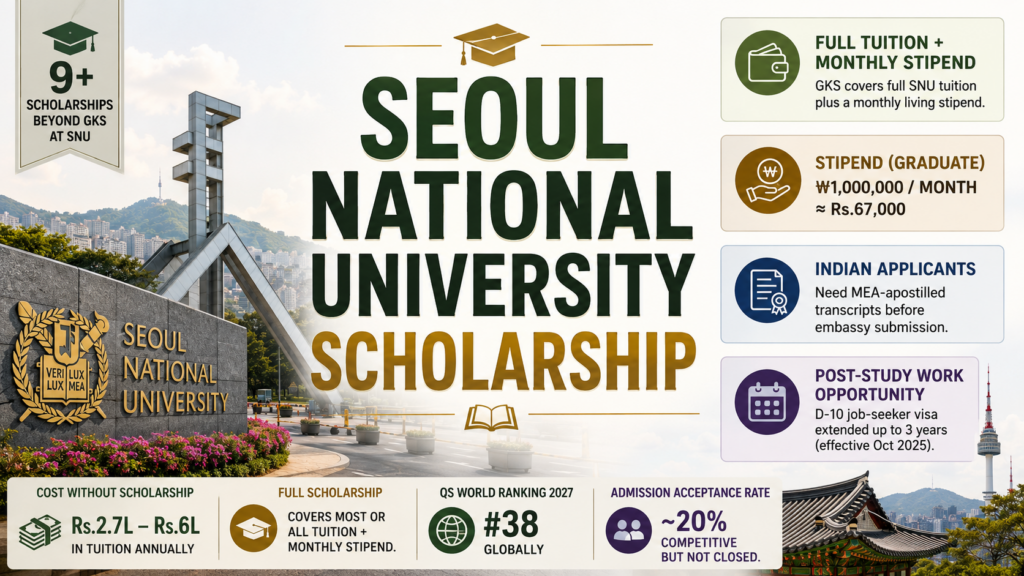
- GKS covers full SNU tuition plus a monthly living stipend.
- Graduate GKS stipend is ₩1,000,000 monthly, about Rs.67,000.
- Indian applicants need MEA-apostilled transcripts before embassy submission.
- SNU runs about nine separate scholarships beyond the GKS.
Why a Seoul National University Scholarship Matters for Indian Students in 2027-28
SNU’s academic standing is one reason to apply. The bigger reason is that a Seoul National University scholarship is what makes that standing affordable for an Indian family.
| Seoul National University Snapshot | Detail |
| QS World University Ranking 2027 | #38 globally, unchanged from 2026 |
| SKY status | One of Korea’s three SKY universities (with Korea University and Yonsei) |
| English-taught courses | 800+ across disciplines |
| Global exchange partners | 240+ universities worldwide |
| International admission acceptance rate | Roughly 20%, competitive but not closed |
| Post-study work runway | D-10 job-seeker visa extended to up to 3 years (effective October 2025) |
| Cost without scholarship vs. with | Full annual cost typically Rs.2.7L to Rs.6L in tuition alone; a full scholarship removes most or all of it |
SNU’s unfunded cost already undercuts most UK or US options. Add a scholarship, and the D-10 job-seeker visa extension gives you up to three years after graduation to convert that degree into a Korean job, which is the real return on a Seoul National University scholarship.
Counselor insight: Most students researching SNU scholarships start with the GKS because it is the most publicized. In practice, a large share of the funding Indian students actually receive at SNU comes from the university’s own scholarships (GSFS, Global Scholarship, and Silk Road), which are bundled into the regular admission application and carry far less competition than the embassy-track GKS.
Seoul National University Scholarship Types for Indian Students: Government vs University-Funded
SNU offers close to nine distinct scholarship routes to international students. They split into three groups: government-funded, university-funded, and private or foundation-funded. Here is how they compare.
| Seoul National University Scholarships | Funded By | Degree Level | Tuition Coverage | Monthly Stipend (KRW → INR) | Duration |
| Global Korea Scholarship (GKS) | Korean government (NIIED) | UG / Master’s / PhD | 100% | Rs.60,300 (UG) / Rs.67,000 (PG) | Up to 8 semesters (UG), 4 (Master’s), 6 (PhD) |
| Overseas Koreans Scholarship | Korean government | UG / Graduate | 100% | Rs.60,300 | Up to 8 semesters |
| Glo-Harmony Scholarship | SNU (for DAC-listed countries incl. India) | UG (enrolled students) | 100% | Rs.40,200 | Up to 8 semesters |
| GKS Self-Financed Track | SNU + NIIED | UG (2nd-4th year) | Stipend only | Rs.33,500 | Approx. 12 months |
| SNU President Fellowship (SPF) | SNU | PhD (faculty applicants) | 100% | Rs.1,00,500 to Rs.1,34,000 | 3 to 4 years |
| Graduate Scholarship for Excellent Foreign Students (GSFS) | SNU | Master’s / PhD | 100% for 4 semesters | Rs.33,500 | Up to 4 semesters |
| SNU Global Scholarship I & II | SNU | Graduate (enrolled) | 100% (1 semester, GS1); tuition only (GS2) | Rs.80,400 (GS1 only) | Per semester, renewable |
| Silk Road Scholarship | SNU | Graduate, Humanities/Social Sciences | 100% for 4 semesters | Up to Rs.40,200 | Up to 4 semesters |
| JN Tata Endowment | Private (Indian trust) | Master’s / PhD / Postdoc | Loan-scholarship | N/A (lump sum up to Rs.10 lakh) | One-time, repayable |
Exchange rate used throughout this article: 1 KRW = Rs.0.067 as of August 2026. Verify the current rate before finalizing your budget.
Sources: Official details for each award are published on the SNU Office of International Affairs, Scholarship Finder, the SNU Graduate Admissions Scholarships page,
Note: SNU also runs three lesser-known internal awards for enrolled students, rarely covered elsewhere: Tuition Grants for Overseas Students (partial to full tuition exemption), the Superior Academic Performance Scholarship (cumulative GPA 3.6+ after four semesters), and a Work-Study Scholarship paid directly into your Korean bank account for approved on-campus work. These are managed by the SNU Office of International Affairs each semester, on top of the scholarships above.
Read the full picture of South Korean scholarships for Indian students if you are also weighing options beyond SNU specifically.
GKS Eligibility and Stipend for Seoul National University Applicants
The Global Korea Scholarship is the flagship route into SNU because it is separate from the university’s own admission process and open to a fixed India quota every year.
| Requirement | Detail |
| Citizenship | Non-Korean citizen; parents must also hold no Korean citizenship |
| Academic record | Typically top 20% of class, or 80%+ on a percentage scale |
| Age limit | Under 25 (undergraduate track), under 40 (graduate track) |
| Degree status | Bachelor’s completed for Master’s applicants; Master’s completed for PhD applicants |
| Health | Must meet standard physical and mental health screening |
| Prior scholarship history | Cannot have previously held another NIIED-administered scholarship |
Current GKS monthly stipend:
| Track | Monthly Stipend | In Rupees | Settlement Allowance |
| Undergraduate | ₩900,000 | Rs.60,300 | ₩200,000 one-time (Rs.13,400) |
| Master’s / PhD (degree program) | ₩1,000,000 | Rs.67,000 | ₩200,000 one-time (Rs.13,400) |
| Research program | ₩1,500,000 | Rs.1,00,500 | ₩200,000 one-time (Rs.13,400) |
Full official eligibility and stipend notices are published on Study in Korea, the Korean government’s official portal, and on the National Institute for International Education (NIIED) GKS page.
The SNU Office of International Affairs posts SNU-specific award notices, including GSFS and Global Scholarship calls.
Counselor insight: A GPA of 80% is the floor NIIED states, not the bar that successful applicants actually clear. In practice, competitive GKS files from India carry 85%+ academics paired with a study plan that names specific SNU departments and, ideally, a specific professor’s research group. Generic “I want to study in Korea” essays are the single biggest reason strong-on-paper applicants get filtered out at the embassy round.
How to Apply for a Seoul National University Scholarship?
Where you submit your application depends entirely on which scholarship you are targeting. This is the step most applicants get wrong, since GKS and SNU’s own scholarships do not share one portal.
| Seoul National University Scholarship Type | Where You Apply |
| GKS, Embassy Track | Korean Embassy in New Delhi, which screens first before forwarding to NIIED |
| GKS, University Track | Directly to SNU, which recommends its shortlist to NIIED |
| SNU Global Scholarship, GSFS, Silk Road, GS I/II | SNU Office of International Affairs (OIA) portal, bundled into your admission application |
| Overseas Koreans Scholarship | Korean diplomatic offices in India, then the Overseas Koreans Foundation |
| Departmental funding or research assistantships | Your SNU department or academic advisor, after you are admitted |
Counselor insight: In practice, this process means two parallel actions: complete your regular SNU admission application, which auto-considers you for GSFS, Global Scholarship, and Silk Road, and separately choose one GKS track. You cannot apply to both GKS tracks in the same cycle.
Which Seoul National University Scholarship Fits You? A Decision Framework
1. If you are a final-year B.Tech. student graduating in mid-2027 and targeting a Master’s:
Your strongest route is the GKS graduate track (Embassy or University), applying around February 2027 for the following intake. Pair this strategy with a GSFS or Global Scholarship application through the SNU admissions portal as a backup, since GSFS approval piggybacks on your regular application and does not require a separate embassy interview.
2. If you are a Class 12 student targeting undergraduate admission:
Apply through the GKS undergraduate track (application window typically September-October the year before intake) alongside the Overseas Koreans Scholarship if you have Korean heritage or the Glo-Harmony Scholarship once enrolled since India is on the DAC list of ODA recipients. Keep your academic record above 80% through Class 12, since the score is checked at multiple stages.
3. If you are a working professional or faculty member considering a PhD:
Look specifically at the SNU President Fellowship, which is built for faculty from developing countries who have not yet completed a PhD. It pays the highest stipend on this list, but only if you are newly admitted to an SNU PhD program and hold a current faculty position, not simply a strong industry résumé.
To compare SNU with other top universities in South Korea, including KAIST and Yonsei, consider the same scholarship logic: KAIST leans toward STEM research funding, Yonsei leans toward exchange and dual-degree funding, and SNU offers the widest spread across both. If your program is closer to a Master’s degree track than a research PhD, GSFS and GKS-G are your two realistic anchors.
Counselor insight: Students often try to hedge by applying to GKS and a university-funded route in the same cycle, assuming it improves their odds. In practice, a scattered application usually weakens both, since GKS and GSFS ask for different framing in the study plan.
Documents Checklist for Your Seoul National University Scholarship Application
| Document | India-Specific Detail |
| Academic transcripts and provisional certificate | Must be apostilled by the Ministry of External Affairs (MEA), not just notarized |
| Passport copy | Valid for at least 18 months beyond your intended arrival date |
| Self-introduction essay and study plan | Name specific SNU departments or professors; generic essays are the top reason for rejection |
| Two recommendation letters | From a teacher, principal, or academic advisor, on institutional letterhead |
| English or Korean proficiency proof | IELTS 6.0+ / TOEFL iBT 80+, or TOPIK 3+ if applying to a Korean-taught program |
| Medical report | Standard physical and mental health certificate, format specified in the GKS notice |
| NIOS or state-board certificates | Accepted, but skipped grades (for example, missing Class 11 marks) should be explained in a short note attached to your transcripts |
| Bank or financial documents | Not required for GKS; required separately if applying for a Korean student visa afterward |
Note: Document requirements can vary slightly by scholarship type and by year. Always cross-check against the current official notice before submission.
Seoul National University Scholarship 2027-28 Application Calendar for Indian Students
NIIED had not published the exact 2027 GKS notice at the time of writing. Based on the consistent multi-year pattern, this document is the planning calendar to work against, mapped to the Indian academic year.
| Period (Indian academic calendar) | Action |
| August 2026 (before Class 12 boards / final semester) | Start monitoring the NIIED notice board for the 2027 undergraduate GKS call |
| September-October 2026 | GKS undergraduate applications typically open; begin MEA apostille process now |
| December 2026 | Start monitoring for the 2027 graduate GKS call |
| January 2027 | Undergraduate GKS first-round results typically announced |
| February 2027 | GKS graduate applications typically open (Embassy and University tracks); SNU Global Scholarship and GSFS windows also active around this period |
| March-April 2027 | Second-round review, interviews for shortlisted embassy-track candidates |
| June-July 2027 | Final results for both tracks typically announced |
| Late August 2027 | Arrival in Korea for scholars starting the mandatory Korean language year |
Counselor insight: Indian students consistently underestimate how long the MEA apostille queue takes, especially during board-exam season when transcript offices are backlogged. Start the apostille process the moment your provisional certificate is issued, not when the GKS window opens.
What to Do If You Miss the Seoul National University Scholarship Deadline
- Missed the Embassy Track window or got rejected in the first round: You can still apply through the University Track directly to SNU, which runs on a separate timeline set by the university rather than the embassy. Some students who are rejected in the first round of Embassy Track reapply successfully through University Track the same cycle.
- Your GPA sits below 80%: GKS becomes a stretch, but Glo-Harmony (for students from DAC-listed countries once enrolled) and the JN Tata Endowment (minimum 60% at the undergraduate level) remain realistic options. A strong study plan and recommendation letters can partly offset a borderline academic record for university-funded awards.
- You do not clear TOPIK Level 3 within your language year: Your Korean-taught degree program enrollment can be delayed, or, in some cases, your scholarship status reviewed. Scholars who already hold TOPIK Level 5 or 6 at the time of application skip the language year entirely, so testing early is worth the effort if you are aiming for a Korean-medium program.
Once your scholarship is confirmed, your next real deadline is the application for a student visa to South Korea, which has its own document and timeline requirements separate from the scholarship process.
Seoul National University Tuition Fee and Scholarship Cost in Rupees
Even with a scholarship, it helps to know what SNU costs before funding is applied.
| Course Load | Tuition Fee (KRW) | Tuition Fee (INR) |
| 1 course (2 credits) | ₩1,200,000 | Rs.80,400 |
| 1 course (3 credits) | ₩1,800,000 | Rs.1,20,600 |
| 2 courses (4 credits) | ₩2,400,000 | Rs.1,60,800 |
| 2 courses (5 credits) | ₩2,790,000 | Rs.1,86,930 |
| 2-3 courses (up to 9 credits) | ₩3,348,000 | Rs.2,24,316 |
| Typical full annual tuition (unfunded) | ₩4,000,000 to ₩9,000,000 | Rs.2,68,000 to Rs.6,03,000 |
| International application fee | ₩70,000 | Rs.4,690 |
Exchange rate used: 1 KRW = Rs.0.067. Verify the current rate before finalizing your budget.
A fully funded GKS or SPF award zeroes out the tuition rows above and replaces them with the stipend. A partial award like GSFS still leaves a living-cost gap, which is covered in detail in the cost of studying in South Korea and cost of living in Seoul guides.
Official tuition and fee schedules are published by Seoul National University’s Academic Resources office and cross-verified against Study in Korea’s official cost information.
3 Takeaways on Seoul National University Scholarship
- Match your degree level to the right scholarship first: GKS for the widest coverage, GSFS or Global Scholarship for lower-competition university funding, and SPF only if you already hold a faculty position.
- Budget in rupees, not just KRW: even a full scholarship rarely covers every rupee of Seoul’s cost of living, so plan the gap before you commit.
- Start your MEA apostille process the day your transcripts are issued, not when the application window opens. It is consistently the slowest step for Indian applicants.
Verified by: LeapScholar’s South Korea counseling team, with hands-on experience guiding Indian students through GKS and SNU scholarship applications.
Have questions about funding your Seoul National University application? Book a free session with a LeapScholar counselor.
Frequently Asked Questions About the Seoul National University Scholarship
-
Is it hard to get a Seoul National University scholarship?
Government-funded routes like GKS are genuinely competitive, since India’s annual quota is limited and academics alone will not carry a weak application. University-funded options like GSFS carry far less competition because they are bundled into the regular admission process rather than requiring a separate embassy interview.
-
What GPA do I need for an SNU scholarship?
NIIED states a floor of roughly 80% or the top 20% of the class for GKS. SNU’s own scholarships like GSFS and Global Scholarship typically expect a GPA of 3.0 or higher on a 4.0 scale, though competitive applicants usually clear this comfortably.
-
Does Seoul National University offer full scholarships?
Yes. GKS, the Overseas Koreans Scholarship, Glo-Harmony, GSFS, SNU President Fellowship, and Silk Road Scholarship all cover full tuition for their respective terms, and several also include a monthly stipend, airfare, and Korean language training.
-
What is the current GKS stipend for Seoul National University students?
Undergraduate GKS scholars receive ₩900,000 per month (about Rs.60,300), while Master’s and PhD scholars receive ₩1,000,000 per month (about Rs.67,000). A one-time ₩200,000 settlement allowance (about Rs.13,400) is paid on arrival.
-
Is SNU better than KAIST or Yonsei for scholarships?
Each has different strengths. SNU offers the broadest spread of scholarships across humanities, sciences, and engineering. KAIST concentrates funding on STEM research. Yonsei leans toward exchange and dual-degree funding. For Indian students wanting the widest range of funded options in one place, SNU is usually the strongest single choice.
-
How do Indian students apply for GKS through the Embassy versus University track?
Embassy Track applications go through the Korean Embassy in New Delhi, which does the first-round screening before forwarding shortlisted files to NIIED. University Track applications go directly to SNU, which recommends its shortlist to NIIED. You can only choose one track per cycle; applying to both will result in disqualification from both.
-
What happens if I miss the GKS deadline or get rejected in the first round?
If you miss the Embassy Track window, the University Track (with its separate deadline set by SNU) may still be open. If you are rejected in the first round of one track, some students successfully reapply through the other track in the same cycle, since evaluation criteria differ slightly.
-
What documents do Indian students specifically need apostilled for an SNU scholarship?
Academic transcripts and your provisional or graduation certificate need MEA apostille, not just notarization. This is the single most time-consuming document step for Indian applicants, so start it as soon as your certificate is issued.
-
How much does SNU cost in rupees after a partial scholarship like GSFS?
GSFS covers full tuition for up to four semesters but pays a smaller stipend (₩500,000, about Rs.33,500) than GKS. After tuition is waived, an Indian student typically still needs to budget for living costs, which is where the stipend and any personal savings or an education loan need to cover the gap.





Have Questions? Get Guidance to reach your Dream University
Connect with India's finest counsellors and biggest study abroad community.
Get Guidance