

Quick Read
- Budget ₩0.95 million–2.4 million/month (₹68,400–₹1,72,800) outside Seoul’s priciest districts
- D-2 visa needs ₩20 million (₹14.40L) in proof of funds, plus mandatory NHIS enrollment
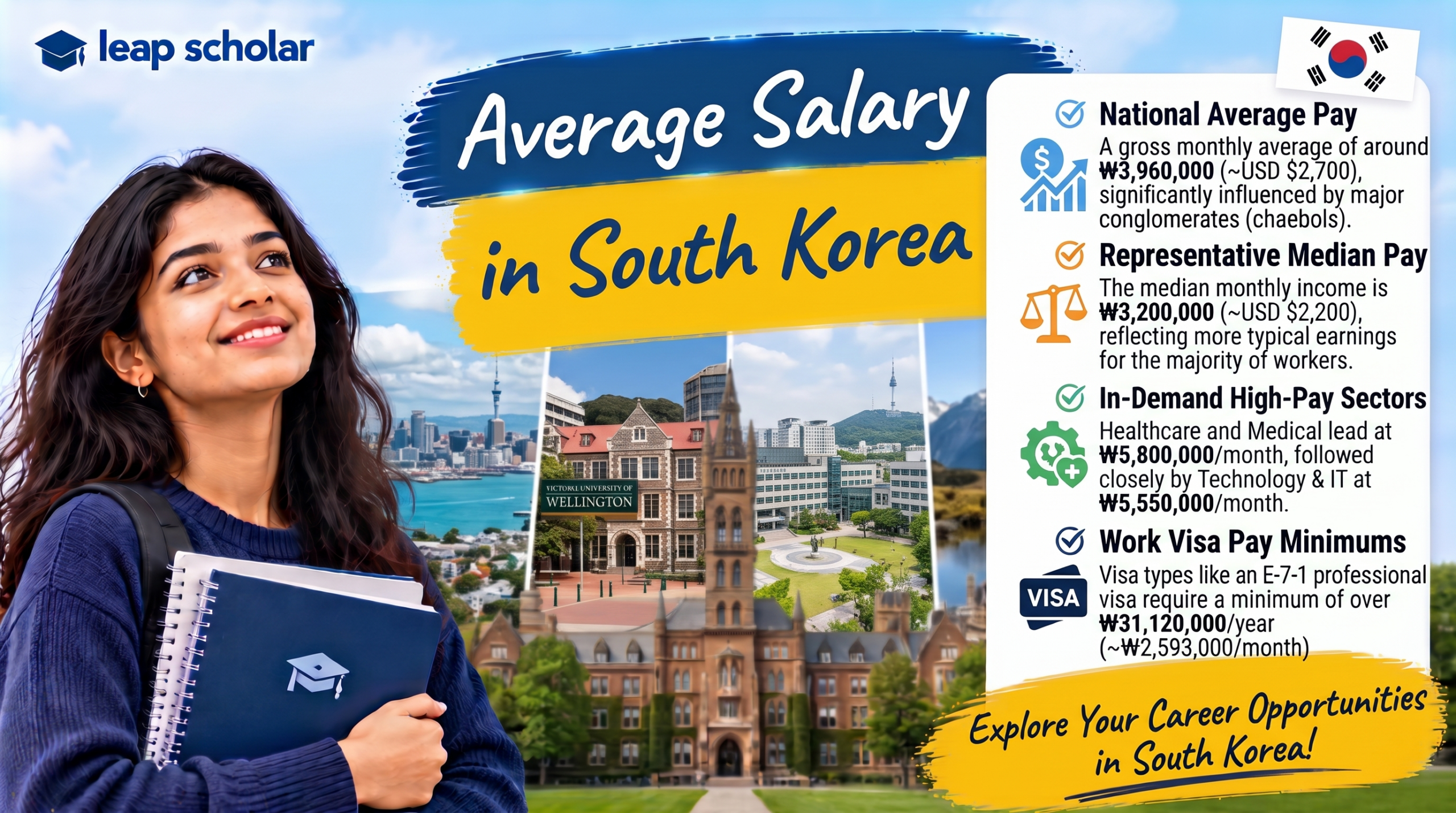
- 2026 minimum wage is ₩10,030/hour (₹722); D-2 students can work up to 30–35 hrs/week
- 20 universities were barred from issuing student visas for one year starting Fall 2026
Cost of Living in South Korea at a Glance
Before the detailed breakdown of living costs in South Korea, here’s what a typical international student budget looks like outside the most expensive Seoul neighborhoods.
| Expense | Monthly Cost (KRW) | INR Equivalent |
| Housing (goshiwon to officetel range) | ₩300,000–1,300,000 | ₹21,600–₹93,600 |
| Food | ₩300,000–600,000 | ₹21,600–₹43,200 |
| Utilities (studio) | ₩150,000–250,000 | ₹10,800–₹18,000 |
| Mobile plan | ₩30,000–50,000 | ₹2,160–₹3,600 |
| Internet | ₩25,000–35,000 | ₹1,800–₹2,520 |
| Transit pass (unlimited subway/bus) | ₩62,000–65,000 | ₹4,464–₹4,680 |
| NHIS health insurance (2026) | ₩79,320 | ₹5,711 |

Choose your dream country
 UK
 USA
 Germany
 Australia
 Ireland
 Canada
 UAE
 France
 Sweden
 Italy
 Other
When do you want to study abroad?
What's your highest level of education?
Have you completed Class 12th?
What was your Class 12 CGPA/percentage?
Are you a student or a parent/guardian?
What do you want to study?
Select your current city
How Leap will help you

Personalised University Shortlist

Express Applications with Quicker Admits

End-to-End Application Support
Currency Conversion Note: All figures use 1 KRW = ₹0.072, fixed for this article as of October 2026. Verify current rates before budgeting.
Source: Compiled from Korea cost-of-living market data, including Seoul National University’s international student housing guidance; visa and insurance figures are government-sourced as cited in their dedicated sections below.
Counselor insight: A single student living modestly, cooking most meals, and choosing a goshiwon or dorm over an officetel can realistically land near the lower end of this range; someone in a private officetel in central Seoul, eating out often, will land well above it.
2026 Visa Changes Every Applicant Should Know First
Before budgeting for South Korea, confirm your university is still eligible to sponsor students. In a 12 February 2026 announcement, Korea’s Ministry of Education barred 20 universities (16 degree programs, 4 language programs) from issuing new student visas for one year, starting Fall 2026, citing oversight failures in managing international student compliance. This doesn’t affect currently enrolled students, but it directly affects anyone choosing a university for upcoming intakes.
This sits alongside Korea’s broader “Study Korea 300K” push: the country hosted 253,434 international students in 2025 and is targeting 300,000 by 2027, so demand and scrutiny are both rising at the same time.
Counselor Insight: We now tell every applicant to confirm their shortlisted university isn’t on the current restricted list before applying, not after accepting an offer. A barred university can derail an entire intake timeline.
Source: Ministry of Education, Republic of Korea, 2026 international student visa oversight announcement
D-2 Student Visa: Financial Requirements and Health Insurance
The D-2 visa, South Korea’s main student visa for degree programs, has two cost components that belong in any living-cost budget, not just the visa checklist.
Financial proof: Most applicants need to show approximately ₩20,000,000 (₹14.40L) in available funds, typically via a recent bank statement, though national/public universities sometimes accept a lower range depending on scholarship status.
National Health Insurance (NHIS): Enrollment has been mandatory for all international students since 1 March 2021. The 2026 monthly premium is ₩79,320 (₹5,711), automatically billed once your Alien Registration Card (ARC) is processed; unpaid balances exceeding ₩500,000 can affect visa renewal.
See what our counselors say about permanent residency options after studying in South Korea if you’re planning your finances with a longer stay in mind.
Source: National Health Insurance Service, 2026 premium notice for international students
Part-Time Work Rules and 2026 Minimum Wage
Part-time work meaningfully offsets South Korea’s cost of living, but only within fixed limits tied to your visa and degree level.
| Factor | 2026 Detail |
| Minimum wage | ₩10,030/hour (₹722) |
| D-2 undergraduate work limit | Up to 30 hours/week |
| D-2 graduate work limit | Up to 35 hours/week |
| Work permit requirement | Separate part-time work permit from immigration, on top of the D-2 visa itself |
Counselor insight: At minimum wage and the maximum weekly cap, an undergraduate working 30 hours/week could earn roughly ₩1,200,000/month (₹86,400) before tax, enough to cover housing and food at the lower end of the budget range above, though most students don’t work the full permitted hours alongside coursework.
Source: Ministry of Employment and Labor, 2026 minimum wage decision
Housing Costs: Goshiwon, Officetel, and Dormitory Compared
Housing is the single biggest line item, and the type you choose changes your budget more than the city does.
| Housing Type | Monthly Cost (KRW) | INR Equivalent | Best For |
| University dormitory | ₩500,000–800,000 (per semester) | ₹36,000–₹57,600 (per semester) | First-year students, lowest hassle |
| Goshiwon | ₩300,000–650,000 | ₹21,600–₹46,800 | Tightest budgets, short stays |
| Officetel (Seoul) | ₩850,000–1,300,000 | ₹61,200–₹93,600 | Privacy, proximity to subway |
| Officetel (Busan) | ₩600,000–950,000 | ₹43,200–₹68,400 | Same privacy, lower cost than Seoul |
Source: Types of Housing in South Korea, 2025–26 market guide, cross-referenced against Dabang and KB Kookmin Bank real estate listings. These are market rates, not government-published figures, and vary by building and negotiation.
Counselor insight: Dormitories are billed per semester, not monthly, which makes them look cheaper on paper and often is cheaper overall, but availability is limited and usually prioritized for first-year and exchange students. Goshiwons typically include basic utilities and sometimes free rice and kimchi, which narrows the gap with dorm pricing once food savings are factored in.
City-Wise Cost Comparison: Seoul vs. Busan
Seoul’s cost premium is driven almost entirely by housing, not daily expenses.
| City | Officetel Rent (Monthly) | Relative Daily Costs |
| Seoul | ₩850,000–1,300,000 (₹61,200–₹93,600) | Higher; base subway fare ₩1,550 (₹112) |
| Busan | ₩600,000–950,000 (₹43,200–₹68,400) | Lower; most commutes stay within base fare |
Source: Cost of Living in Seoul vs. Busan, 2026 comparison. Transit fares are confirmed via Seoul Metro’s 2025 fare adjustment; rental figures are market averages, not government-set.
Counselor insight: Students prioritizing budget over campus-adjacent convenience often find Busan, Daejeon, or Incheon meaningfully cheaper on housing while daily costs (food, transit, utilities) stay fairly close to Seoul’s.
Tuition Fees: What to Budget For
Tuition varies widely by university type and program. As a general pattern, national universities (Seoul National University, Korea University’s public programs) tend to sit at the lower end, while private research universities (Yonsei, POSTECH) and specialized STEM programs run considerably higher. Rather than quote specific per-university figures that shift by program and intake, confirm current tuition directly on each shortlisted university’s admissions page before budgeting, since the gap between a national and a top private university’s tuition can be several times over.
Scholarships That Offset Cost of Living in South Korea
Scholarships in Korea don’t just cover tuition; several directly fund living costs through stipends, which is what actually moves the needle on a monthly budget.
| Scholarship | Offered By | Coverage |
| Global Korea Scholarship (GKS) | Korean Government | Full tuition, monthly stipend (₩900,000 undergrad / ₩1,000,000 grad), airfare, health insurance |
| KNU International Graduate Scholarship (KINGS) | Kyungpook National University | 50–100% tuition waiver for Master’s and PhD programs, open to all international nationalities |
| Korea University Graduate School of International Studies (KU GSIS) Scholarship | Korea University | Partial to full tuition coverage |
| Changwon National University Scholarship | Changwon National University | One-semester award; 30%, 50%, or 70% tuition reduction based on evaluation |
| Hanyang International Excellence Awards | Hanyang University | One-semester award; 30%, 50%, or 70% tuition waiver based on evaluation |
| Yonsei University Underwood International College (UIC) Scholarship | Yonsei University | Admissions, merit-based, and need-based tracks |
Why the GKS stands out for living costs specifically: its monthly stipend (₩900,000–1,000,000, or ₹64,800–₹72,000) alone covers most of the housing-and-food budget outlined earlier in this guide, on top of the tuition, airfare, and health insurance it already pays for. KNU’s KINGS scholarship, by contrast, is tuition-only, so a KINGS recipient still needs to budget for housing, food, and NHIS separately, which is worth factoring in before comparing the two as equivalent offers.
Most of these, apart from GKS, are awarded per semester rather than for the full program, so check whether you need to reapply or maintain a GPA threshold each term to keep the award.
Source: Study in Korea portal, Government and university scholarship listings
How to Reduce Your Cost of Living in South Korea
- Choose a goshiwon or dormitory over an officetel in your first year
- Cook at home using discount grocery chains (E-Mart, Lotte Mart) rather than eating out regularly
- Get a T-money transit card for discounted bus and subway fares
- Apply for a part-time work permit early, since processing isn’t instant
- Check your university’s own housing office before searching private listings, since on-campus options are usually cheapest
- Apply for GKS or university-specific scholarships well before deadlines, since award amounts often exceed tuition alone
Cost of Living: South Korea vs. India
| Expense | South Korea (Monthly) | India (Monthly, approximate) |
| Food | ₩300,000–600,000 (₹21,600–₹43,200) | ₹3,000–5,000 |
| Transit pass | ₩62,000–65,000 (₹4,464–₹4,680) | ₹1,000–1,500 |
| Utilities | ₩150,000–250,000 (₹10,800–₹18,000) | ₹2,000–3,500 |
| Rent (1BHK equivalent) | ₩850,000+ (₹61,200+) | ₹10,000–17,000 |
Note: India-side figures are general market estimates for comparison purposes rather than a single cited dataset.
Counselor insight: The gap is largest on housing and food, which is exactly where the housing-type and cooking-at-home choices above make the most difference to a student’s actual monthly spend.
3 Takeaways on Cost of Living in South Korea
- South Korea’s cost of living isn’t one number; it swings from roughly ₩0.95 million to ₩2.4 million a month (₹68,400–₹1,72,800) depending almost entirely on your housing choice.
- Budget for the D-2 visa’s ₩20 million (₹14.40L) financial proof and the ₩79,320/month (₹5,711) NHIS premium alongside daily living costs, not as a one-time, separate expense.
- Confirm your shortlisted university isn’t among the 20 barred from issuing visas for the Fall 2026 intake before finalizing your cost-of-living budget around it.
Verified by: LeapScholar’s South Korea counseling team, drawing on direct experience guiding students through D-2 visa financial documentation, National Health Insurance (NHIS) enrollment, and part-time work permit applications.
Have a specific question about the cost of living in South Korea? Book a free session with a LeapScholar counselor.
Frequently Asked Questions About Cost of Living in South Korea
-
Is South Korea expensive for Indian students?
It’s moderate by developed-country standards. A student in a goshiwon or dormitory, cooking most meals, can budget around ₩950,000/month (₹68,400), while someone in a private officetel eating out regularly can spend ₩2.4 million/month (₹1,72,800) or more.
-
What is the monthly cost of living in South Korea?
Including housing, food, utilities, mobile, internet, and transit, most students budget between ₩0.95 million and ₩2.4 million/month (₹68,400–₹1,72,800), depending heavily on housing type and city.
-
What is the cost of living in Seoul specifically?
Seoul's officetel rents (₩850,000–1,300,000, or ₹61,200–₹93,600/month) run noticeably higher than Busan or Daejeon, though daily costs like food and transit stay relatively similar across cities.
-
How much money do I need to prove for a South Korea student visa?
Most D-2 visa applicants need to show approximately ₩20,000,000 (₹14.40L) in available funds, in addition to budgeting for the mandatory NHIS health insurance premium once enrolled.
-
Can international students work part-time in South Korea?
Yes, with a separate work permit beyond the D-2 visa itself. Undergraduates can work up to 30 hours/week and graduate students up to 35 hours/week, at the 2026 minimum wage of ₩10,030/hour (₹722).
-
Are there universities I should avoid for the upcoming intake?
Check first. In February 2026, Korea’s Ministry of Education barred 20 universities from issuing new student visas for one year starting Fall 2026. Confirm your shortlisted university isn’t on that list before applying.
-
How can I reduce my living costs in South Korea?
Choose a goshiwon or dormitory over an officetel, cook at home instead of eating out, use a T-money transit card, and apply early for scholarships like the Global Korea Scholarship, which covers tuition and provides a monthly stipend.
-
How does South Korea’s cost of living compare to India?
South Korea runs significantly higher across every category, most sharply in housing and food, where costs can run 5–10 times India’s equivalent, depending on city and lifestyle choices.










Have Questions? Get Guidance to reach your Dream University
Connect with India's finest counsellors and biggest study abroad community.
Get Guidance