Blogs
Blogs  Leap Digest
  Events
  About Us
 Trending News
Why South Korea Is Becoming One of the Most Popular Study Abroad Destinations for Indian Students in 2026
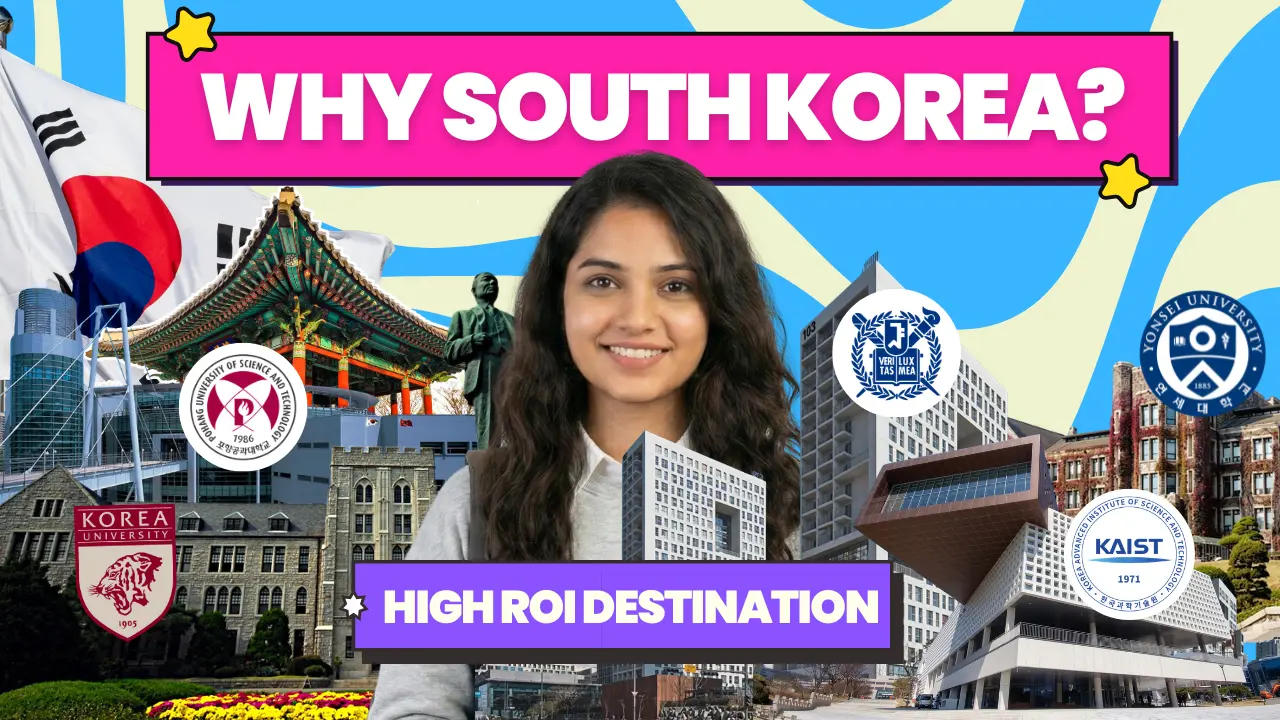
South Korea has just crossed 300,000 international students, two years ahead of the government's own target. For Indian families still defaulting to the US, UK, Canada, or Australia, that number is worth paying attention to. Those four destinations dominated every discussion, every counseling session, and every parent-student counseling conversation at the dinner table.
As of April 2025, South Korea enrolled 253,400 international students in Korean universities, marking a 21.3 percent increase from 209,000 in 2024. The government had set a target of reaching 300,000 international students by 2027. It achieved this milestone two years ahead of the planned timeline.
(Note: The 253,400 figure (April 2025) counts degree-enrolled students only; the 300,000 figure (August 2025) includes language program students.)
Such growth is not a coincidence. Here is the full picture of why students are choosing South Korea and what Indian students specifically need to know before they apply.
Why Students Are Moving Away From the Big Four
The traditional destinations have gotten harder. UK visa rules are tightening. US policy uncertainty is making students and families nervous. Canada has capped study permits. Australia raised visa costs significantly in 2026.
Against that backdrop, South Korea has been doing the exact opposite. More scholarship budgets. Easier visa pathways. Better post-study work rights. Lower costs. The country has been building itself into a genuinely attractive study destination for several years, and students are now noticing.
The total annual cost of studying in South Korea, including tuition and living expenses, ranges from approximately Rs.10 to 15 lakh per year. This is significantly lower than the US at Rs.25 to 40 lakh, the UK at Rs.20 to 35 lakh, and Australia at Rs.20 to 30 lakh.
For Indian families doing a real cost-benefit comparison, those numbers are difficult to ignore.
Are Korean Universities Globally Competitive? The Data Says Yes
This is the first question every Indian student asks, and it deserves a direct answer.
Seoul National University ranks number 31 globally in the QS World University Rankings 2026, making it one of the highest-ranked universities in all of Asia. Samsung, Hyundai, LG, and major global companies recruit graduates from the SKY universities, including Seoul National University, Korea University, and Yonsei University.
Here are the top universities Indian students are targeting and what they are known for:
University | QS World Ranking 2025 | Best Known For |
| Seoul National University (SNU) | #31 | Engineering, Business, Natural Sciences |
| KAIST | Top 60 globally | AI, Robotics, Science and Technology |
| Yonsei University | #73 | Business, International Studies, Medicine |
| Korea University | #74 | Law, Engineering, Business |
| POSTECH | Top 100 | Science, Engineering, Research |
(Currency note: All INR figures in this blog are converted at 1 KRW = Rs.0.061, as of April 8, 2026.)
Five South Korean universities are ranked within the top 100 globally according to QS World University Rankings 2026. That is not a regional achievement. That is genuinely world-class academic standing, and it is the kind of credential that travels well on a resume anywhere in the world.
What Will It Actually Cost You? Real Numbers, Not Estimates
Tuition fees:
- The cost of studying in South Korea for Indian students ranges from Rs.2.5 lakh to Rs.10 lakh per year for undergraduate programs and Rs.3 lakh to Rs.25 lakh per year for postgraduate programs, depending on the university and course
- Public universities like SNU and KAIST sit comfortably at the more affordable end of that range
- Tuition fees in South Korea are 30 to 40 percent lower than in the US, UK, or Australia
Monthly living costs:
- On average, Indian students spend between Rs.65,000 and Rs.97,000 per month on living costs, including accommodation, food, transportation, and personal expenses
- Students outside Seoul, in cities like Daejeon or Busan, spend considerably less
- International students can work 20 hours per week during the semester and full-time during academic breaks, which meaningfully reduces living costs for students who plan ahead
The Scholarships: Genuinely Generous, Not Just on Paper
South Korea's scholarship ecosystem is one of the strongest reasons to take it seriously. This is not a destination where you are hoping for a small tuition discount. There are real, substantial funding options available.
Global Korea Scholarship (GKS): This is the South Korean government's flagship scholarship and one of the most comprehensive available to Indian students anywhere in the world. Here is what it covers:
- Full tuition for the entire degree duration
- Monthly living stipend of Rs.61,000 (₩1,000,000), as per NIIED's official GKS guidelines
- Round-trip airfare
- Health insurance and settlement allowance
- One full year of Korean language training before your program begins
- Available for undergraduate, master's, and doctoral programs
- On average, 20 to 30 Indian students receive the GKS scholarship each year
University-specific scholarships: KAIST covers full tuition for eight semesters for undergraduates. Yonsei University and Korea University both offer full-tuition pathways for high-performing international applicants. Most Korean universities also offer merit-based scholarships covering 30 to 100 percent of tuition fees based on academic performance, awarded automatically without a separate application in numerous instances.
The practical implication is significant. An Indian student who secures GKS or a strong university scholarship can study at a globally top-60 university for a total annual cost that is a fraction of what a mid-ranked UK or US university charges without any financial aid whatsoever.
The Post-Study Work Visa: The Part Most Students Do Not Know About
This is truly the most overlooked change in South Korean policy for international students, and it holds significant importance.
South Korea's D-10 job-seeker visa, available to graduates of Korean universities, was recently extended from a maximum of two years to up to three years (effective October 2025). The initial grant is six months, extendable in one-year increments. After graduation, students can apply for the D-10-1 job seeker visa, transition to an E-1 work visa once employed, and become eligible for permanent residency after a total of five years in Korea.
Three years of post-study work rights. In a country that is home to Samsung, LG, Hyundai, Kakao, and NAVER. Those are not small names. They are among the most powerful technology and industrial companies in Asia, and they actively recruit from Korean university campuses.
The Korean Language Question: An Honest Answer
Every Indian student asks this question. Most assume the answer means South Korea is off the table for them. It is not.
Many universities in South Korea offer programs fully in English, especially at the graduate level. For English-taught programs, Korean language proficiency is not mandatory, though basic Korean knowledge is helpful for everyday life on campus.
At the undergraduate level, universities like KAIST, Yonsei's Underwood International College, and Korea University offer programs taught entirely in English. At the graduate level across most disciplines, English-medium instruction is now standard across the sector.
And if you end up needing Korean? The GKS scholarship includes a full year of funded language training before your academic program begins. Most students who initially worried about their language skills find that six to twelve months of focused learning is enough to function comfortably in daily life.
What Fields Are Indian Students Actually Studying There?
The proportion of international students in STEM fields in South Korea climbed to 23.9 percent in 2025, a 2.5 percentage point rise from the previous year, reflecting strong and growing interest in engineering, AI, and technology programs specifically.
The most popular choices among Indian students include:
- Engineering and Computer Science: KAIST and POSTECH are genuinely world-class for both
- Business and Management: Korea University and Yonsei Business School carry strong global recognition
- Medicine and Healthcare: MBBS tuition in South Korea is significantly more affordable than the UK or Australia
- AI, Robotics, and Technology: South Korea's tech ecosystem, anchored by billions in Samsung and Hyundai R&D spending, makes this an unusually good location for applied technology education
- Natural Sciences and Research: SNU's research institutes are among Asia's strongest and most internationally collaborative
The Straightforward Comparison No One Is Making Loudly Enough
Here is the question worth asking directly before you commit to an application.
You could potentially attend a top-30 globally ranked Korean university with a scholarship that covers most of your costs for the same total investment, including tuition and living costs, that you would spend at a mid-ranked UK or Australian university without scholarship support.
South Korea is not a compromise. For an increasing number of Indian students who do the real comparison, it is the smarter choice.
Want to Know If South Korea Makes Sense for Your Profile?
Every student's situation is different. The right university, scholarship, and program depends on your academic background, your field of interest, and your timeline. While there is no universal solution, there is a specific solution that is tailored to your profile.
Book a free counselling session with Leap Scholar and speak to a counselor who will tell you honestly whether South Korea is the right move for you, which universities and scholarships you are eligible for, and how to build an application that stands out in 2026.
Sources: Korea Herald — South Korea International Student Data 2025 | ICEF Monitor — South Korea Hits 300,000 Student Target | Standyou — Study in South Korea | Shiksha — Study in South Korea for Indian Students | Korea Educational Development Institute (KEDI) statistics service

Kirti Singhal
Kirti is an experienced content writer with 4 years in the study abroad industry, dedicated to helping students navigate their journey to international education. With a deep understanding of global education systems and the application process, Kirti creates informative and inspiring content that empowers students to achieve their dreams of studying abroad.
Users also read
Vietnam Steps Into the Global Academic Spotlight at APAIE 2026: And Indian Students Should Pay Attention
Vietnam Steps Into the Global Academic Spotlight at APAIE 2026: And Indian Students Should Pay Attention

Indian Passport Fees Rise From July 1, 2026. Here Is What It Means If You Plan to Study Abroad.