
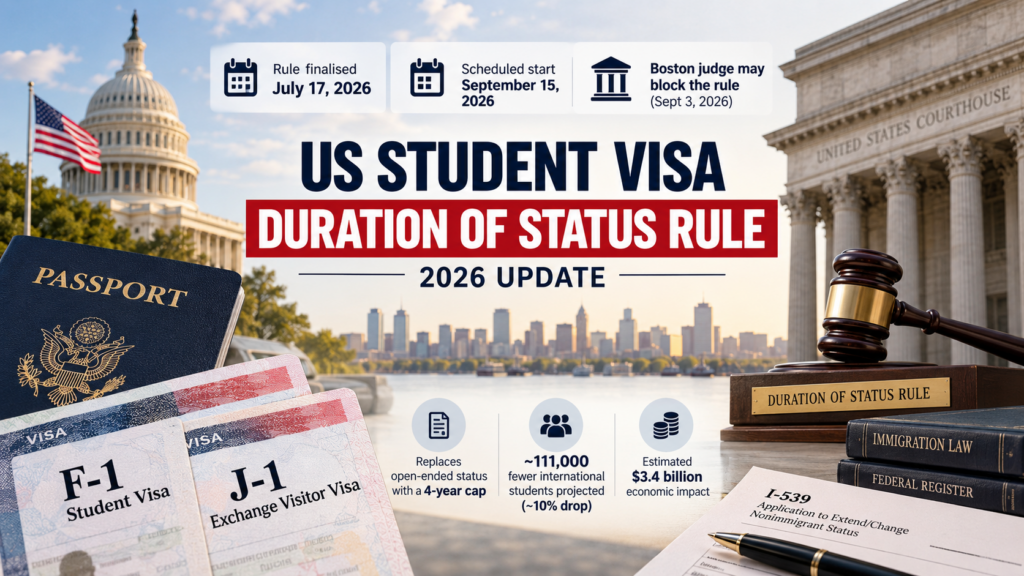
A federal judge in Boston signalled on September 3, 2026 that he may temporarily block the US student visa duration of status rule, DHS’s new policy ending open-ended student status, just days before it is due to take effect on September 15.
The Specific Facts
- The rule replaces the decades-old “duration of status” system, under which F-1 and J-1 students could remain in the US as long as they were making normal progress in their studies, with a fixed admission period capped at four years, as NAFSA’s regulatory summary explains. Students whose programs run longer must file for an extension of stay.
- DHS published the final rule in the Federal Register on July 17, 2026, with a scheduled effective date of September 15, 2026, unless a court intervenes.
- A coalition led by NAFSA and the Presidents’ Alliance on Higher Education and Immigration argued its motion for a preliminary injunction on September 3 before District Judge F. Dennis Saylor IV at the Moakley US Courthouse in Boston.
- Per the Boston Globe’s courtroom reporting, Saylor called the government’s national-security justification for the four-year cap unconvincing and indicated he could issue a temporary order to buy himself more time to rule before the 15th. He went further, dismissing the government’s stated fraud and security concerns as anecdotal and unconnected to the specific four-year time limit it had chosen.
- DHS received 22,000 public comments on the proposed rule, as Forbes reported when the rule was finalized. The judge suggested the agency hadn’t meaningfully engaged with them.
- NAFSA and JB International’s Fall 2026 outlook, drawing on IIE’s Spring 2026 Snapshot, projects roughly 111,000 fewer international students (about a 10% drop) in the US this fall, costing the economy an estimated $3.4 billion.
Why The US Student Visa Duration of Status Rule Matters for Indian Students?
India sends more F-1 and J-1 students to the US than almost any other country, so this rule change lands directly on Indian applicants and current students. Under the rule as written, an Indian student admitted after September 15 would generally get a fixed stay tied to their program length, capped at four years, rather than open-ended status, and would have to file Form I-539 to extend if their degree runs longer, with no right to appeal a denied extension. Students already in the US move into a transition period but still face the same four-year outer limit from the effective date.

Choose your dream country
 UK
UK
 USA
USA
 Germany
 Australia
 Ireland
 Canada
 UAE
UAE
 France
 Sweden
 Italy
Italy
 Other
Other
When do you want to study abroad?
What's your highest level of education?
Have you completed Class 12th?
What was your Class 12 CGPA/percentage?
Are you a student or a parent/guardian?
What do you want to study?
Select your current city
How Leap will help you

Personalised University Shortlist

Express Applications with Quicker Admits

End-to-End Application Support
What to Do Now
Because Saylor hasn't ruled yet and the rule remains legally set to start September 15 unless a court order says otherwise, current and incoming F-1/J-1 students should hold off on non-essential international travel until a decision comes out, keep their I-20 or DS-2019 and SEVIS records current, and check with their university's international student office for updates in the coming days.
For the complete process, see our US F-1 student visa guide. If you're mapping the longer path, our guide to settling in the USA from India covers how status changes ripple through the OPT-to-H-1B-to-green-card timeline.
Have questions about the US student visa duration of status rule? Book a free session with a LeapScholar counselor.





Have Questions? Get Guidance to reach your Dream University
Connect with India's finest counsellors and biggest study abroad community.
Get Guidance