
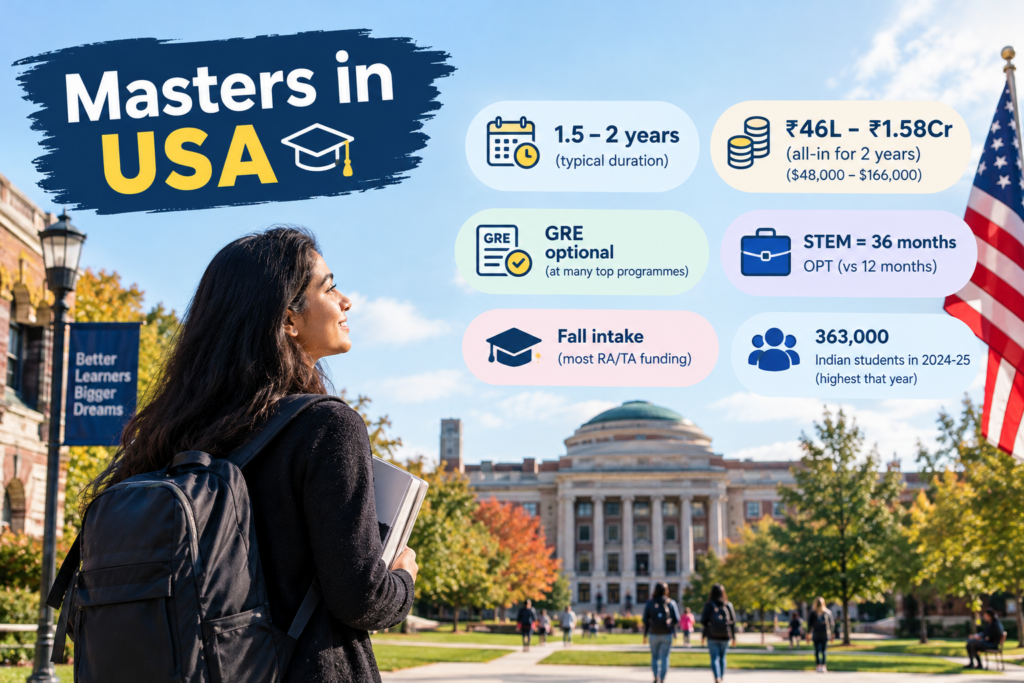
Quick Read
- Masters in USA takes 1.5 to 2 years and costs Rs.46 lakh to Rs.1.58 crore ($48,000 to $166,000) for two years, all-in.
- GRE is optional at many top programmes, but a strong score still helps.
- STEM-designated Masters give 36 months of OPT instead of 12.
- Fall is the main intake and has the most RA/TA funding.
- In 2024-25, India sent 363,000 students to the US, the highest number for that year.
Why Indian Students Choose USA for a Masters Degree
Four of the QS 2027 global top 10 universities are American, and the US has 184 ranked institutions in total. Here are the specific factors that drive Indian students:
- World-class research: No other facilities replicate the scale of MIT’s CSAIL and Stanford’s AI Lab.
- 36 months of OPT: STEM-designated Masters programmes give you three H-1B selection attempts instead of one, a structural career advantage for Indian students.
- Paid internships during study: The CPT model lets you work in your field before you even graduate.
- Strong career outcomes: 26 US universities are in the QS 2027 top 100, covering STEM, business, and social sciences.

Choose your dream country
 UK
 USA
 Germany
 Australia
 Ireland
 Canada
 UAE
 France
 Sweden
 Italy
 Other
When do you want to study abroad?
What's your highest level of education?
Have you completed Class 12th?
What was your Class 12 CGPA/percentage?
Are you a student or a parent/guardian?
What do you want to study?
Select your current city
How Leap will help you

Personalised University Shortlist

Express Applications with Quicker Admits

End-to-End Application Support
Source:QS World University Rankings 2027, published June 2026
Eligibility for Masters in USA for Indian Students in 2027
| Requirement | What You Need | Notes for Indian Students |
|---|---|---|
| Bachelor’s degree | 3 or 4-year degree in a relevant field | Some US universities accept Indian 3-year degrees, often with conditions such as first-class marks or a WES evaluation; many programmes require a 4-year degree. Confirm with your programme. |
| GPA | Minimum 3.0 on a 4.0 scale | Top-10 programs expect 3.5 to 3.8, roughly 80 to 90% in Indian grading |
| GRE | Optional at 80+ universities for 2027, including MIT, Stanford, UC Berkeley, and CMU | If you submit a score, target 315 to 325 for STEM and 300 to 310 for mid-tier |
| English proficiency | TOEFL iBT 90 to 100, or IELTS 6.5 to 7.0 | Competitive programs at MIT and Stanford prefer TOEFL 100 to 110. TOEFL iBT changed on 21 January 2026 to a 1-6 band score; check each programme’s current requirement, since many still list the old 0-120 scale. |
| SOP | Research-focused statement, programme-specific | Not the same as a study visa SOP. Focuses on research fit |
| LOR | 2 to 3 references | Academic preferred; professional acceptable for working applicants |
| Work experience | Preferred but not mandatory for STEM | Business Analytics and Finance programs often prefer 1 to 2 years |
Full breakdown: MS eligibility in USA.; GRE concern: Masters in USA without GRE.
My insight: GRE-optional is not GRE-irrelevant. A 320+ score gives the committee something concrete when your GPA or institution are not obvious strengths.
Cost of Masters in USA for Indian Students: Fees in INR (2027)
| University Tier | Annual Tuition (USD) | Annual Tuition (INR) | Total 2-Year Cost (INR) |
|---|---|---|---|
| Tier 1 Private (MIT, Stanford, Columbia) | USD 55,000 to 65,000 | Rs.52,24,000 to Rs.61,74,000 | Rs.1,04,48,000 to Rs.1,23,47,000 |
| Mid-Tier Public (Purdue, UC Davis, UMass) | USD 22,000 to 35,000 | Rs.20,89,000 to Rs.33,24,000 | Rs.41,79,000 to Rs.66,49,000 |
| Affordable Public (UT Arlington, Iowa State) | USD 14,000 to 20,000 | Rs.13,29,000 to Rs.18,99,000 | Rs.26,59,000 to Rs.37,99,000 |
Sources: MIT, Stanford and Columbia tuition pages; Purdue Graduate School (mid-tier); UT Arlington. Verify with each university’s official registrar before applying.
Tuition only. Living costs add USD 10,000 to 18,000 per year (Rs.9,50,000 to Rs.17,10,000) depending on the city.
If you want to know about the city-wise cost breakdowns and other expenses, check out our blog on cost of living in USA.
My insight: RA funding is more common at mid-tier public universities than at elite privates, but most MS students are not funded. Thesis-based MS students and those who secure a faculty RA after arriving are the usual exceptions. Check each department’s funding page.
Top Specializations for Masters in USA
| Specialization | Top Universities | Annual Tuition (USD / INR) | STEM | Avg. Starting Salary (USD) indicative |
|---|---|---|---|---|
| MS in AI / Computer Science | MIT, CMU, Stanford, UC Berkeley | USD 55,000–62,000 (Rs.52,24,000–58,88,000) | Yes | USD 120,000–160,000 |
| MS in Business Analytics | MIT Sloan, UCLA, UT Austin, Columbia | USD 48,000–94,000 (Rs.45,59,000–89,28,000) | Yes (most) | USD 90,000–130,000 |
| MS in Data Science | Columbia, NYU, Carnegie Mellon | USD 45,000–65,000 (Rs.42,74,000–61,74,000) | Yes | USD 1,00,000–1,40,000 |
| MS in Finance | Princeton, MIT, Columbia, NYU Stern | USD 55,000–82,000 (Rs.52,24,000–77,88,000) | Yes (most) | USD 1,00,000–1,40,000 |
| Masters in Public Health | Johns Hopkins Bloomberg, Harvard T.H. Chan, Columbia Mailman | USD 45,000–60,000 (Rs.42,74,000–56,99,000) | Partially | USD 55,000–85,000 |
Sources: Programme employment reports; BLS median pay for the related occupations. Verify fees at official university pages before applying.
After MBBS, CS and engineering programmes are not realistic paths, as the prerequisite coursework does not overlap with MBBS. A master's in public health at Harvard, Johns Hopkins, or Columbia is a better fit, as are MS programs in biostatistics or bioinformatics where your clinical background can work in your favor. An online MBA is another option worth considering if you want flexibility.
Detailed guide: MS courses in USA.
Top Universities for Masters in USA: QS 2027 Rankings
| University | QS Rank 2027 | Popular MS Programs | Annual Tuition (USD / INR) | STEM |
|---|---|---|---|---|
| MIT | #1 | CS, AI, Data Science, Finance | USD 59,000–65,000 (Rs.56,04,000–61,74,000) | Yes |
| Stanford | =2 | CS, EE, Management Science, Statistics | USD 58,000–65,000 (Rs.55,09,000–61,74,000) | Yes |
| Harvard | #5 | Computational Science, Data Science, Public Health | USD 54,000–60,000 (Rs.51,29,000–56,99,000) | Yes |
| Caltech | #7 | Applied Physics, CS, Electrical Engineering | USD 60,000–65,000 (Rs.56,99,000–61,74,000) | Yes |
| UC Berkeley | =20 | EECS, Data Science, Civil Engineering | USD 27,000–44,000 (Rs.25,64,000–41,79,000) | Yes |
| University of Chicago | #24 | CS, Statistics, Financial Mathematics | USD 58,000–62,000 (Rs.55,09,000–58,88,000) | Yes |
| Carnegie Mellon (CMU) | #55 | CS, Robotics, Business Analytics, HCI | USD 53,000–62,000 (Rs.50,33,000–58,88,000) | Yes |
Sources: QS World University Rankings 2027, official university tuition fee pages. Fees vary by program. Verify at the university’s official registrar page.
Masters in USA: Fall vs Spring Intake
If you are graduating in May or June 2027, Fall 2027 is your natural target. It fits Indian graduation calendars and gives you access to RA/TA funding. If you are graduating in November or December 2026, most Spring 2027 applications have closed by now, so look at Fall 2027 or Spring 2028, and check whether your programme has a Spring cohort.
Spring entrants often pay full fees, since most RA and TA funding is allocated for Fall.
| Intake | Start Month | Application Window | Availability | Scholarships |
|---|---|---|---|---|
| Fall | August to September | December to February | Most programmes | Full access |
| Spring | January | August to October | A minority of programmes | Reduced |
For a full intake calendar: Intakes in USA
Documents Required for Masters in USA
| Document | Details | Tips for Indian Students |
|---|---|---|
| Academic Transcripts | Official sealed transcripts from all universities attended | Get multiple certified copies; allow 2 to 4 weeks for processing |
| WES Evaluation | Required if your institution is not well known to US admissions committees | Apply early; WES processing takes 7 to 10 weeks |
| Statement of Purpose (SOP) | Programme-specific research statement | Not the same as a visa SOP; Write a fresh one for each programme |
| Letters of Recommendation (LOR) | 2 to 3 references | Academic referees preferred; give recommenders at least 4 weeks' notice |
| GRE Scorecard | Optional at 80+ universities for 2027 | Valid for 5 years from test date; submit if 315 or above |
| TOEFL / IELTS Scorecard | TOEFL iBT 90 to 100 or IELTS 6.5 to 7.0 | Valid for 2 years from test date; check expiry before applying |
| Updated CV / Resume | Academic projects, internships, research, publications | Keep it to 1 to 2 pages; US CVs differ from Indian formats |
| Passport | Valid for at least 6 months beyond your intended stay | Renew early if expiry is close; delays are common |
| Financial Proof | Bank statements showing funds to cover at least one year of study | Most universities ask for USD 40,000 to 80,000 (Rs. 37,99,200 to Rs. 75,98,400) |
| Offer Letter / I-20 | Issued by the university after admission | Needed to apply for your F-1 visa; do not book flights before this arrives |
Scholarships for Masters in USA for Indian Students
For STEM students, an RA or TA is the most realistic funding route. Named scholarships are worth pursuing in parallel but should not be your primary plan.
| Scholarship / Funding | Amount | Next Deadline | Who It Is For |
|---|---|---|---|
| Fulbright-Nehru Master’s Fellowship (USIEF) | Full tuition, stipend, airfare, health insurance | Around May 2027 for the 2028-29 cycle (the 2027-28 cycle has closed; (confirm at usief.org.in) | Indian professionals with at least 3 years post-graduation work experience in the fellowship’s listed fields only (for example, public health); government employees are not eligible |
| Knight-Hennessy Scholars, Stanford | Full tuition + stipend for up to 3 years | October 2027 for the 2028 cohort (2027 cycle closed 6 Oct 2026) | Any Stanford graduate program; all nationalities |
| AAUW International Fellowships | USD 20,000 (Rs.18.99 lakh) for a first master’s, one-time and non-renewable | The 2027-28 round closed on 17 September 2026; the next window is expected around August to September 2027 | Women who are not US citizens or permanent residents, pursuing a first master’s or doctorate (STEM only per current guidance; check aauw.org) |
| Research Assistantship (RA) | Stipend of USD 1,400 to USD 2,200/month (Rs.1,32,972 to Rs.2,08,956), often with a partial or full tuition waiver | Applied directly to the faculty/department on admission | STEM students with a research background, strongest at mid-tier publics |
| Teaching Assistantship (TA) | Partial or full tuition waiver + stipend | Applied directly to the department on admission | Students with a strong academic record in their subject |
For the full list with eligibility details: Scholarships for MS in USA.
How to Apply for Masters in USA: Step-by-Step for Indian Students
A well-run application takes 12 to 18 months. Students who land funded places almost always start earlier than the rest.
Step 1: Shortlist your universities (June to August 2026)
Do not go straight to rankings. Check the STEM OPT designation of the specific program, whether the department funds MS students through RAs, and the cost of living in that city. Aim for 6 to 10 universities spread across ones that are a stretch, ones where you are a realistic fit, and a couple where you are confident you will get in. That spread is not about hedging. It is about making sure you have real options when decisions come back.
Step 2: Test scores (August to October 2026)
If your undergraduate was not taught in English, TOEFL or IELTS is non-negotiable. Book your slot early rather than fitting it in around everything else. Check expiry dates too. TOEFL scores are valid for 2 years and GRE for 5. If you need a retake, give yourself the runway for it. October is too late to find out that you need a retake.
Step 3: Prepare your documents (October to November 2026)
This process takes longer than most people expect. You need official sealed transcripts, a WES evaluation if your institution is not well known to US admissions committees, a program-specific SOP that is not recycled across applications, 2 to 3 LORs from people who have actually seen your work, and a current CV.
Step 4: Submit applications (December 2026 to February 2027)
Most Fall 2027 deadlines fall between 1 December and 15 February 2027. Each department makes its own funding decisions, and early applicants usually have an advantage, so check each department’s funding page and deadline.
Step 5: F-1 Student Visa (April to June 2027)
You are looking at two separate payments: the SEVIS I-901 fee at USD 350 (Rs.33,243) and the MRV visa application fee at USD 185 (Rs.17,571). A USD 250 (Rs.23,745) Visa Integrity Fee may also be collected when your visa is issued; rollout has been uneven, so check with your consulate. Pay these early and keep the receipts. Book your consulate appointment the moment your I-20 arrives. April to June is peak season, and slots fill fast. You cannot land in the US more than 30 days before your I-20 start date, so factor that into your flight planning.
Sources: U.S. Embassy and Consulates in India | Study in the States, DHS
For more information on visa requirements and other details, check our blog on F-1 visa.
If you have narrowed it down to a field, you can check these blogs: MS in Computer Science in USA and MS in Finance in USA that cover the program-level detail this section cannot.
OPT and STEM OPT After Masters in USA: What Indian Students Actually Need to Know
Most guides skip this section. It is the part that determines whether your degree pays off.
Standard OPT: 12 months of work authorization after graduation with any US employer.
STEM OPT: If your degree is on the DHS STEM Designated Degree Program List, you add 24 months for 36 total. Filing costs USD 470 (Rs. 44,641) online or USD 520 (Rs. 49,390) on paper.
Why it matters: H-1B selection is now weighted by wage level, so higher-paid offers carry more weight. Three attempts over 36 months is still a fundamentally different situation from a single shot.
Sources: USCIS: STEM OPT Extension | Study in the States, DHS
My insight: Verify the STEM designation at the program level before accepting any offer. University ranking means nothing here. What matters is whether your specific MS program is on the DHS list.
Important News (October 2026) DHS has proposed a rule requiring universities to pay USD 70,000 per student for OPT recommendations and USD 30,000 for STEM OPT extensions. This is a proposed rule only, not yet in effect. The fee falls on universities, not students directly, but if passed, universities may become far more selective about who they recommend. Public comments close on 9 November 2026. Monitor the before committing to a programme.
Source: DHS Federal Register, October 8, 2026
An MS in Architecture without a STEM designation gives 12 months of OPT. An MS in Business Analytics from the USA at a STEM-designated school gives 36 months of OPT.
3 Key Takeaways on Masters in USA
- GRE is optional at over 80 US universities for 2027. A score of 320 or above still matters when the rest of your profile is borderline.
- A STEM-designated Masters in USA gives 36 months of OPT instead of 12. That is three H-1B selection attempts instead of one. This single decision shapes your entire post-graduation path.
- Mid-tier public STEM universities often deliver better financial outcomes than elite privates once RA and TA funding is factored in. The tuition figure on a university website is a starting point, not the final number.
Verified by: LeapScholar’s USA counseling team, with direct experience guiding Indian students through Masters in USA applications, F-1 visas, and OPT planning.
Have questions about your Masters in USA application? Book a free session with a LeapScholar counselor.
Frequently Asked Questions About Masters in USA
-
What is the eligibility for Masters in USA for Indian students?
You need a 3- or 4-year bachelor’s degree, a GPA of 3.0 or above on a 4.0 scale, a TOEFL of 90 to 100 or IELTS of 6.5 to 7.0, a program-specific SOP, and 2 to 3 LORs. GRE is optional at most universities for 2027. The subject prerequisite requirement is what causes the most difficulty for students. CS, Engineering, and Statistics programs expect specific coursework, and if your bachelor’s degree did not include it, you will need to address that before applying.
-
Is GRE still required for Masters in USA in 2027?
GRE is optional at over 80 universities for 2027, including MIT, Stanford, CMU, and UC Berkeley. But if your GPA is on the lower side, or your college is not a name US admissions committees recognize immediately, a strong GRE score of 320 or above gives reviewers something concrete to work with. Quantitative programs, especially, have been treating it as an unspoken expectation, even while calling it optional on the website.
-
How much does a Masters in USA cost in Indian rupees?
Two years at a Tier 1 private university, including living costs, can reach about Rs.1.58 crore ($166,000). An affordable public university like UT Arlington works out to roughly Rs.46 lakh to Rs.72 lakh. That gap is worth factoring in before you build your shortlist.
-
Can I do a Masters in USA after an MBBS in India?
Not through a standard MS in CS or Engineering since the prerequisite coursework does not match what MBBS covers. Masters in Public Health programs at Harvard, Johns Hopkins, and Columbia are a better fit, as are MS programs in Biostatistics or Bioinformatics, where your clinical training is an asset rather than something you need to explain away.
-
Which Masters in USA specialization gives the best post-study work outcome?
The specialization matters less than whether the program has a STEM designation. An MS in CS, an MS in Business Analytics, an MS in Data Science, and an MS in Financial Engineering typically have a STEM designation, which means you get 36 months of OPT and three H-1B selection attempts instead of one. The STEM designation is at the program level, not the university level, so verify your specific program before accepting any offer.
-
What is STEM OPT, and how does it work after a Masters in USA?
Every F-1 student gets 12 months of OPT after graduation. With a STEM-designated degree, you can extend that by 24 months for 36 total. The USCIS filing fee is USD 470 online (USD 520 on paper), your employer needs to be E-Verify registered, and you must be working at least 20 hours a week. For Indian students, 36 months means three separate H-1B selection cycles, which is a very different situation from a single shot.
-
What IELTS score is required for Masters in USA?
Most universities require IELTS 6.5 to 7.0. At MIT, Stanford, and Harvard, competitive applicants typically show 7.0 to 7.5, or a TOEFL of 100 to 110. Some MIT departments do not publish a minimum score at all. That usually means the real expectation is higher, not lower.
-
What are the application deadlines for Masters in USA for Fall 2027?
Applications open around September to October 2026, with most deadlines between 1 December 2026 and 15 February 2027. If RA or TA funding is part of your plan, apply as early as each department allows and check its funding page, since funded positions are decided department by department. For Spring 2027, the application window (August to October 2026) is closing now, but confirm your programme actually offers a Spring intake before planning around it.
-
What is the masters in Public Health in USA?
An MPH runs for 1 to 2 years and covers epidemiology, health policy, biostatistics, and healthcare management. For MBBS graduates who want a US public health career without the USMLE route, the MPH is the most practical path available. Programs worth targeting: Johns Hopkins Bloomberg, Harvard T.H. Chan, Columbia Mailman, and Michigan.











Have Questions? Get Guidance to reach your Dream University
Connect with India's finest counsellors and biggest study abroad community.
Get Guidance