
Quick Read
- NUS MSc Biotechnology costs Rs.39.2 lakh (SGD 52,320) for the August 2027 intake.
- NUS requires IELTS 6.0 and 2 years relevant work experience.
- Regular admission for the August 2027 intake runs 1 Oct 2026 to 15 Mar 2027.
- Biotech graduates in Singapore earn roughly Rs.44-57 lakh a year.
Why Singapore for a Masters in Biotechnology
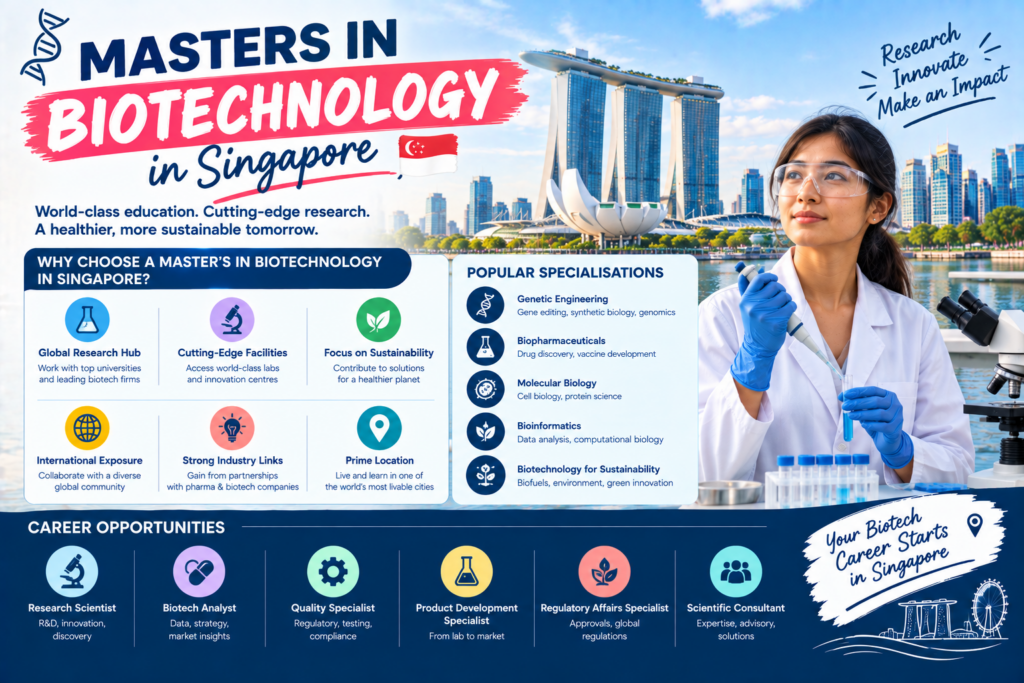
Singapore pairs two globally ranked universities with A*STAR’s research infrastructure and a biotech sector that is expanding by roughly 8% a year, according to Singapore’s Economic Development Board. If you’re weighing where the best place to study biotechnology in Asia is, Singapore’s case rests on a shorter, one-year coursework format compared to the two-year masters common in the UK or the US, and program design that leans on real industry problems rather than pure classroom theory. For Indian students, that means a faster, more affordable route into a research or industry biotechnology career without leaving Asia.
For a broader look at admissions, costs, and life on campus, see LeapScholar’s study in Singapore guide.

Choose your dream country
 UK
UK
 USA
USA
 Germany
 Australia
 Ireland
 Canada
 UAE
UAE
 France
 Sweden
 Italy
Italy
 Other
Other
When do you want to study abroad?
What's your highest level of education?
Have you completed Class 12th?
What was your Class 12 CGPA/percentage?
Are you a student or a parent/guardian?
What do you want to study?
Select your current city
How Leap will help you

Personalised University Shortlist

Express Applications with Quicker Admits

End-to-End Application Support
Best Universities for Masters in Biotechnology in Singapore
Two public universities offer verified, coursework-based programs relevant to Indian applicants researching universities in Singapore for masters in biotechnology. If you're comparing masters in biotechnology at universities in Singapore, the main difference will be your undergraduate background and whether you already have work experience.
| University | Program | Duration | Format |
| National University of Singapore (NUS) | MSc in Biotechnology | 1 year full-time (2 semesters) / 2 years part-time | Coursework + master's-level project |
| Nanyang Technological University (NTU) | MSc in Biomedical Data Science (Biotechnology track) | 1 year full-time (max 2 years) / 2 years part-time (max 4 years) | Coursework, run jointly with A*STAR |
NUS's MSc Biotechnology sits under the Department of Biological Sciences and lets students specialise in areas like genome editing, structural biology, urban farming biotechnology, or pharmaceutical biotechnology. NTU's program is broader by design: it is a joint NTU-A*STAR degree with three tracks (Bioinformatics, Biotechnology, Artificial Intelligence), aimed at students who want data-science skills layered onto a biology background.
Private institutions in Singapore also advertise biotechnology-related postgraduate courses. Verify current accreditation and course content directly with the institution before applying, since offerings change frequently.
For a wider view of Singapore's ranked institutions across disciplines, see top universities in Singapore for Indian students; for MS programs outside biotechnology, LeapScholar's MS in Singapore guide covers cost and eligibility across other specializations.
Counselor insight: If your undergraduate degree is in computer science or engineering rather than pure biology, NTU's Biomedical Data Science route is usually the better fit. NUS's MSc Biotechnology assumes a stronger life sciences base and expects 2 years of relevant work experience.
MSc Biotechnology in Singapore: Fees for Indian Students
All figures below use SGD 1 = Rs.75, the live rate in early September 2026. Exchange rates fluctuate daily, so please check the current rate before budgeting.
| Cost head | SGD | INR (approx.) |
| NUS MSc Biotechnology, full program fee (AY2026/27-2027/28) | 52,320 (incl. 9% GST) | Rs.39.2 lakh |
| NUS application fee | 100 | Rs.7,500 |
| Estimated annual cost of living (NUS estimate) | 8,243 | Rs.6.2 lakh |
NTU has not published a standalone tuition figure for the Biotechnology track of its MSc in Biomedical Data Science as of this writing.
Full-time NUS students pay the total fee across the first two semesters; part-time students spread it across four. On accepting an offer, NUS also charges a non-refundable acceptance fee of SGD 5,450 (Rs.4.1 lakh), which is later credited toward your tuition. Singapore Citizens and Permanent Residents get a 40% tuition subsidy that international students, including Indian applicants, are not eligible for.
For a full breakdown of tuition and living costs across Singapore, see LeapScholar's cost of studying in Singapore and cost of living in Singapore guides.
Eligibility for MS in Biotechnology in Singapore
- A bachelor's degree in a relevant discipline (life sciences, biotechnology, biochemistry, or a related engineering/science field).
- NUS also expects at least 2 years of relevant work experience for its MSc Biotechnology program.
- The minimum IELTS score required is 6.0 overall (or an equivalent TOEFL iBT score); some waivers may apply on a case-by-case basis depending on prior qualifications.
- You will also need to submit two academic referee reports, official transcripts, your degree certificate, and proof of financial support.
- NTU's Biotechnology track additionally welcomes computing and engineering graduates who want to add biotechnology or bioinformatics skills, alongside a good honors degree and relevant IELTS/TOEFL scores.
Intakes and Application Timeline
NUS runs its main intake in August, with an Early Admission Cycle and a Regular Admission Cycle for MSc Biotechnology:
- Early Admission Cycle (August 2027 intake): 16 May to 15 July 2026 - CLOSED.
- Regular Admission Cycle (August 2027 intake): 1 October 2026 to 15 March 2027. This is the current live window for Indian applicants targeting the 2027 intake.
If you're reading this message after 15 March 2027, the Regular Cycle has also closed for that intake; the next opportunity is the Early Admission Cycle for the August 2028 intake, which typically opens in mid-May 2027. Confirm exact dates on the NUS Graduate Admission System before you plan around them.
NTU's Biomedical Data Science program commences in August each year, with applications generally reviewed several months in advance.
Counselor insight: Indian applicants often lose weeks to slow referee responses. With the Early Admission Cycle already closed, line up your two academic referees and IELTS or TOEFL score now so you can submit early in the Regular Cycle window rather than close to the 15 March 2027 cutoff, when application volumes peak.
Once you accept an offer, start your Singapore study visa process well ahead of your intended intake; see LeapScholar's Singapore student visa fees breakdown for what to budget beyond tuition.
Scholarships for Masters in Biotechnology in Singapore
NUS MSc Biotechnology students in the AY2025/26 intake had access to scholarships such as the NUS Guangzhou Research Translation and Innovation Institute (NUS GRTII) Master's Scholarship; availability and eligibility criteria are reviewed each admission cycle, so check the current NUS scholarships page before you apply.
For a wider list of funding options across Singapore's universities, see LeapScholar's scholarships in Singapore guide.
What Can You Do With a Masters in Biotechnology in Singapore?
The most common question after "What is MS in biotechnology?" is what jobs it actually leads to. Singapore's biotech and pharma cluster, backed by roughly 52 active biotech companies and growing, hires MSc Biotechnology graduates into roles such as
- Research Associate / Research Officer (pharma, agri-tech, or industrial biotech)
- Scientist I/II (cell biology, molecular biology, bioprocess development)
- Quality Assurance and Regulatory Affairs Associate
- Bioinformatics or Biomedical Data Analyst (stronger fit for NTU's track)
- Clinical Trial Coordinator at a CRO (contract research organization)
According to Jobstreet's 2026 salary data, biotechnologists in Singapore earn between SGD 4,900 and SGD 6,300 a month (roughly Rs.44-56.7 lakh a year at Rs.75/SGD). Payscale and ERI both place average Research Scientist, Biotechnology salaries at around SGD 75,000-76,000 a year (about Rs.56.6 lakh) for more experienced profiles. Entry-level pay depends heavily on the employer type, with A*STAR, pharma multinationals, and CROs generally paying more than early-stage biotech start-ups.
See LeapScholar's average salary in Singapore for Indian students and job opportunities in Singapore guides for a broader view across sectors.
Is a Masters in Biotechnology in Singapore Worth It?
Is a masters in biotechnology worth it for an Indian applicant specifically targeting Singapore? For Indian students, the case comes down to three things: the program is one year shorter than most Western equivalents, tuition is competitive against comparable UK or US biotech masters, and Singapore's biotech hiring market is genuinely active rather than saturated with graduates chasing few openings. The trade-off is that NUS expects prior work experience, so this route suits candidates a few years into their career more than a student going straight from an undergraduate degree.
3 Takeaways on Masters in Biotechnology in Singapore
- NUS's MSc Biotechnology is the strongest verified option for Indian students but the budget is Rs.39.2 lakh in tuition plus the SGD 5,450 acceptance fee, and confirm you meet the 2-year work-experience requirement before applying.
- With Early Admission closed, apply in the Regular Cycle (1 October 2026 to 15 March 2027) for the August 2027 intake, and submit early in that window rather than near the deadline.
- Budget for the full international tuition figure. Singapore's 40% coursework subsidy applies only to Singapore Citizens and PRs, not to Indian applicants on a student pass.
Start your masters in biotechnology in Singapore application by getting your profile reviewed with a LeapScholar counselor.
Frequently Asked Questions About Masters in Biotechnology in Singapore
-
Is Singapore good for masters in biotechnology?
Singapore works well for biotechnology postgrads: A*STAR funds real research infrastructure, NUS and NTU rank globally, and around 52 active biotech firms hire locally. The 1-year format also gets you job-ready faster than most Western programs.
-
Is a master's degree worth it in Singapore?
For biotechnology specifically, it pays off if you already have relevant work experience and want industry-linked exposure rather than pure theory. Weigh the roughly Rs.45 lakh total spend against Singapore's genuinely active biotech hiring market before committing.
-
Is Singapore cheap for masters?
Singapore isn't a budget destination. NUS's MSc Biotechnology tuition alone runs Rs.39.2 lakh, plus an SGD 5,450 acceptance fee and around Rs.6.2 lakh a year in living costs.
-
How much do Masters in Biotechnology in Singapore cost?
NUS charges SGD 52,320 (about Rs.39.2 lakh) in tuition for its MSc Biotechnology, plus a one-time SGD 5,450 acceptance fee. On top of that, budget another Rs.6.2 lakh a year for living expenses.
-
Which job is best after an MSc in biotechnology?
There is no best role. The best role depends on your course. For lab-focused graduates, they should target opportunities such as Research Associate and Scientist I/II. For those who have taken a data science route such as the one offered by NTU, Bioinformatics Analyst posts pay highly.
-
What are the requirements for a masters in biotechnology in Singapore?
NUS requires a valid bachelor's degree, 2 years of relevant work experience, and an IELTS score of 6.0 or a comparable TOEFL. Also required are transcripts, two academic reference reports, and evidence of funding.
-
What biotechnology courses are available in Singapore?
NUS offers a specific MSc in Biotechnology, while NTU offers an MSc in Biomedical Data Science with a Biotechnology track that was established in collaboration with A*STAR. Private institutes also provide postgraduate courses related to biotechnology, so check their accreditation status before enrolling.
-
How hard is it to get into NUS Masters?
NUS graduate admissions are competitive with acceptance rates often quoted at 5-10% across programs. Any acceptance rate number is not as important as the work experience and IELTS cut-offs for MSc Biotechnology.







Have Questions? Get Guidance to reach your Dream University
Connect with India's finest counsellors and biggest study abroad community.
Get Guidance