
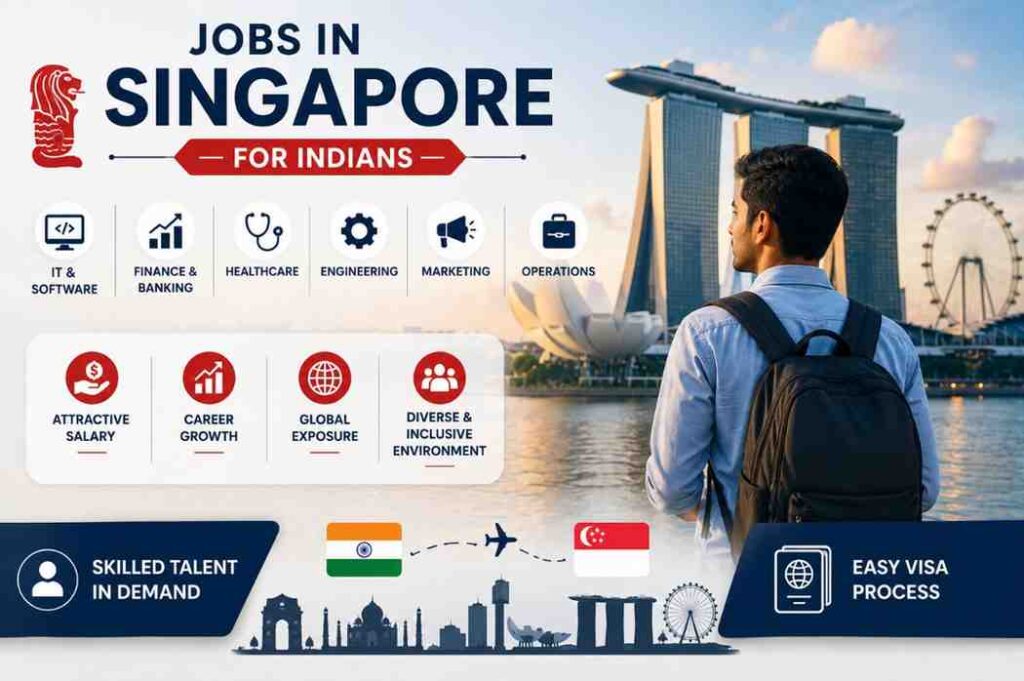
Quick Read
- EP threshold: Rs.4.19 lakh now, rising to Rs.4.49 lakh from 2027.
- S Pass minimum is Rs.2.47 lakh a month.
- MOM’s shortage list prioritizes AI and healthcare roles.
- Singapore has 203,300 Employment Pass holders currently.
- Around 6.5 to 7 lakh Indians work in Singapore.
Jobs in Singapore for Indians 2026-27: The Current Landscape
Singapore’s job market for Indians runs entirely on employer sponsorship, not points-based immigration. There is no equivalent of Canada’s Express Entry here. Every legal route into the workforce starts with a job offer, then a work pass application from that employer.
| Metric | Figure |
|---|---|
| Indians living and working in Singapore | 6.5-7 lakh |
| Employment Pass holders (all nationalities) | 203,300 (Dec 2025) |
| S Pass holders (all nationalities) | 178,900 (Dec 2025) |
| Total foreign workforce | 1.64 million (Dec 2025) |
| Job vacancies (all sectors) | 73,300 (March 2026) |
| Job vacancy-to-unemployed ratio | 1.46 |
Exchange rate: Rs.74.87 per SGD (locked for this session). Verify the current rate before finalizing your budget.
Counselor insight: Students often assume a strong resume alone gets them a Singapore job. It does not. Your employer must be willing to sponsor a work pass, and that pass must clear MOM’s salary and points thresholds before you can even start the visa process.

Choose your dream country
 UK
UK
 USA
USA
 Germany
 Australia
 Ireland
 Canada
 UAE
UAE
 France
 Sweden
 Italy
Italy
 Other
Other
When do you want to study abroad?
What's your highest level of education?
Have you completed Class 12th?
What was your Class 12 CGPA/percentage?
Are you a student or a parent/guardian?
What do you want to study?
Select your current city
How Leap will help you

Personalised University Shortlist

Express Applications with Quicker Admits

End-to-End Application Support
In-Demand Jobs in Singapore for indians
MOM's 2026 Shortage Occupation List spans seven industries and 29 named roles.
| Sector | Example Roles on the 2026 Shortage List |
|---|---|
| Infocomm Technology | AI scientists and engineers, cybersecurity specialists |
| Financial Services | Investment advisers, relationship managers for high-net-worth clients |
| Healthcare | Registered nurses, clinical psychologists, diagnostic radiographers, physiotherapists, occupational therapists |
| Green Economy | Carbon project managers, carbon traders, carbon verification specialists |
| Agritech | Alternative protein food application scientists, novel food biotechnologists |
| Maritime | Specialist maritime roles (sector-specific) |
Roles on this list are weighted more heavily in the COMPASS scoring framework, which can significantly improve an Indian applicant's approval odds even at the same salary level as a non-listed role.
If you are researching a related destination in the region for comparison, our guide on best countries for MBBS for Indian students covers where nursing and allied health qualifications are most transferable.
Average Salaries by Sector for Jobs in Singapore for Indians
Indian professionals in Singapore are concentrated in a handful of sectors, and pay within each varies far more by role and seniority than the single median figure above suggests. These ranges are compiled from industry salary surveys (Robert Half, Morgan McKinley, Michael Page), not MOM data, so treat them as market benchmarks rather than official figures.
| Sector | Role | Monthly Salary (SGD) | Monthly Salary (INR) |
|---|---|---|---|
| Information Technology | Software Engineer | S$5,500-13,000 | Rs.4.12-9.73 lakh |
| Information Technology | Data Scientist | S$6,000-12,000 | Rs.4.49-8.98 lakh |
| Information Technology | AI Engineer | S$8,000-15,000 | Rs.5.99-11.23 lakh |
| Financial Services | Financial Analyst | S$5,500-9,000 | Rs.4.12-6.74 lakh |
| Financial Services | Risk Manager | S$7,000-14,000 | Rs.5.24-10.48 lakh |
| Financial Services | Investment Manager | S$10,000-18,000+ | Rs.7.49-13.48 lakh+ |
| Healthcare | Registered Nurse | S$2,800-5,000 | Rs.2.10-3.74 lakh |
| Healthcare | Regulatory Affairs Manager | S$6,000-11,000 | Rs.4.49-8.24 lakh |
| Engineering | Civil/Mechanical/Electrical (mid-career) | S$8,500-13,500 | Rs.6.36-10.11 lakh |
Most finance-sector roles also carry a variable bonus of 1 to 6 months' salary on top of these base figures, while IT and engineering bonuses typically run 0.5 to 3 months.
Counselor insight: Notice that IT and finance ranges overlap heavily with the EP salary floor, while a fresh Registered Nurse's starting pay sits close to the S Pass floor rather than the EP floor. This is precisely why nursing applicants often enter on an S Pass first and move to an EP later, once their pay crosses the EP threshold with experience.
Jobs in Singapore for Indians with Good Salary
MOM's official median gross monthly income for full-time employed residents (Singapore Citizens and Permanent Residents) was Rs.4.32 lakh a month (S$5,775) as of mid-2025, the most recent government release. This figure covers residents broadly and is not specific to Indian EP or S Pass holders, whose actual pay depends heavily on sector, role, and negotiated package.
| Benchmark | Monthly (SGD) | Monthly (INR) |
|---|---|---|
| MOM median, all full-time employed residents (mid-2025) | S$5,775 | Rs.4.32 lakh |
| Fresh graduate median, all clusters (JAUGES 2025) | S$4,500 | Rs.3.37 lakh |
| Fresh graduate median, Info & Digital Technologies | S$5,500 | Rs.4.12 lakh |
| Fresh graduate median, Medicine (NUS/NTU) | S$6,500 | Rs.4.87 lakh |
For a fuller breakdown by role, see our dedicated guide on average salary in Singapore for Indian students, and factor in real living costs using our cost of living in Singapore guide before comparing any offer with your India salary.
Singapore Work Visa Types for Jobs in Singapore for Indians
Each row below has two things changing at once, so it's worth reading carefully. The two columns compare the salary floor today against the new, higher floor from January 1, 2027. Within each column, the salary floor also scales with the applicant's age, so the figure you need depends on your age when you apply.
| Pass Type | Who It's For | Current Minimum Salary | From 1 Jan 2027 |
|---|---|---|---|
| Employment Pass (EP) | Professionals, managers, executives | Rs.4.19 lakh/month (S$5,600), rising with age to Rs.8.01 lakh (S$10,700) at 45+ | Rs.4.49 lakh (S$6,000), rising to Rs.8.61 lakh (S$11,500) at 45+ |
| EP, Financial Services sector | Same, higher-paying sector | Rs.4.64 lakh/month (S$6,200), rising to Rs.8.83 lakh (S$11,800) at 45+ | Rs.4.94 lakh (S$6,600), rising to Rs.9.51 lakh (S$12,700) at 45+ |
| S Pass | Mid-skilled workers | Rs.2.47 lakh/month (S$3,300), rising with age to Rs.3.59 lakh (S$4,800) at 45+ | Rs.2.70 lakh (S$3,600), rising to Rs.3.82 lakh (S$5,100) at 45+ |
| Work Permit | Semi-skilled workers in specific sectors | No fixed minimum salary; governed by sector quota and employer levy | No change announced |
| Personalised Employment Pass (PEP) | High earners, greater job flexibility | Rs.16.85 lakh/month (S$22,500) to qualify | No change announced |
| ONE Pass (AI and Tech track) | Top AI/tech talent | Launches January 2027, replacing Tech.Pass | New track, details finalising |
Beyond the salary floor, every EP application must also clear the Complementarity Assessment Framework (COMPASS), a points-based system requiring 40 points across four core criteria plus two bonus categories. Candidates earning a fixed monthly salary of Rs.16.85 lakh (S$22,500) or more are automatically exempt from COMPASS.
Counselor insight: Meeting the salary threshold does not guarantee EP approval. MOM also weighs your employer's existing workforce diversity, your qualifications against the role, and whether the position was fairly advertised to local candidates on MyCareersFuture.sg for at least 14 days first.
Documents for Jobs in Singapore for Indians
| Document | Purpose | India-Specific Detail |
|---|---|---|
| Confirmed job offer letter | Mandatory before any work pass application | Employer, not the candidate, submits the EP/S Pass application |
| Degree certificates and transcripts | Qualification verification for COMPASS scoring | Attested copies from your university are typically required |
| Passport (valid 6+ months) | Work pass issuance | Standard Indian passport validity rules apply |
| MOM Self-Assessment Tool result | Pre-check EP/S Pass eligibility before applying | Free online tool; run this before signing any offer |
| Educational Testing (if entering via study route) | Postgraduate admission requirement | IELTS, TOEFL, PTE, or Duolingo depending on the university |
| CPF and tax registration (post-arrival) | Payroll setup once employed | Foreign workers on EP/S Pass are not CPF members; income tax still applies |
For a broader look at university-side costs if you're combining study and work, see our guide on scholarships in Singapore for international students.
Counselor insight: The single biggest document delay I see is when students assume their employer will handle the MOM Self-Assessment Tool check. Run it yourself before you accept an offer. It takes minutes and can save you from accepting a role that will not clear Stage 1 eligibility.
Tips to Find Good Jobs in Singapore for Indians
| Tip | Why It Helps |
|---|---|
| Apply directly through MyCareersFuture.sg | This is MOM's own job portal, and employers hiring foreign talent must advertise here first under the Fair Consideration Framework, so genuinely sponsorship-open roles show up here |
| Run MOM's Self-Assessment Tool before applying widely | Filters out roles that will never clear EP or S Pass eligibility, saving weeks of applications to offers that can't be converted into a visa |
| Target Shortage Occupation List roles first | These carry extra COMPASS points, improving your odds at the same salary level as a non-listed role |
| Only use MOM-licensed employment agencies | Verify any recruiter through MOM's EA Directory before paying any fee; unlicensed agents have taken deposits from Indian applicants without delivering a real job |
| Tailor your resume to Singapore norms | Keep it to 1-2 pages, drop the photo, and quantify achievements; Singapore hiring managers read far more resumes per role than most Indian recruiters and skim fast |
| Network through Indian professional bodies | The Singapore Indian Chamber of Commerce and Industry (SICCI) and alumni groups of Indians already working in Singapore surface referral-based openings that never get advertised |
| Research a company's sponsorship history before applying | Companies that already employ EP or S Pass holders are far likelier to sponsor a new hire than one with no foreign hiring track record |
Counselor insight: The biggest time-waster I see is students mass-applying to any Singapore job posting they find on LinkedIn without checking whether the salary band could ever clear an EP. Running MOM's Self-Assessment Tool against a role's advertised salary range first, before you apply, cuts out most of the dead-end applications.
3 Takeaways Jobs in Singapore for Indians
- Every route into Singapore's job market starts with an employer-sponsored offer, not a personal visa application, so your job search and your visa eligibility need to be planned together, not sequentially.
- Salary thresholds are rising from January 2027: the EP floor moves to Rs.4.49 lakh a month and the S Pass floor to Rs.2.70 lakh, so factor the higher 2027 numbers into any offer you're negotiating for a 2027-28 start.
- Roles on MOM's 2026 Shortage Occupation List, particularly in AI, cybersecurity, and healthcare, carry real COMPASS scoring advantages, so target these sectors first if your skills genuinely fit.
Verified by: LeapScholar's Singapore counseling team, with hands-on experience guiding Indian students and professionals through Singapore's study and work-visa pathways.
Have questions about jobs in Singapore for Indians? Book a free session with a LeapScholar counselor.
Frequently Asked Questions About Jobs in Singapore for Indians
-
How do I get jobs in Singapore for Indians?
You'll need to land a job offer first, since work passes here are always employer-sponsored, not something you apply for on your own. Once an employer commits, run MOM's Self-Assessment Tool together to confirm you'll actually clear eligibility, and then your employer files the Employment Pass or S Pass application through MOM's official portal on your behalf.
-
What is the Employment Pass minimum salary for Indians?
Right now, it's Rs.4.19 lakh a month (S$5,600) if you're 23 or younger, and that floor climbs steadily as you get older. Come January 2027, it rises to Rs.4.49 lakh (S$6,000). If you're eyeing a financial services role, expect a noticeably higher bar at every age band.
-
What is the difference between an Employment Pass, S Pass, and Work Permit?
Think of it as a ladder based on skill level and pay. The Employment Pass sits at the top for professionals, managers, and executives clearing a salary floor. The S Pass covers mid-skilled workers on a lower floor. The Work Permit has no fixed salary requirement at all, but it's capped by employer quotas and levies instead. Your role and salary offer decide which one actually applies to you.
-
Can freshers get a job in Singapore from India?
It's tougher than it looks on paper, since freshers still need to clear the same EP salary threshold as anyone else, and that's a real stretch without Singapore-specific experience behind you. This is exactly why so many Indian freshers take the Master's-first route instead: enter on a Student Pass, build local experience, then convert to an EP or S Pass once you've got an offer in hand.
-
Which jobs are in demand in Singapore for Indians?
MOM's 2026 Shortage Occupation List points to AI scientists and engineers, cybersecurity specialists, registered nurses, clinical psychologists, and a handful of financial services roles as current priority hires. If your skills genuinely fit one of these, you're not just filling a gap; you're picking up real COMPASS scoring points over an equally paid role that isn't on the list.
-
Is it easy for Indians to get a job in Singapore?
In the end, it depends on whether your qualifications match a genuine skills gap that employers can't fill locally, not on how polished your resume looks. Singapore's system doesn't hand out guarantees. What really matters is a Shortage Occupation List role, solid academic results, and salary expectations that match MOM's thresholds from the start rather than after a rejection.
-
Do I need a job offer before applying for a Singapore work visa?
Without exception, yes. Singapore has no jobseeker visa and no points-based immigration route like Canada's, so there's simply no way around a confirmed offer. Every Employment Pass, S Pass, and Work Permit application has to be submitted by a Singapore-based employer on your behalf, never by you directly.
-
What happens if my Employment Pass application is rejected?
MOM won't provide an exact COMPASS score breakdown, but rejections usually result from a salary-role mismatch or gaps in the employer's own workforce diversity. Your employer can often go back and reapply with a tweaked job title or salary, or pivot to an S Pass if your profile genuinely fits a mid-skilled role better.
-
What is a good salary in Singapore for Indians in 2026-27?
MOM's latest figure puts the median gross monthly income for full-time employed residents at Rs.4.32 lakh (S$5,775), as of mid-2025. If you're comparing yourself to fresh graduates specifically, Info and Digital Tech grads earned Rs.4.12 lakh (S$5,500), while medicine graduates earned the highest at Rs.4.87 lakh (S$6,500), according to the 2025 Joint Autonomous Universities Graduate Employment Survey.











Have Questions? Get Guidance to reach your Dream University
Connect with India's finest counsellors and biggest study abroad community.
Get Guidance