
Quick Read
- Three original practice items here are fictional, not official OET samples.
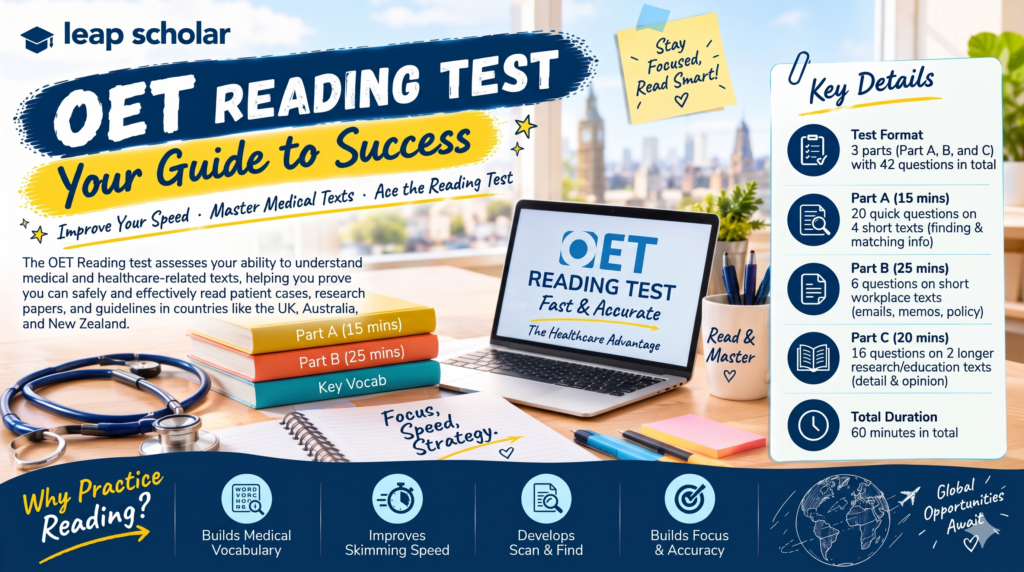
- OET Reading is 42 questions in 60 minutes, split into three parts.
- For Indian nurses, the NMC’s Reading bar is Grade B (350).
- Every OET sitting costs INR 39,300 (AUD 587), Reading included.
Is the OET reading test hard if your English is already good at work?
The OET reading test is 42 questions in 60 minutes, and it tests your English, not your medical knowledge.
OET (the Occupational English Test) is an English test for health professionals. A sub-test is one of its four parts: Listening, Reading, Writing and Speaking.

Choose your dream country
 UK
 USA
 Germany
 Australia
 Ireland
 Canada
 UAE
 France
 Sweden
 Italy
 Other
When do you want to study abroad?
What's your highest level of education?
Have you completed Class 12th?
What was your Class 12 CGPA/percentage?
Are you a student or a parent/guardian?
What do you want to study?
Select your current city
How Leap will help you

Personalised University Shortlist

Express Applications with Quicker Admits

End-to-End Application Support
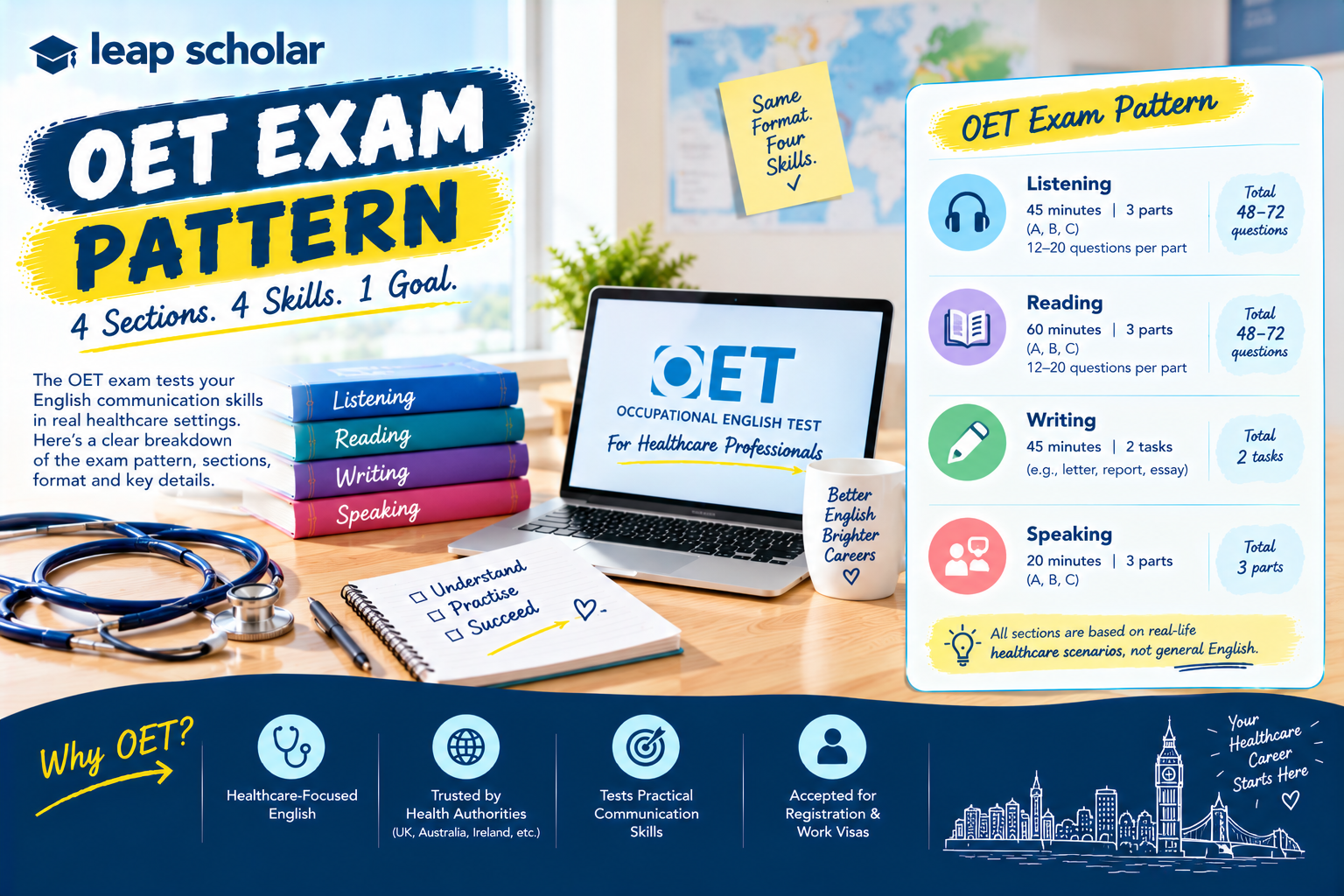
Our OET exam guide covers fees, dates, and the whole test pattern, so this page stays with Reading.
Worried it's hard? Good English at work helps, but the OET reading test also tests exact words and spelling. Reading is the same paper for every profession, so doctors on the doctor route to the UK sit the same Reading sub-test as nurses. If your goal is NHS roles, your English score is one requirement, so it pays to understand how Reading is marked.
What this page gives you:
- The three parts: Part A, Part B, and Part C, are the three sections of Reading, each with its own marks (points).
- The marking rules: spelling, exact word form, and abbreviations.
- Three fictional practice items: each with an answer key.
OET reading test at a glance: three parts, 42 questions, 60 minutes
The OET reading test has 42 marks in total, and 20 of them sit in Part A. Marks are the points you earn, one for each correct answer.
Read the table from top to bottom as the shape of your 60 minutes.
| Item | Detail |
| Duration | 60 minutes in total |
| Parts | Three: Part A, Part B, and Part C |
| Questions | 42 in total, one mark each |
| Part A | 20 marks; four texts; collected after 15 minutes |
| Part B | 6 marks |
| Part C | 16 marks |
| Who sits it | Every profession, same paper |
What this means for you: Part A is nearly half the marks, so its 15 minutes matter most. Part A is what OET calls the expeditious reading task, which means reading fast to locate specific information.
Sources: OET Reading sub-test page, OET test overview
How is the OET reading test marked and scored?
Each correct answer in the OET reading test earns 1 mark, and your score out of 42 is converted to OET's 500 scale.
Your scale score is the result from 0 to 500 in ten-point steps, with a letter grade from A (highest) to E (lowest).
Four rules decide your marks:
- One mark per correct answer: 42 marks in all. OET publishes no table that turns marks into a scale score.
- Spelling counts: a misspelled answer receives no mark. American and British spellings are both accepted, and Reading treats misspellings differently from Listening.
- Exact words in Part A: use exactly the same form of the word or short phrase as the texts. An abbreviation (a short form like "BP" for a longer term) is not accepted unless it appears in the texts.
- Grade B: Grade B is the letter grade for a scale score of 350. People awarded it typically have at least 30 marks, but OET adjusts the grade boundaries slightly for each test, so the marks needed vary.
A regulator is the official body that registers nurses or doctors in a country and decides which English proof it accepts. If you plan nursing in the UK, the NMC (Nursing and Midwifery Council) asks for B (350) in Reading; for nursing in Australia, Ahpra (the Australian Health Practitioner Regulation Agency) asks for 360 on tests taken on or after 23 April 2026.
My insight: The number to watch is 20, not 30: the marks for Grade B vary by test, so protect the 20 Part A marks first, because spelling and word form are the cheapest marks to lose.
Sources: OET results and scoring, NMC OET page, Ahpra accepted tests
Part A of the OET reading test: 15 minutes of fast, exact reading
Part A of the OET reading test is worth 20 marks, and its materials are collected after 15 minutes.
It uses four texts. Once Part A is collected, you can't check it again, and there's no extra time at the end. On paper, you write your answers in the spaces in the question booklet, which is the printed booklet of questions.
My practice advice:
- Question first: read the question, then scan the four texts for the word it needs.
- Copy the exact form: plural stays plural; a phrase stays a phrase.
- Only in the space: answers written elsewhere in the booklet aren't marked.
- Keep moving: don't spend a minute on one gap while others sit empty.
Parts B and C of the OET reading test: shading the right answer
Part B of the OET reading test is worth 6 marks and Part C 16 marks, and on paper you shade the circle next to your answer.
Answers written anywhere else in the booklet aren't marked. OET's Reading page doesn't list the text types, option counts, or text lengths for Parts B and C, so this guide doesn't guess them; OET's free sample tests show the real layout. My practice advice:
- Evidence over belief: choose the option the text supports, not the one you believe is true at work.
- Pace Part C: at 16 marks, it needs a reasonable amount of the remaining time.
OET reading test on paper, computer, or OET@Home: what changes?
Every mode costs INR 39,300 (AUD 587), and OET on Paper and OET on Computer follow the same structure, content, length, and marking.
OET@Home is the remote version on your computer. The table shows three ways to sit Reading.
| Mode | Where you take Reading | Fee |
| Paper | At a test venue, on paper | INR 39,300 (AUD 587) |
| Computer | At an approved venue, digitally on screen | INR 39,300 (AUD 587) |
| OET@Home | Online, on your own computer | INR 39,300 (AUD 587) |
The fee is converted at 1 AUD = INR 66.93 as of October 2026 and will shift with the exchange rate, so check the latest rate before paying.
What this fee means for you: sit for the OET reading test in the mode you read best in, paper or screen. Not every regulator accepts OET@Home, so check yours first.
Sources: OET test on paper page, OET test on computer page, OET@Home page
OET reading test sample questions, Part A style: a fictional exact-words item
This first OET reading test practice item has three short notes and four questions, each answered with words copied from the notes.
It practices copying the exact word or short phrase a text gives; the real test's layout may differ, so use the free OET sample tests to see it.
This exercise is a fictional practice item written for this guide, not an official OET sample. It is a reading exercise, not clinical guidance.
Note 1 (notice board): Staff training day at Sample Clinic starts at 9:30 on Thursday in Rooms 2 and 3 on the first floor. Sign in at the front desk before you go up.
Note 2 (email): Bring your staff badge, a pen, and a packed lunch. The car park behind the clinic is closed for repairs, so use the side street.
Note 3 (text message): Change of plan: the afternoon session will now be in the library, not the meeting room. Coffee is served in reception at 11:00.
Questions
- The training starts in __________ 2 and 3.
- On which floor are the training rooms? (Do not answer with a short form.)
- Where will the afternoon session be held?
- Apart from a badge and a pen, what should staff bring?
Answer key and why (practice advice, not a grade):
- Rooms: the note prints the plural, so "Room" wouldn't match the text.
- first floor: the note spells it in full, and "1st" doesn't appear in the texts.
- library: Note 3 changes the plan, so "meeting room" is out of date.
- packed lunch: copy the item as printed; "food" is your word, not the note's.
My insight: Copy the word exactly as the note prints it, even if your phrase sounds better; a better word is still a wrong answer here.
OET reading test sample questions, Part B and C style: two fictional items
These two OET reading test practice items ask one multiple-choice question each.
Item 2: a fictional workplace email
It practices choosing the option the text supports; the real test's layout may differ, so use the official sample tests to see it.
This is a fictional practice item written for this guide, not an official OET sample.
From: Ward Manager, Sample Ward. To: Ward team. From next week, the weekly supplies check moves from Monday to Wednesday, because the new rota leaves Mondays short of staff. Whoever is on the early shift on Wednesday should complete the checklist and return it to the office by noon. Thank you.
What is the main purpose of the email?
- A. To explain why the ward rota has changed
- B. To tell the team the new day for the supplies check and who does it
- C. To ask staff to cover extra Monday shifts
Answer key: B. Why (practice advice): the email's request is about the new day and who completes the check; the rota is only the reason given.
Item 3: a fictional short passage
It practices reading for the writer's view; the real test's layout may differ, so use the official sample tests to see it.
Fictional practice item written for this guide, not an official OET sample.
A small clinic recently replaced its phone-call reminders with text messages. Fewer people missed appointments. Not everyone gained, though. Some older patients rarely read texts, and a few missed visits they would once have kept. The clinic's response was sensible rather than dramatic: texts became the default, but staff still call the small group who asked for a call. A cheaper system, the writer suggests, works best when it keeps a door open.
What is the writer's main point?
- A. Text reminders have solved the problem of missed appointments.
- B. Phone calls work better than texts for every patient.
- C. Texts helped, and keeping some calls was a fair fix for those they missed.
- D. Older patients should learn to read text messages.
Answer key: C. Why (practice advice): C covers both the benefit and the limit, while A and B each overstate one side, and D is never said.
My insight: Choose the option the text supports, not the one you believe is true at work; the test measures language, and the passage is your only evidence.
Which mistakes cost marks in the OET reading test?
Five habits cost marks in the OET reading test, and four break a written OET rule:
- Misspelling a word from the text: a misspelled answer earns no mark.
- Changing the word form in Part A: "room" for "rooms" doesn't match.
- Using an abbreviation: not accepted unless it appears in the texts.
- Writing outside the spaces: answers elsewhere in the booklet aren't marked.
- Stalling on one Part A gap: practice advice, since Part A is collected at 15 minutes.
How do you prepare and manage time for the OET reading test?
OET suggests one practice test every 2 to 3 weeks, with work on your language skills in between.
My practice advice for the OET reading test:
- Official tests first: use OET's free sample tests for your mode, paper or computer.
- Time Part A at 15 minutes: stop when the timer ends, as the real collection does.
- Skip unofficial papers: OET warns that material on social media may misrepresent the test.
- Read healthcare English daily: leaflets and workplace notices build vocabulary.
A short OET vs IELTS comparison helps if your regulator accepts both tests. If you also sit for IELTS, IELTS Academic Reading is a different test with different tasks, so keep the two practice routines apart.
What if you run out of time, score low, or get mixed results in the OET reading test?
A low OET reading test result has two official routes: a remark within 72 hours of your results or a retake.
A remark means asking OET to mark one or more sub-tests again. Three situations:
- Time runs out: Part A is collected at 15 minutes, with nothing to fix later. In Parts B and C, shade an answer for every question left (practice advice).
- Your score is low: check your regulator's Reading number first, such as B (350) at the NMC. Ask for a remark if you think the score is wrong; a retake means booking another sitting.
- Mixed results: say Reading is strong and Writing is low. Your regulator decides whether two sittings can combine; the NMC accepts two sittings whose test dates are within 12 months of each other.
If a low score keeps repeating, ask your counselor which routes need an English test at all.
Who to contact after an OET reading test result: OET for a remark, your regulator for its score, and your counselor for the next step.
My insight: When time is nearly gone, put an answer in every remaining space or circle; a blank can't earn a mark.
This is general information, not registration or medical advice; check your regulator's page and oet.com before you decide.
Sources: NMC accepted tests
3 Takeaways on OET Reading Test
- Know the split: 42 marks in 60 minutes, and Part A holds 20 of them.
- Guard Part A: exact word form and correct spelling decide those 20 marks.
- Practice on official tests: take OET's free sample tests once every 2 to 3 weeks.
Talk to a Leap Scholar counselor to plan your OET preparation around your regulator's requirements.
Frequently Asked Questions About OET Reading Test
-
How many questions and minutes are in the OET reading test?
The OET reading test has 42 questions in 60 minutes, split into three parts. Part A has 20 marks and is collected after 15 minutes, Part B has 6, and Part C has 16. Every correct answer earns one mark, so there are 42 marks in all.
-
How are marks split across the three Reading parts?
OET splits the 42 Reading marks as Part A 20, Part B 6, and Part C 16. With one mark per correct answer, the question counts match those numbers. Part A alone is nearly half the total, which is why its 15-minute limit matters so much.
-
What Reading score do nurses need?
Your regulator sets the number. The NMC asks for a B (350) in Reading for UK nursing, and Ahpra asks for 360 on tests taken on or after 23 April 2026. Other regulators publish their own, so read your regulator's English page before you book a test.
-
How many marks do you need for Grade B in the OET reading test?
People awarded Grade B, a scale score of 350, typically have at least 30 of the 42 marks. OET adjusts the grade boundaries slightly for each OET reading test, so the exact number varies, and OET publishes no conversion table from marks to scale scores.
-
Do spelling mistakes lose marks in the OET reading test?
A misspelled answer earns no mark in Reading, even when the meaning is clear. American and British spellings are both accepted, so either variant counts. Reading treats misspellings differently from Listening, so copy words from the texts letter by letter.
-
Can I use abbreviations or change the word form in Part A?
Part A answers must use exactly the same form of the word or short phrase as the four texts. Abbreviations aren't accepted unless they appear in the texts. Writing "room" when the text says "rooms," or "1st" for "first," can cost you the mark.
-
Is the OET reading test different on computer?
OET on Computer follows the same structure, content, length, and marking as OET on Paper. The difference is how you read: on screen at an approved venue instead of on paper. OET@Home is taken online on your own computer, but not every regulator accepts it.
-
Where can I find free OET reading practice?
OET offers free official sample tests for paper and for computer or OET@Home and suggests one every 2 to 3 weeks. The three items on this page are fictional practice, not official samples. OET warns that unofficial material on social media may misrepresent the test.












Have Questions? Get Guidance to reach your Dream University
Connect with India's finest counsellors and biggest study abroad community.
Get Guidance