

Quick Read
- OET exam difficulty is judged against your regulator’s minimum sub-test scores.
- In OET’s 2025 data, Indian-nationality candidates averaged 313 in Reading.
- OET’s own table places Grade B (350) near IELTS 7.0.
- Reading and Listening medians were C+ for Indian-nationality candidates in 2025.
Is the OET exam tough, or just unfamiliar?
The Occupational English Test (OET) for health professionals is as tough as your regulator’s minimums make it, and each of its four parts gets its own score. The common mistake is asking “is the OET exam tough?” as if OET exam difficulty were the same for every nurse and doctor.
Our OET exam guide covers fees, dates, and the test pattern, so this page sticks to how hard the test is.

Choose your dream country
 UK
 USA
 Germany
 Australia
 Ireland
 Canada
 UAE
 France
 Sweden
 Italy
 Other
When do you want to study abroad?
What's your highest level of education?
Have you completed Class 12th?
What was your Class 12 CGPA/percentage?
Are you a student or a parent/guardian?
What do you want to study?
Select your current city
How Leap will help you

Personalised University Shortlist

Express Applications with Quicker Admits

End-to-End Application Support
A sub-test is one of those four parts: Listening, Reading, Writing and Speaking. Your regulator is the official body that registers nurses or doctors in a country, and it decides the minimum it accepts in each sub-test. So the OET exam difficulty is really the gap between your English today and that number.
A recognized organization is OET's name for any regulator, employer, or authority that accepts its results. OET doesn't publish a pass rate. It does publish 2025 test statistics with average scores by nationality and profession, and this page uses them below.
My verdict: OET exam difficulty is real, but you can measure it before you pay for a sitting, which is one attempt at the whole test on one test date.
What does OET exam difficulty mean when your regulator sets the score?
A scaled score is the number of OET reports for each sub-test, from 0 to 500 in ten-point steps, such as 350, 360, and 370. Each score maps to a grade, which is a letter from A (highest) to E (lowest). Grade B starts at 350, and C+ covers 300 to 340.
OET also publishes a table with IELTS benchmarking. IELTS is the other English test many regulators accept. In OET's table, 350 to 390 (the lower part of Grade B) sits next to IELTS 7.0, and C+ (300 to 340) sits next to IELTS 6.5. It's OET's comparison, not a rule every regulator applies.
In Listening and Reading, each of the 42 questions earns 1 mark, and Grade B typically needs at least 30 marks. OET adjusts grade boundaries slightly for each test.
The NMC (Nursing and Midwifery Council) is the UK nursing register, the NMBI is Ireland's nursing board, and Ahpra is the Australian agency that registers health workers with national boards. Each row is one country:
| Regulator | Listening | Reading | Writing | Speaking |
| NMC (UK) | 350 (B) | 350 (B) | 300 (C+) | 350 (B) |
| NMBI (Ireland) | 350 | 350 | 300 | 350 |
| Ahpra (Australia, tests on or after 23 April 2026) | 350 | 360 | 350 | 360 |
| Nursing Council of New Zealand | 350 | 350 | 300 | 350 |
Writing 300 meets the NMC, so it works if you plan on nursing in the UK. The same score falls short for nursing in Australia, where Ahpra wants 350 in Writing. Your country's row shows your actual OET exam difficulty.
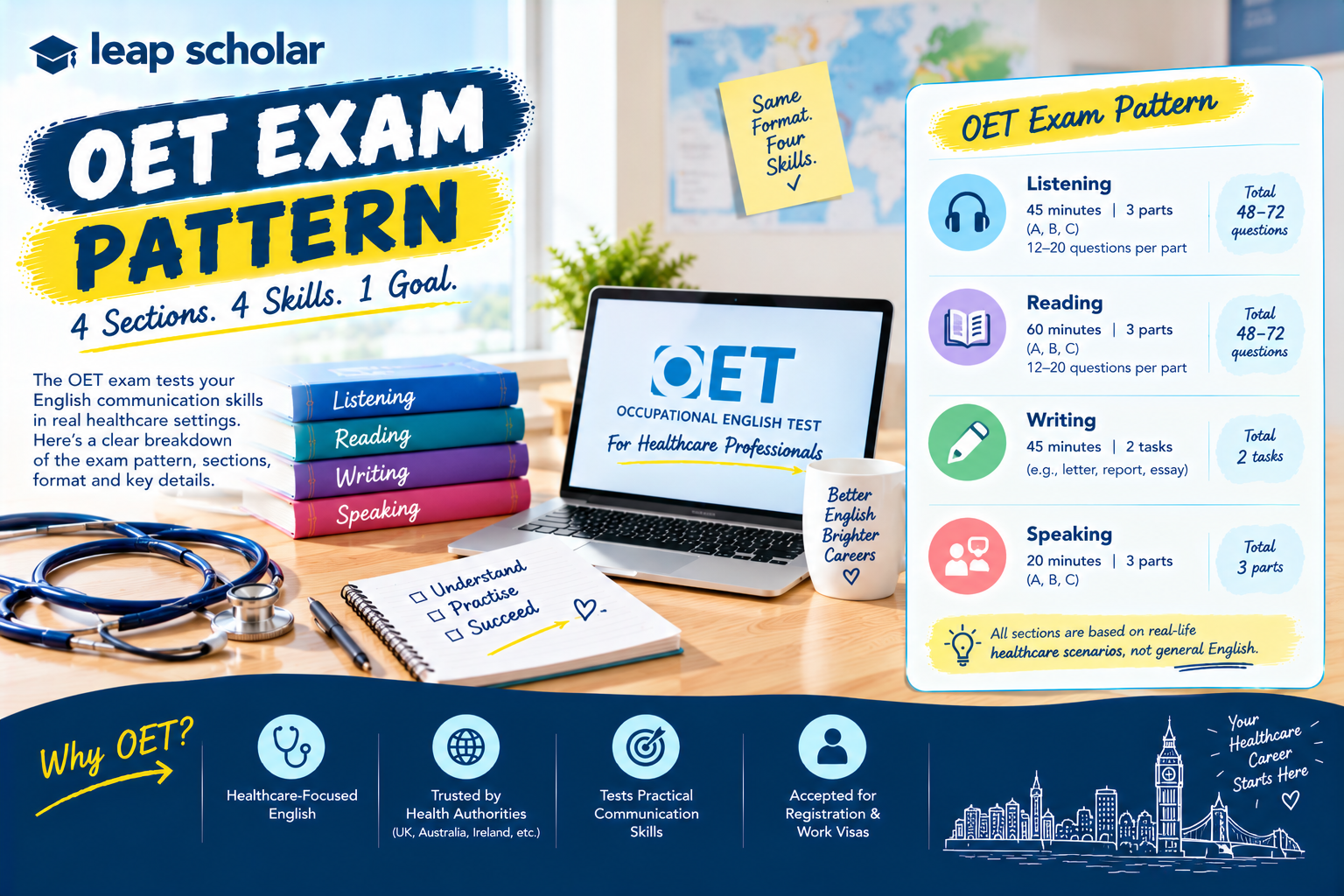
What does each sub-test ask, and how long does it run?
OET tests English, not medical knowledge: Listening and Reading are the same for every profession, while Writing and Speaking are set for your own profession.
Read the table as a time budget, because the clock is a big part of OET exam difficulty:
| Sub-test | Length | What you do | Same for every profession? |
| Listening | About 40 minutes | 42 questions in three parts, each part heard once | Yes |
| Reading | 60 minutes | 42 questions in three parts | Yes |
| Writing | 45 minutes (5 reading, 40 writing) | One formal letter of 180 to 200 words | No, set for your profession |
| Speaking | About 20 minutes | Two 5-minute role-plays, recorded and marked by two assessors | No, set for your profession |
Each subtest is scored on its own, so a strong Speaking score can't rescue a weak Reading score. OET exam difficulty is four separate questions, not one.
OET is an English test, not a licensing exam, so doctors heading to the UK also face the PLAB exam, which is the UK's knowledge and skills test for doctors. Nurses aiming at North America sit for the NCLEX exam, which is a licensing exam and a separate step from any English test. Keep the OET exam difficulty question apart from those.
Which sub-test shows the biggest OET exam difficulty in the 2025 data?
OET's 2025 test statistics give average scores, not pass rates, and Reading had the lowest average for Indian-nationality candidates at 313. OET does not publish a ranking of the hardest sub-test.
A mean is the average of everyone's scores in a group, so it neither indicates a pass mark nor predicts your result. The median grade is the middle grade when a group is put in order, and the mode grade is the most common one. Nationality here is self-reported, which means candidates typed it in themselves, and OET says it may not reflect language proficiency. Every figure below is from 2025, for groups of 100 or more candidates.
The NMC column is the UK minimum for nurses, so compare it with the Nursing mean only, not the Medicine mean:
| Sub-test | Indian nationality mean (2025) | Nursing mean, all nationalities (2025) | Medicine mean, all nationalities (2025) | NMC minimum (nurses) |
| Listening | 322 | 313 | 377 | 350 |
| Reading | 313 | 303 | 375 | 350 |
| Writing | 343 | 334 | 349 | 300 |
| Speaking | 370 | 365 | 385 | 350 |
What this score means for your OET exam difficulty:
- Reading and Listening: the Indian-nationality median grade was C+ in both, and the most common Reading grade was C.
- Writing: the Indian mean of 343 sits under 350, yet the Indian median grade was B, so the middle candidate still reached B.
- Writing across nationalities: means ranged only from 318 to 354, a narrower spread than in Reading or Listening.
- Speaking: means ranged from 355 to 398 across nationality groups, with the Indian mean at 370.
The Indian column covers every profession, as OET does not provide a split by profession.
My insight: A common mistake is averaging your four mock scores. Compare each sub-test with your regulator's number instead, because the one sub-test under the line decides your result, not the average.
Why do Writing and Speaking add to OET exam difficulty?
Writing and Speaking are marked against set criteria, six for Writing and two groups for Speaking, so fluent English alone may not reach Grade B. The trap is thinking you can wing a role-play because you talk to patients every day.
- Writing task: one formal letter on a matter from your profession, built from case notes, which are the patient notes you turn into the letter.
- Writing criteria: Purpose, Content, Conciseness and Clarity, Genre and Style, Organization and Layout, and Language; to get Grade B, you need 2 of 3 for Purpose and 5 of 7 for the rest.
- Word range: 180 to 200 words, with no automatic penalty for going over or under.
- Speaking task: a role-play is a task where you act as the health professional talking to a patient, and you do two.
- Speaking criteria: four Linguistic criteria, each out of 6, and five Clinical Communication categories, each out of 3; Grade B is mostly 5 of 6 and 2 of 3.
- Patients: role-plays may include anxious or angry patients, and there's no penalty for not finishing every element on the role card.
Practice advice: write timed letters and record your role-plays, because OET exam difficulty in these two sub-tests drops with trained skill.
Is OET exam difficulty higher than IELTS?
OET publishes no ranking of OET exam difficulty against IELTS, and neither does this page. The myth that one test is simply "easier" skips the only number that matters: your regulator's.
IELTS Academic is the version of IELTS the NMC accepts alongside OET, and the NMC doesn't let you combine an OET result with an IELTS one. What the official pages do say about OET exam difficulty:
- Same paper for everyone: OET Listening and Reading are common to all professions.
- Your own profession: OET Writing and Speaking use tasks from your field.
Practice advice: take one timed OET sample and one timed IELTS Academic section, then compare your weakest sub-test in each with your regulator's line. For you, the lower OET exam difficulty is wherever that weakest score sits closer to the number. A longer OET vs IELTS comparison helps if your regulator accepts both tests.
What adds to OET exam difficulty for Indian candidates?
Nothing on oet.com says Indian candidates face a different test, yet OET's 2025 Indian-nationality averages sat below 350 in both Reading and Listening. The rest of this section is my practice advice, not data:
- Accents: OET lists Australian, British, and American as the main Listening accents, with New Zealand, Irish, Canadian, and South African also used.
- Reading speed: Part A is the first part of each paper, and in Reading its materials are collected after 15 minutes.
- Letters: your hospital job may not have trained you to write formal clinical letters.
- Emotional patients: role-plays with an anxious or frustrated patient need calm, simple English.
If you're on the doctor route to the UK, you sit the same Listening and Reading papers as nurses, with Writing and Speaking set for medicine. If your goal is NHS roles (the NHS is the UK's National Health Service), start with Reading and Listening, where the 2025 Indian-nationality averages ran lowest.
Other exams also compete for your study hours. If you're a medical graduate planning to practice in India first, the FMGE exam, which is India's licensing test for foreign medical graduates, adds to the OET exam difficulty simply by eating your study time.
How do you judge OET exam difficulty for yourself before booking?
OET offers free official sample tests, and it says that a sample taken in test conditions shows your progress toward the grade you need. Guessing your level based on how you feel at work is a classic mistake.
- Write down your numbers: name your regulator and copy its four minimums from the table above.
- Sit an official sample: take OET's free sample tests in test conditions, timed and in one go.
- Mark Listening and Reading: compare your marks out of 42 with the typical 30 for Grade B.
- Get Writing and Speaking marked: self-marking against those criteria is unreliable, so ask a trained assessor.
- Repeat on OET's cadence: OET recommends one practice test every 2 to 3 weeks, with work on your errors in between.
- Book on two results: book when every sub-test reaches your regulator's number on two timed attempts.
OET warns that unofficial social media material may misrepresent the test, so measure OET exam difficulty on official samples. If you plan an MSc nursing in the UK, ask early which pieces of English evidence your university and the NMC will each accept.
My insight: One lucky mock is not a trend. Two timed results at or above the number in every sub-test are your booking signal; anything less is a guess with a fee attached.
How long does OET preparation take?
OET publishes no standard preparation time, so the real answer depends on the gap between your mock scores and your regulator's numbers. That gap is where OET exam difficulty lives, and it sets your timeline:
- At the number in every sub-test: you need only format practice, and then you can book.
- One sub-test under the number: work on that sub-test, then retest with an official sample test.
- Several sub-tests under the number: build your general English first and book later.
Booking early to "force" yourself is an expensive kind of motivation, since a retake means paying the full fee of INR 39,300 (AUD 587) again. Measure your OET exam difficulty first, then pay.
The fee is converted at 1 AUD = INR 66.93 as of October 2026; the rate moves, so recheck it before you pay for a sitting.
What if your OET score falls below your regulator's grade?
A result that is one sub-test short of your regulator's number has a clear next step, and that step depends on your regulator's rules. Combining scores means using results from two sittings to reach the minimums, where your regulator allows it.
- NMC (UK): you can combine two OET sitings taken within 12 months.
- Ahpra (Australia): up to two sittings within 12 months can be combined.
- NMBI (Ireland): all four scores must come from one result, with no combining.
- Nursing Council of New Zealand: your scores must fall within 12 months of your first sitting.
- Close to the line: a remark is a second marking of one or more sub-tests, and you can request it within 72 hours of getting your results.
- The IELTS route: only if your regulator accepts it; the NMC takes IELTS Academic but won't mix it with OET.
- Who to contact: OET support for bookings and remarks, your regulator for score rules, and your counselor for the plan.
If you switch to IELTS, check IELTS score validity first, because a result that lapses before you apply costs a second sitting. A low score at least turns OET exam difficulty into a measured gap.
This is general information, not legal or registration advice; check your regulator's page before you decide.
My insight: Read your regulator's combining rule before you pay for another full sitting. Under the NMC or Ahpra, a second sitting within 12 months can count alongside the first, while the NMBI requires all four scores from one sitting.
3 Takeaways on OET Exam Difficulty
- Judge against numbers, not adjectives: OET exam difficulty is the gap between your sub-test scores and your regulator's four minimums.
- Check each sub-test on its own: 2025 Indian-nationality averages were lowest in Reading (313) and Listening (322), so start there.
- Book after two timed mocks at that number, and read your regulator's combining rule before paying for another sitting.
Talk to a Leap Scholar counselor to map your sub-test scores against your regulator's minimums and plan your sitting.
Frequently Asked Questions About OET Exam Difficulty
-
Is the OET exam tough for nurses?
OET's 2025 data shows nursing candidates of all nationalities averaged 313 in Listening, 303 in Reading, 334 in Writing, and 365 in Speaking. These are averages, not pass marks or predictions. OET exam difficulty for you depends on how your own mocks compare with your regulator's minimums.
-
Can you fail the OET exam?
OET reports a score and a grade for each sub-test, and your regulator or employer decides which scores it accepts. So whether a result is enough depends on whose minimums you need. If you do not meet the minimum, you can request a remark within 72 hours or book another sitting.
-
Can I request a remark if I just missed Grade B in OET?
Yes. If one sub-test score looks close to the grade you needed, OET allows a remark request within 72 hours of your results being published. A remark reviews the same scripts against OET's assessment criteria; it does not guarantee a higher grade, but it is faster and cheaper than booking a full retake. If the gap is more than a few marks, a retake with focused practice on that sub-test is usually the better use of your time and the AUD 587 fee.
-
Which OET sub-test is the hardest?
OET publishes no official ranking of the hardest sub-test. In its 2025 data, Indian-nationality candidates averaged the lowest in Reading (313) and Listening (322). Nationality is self-reported, so treat the figures as a guide to where to start practicing, not a forecast of your score.
-
How many marks do you need in OET Reading and Listening?
Each paper has 42 questions, each worth 1 mark. OET says candidates awarded Grade B typically score at least 30 marks, but it adjusts grade boundaries slightly for each test. Aim above 30 in timed practice so a harder paper doesn't push you under.
-
How long should you prepare for OET exam difficulty?
OET sets no fixed preparation time, and its advice of one practice test every 2 to 3 weeks is a testing rhythm, not a study length. Take an official sample test, compare each sub-test with your regulator's number, then work on the weakest until two timed mocks reach it.
-
Can you pass OET on the first attempt?
That depends on your starting level, and nobody can promise it. Your best odds come from official sample tests, assessor feedback on Writing and Speaking, and booking only after two timed mocks reach your regulator's number in every sub-test. First, check your OET exam difficulty against that number.
-
Does OET test medical knowledge?
OET is designed to test English, not medical knowledge, across 12 healthcare professions. Listening and Reading are the same for every profession, while Writing and Speaking use tasks from your own field. Your clinical knowledge gives you context, but the marks come from how clearly you communicate in English.












Have Questions? Get Guidance to reach your Dream University
Connect with India's finest counsellors and biggest study abroad community.
Get Guidance