
Quick Read
- A masters in marketing in Singapore costs Rs.54.8-58L (S$73,030-77,390) total at NTU and NUS.
- NUS MSc in Marketing Analytics and Insights and NTU MSc Marketing Science are the two dedicated options.
- No GRE/GMAT is mandatory at either university, though a strong score helps your file.
- Singapore has no post-study work visa; graduates apply directly for an Employment Pass.
Why Consider a Masters in Marketing in Singapore
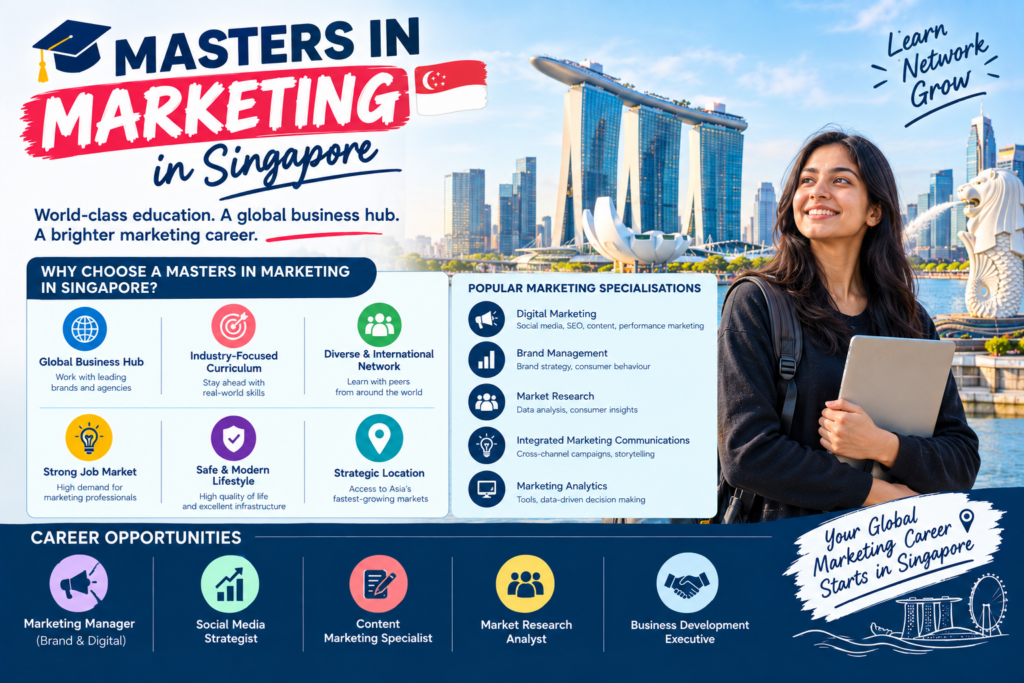
Singapore’s marketing masters programs are built around consumer analytics, digital marketing, and data-driven decision-making rather than the broader “brand management” style still common in some Western programs. Both NUS and NTU sit inside top-15 Asia-ranked business schools, run 12-month coursework formats, and place graduates into regional roles at consumer, tech, and consulting firms based in Singapore, one of Asia’s few marketing and retail hubs with a fully English-medium job market.
For Indian applicants specifically, the appeal is speed and proximity. A 12-month program means one year of tuition instead of two, flights home take under six hours, and Singapore’s business environment gives Indian graduates immediate exposure to Southeast Asian and Indian-subcontinent marketing accounts run out of regional headquarters based there.

Choose your dream country
 UK
UK
 USA
USA
 Germany
 Australia
 Ireland
 Canada
 UAE
UAE
 France
 Sweden
 Italy
Italy
 Other
Other
When do you want to study abroad?
What's your highest level of education?
Have you completed Class 12th?
What was your Class 12 CGPA/percentage?
Are you a student or a parent/guardian?
What do you want to study?
Select your current city
How Leap will help you

Personalised University Shortlist

Express Applications with Quicker Admits

End-to-End Application Support
Top Universities for a Masters in Marketing in Singapore
NUS: MSc in Marketing Analytics and Insights
Run by NUS Business School, this is a 12 to 15-month coursework program focused on marketing analytics, consumer insights, big data in marketing, and pricing decisions. Applicants can also opt into the CEMS Master's in International Management (CEMS MIM) double-degree track, which adds an international exchange semester.
Admission requires a good undergraduate degree in any discipline and a strong interview performance; there is no fixed GPA or test-score cutoff published, though English proficiency scores (IELTS or TOEFL) are required if your undergraduate instruction wasn't in English. Recent graduates have gone on to roles at Apple, Grab, Shopee, and Procter & Gamble.
NTU: MSc Marketing Science
Nanyang Business School's MSc Marketing Science (MMS) is a 12-month program covering marketing strategy, consumer behavior, and marketing technology. GMAT or GRE is optional, and no prior work experience is required, which makes it a realistic option for students applying straight out of an undergraduate degree.
NTU reviews applications on a rolling basis across three rounds (30 November, 31 January, and 31 March for the July intake), so applying in the first round genuinely improves your shortlisting odds rather than being a formality.
SMU: No dedicated marketing masters, but a workable alternative
SMU does not currently run a standalone Master's in Marketing. Its closest equivalent is the MSc in Management (MiM) at Lee Kong Chian School of Business, which allows students to specialize in marketing electives and connects to SMU's "SMarketing" industry network (events with Google, Unilever, P&G, and Ogilvy). If you're specifically set on a marketing degree title, NUS or NTU are the direct routes; if you want flexibility across functions with a marketing tilt, SMU's MiM is worth evaluating separately.
Counselor insight: Students often assume "marketing masters" and "MBA with a marketing major" are interchangeable in Singapore. They aren't priced or positioned the same way. An MBA (like Singapore's top MBA programs) usually asks for 2+ years of work experience and costs more, while NUS and NTU's marketing-specific masters accept fresh graduates and run cheaper and shorter. Pick based on your work-experience level, not just the word "marketing" in the title.
Eligibility and Admission Requirements
| Requirement | NUS MSc Marketing Analytics & Insights | NTU MSc Marketing Science |
| Academic background | Good bachelor's degree, any discipline | Good bachelor's degree, any discipline |
| GRE/GMAT | Not mandatory | Optional |
| English test | IELTS/TOEFL if UG medium wasn't English | IELTS 6.5+ or TOEFL 100+ if applicable |
| Work experience | Not required | Not required |
| Duration | 12-15 months | 12 months |
| Application fee | S$100 (Rs.7,500) | S$100 (Rs.7,500) |
Both universities stopped accepting online-proctored GMAT/GRE and TOEFL/IELTS scores taken after 31 December 2023, so plan for an in-person test date if you haven't tested since.
Masters in Marketing in Singapore: Fees in INR
| University | Total program fee (SGD) | Total program fee (INR) | Enrollment/acceptance fee | Duration |
| NTU MSc Marketing Science (July 2027 intake, AY2027) | S$73,030 | Rs.54.77 lakh | S$21,800 enrollment (deducted from total) | 12 months |
| NUS MSc Marketing Analytics & Insights (August 2027 intake, AY2027/28) | S$77,390 | Rs.58.04 lakh | S$10,900 acceptance fee (deducted from total) | 12-15 months |
Both figures are pulled directly from each university's live fee page as of September 2026 and apply specifically to the 2027 intake cohort named above, inclusive of GST. NUS and NTU update these pages seasonally for each new intake, so a different intake year can carry a different total; always re-check the live page against the intake you're actually applying for before finalizing a budget.
On top of tuition, budget for cost of living in Singapore, which typically runs SGD 1,500-2,000 a month (roughly Rs.1.13L-1.5L) depending on housing choice; hawker-centre eating and public transport keep this toward the lower end.
Scholarships and Funding
- NTU MSc Marketing Science Merit Scholarship: partial, competitive, for candidates with strong academics and interview performance.
- NTU ASEAN Development Scholarship: for ASEAN nationals (not applicable to Indian students, since India isn't an ASEAN member).
- NTU Diversity Scholarship: covers 40% of tuition for candidates who bring a distinctive background to the cohort.
- NUS Study Awards: limited awards for outstanding NUS MSc Marketing Analytics and Insights applicants; check the Study Awards page directly, as amounts vary by intake.
Full scholarship or grant coverage for Indian students on either program is uncommon; most Indian applicants self-fund or use an education loan, and Indian banks (SBI, HDFC Credila, Avanse) do lend against Singapore admits.
Student Pass Process
Once you accept your offer, the university applies for your Student's Pass through Singapore's Immigration and Checkpoints Authority (ICA) via the SOLAR system. You'll need your offer letter, passport, and a passport-sized photo; most students receive approval before the term starts if the university submits early. For a step-by-step breakdown, see LeapScholar's Singapore study visa guide.
On a Student's Pass, you can work up to 16 hours a week during the term and full-time during official vacation periods; no separate work permit is needed.
Jobs and Salary After a Masters in Marketing in Singapore
Singapore has no dedicated post-study work visa. Graduates apply directly for an Employment Pass or S Pass once they have a qualifying job offer, so your job search needs to start during your final term, not after graduation.
NUS and NTU marketing masters graduates typically move into roles such as marketing analyst, consumer insights associate, brand executive, or digital marketing specialist at consumer goods firms, e-commerce platforms, and consulting firms with a regional Singapore base. Reported marketing manager salaries in Singapore range from SGD 5,250 to SGD 7,750 a month (roughly Rs.3.9L-5.8L a month) at the manager level, according to job platform JobStreet: entry-level marketing analyst and executive roles for fresh masters graduates typically start lower than manager-level pay.
For a broader view of what Indian graduates across disciplines earn in Singapore, see average salary in Singapore for Indian students and job opportunities in Singapore for Indian students.
Counselor insight: Students who treat the 12-month program as "study first, job search later" will find their job search time limited. Singapore employers hire close to graduation dates, not months after. Start applying and networking with alumni from month 6 onward, not month 11.
Is a Masters in Marketing in Singapore Worth It for Indian Students?
It depends on what you're comparing it against. Against a 2-year marketing masters in the UK or Australia, Singapore's 12-month format is cheaper on living costs and gets you into the job market faster. Compared to staying in India for an MBA, Singapore adds an international brand name and English-medium global exposure, at a real cost of roughly Rs.55-70 lakh all-in (tuition plus living costs for one year). If your goal is Singapore or Southeast Asia-based marketing roles specifically, NUS or NTU is a direct route in.
If your goal is a global marketing career and you're open to other countries, it's worth comparing against options covered in MS in Singapore for Indian students and other country-specific programs before committing.
3 Takeaways on Masters in Marketing in Singapore
- Confirm which of the two real Singapore marketing masters, NUS's analytics-heavy program or NTU's broader marketing science program, fits your career direction before you shortlist further.
- Budget Rs.55-58 lakh for tuition alone at Rs.75/SGD, plus roughly Rs.1.13-1.5 lakh a month in living costs, and lock in your exchange rate assumption before finalizing a loan amount.
- Start your Singapore job search and networking from the middle of your program, not after graduation, since there's no safety net for post-study work visas.
Not sure if a masters in marketing in Singapore fits your profile and budget? Talk to LeapScholar and get a free assessment against your specific background before you apply.
Frequently Asked Questions About Masters in Marketing in Singapore
-
Is a master's degree worth it in Singapore?
It depends on the university and program you pick. Regional employers regard NUS and NTU highly, and the 12-month format means you pay fees for only one year instead of two. Without a Singapore-specific career goal, a longer program elsewhere might still serve you better.
-
Does marketing pay well in Singapore?
Marketing manager roles average SGD 5,250-7,750 a month, which is competitive for the region. Entry-level marketing and analyst roles start well below that, so pay depends more on experience and specialization than on the job title alone.
-
Is it worth it to do a master's in marketing?
A focused marketing master's makes sense if you already want to move into analytics, brand strategy, or consumer insights, since it builds skills a general MBA elective won't cover. If you're switching careers entirely, an MBA typically provides more opportunities.
-
Will AI replace marketing jobs?
AI is changing how marketers work, not eliminating the function. Tools now handle campaign optimization and reporting, but roles built around strategy, judgment, and consumer insight are becoming more valuable, not less, as routine tasks get automated.
-
Which is better, MBA or Masters in marketing?
An MBA suits professionals with two-plus years of experience who want a broader business qualification and a career switch. A Masters in marketing suits fresh graduates who already know they want a marketing-specific career and want to start earning sooner.
-
What jobs can I get with a master's in marketing?
Common roles include marketing analyst, brand executive, consumer insights associate, and digital marketing specialist, typically at consumer goods, e-commerce, tech, or consulting firms with a regional presence.
-
Is Singapore cheap for Masters?
Singapore isn't a budget destination. A one-year marketing masters at NUS or NTU runs Rs.55-58 lakh in tuition alone, though the shorter duration keeps total costs lower than a two-year program in most other countries.
-
Can I work while studying in Singapore?
On a Student's Pass, you can work up to 16 hours a week during the term and full-time during official vacation periods, without needing a separate work permit for either.






Have Questions? Get Guidance to reach your Dream University
Connect with India's finest counsellors and biggest study abroad community.
Get Guidance