
Quick Read
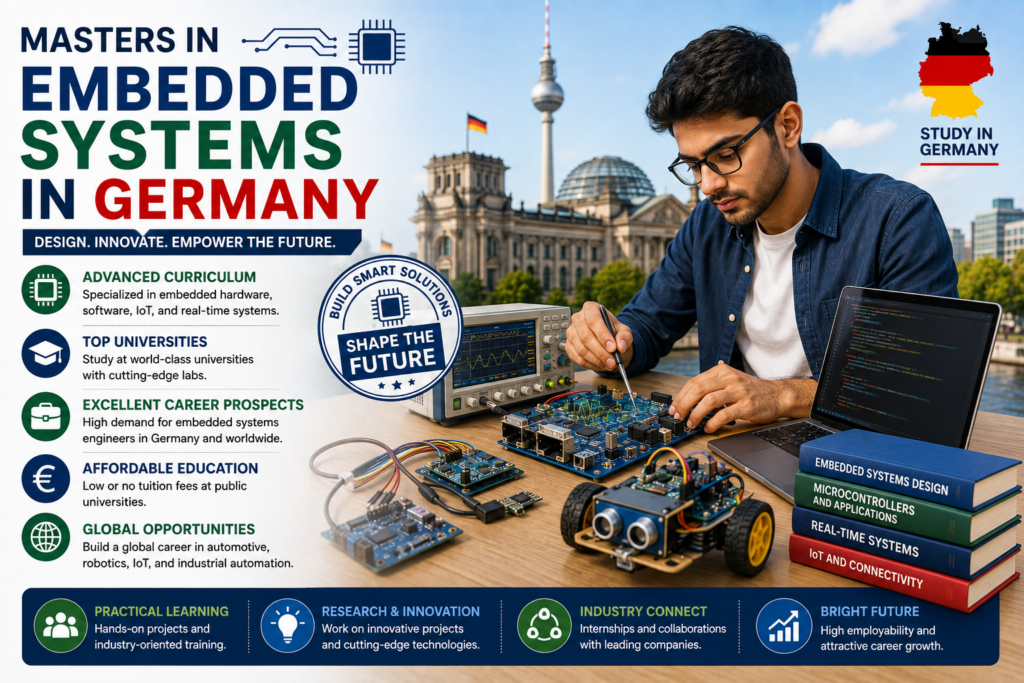
- Saarland, TU Chemnitz and RPTU offer tuition-free masters in embedded systems in Germany.
- Semester fees run Rs.37,000 to Rs.43,000, no separate tuition at public universities.
- Entry-level embedded engineers earn Rs.38.5 to Rs.71.5 lakh gross.
- dMAT becomes mandatory for Engineering-background applicants from Summer 2027 intake.
Which German Universities Offer a Masters in Embedded Systems
Most “top university” lists mix up two very different things: a dedicated M.Sc. in Embedded Systems, and a general Electrical Engineering or Computer Science degree that happens to offer embedded systems as one specialization among many. If you want deep, hands-on embedded work, the dedicated programs below are what actually matter.
| University | Program | Tuition | Semester fee (EUR) | Semester fee (INR @ Rs.110) | Intake |
| Saarland University | M.Sc. Embedded Systems | Free | €394.30 | Rs.43,373 | Winter & Summer |
| TU Chemnitz | M.Sc. Embedded Systems | Free | €340.50 | Rs.37,455 | Winter only |
| RPTU Kaiserslautern-Landau | M.Sc. Embedded Computing Systems (ESY) | Free | €381.80 (Kaiserslautern campus, Winter 2026/27) | Rs.41,998 | Winter |
| University of Freiburg | M.Sc. Embedded Systems Engineering | €1,500/semester (non-EU, Baden-Württemberg state fee) | €190 semester contribution on top | Rs.1.65 lakh tuition + Rs.20,900 contribution, per semester | Winter |
| Ravensburg-Weingarten (RWU) | M.Eng. Electrical Engineering & Embedded Systems | Free | Standard public-university fee | Check current RWU fee page | Winter only, 30 seats/year |

Choose your dream country
 UK
UK
 USA
USA
 Germany
 Australia
 Ireland
 Canada
 UAE
UAE
 France
 Sweden
 Italy
Italy
 Other
Other
When do you want to study abroad?
What's your highest level of education?
Have you completed Class 12th?
What was your Class 12 CGPA/percentage?
Are you a student or a parent/guardian?
What do you want to study?
Select your current city
How Leap will help you

Personalised University Shortlist

Express Applications with Quicker Admits

End-to-End Application Support
Freiburg is the one paid option on this list. Baden-Württemberg is one of the few German states that charges non-EU students tuition, but at €1,500/semester it still stays well under two years' total fees at most private European alternatives, and the program is entirely English-taught with no German requirement.
Note on the RPTU fee: DAAD's own program listing shows an older €314 social fee for this course. RPTU's own re-registration page confirms €381.80 as the current Winter 2026/27 rate; semester fees rise most cycles with regional transport ticket costs, so this is the more current figure, but confirm the exact number on RPTU's fee page before budgeting.
A word of caution on EMECS (European Master in Embedded Computing Systems), the Erasmus Mundus joint degree run across RPTU, Southampton, NTNU, and Politecnico di Torino. It charges €4,000/year for EU students and €8,000/year for non-EU students, funded mostly through scholarships. As of this writing, EMECS has confirmed it will not admit new students for the upcoming intake and directs applicants toward each partner university's own local program instead, which for RPTU means the tuition-free ESY program above. Do not plan your application around EMECS without checking its admission page directly first.
Saarland's program is the most flexible on module choice and asks for an English C1 score with no waiver for a Medium-of-Instruction certificate, which trips up a lot of Indian applicants who assume their B.Tech being taught in English is enough. TU Chemnitz is the outlier on language: it wants German A1 at entry and A2 by your third semester even though teaching is in English, so factor in a few months of German classes before you apply.
Starting early pays off well beyond admission. Hemanth Kiran, a TU Bergakademie Freiberg graduate now working as a Process Engineer in North Germany, contributed to LeapScholar's Germany guide and describes his own approach: "Recognised early on that the primary obstacle to studying in Germany is the language barrier. Started learning German (A1, A2) during undergraduate studies in India and continued through B1 and B2 levels after arriving."
Counselor insight: Students often shortlist purely by QS ranking and miss that TU Chemnitz and Saarland, both mid-ranked overall, run some of the strongest dedicated embedded systems curricula in the country because the program is departmental, not diluted across a broader EE degree. Rank the program, not just the university brand, when the field is this specific.
Eligibility for Masters in Embedded Systems in Germany
- Bachelor's degree in Electrical/Electronics Engineering, Computer Science, Mechatronics, Computer Engineering, or a closely related field
- English proficiency: B2 to C1 depending on the university (Saarland asks for C1; TU Chemnitz and RPTU typically accept B2)
- APS certificate, mandatory for all Indian applicants regardless of which university or program
- Two letters of recommendation and a motivation letter/SOP at most universities
- German A1/A2 at TU Chemnitz specifically; not required at Saarland or RPTU's ESY track
Fee structure and payment timing trip up a lot of applicants too; our counselors have answered this exact question on how German masters fees and payment structure actually work on LeapScholar Questions.
Is dMAT required for masters in embedded systems in Germany
Yes, conditionally. The Digital Master Test (dMAT), introduced by APS India and g.a.s.t. in mid-2026, is now part of APS documentation for Indian applicants with an Engineering bachelor's degree (which covers ECE, EEE, CS, and Mechatronics degrees that feed into embedded systems programs) applying for Summer Semester 2027 intake or later. It costs €150 (Rs.16,500) and does not replace the APS certificate; it sits alongside it. Winter 2026/27 applicants are exempt from this requirement. If your APS process started before 29 June 2026, you're also exempt. Anyone targeting Summer 2027 should register early since test slots are limited.
Since dMAT now sits alongside APS, leave room for APS itself as well. Mahendra Wagh, a Master's student at Hof University of Applied Sciences and a contributor to LeapScholar's Germany guide, recalls: "The student visa took about a month to process. The APS certificate took around 3 months, as the system was newly introduced at the time, though the timeline has since improved to a few weeks."
Take the free dMAT mock test here
Cost of Masters in Embedded Systems in Germany for Indian Students
Public universities in Germany do not charge tuition for a consecutive masters, embedded systems included. Your actual costs are the semester fee, the blocked account, and living expenses.
| Cost head | Amount (EUR) | Amount (INR @ Rs.110) |
| Semester fee (per semester) | €340 to €395 | Rs.37,400 to Rs.43,400 |
| Blocked account (per year) | €11,904 | Rs.13.09 lakh |
| Blocked account (monthly release) | €992 | Rs.1.09 lakh |
| dMAT fee (Summer 2027 onward, if applicable) | €150 | Rs.16,500 |
Rs.13 lakh sounds steep as a lump sum, but remember it is not spent; it is deposited, released monthly, and largely comes back to you as living funds through the course of the year. Health insurance (roughly €120 to €150/month) and initial accommodation deposits sit outside this amount and should be budgeted separately.
Counselor insight: Students consistently underbudget for the gap between opening a blocked account and the first monthly release, which can take a few weeks after landing. Carry a buffer of at least Rs.50,000 in freely accessible funds for your first month in Germany.
Career Outcomes and Salary After Masters in Embedded Systems in Germany
Germany's automotive, industrial automation, and semiconductor sectors, think Bosch, Siemens, Continental, and Infineon, run heavily on embedded engineers, which keeps demand for this specialization well above general software roles. Graduates of an embedded systems masters typically get hired under one of two job titles, Embedded Systems Engineer (hardware-leaning) or Embedded Software Engineer (firmware/software-leaning), the coursework overlaps enough that most students end up in either depending on the employer, so here's one blended salary picture by experience level.
| Experience level | Salary range (EUR/year) | Median (EUR) | Salary range (INR @ Rs.110) |
| Entry-level (0-3 yrs) | €35,000 to €65,000 | €49,000 | Rs.38.5 lakh to Rs.71.5 lakh |
| Mid-level (4-8 yrs) | €50,000 to €73,000 | €63,000 | Rs.55 lakh to Rs.80.3 lakh |
| Senior (8+ yrs) | €60,000 to €103,000 | €75,000 | Rs.66 lakh to Rs.113.3 lakh |
Numbers above are pooled from Payscale and Glassdoor data for both job titles in Germany. Actual offers vary by city (Munich and Stuttgart pay above this range; smaller manufacturing towns slightly below) and by whether the role leans more hardware or software.
Can I get PR in Germany after masters in embedded systems
Yes, and the path is more direct than most students expect. The EU Blue Card is Germany's fastest route to permanent residence for non-EU graduates. For 2026, the standard salary threshold is €50,700/year (Rs.55.77 lakh), but engineering is officially classified as a shortage occupation, and recent graduates within three years of finishing their degree qualify for the lower threshold of €45,934.20/year (Rs.50.53 lakh) regardless of occupation. Most embedded systems graduates clear the threshold on their very first job offer. Blue Card holders reach PR in 21 months with B1-level German, or 27 months without any German at all.
Get PR in 21 months with the EU Blue Card, no lottery. Read more about it in our complete Software Engineering in Germany guide.
Application Timeline for Masters in Embedded Systems in Germany
| Stage | Timing |
| Shortlist programs, start APS, book IELTS/TOEFL | 12 to 18 months before intake |
| Submit Uni-Assist/direct university applications | 9 to 12 months before intake |
| Take dMAT if applicable (Summer 2027+, Engineering background) | Before APS documentation is finalised |
| Accept offer, open blocked account, book visa appointment | 6 to 9 months before intake |
| Collect visa, arrange housing, travel | 3 to 6 months before intake |
Deadlines vary sharply by university: TU Chemnitz closes winter applications on 15 July; Saarland's early winter deadline is 15 November with a late window to 15 May; and RPTU's ESY program deadlines should be checked directly on its current cycle page since it changed cycles after the RPTU merger.
For a full walkthrough of the Uni-Assist and direct-application process, see LeapScholar's step-by-step guide to applying to German universities.
Scholarships for Masters in Embedded Systems in Germany
Tuition-free public universities already cut your biggest cost, but scholarships can cover the rest, including living expenses, health insurance, and travel, if you plan early.
- DAAD Study Scholarship: The standard master's award pays roughly €934 to €992/month, plus a one-time travel allowance and health insurance contribution, for the full duration of your degree. It's open to Engineering applicants, competitive (India's selection rate runs roughly 1 in 8 to 1 in 12), and the application goes in about a year before your intended start, typically by mid-October for the following autumn intake.
- Deutschlandstipendium: A merit-based scholarship offered directly by individual German universities, worth €300/month, split between federal funding and private sponsors. Ask your shortlisted university's international office whether it participates.
- University-specific merit awards: TU Chemnitz, Saarland, and RPTU each run smaller internal scholarship pools for high-CGPA international applicants; check each program's funding page directly rather than assuming eligibility.
Counselor insight: Most students apply for DAAD only after getting a university admit, but the DAAD Study Scholarship application actually opens before that; you apply directly through the DAAD portal, and DAAD matches shortlisted candidates to universities afterward. Missing this order is the single biggest reason strong applicants lose a year.
Full eligibility details are in LeapScholar's DAAD Scholarship Germany guide.
3 Key Takeaways on Masters in Embedded Systems in Germany
- Separate the paid, currently paused EMECS program from RPTU's own tuition-free Embedded Computing Systems masters. They are frequently confused online, and only one is actually accepting applications right now.
- Budget Rs.13 lakh for the blocked account and Rs.37,000 to Rs.43,000 per semester in fees, not lakhs in tuition, since public German universities don't charge it for a consecutive masters.
- If your bachelor's is in Engineering and you're targeting Summer 2027 or later, factor the dMAT into your APS timeline now; it's a new requirement most competitor content hasn't caught up with yet.
Ready to start your masters in embedded systems in Germany? Talk to a LeapScholar counselor for university shortlisting, APS and dMAT guidance, and visa support tailored to Indian engineering graduates.
Frequently Asked Questions About Masters in Embedded Systems in Germany
-
Is Germany good for embedded systems?
Yes. Germany's automotive, industrial automation, and semiconductor industries, Bosch, Siemens, Continental, and Infineon among them, run on embedded engineering talent, so the country combines strong academic programs with genuine hiring demand and tuition-free public education.
-
How much CGPA is required for masters in embedded systems in Germany?
Most universities want a minimum of 7.0 to 7.5 out of 10 (roughly a German grade of 2.5). Saarland and similar research-heavy programs get competitive, so a CGPA closer to 8 plus relevant project work strengthens your application.
-
What are the top universities for MS in embedded systems in Germany?
Saarland University, TU Chemnitz, RPTU Kaiserslautern-Landau (ESY program), and University of Freiburg run the most established dedicated embedded systems master's programs, all tuition-free at the public university level.
-
Is a Master's in Embedded Systems in Germany available in English?
Yes. Saarland, RPTU's ESY program, and Freiburg's Embedded Systems Engineering all offer courses fully in English. TU Chemnitz teaches in English too but still asks for basic German (A1 at entry, A2 by semester three).
-
Are there private universities in Germany for masters in embedded systems?
Not really. The dedicated embedded systems programs Indian students actually shortlist are all at public technical universities. Private German universities rarely offer this specialization, and where they do, tuition fees apply.
-
Is dMAT required for masters in embedded systems in Germany?
Yes, if you have an Engineering bachelor's degree and are applying for Summer Semester 2027 intake or later. It is an additional APS requirement, not a replacement for the APS certificate, and costs €150.
-
What is the salary after masters in embedded systems in Germany?
Entry-level embedded engineers earn roughly €40,000 to €65,000 gross per year in Germany, translating to about Rs.44 lakh to Rs.71.5 lakh at current rates, with salaries rising well past €90,000 at senior levels.
-
Can I get PR in Germany after masters in embedded systems?
Yes, through the EU Blue Card. Engineering roles qualify for the lower salary threshold of €45,934.20/year as a shortage occupation, and PR follows in 21 to 27 months depending on your German language level.






Have Questions? Get Guidance to reach your Dream University
Connect with India's finest counsellors and biggest study abroad community.
Get Guidance