
Quick Read
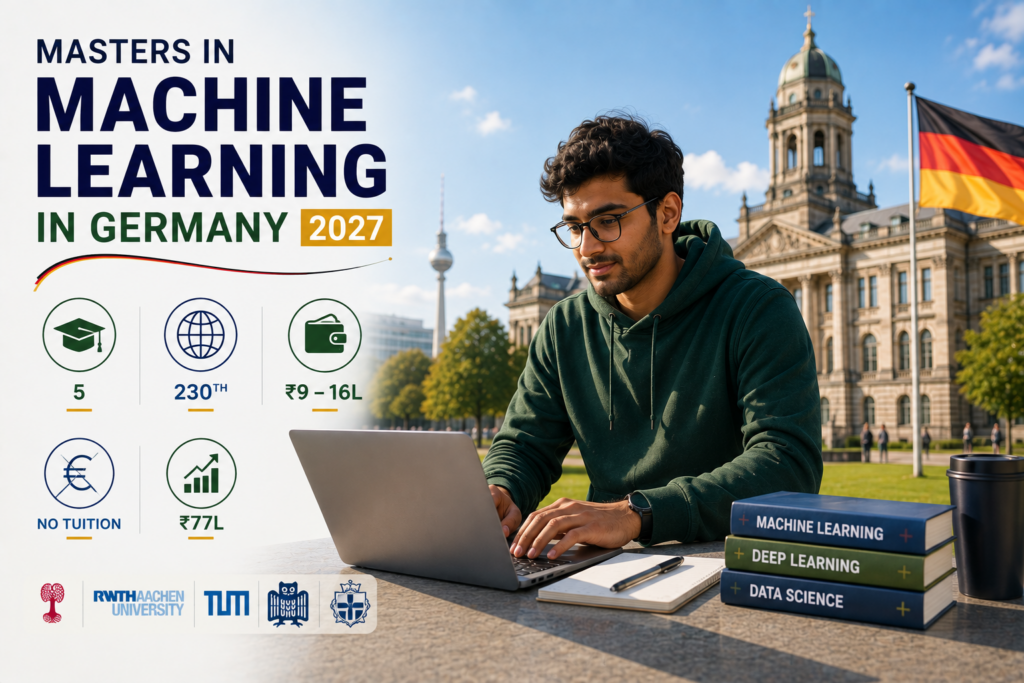
- 5 German universities offer genuine masters in machine learning in Germany.
- Tübingen’s dedicated MSc Machine Learning ranks 230th globally (QS 2027).
- Indian students need roughly Rs. 9-16 lakh per year, including tuition and living costs.
- RWTH Aachen and Saarland charge no tuition, only a small semester fee.
- TUM now charges non-EU master’s students Rs.8.8-13.2 lakh a year in tuition.
- Machine learning engineers in Germany earn about Rs.77 lakh a year on average.
Top Universities for a Masters in Machine Learning in Germany
Five German universities offer a genuine masters in machine learning in Germany or a close equivalent, spanning pure research tracks to industry-facing programs.
| University & Program | QS World Ranking 2027 | Tuition (non-EU) | GRE |
|---|---|---|---|
| University of Tübingen: MSc Machine Learning | #230 | Semester fee: Rs.1.65 lakh (€1,500) | Not required |
| TUM: MSc Informatics (ML specialization) | #25 | Tuition: Rs.4.4-6.6 lakh/semester (€4,000-6,000) | Program-dependent |
| RWTH Aachen: MSc Data Science | #104 | No tuition, semester fee: Rs.36,163 (€329) | Optional, recommended |
| TU Darmstadt: MSc Artificial Intelligence and Machine Learning | #250 | No tuition, semester fee: Rs.41,770 (€380) | Accepted as an entrance exam substitute |
| Saarland University: MSc Data Science and Artificial Intelligence | =588 | No tuition, semester fee: Rs.30,778 (€280) | Not required |

Choose your dream country
 UK
UK
 USA
USA
 Germany
 Australia
 Ireland
 Canada
 UAE
UAE
 France
 Sweden
 Italy
Italy
 Other
Other
When do you want to study abroad?
What's your highest level of education?
Have you completed Class 12th?
What was your Class 12 CGPA/percentage?
Are you a student or a parent/guardian?
What do you want to study?
Select your current city
How Leap will help you

Personalised University Shortlist

Express Applications with Quicker Admits

End-to-End Application Support
This list mixes dedicated ML degrees with broader masters in AI and machine learning in Germany and masters in data science and machine learning in Germany options, including TU Darmstadt's own masters in artificial intelligence and machine learning in Germany.
My insight: Most guides compare these five masters in machine learning in Germany options purely on QS rank and miss the bigger cost driver. Baden-Württemberg (Tübingen) and Bavaria (TUM) both charge non-EU students real tuition now. North Rhine-Westphalia (RWTH), Hesse (TU Darmstadt), and Saarland still don't. That state-level policy changes your total budget more than a 200-rank difference on QS ever will, so check the state before you check the ranking.
Eligibility, GRE, and Documents for a Masters in Machine Learning in Germany
Getting into a masters in machine learning in Germany comes down to two things: your quantitative background and, for a handful of programs, a GRE or equivalent score. Here's what each university actually checks and what you'll need to have ready.
Eligibility and GRE Requirements
| University | Minimum background | GRE policy |
|---|---|---|
| University of Tübingen | Bachelor's in CS, math, physics, or related field, grade of 2.0 or better (German scale), 27 ECTS in maths, 18 ECTS in CS | Not accepted or required |
| TUM | Bachelor's in Informatics or closely related field | Program-dependent, check individual page |
| RWTH Aachen | Bachelor's in CS, math, physics, or related STEM field | Optional; helps for competitive intakes |
| TU Darmstadt | Bachelor's in CS or AI-related field | Accepted (155 verbal, 165 quant, 3.5 AWA) as a substitute for the entrance exam |
| Saarland University | Bachelor's (180 CP) in CS, informatics, or related field, C1 English | Not required |
If you don't have a pure computer science degree, this is where the "27 ECTS in math, 18 ECTS in CS" benchmark matters: it's roughly what admissions teams expect from a mechanical engineering or electronics background too, just distributed differently across your transcript.
Documents Checklist
These are the documents every Indian applicant to a masters in machine learning in Germany needs ready before applying.
| Document | Notes for Indian applicants |
|---|---|
| APS certificate | Mandatory for most Indian applicants; apply through the German Embassy's APS office in New Delhi |
| dMAT (Digital Master's Admission Test) | New from Summer 2027; may apply depending on your bachelor's background, see note below |
| Bachelor's transcript and provisional certificate | Get an English-translated, notarized copy ready before you start applications |
| Statement of Purpose | Program-specific: Tübingen and Darmstadt ask for a clear research-interest statement, not a generic essay |
| Letters of recommendation | 2, usually academic; industry LORs are accepted where you have relevant internships |
| IELTS/TOEFL score | 7.0 IELTS or 100 TOEFL iBT is the Tübingen benchmark; most others sit close to this |
| Blocked account confirmation | Rs.13.08 lakh (€11,904) minimum, required for the visa application, not the university application |
Important note on dMAT: This is a new requirement inside the APS process starting from the Summer 2027 intake, and it only applies to select bachelor's backgrounds (engineering, commerce, finance, economics, business, and management). It costs €150, doesn't replace APS, and a weak score doesn't fail your application on its own. Confirm with APS India whether your specific program requires it, since coverage for CS and Data Science backgrounds is still being clarified. Check the current exemption list before assuming either way.
My Insight: APS policy changes cause a backlog at the New Delhi office in their first cycle. If dMAT covers your background, book your APS slot the moment the window opens, and register for dMAT separately through g.a.s.t. as soon as its own window opens too.
Find relevant Q&As on Germany APS and admissions requirements here →
Application Deadlines for the Next Intakes
Germany runs two intakes: Winter, starting in October, which is the main intake with the widest course choice; and Summer, starting in April, which fewer programs offer. If you're reading this in August 2026, Winter 2026/27 admissions for all five programs below have already closed.
The realistic windows for a masters in machine learning in Germany are Summer 2027 and Winter 2027/28, shown here.
| University & Program | Summer 2027 deadline | Winter 2027/28 deadline |
|---|---|---|
| University of Tübingen (MSc Machine Learning) | No summer intake | 30 April 2027 |
| TUM (MSc Informatics) | 30 November 2026 | 31 May 2027 |
| RWTH Aachen (MSc Data Science, non-EU) | 1 September 2026 | 1 March 2027 |
| TU Darmstadt (MSc AI and Machine Learning) | 15 January 2027 | 15 July 2027 |
| Saarland University (MSc Data Science and AI) | 15 January 2027 | 15 July 2027 |
Start your APS certificate process the moment you shortlist universities, not after you're admitted. It routinely takes six to ten weeks, and your visa application can't move without it.
My Insight: RWTH's non-EU deadline is the one everyone underestimates. Students plan around the distant Winter date and miss that RWTH's Summer window shuts by 1 September, often before APS paperwork is done.
Cost of a Masters in Machine Learning in Germany: Tuition, Living, and Scholarships
Your actual annual cost for a masters in machine learning in Germany depends far more on which state you pick than on which QS band the university sits in. This holds whether you're comparing a straight MSc in Machine Learning or a masters in data science and machine learning in Germany, since the state-level tuition rule applies the same way regardless of program name.
Here's the breakdown across tuition, living costs, and the scholarships that can offset both.
Tuition Fee
Here's what a masters in machine learning in Germany actually costs in tuition, state by state.
| University | Tuition (non-EU, per year) | In INR |
|---|---|---|
| University of Tübingen | €3,000/year | Rs.3.30 lakh/year |
| TUM | €8,000-12,000/year | Rs.8.79-13.19 lakh/year |
| RWTH Aachen | No tuition, €658/year semester fee | Rs.72,327/year |
| TU Darmstadt | No tuition, ~€760/year semester fee | Rs.83,539/year |
| Saarland University | No tuition, €560/year semester fee | Rs.61,555/year |
Sources: University of Tübingen tuition fees, TUM tuition for non-EU students, RWTH Aachen international student fees, DAAD listing for TU Darmstadt semester fee, Saarland University fees
Cost of Living
Daily living costs for a masters in machine learning in Germany swing sharply between Munich and everywhere else.
| City | Monthly cost, excluding rent | Estimated total with shared accommodation |
|---|---|---|
| Munich (TUM) | Rs.1.23 lakh (€1,117.3) | Rs.1.43-1.87 lakh/month |
| Germany average (Aachen, Darmstadt, Saarbrücken, Tübingen) | Rs.1.10 lakh (€1,002.3) | Rs.1.04-1.32 lakh/month |
Sources: Numbeo cost of living, Munich, 2026; Numbeo cost of living, Germany, 2026
The German visa blocked account requirement is fixed at Rs.13.08 lakh/year (€992/month), which is a proof-of-funds threshold, not your actual monthly spending.
Scholarships
| Scholarship | Applies to | Amount |
|---|---|---|
| Deutschlandstipendium, via the DAAD scholarship database | All universities | Rs.32,976/month (€300) |
| TUM Scholarship for International Students | TUM only | Rs.54,960-1,97,856/semester (€500-1,800) |
| RWTH DAAD STIBET Scholarship | RWTH Aachen only | Varies, need-based top-up |
| Tübingen STIBET Study Completion Grant | University of Tübingen only | ~Rs.60,456/month (€550), up to 3 months |
Salary After a Masters in Machine Learning in Germany
Your job title after graduation matters more for pay than the university name on your degree. Whether you graduate from a dedicated MSc Machine Learning or a broader masters in AI and machine learning in Germany, the starting salary band barely shifts; recruiters hire against the skill set, not the program title.
Glassdoor's 2026 Germany data (500+ reported salaries per role) shows a real spread depending on whether you land a pure engineering role, a research-heavy scientist role, or a hybrid software role.
| Role | Average salary (2026) | Typical range | In INR (average) |
|---|---|---|---|
| Machine Learning Engineer | €70,000/year | €58,000-82,500 | Rs.76.9 lakh |
| Machine Learning Scientist | €77,750/year | €61,250-93,638 | Rs.85.5 lakh |
| Software Engineer, Machine Learning | €57,000/year | €57,000-60,000 | Rs.62.7 lakh |
Sources: Glassdoor, Machine Learning Engineer salary in Germany, 2026; Glassdoor, Software Engineer Machine Learning salary in Germany, 2026
After graduation, you get an 18-month permit to search for a qualifying job; no employer sponsorship is required to start that search. Once you land one, the EU Blue Card becomes your route to longer-term residence, and Munich or Berlin roles tend to pay a notch above this national average.
My Insight: The 18-month window feels generous until you're three months in with no German-language postings on your radar. Graduates who land roles fast apply from month one.
For more information on the same, read our extensive guide on Software Engineering in Germany.
3 Key Takeaways on Masters in Machine Learning in Germany
If you're still weighing whether it's good to do a masters in Germany at all versus staying in India or looking elsewhere, these three points are what actually move the needle for a masters in machine learning in Germany specifically:
- Check the state, not just the university, before you budget: Baden-Württemberg and Bavaria now charge non-EU tuition; North Rhine-Westphalia, Hesse, and Saarland don't.
- Start your APS certificate the day you shortlist universities, since it gates your entire visa timeline.
- Match the program name to your background: a dedicated MSc Machine Learning suits CS graduates, while a broader AI or data science track suits applicants without a pure computer science degree.
Verified by: LeapScholar's Germany counseling team, with hands-on APS and visa guidance experience.
Have questions about your machine learning masters application? Book a free session with a LeapScholar counselor.
Frequently Asked Questions About Masters in Machine Learning in Germany
-
Is the GRE required for a masters in machine learning in Germany?
Not really, and this is one of the more common misconceptions. Tübingen and Saarland skip it entirely, RWTH treats it as a nice-to-have rather than a requirement, and Darmstadt only wants it if you're trying to dodge its own entrance exam. Check the specific program page before you spend months prepping for a test you might not need.
-
How much does a masters in machine learning in Germany actually cost for an Indian student?
It swings a lot depending on the state, which is honestly the part most students don't realize until they're already deep into applications. Budget around Rs.9-13 lakh a year at RWTH, Saarland, or Darmstadt once you add living costs. At TUM or Tübingen, where tuition now applies, that climbs to roughly Rs.16-20 lakh a year.
-
Can I get in without a computer science degree?
Yes, plenty of engineering and math graduates do. What admissions teams actually check is whether your transcript covers enough linear algebra, statistics, and programming, not the exact title printed on your bachelor's degree.
-
What if my GRE score is weak or my application gets rejected?
Since most of these programs don't require GRE in the first place, a weak score rarely decides the outcome. Rejections tend to come down to grade cutoffs or missing coursework instead. If that happens, a broader program like RWTH's Data Science track is often a better second attempt than reapplying to the same dedicated ML program next cycle.
-
Is it worth doing a machine learning masters in Germany instead of the US or UK?
For the cost alone, yes, in most cases. You're looking at a fraction of US tuition, genuine research depth through places like Cyber Valley, and an 18-month job-search window built into the visa. The trade-off is that German bureaucracy, especially the APS certificate and blocked account, takes real planning time that US and UK applications don't demand.
-
Is Germany good for masters in machine learning compared to a general AI or data science track?
Both work, honestly, and the outcomes converge more than people expect. A dedicated ML degree goes deeper into the theory and research side, while the AI or data science versions give you a bit more breadth if you're still deciding between industry and academia. Neither closes doors the other keeps open.
-
Does TU Darmstadt really offer a masters in artificial intelligence and machine learning in Germany, or is that just clever branding?
It's the actual program name, not marketing. TU Darmstadt's AIM MSc draws faculty from DFKI and Hessian.AI, two of the country's more serious AI research bodies, and it's one of the few programs on this list where the title matches almost exactly what applicants search for.
-
Do I need to speak German to study or work there afterward?
Not for the degree itself, all five programs teach entirely in English. Day-to-day life gets easier with even basic German, though, and if you're planning to stay on for the job hunt, B1-level German noticeably widens which roles you're eligible for outside the big tech hubs.
-
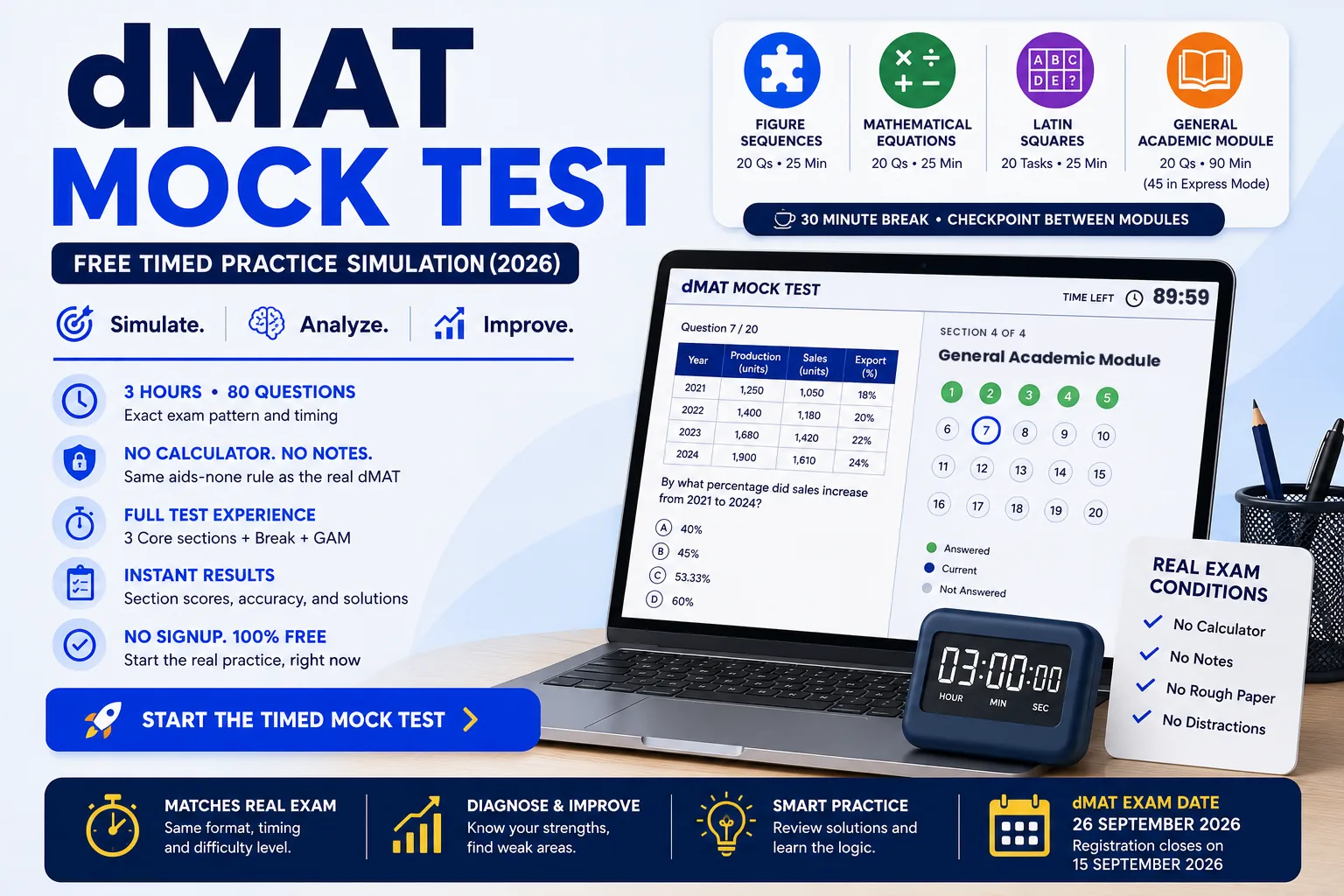
What's the dMAT test?
It's a new aptitude test folded into the APS process starting Summer 2027, and it doesn't apply to everyone. Right now it's aimed at applicants from engineering, commerce, finance, economics, business, or management backgrounds, not specifically CS or data science, though that scope is still being finalized. Check with APS India closer to your application rather than assuming either way. If it does apply to you, start preparing early.







Have Questions? Get Guidance to reach your Dream University
Connect with India's finest counsellors and biggest study abroad community.
Get Guidance