

Quick Read
- DAAD pays Master’s students Rs.1,08,902 (€992) monthly, tax-free.
- Baden-Württemberg charges non-EU/non-EEA students tuition (roughly €1,500/semester) at its public universities.
- Indian students need an APS certificate before most applications move forward.
- Deutschlandstipendium pays Rs.32,934 (€300) monthly on top of any income.
- DAAD selection for Indian applicants typically stays under 15 percent.
- Germany’s 2027-28 funding cycle opens for applications from August 2026.
Types of Scholarships in Germany for Indian Students
Fully funded scholarships in Germany for international students run through four separate channels, and most Indian applicants only ever chase one of them.
| Type | Who Funds It | Typical Monthly Value (INR) | Competition |
|---|---|---|---|
| Government (DAAD) | German Federal Government | Rs.1,08,902 to Rs.1,53,692 | Very high |
| Political foundations (KAS, FES, Heinrich Böll) | Political parties, civil society | Rs.1,08,902 to Rs.1,53,692 | High |
| University-specific (Deutschlandstipendium, merit awards) | Universities + private co-sponsors | Rs.32,934 and up | Moderate |
| Erasmus Mundus Joint Masters | European Commission | Up to Rs.1,53,692 | Very high |
DAAD is the name everyone knows, but the political foundations fund a similar number of students each year with far fewer applications, worth acting on before choosing where to focus.
My insight: Most students spend three weeks perfecting their DAAD file and leave two days for everything else. Flip that ratio; foundations ask for nearly identical documents, and your odds there are better.
Government and University Scholarships in Germany
This category covers the two funding sources most Indian students actually use: DAAD, run by the German federal government, and university-granted awards alongside it, including the Deutschlandstipendium and institution-specific merit scholarships. Between them, they fund far more Indian students than the political foundations covered later, mainly because they’re the ones applicants hear about first.
DAAD
DAAD (the German Academic Exchange Service) remains the most well-known fully funded scholarship in Germany, funding Master’s, PhD, and short research stays for students from nearly every country. Here’s how the stipend and eligibility actually break down for Indian applicants:
| DAAD Detail | Information |
|---|---|
| Master’s stipend | €992 (Rs.1,08,902) per month |
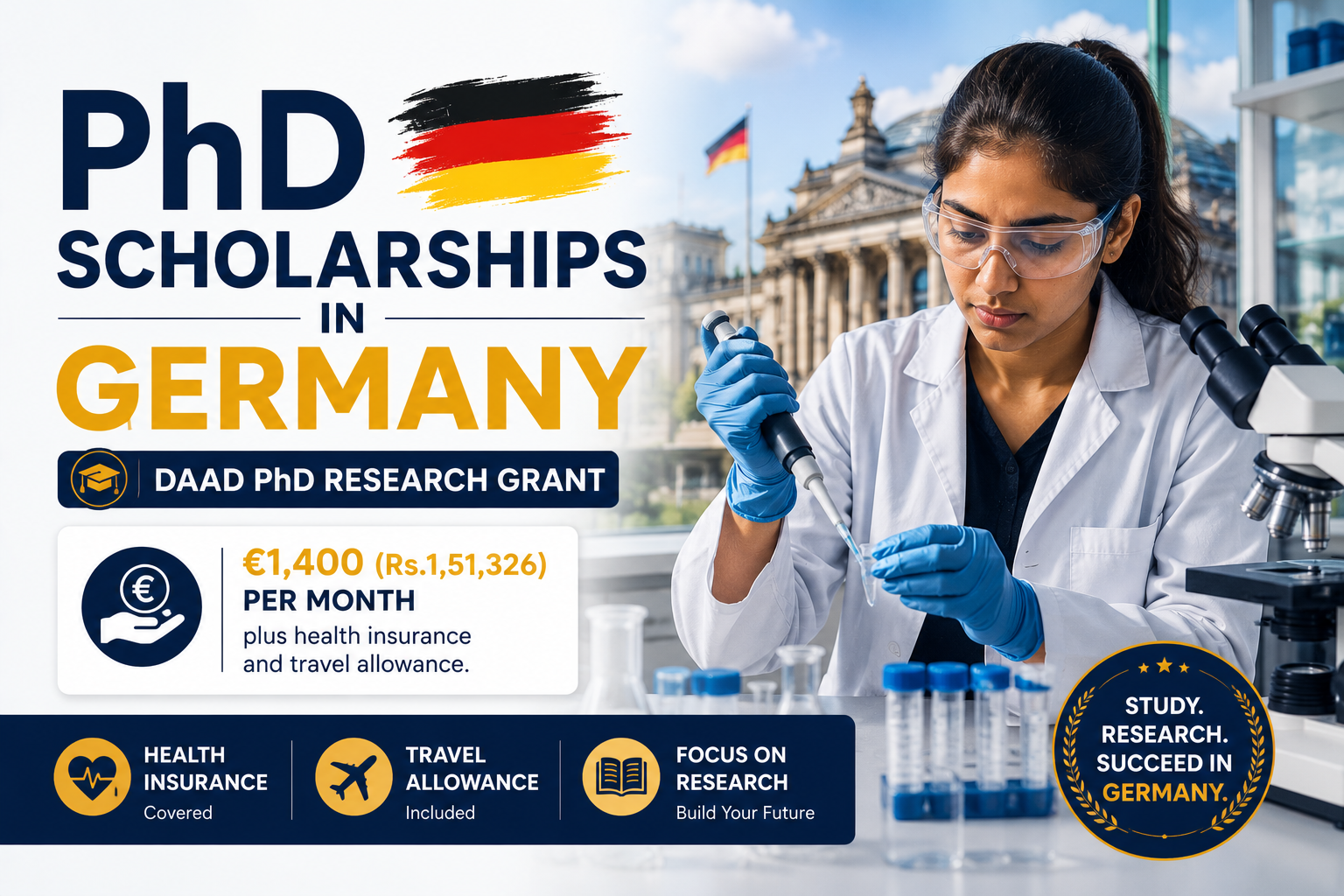
| PhD/doctoral stipend | €1,300 to €1,400 (Rs.1,42,714 to Rs.1,53,692) per month, depending on the program |
| Additional support | Health, accident and liability insurance; travel allowance; €460 (Rs.50,499) annual study allowance |
| Academic eligibility | Completed bachelor’s degree, or final year in progress |
| Age limit | None for most programs |
| Prior residence in Germany | Under 15 months, if you’ve already spent time there |
| Language requirement | IELTS/TOEFL for English-taught courses, TestDaF/DSH for German-taught ones |
| Mandatory Indian document | APS certificate, jointly issued by the German Embassy and DAAD |
| Application deadline | Around 15 October each year, for Winter Semester funding starting the following year |
None of this needs repaying. What most guides leave out: your APS certificate has to be sorted before a scholarship file is considered complete, and it runs on its timeline. Start it the moment Germany becomes your plan, not after your deadline is close.
€992 a month can look modest once you convert it and compare it to Indian salaries, so it’s fair to ask whether it covers real life in Germany. Pooja Kale, a Management master’s graduate from SRH Heidelberg who contributed to LeapScholar’s Germany guide, found a monthly stipend went further than expected: “The monthly stipend was sufficient to cover my rent, health insurance, and basic monthly living expenses without needing financial support from my family.”
See this detailed answer on English proficiency and APS requirements for Germany on LeapScholar’s Q&A page.
My insight: DAAD doesn’t publish a minimum CGPA, but selected applicants consistently carry a first-class or 7.5-plus average. A specific, well-argued research proposal beats a polished file with only average marks.
Deutschlandstipendium
Among fully funded scholarships for Indian students in Germany, the Deutschlandstipendium is one of the most overlooked. Granted directly by universities rather than through a central portal, it’s more accessible than most students assume.
| Detail | Information |
|---|---|
| Monthly stipend | Rs.32,934 (€300), for at least two semesters |
| Funded by | German government plus private co-sponsors |
| Eligibility basis | Academic performance, social engagement, personal achievement |
| Restrictions | None on nationality or parental income |
| Application deadline | Set by each university; commonly June-July for the Winter Semester intake |
Sources: Deutschlandstipendium (BMBF), Studying-in-Germany.org Deutschlandstipendium overview
If you’re already shortlisted at a German university, check that university’s scholarship office directly; it’s often the least competitive award on this list simply because few applicants think to look.
Top University-Specific Scholarships
Beyond the Deutschlandstipendium, individual universities run their own merit awards, often tied to a specific program, and these get far less attention than DAAD despite being genuinely accessible once enrolled or shortlisted.
| University | Scholarship | Typical Value | Who It Suits | Deadline |
|---|---|---|---|---|
| TU Munich | Linde/MDSI Master Scholarship | Rs.1,09,780 (€1,000)/month, up to 12 months | Data Engineering, Maths in Data Science students | Typically early July; exact date varies by call |
| Heidelberg University | Merit and field-based awards | Varies by field | Top performers in Medicine, Law, and Chemistry | Varies by scholarship; check individual pages |
| University of Hamburg | Merit Scholarship | Up to Rs.1,02,095 (€930)/month | Students enrolled 2+ semesters | 15 April annually (single round from 2026) |
| RWTH Aachen | International engagement scholarship | Six months, summer semester | Students with strong community involvement | Two rounds a year, around Dec and Jun; exact cutoff varies |
If you want to know about other scholarships specifically for masters, check our scholarships for masters in Germany for Indian students.
Political Foundations and Erasmus Mundus
Germany’s political foundations are DAAD’s closest competitors in value, just with far less name recognition among applicants researching scholarships for Indian students in Germany.
- Konrad-Adenauer-Stiftung (KAS): €992 (Rs.1,08,902) monthly for Master’s students, €1,400 (Rs.1,53,692) for PhD candidates. Applicants must have B2-level German and a demonstrated interest in political and social issues. Deadline: 15 July annually.
- Friedrich-Ebert-Stiftung (FES): €992 (Rs.1,08,902) for students, €1,400 (Rs.1,53,692) for doctoral candidates, aimed at applicants aligned with social democracy values. Deadlines: 31 May and 30 November annually; PhD applicants may apply anytime.
- Heinrich Böll Foundation: Non-EU students get €992 (Rs.1,08,902) plus insurance for Master’s study; doctoral candidates get €1,400 (Rs.1,53,692) plus a mobility allowance. Deadlines: 1 March and 1 September annually.
Separately, Erasmus Mundus Joint Master’s programs, another fully funded scholarship in Germany, pay €1,400 (Rs.1,53,692) monthly for up to 24 months, plus full tuition, totaling roughly €33,600 (Rs.36,88,608) over a two-year degree. Like other fully funded scholarships in Germany for international students, it’s open to applicants worldwide.
My insight: Foundation scholarships reward social or political engagement. A motivation letter built only around career goals underperforms here. Name an actual volunteer role or community project; vague lines about “a better world” get flagged instantly.
Sources: Konrad-Adenauer-Stiftung, Friedrich-Ebert-Stiftung, Heinrich Böll Foundation, and the European Commission Erasmus+ Program guide.
Which Scholarship Fits Your Situation?
If you’re a final-year BTech student graduating in 2027 with no work experience yet, DAAD’s general study scholarship and the Deutschlandstipendium are your strongest first bets. EPOS and most foundation PhD tracks expect experience you don’t have yet.
If you’re a working professional with two or more years’ experience applying for an MBA or a development-focused Master’s, DAAD’s EPOS program was built for you and draws fewer applicants since most don’t meet the work-experience bar. Foundation scholarships fit well here too, since your professional record substitutes for some of their engagement criteria.
If you’re applying for a PhD via the APS route, DAAD’s research grants and foundation PhD tracks pay more than Master’s funding, since they assume years of independent study. Start your APS certificate the day you decide on Germany; PhD applications move slower.
My insight: Students who apply to only one scholarship almost always reapply a year later. Running two tracks at once, DAAD plus one foundation, costs a few extra hours and meaningfully improves your odds.
Documents Required for Scholarships in Germany
| Document | Purpose | India-Specific Detail |
|---|---|---|
| APS Certificate | Verifies academic qualifications | Mandatory for Indian applicants; apply through APS India months ahead |
| Transcripts and marksheets | Proof of academic record | Notarised, English-translated provisional certificate and final marksheet |
| Letter of motivation | Explains programme fit | Name a specific research interest, not a general one |
| CV/Resume | Summarises education, experience | Europass format is what most German reviewers expect |
| 2-3 Recommendation letters | Academic or professional endorsement | At least one from a professor who taught your final-year subjects |
| Language proficiency proof | Confirms programme readiness | IELTS/TOEFL for English-taught, TestDaF/DSH for German-taught |
| Blocked account confirmation | Required for the visa | Roughly Rs.13,06,821 (€11,904) a year if unfunded |
If your target program doesn’t state a language requirement upfront, check whether it admits students without IELTS; check more details on studying in Germany without IELTS.
For the fee and blocked-account breakdown, see this answer on total fees and the payment structure in Germany on LeapScholar’s Q&A page.
Intakes and When to Apply: The 2027-28 Cycle
Germany runs two intakes a year: Winter Semester (Wintersemester), starting in October with the widest program selection, and Summer Semester (Sommersemester), starting in April with far fewer courses. DAAD and nearly every scholarship here, including the political foundations, fund only the Winter intake.
If you’re researching your options in mid-2026, the intake that matters for funding is Winter 2027, and the calendar below is built around it.
| Month | What to Do |
|---|---|
| Jul-Aug 2026 | Finalise your shortlist; start your APS certificate |
| Sep-Oct 2026 | Submit DAAD and most foundation applications (deadlines cluster near October 15) |
| Nov 2026-Jan 2027 | KAS, FES, and Erasmus Mundus deadlines fall here |
| Feb-Apr 2027 | Most decisions arrive; start backup applications immediately if rejected |
| May-Jun 2027 | Indian board and university results season; confirm admission and visa documents |
| Jul-Sep 2027 | Visa appointment, blocked account setup, travel booking |
| Oct 2027 | Winter Semester begins for most DAAD-funded programs |
If Summer 2027 is your only realistic option, check availability directly with the university, since most scholarships here won’t apply to that intake.
Keep your APS certificate moving alongside everything else. It’s the one document nobody remembers is holding up their file until it’s all that’s left.
Build some slack into that July–September visa window, because it doesn’t always run to plan. Pooja Kale, who contributed to this guide, learned this firsthand: “My visa processing took longer than expected, so even though the course began in mid-October, I only arrived in Germany on November 3rd.”
What to Do If Your Application Gets Rejected?
Rejection happens to most applicants, so a real backup plan matters more than hoping otherwise.
- Don’t wait for the formal rejection letter. If you haven’t heard back within the review window, start a self-financed route in parallel. A blocked account remains a valid path into Germany with or without a scholarship, since tuition is already free at public universities.
- Reapply to a different track, not the same one twice. A foundation scholarship or a university merit award is a different applicant pool, not a weaker version of whatever rejected you first.
- Check whether the language score was really the problem. If IELTS cost you the scholarship, confirm your target programme requires it before retaking a test you might not need.
- Keep a post-study plan ready regardless of funding source. If working in Germany after graduating is part of your plan, it’s worth understanding the Germany Opportunity Card, since it affects how you can stay while your qualifications get recognised.
My insight: A rejected DAAD file isn’t a verdict on your profile. Committees and country allocations shift every cycle, and the same application rejected one year is often funded the next.
3 Key Takeaways on Scholarships in Germany
- Start your APS certificate now, whichever scholarship you’re targeting; it’s on the critical path for nearly every application.
- Apply to at least two tracks in the same cycle, DAAD plus one foundation, rather than betting on one.
- Set up a backup blocked-account budget in parallel, so a rejection doesn’t cost you an entire cycle.
Verified by: LeapScholar’s Germany counseling team, with hands-on experience guiding Indian students through DAAD, foundation, and university scholarship applications.
Have questions about scholarships in Germany? Book a free session with a LeapScholar counselor.
Frequently Asked Questions About Scholarships in Germany for Indian Students
-
What is the DAAD scholarship stipend for Indian students?
Master’s students get €992 (Rs.1,08,902) a month, and doctoral candidates get €1,300 to €1,400 (Rs.1,42,714 to Rs.1,53,692), depending on the program. DAAD also throws in health insurance, a travel allowance, and an annual study allowance of €460, none of which you’ll pay back.
-
Can I study in Germany for free without a scholarship?
Tuition, mostly yes. Public universities don’t charge fees for most programs, scholarship or not. What you can’t skip is living costs, roughly Rs.13,06,821 (€11,904) a year, covered through a blocked account or part-time work if no scholarship comes through.
-
What is the eligibility for scholarships in Germany for Indian students?
It varies, but the common thread is a completed or nearly completed bachelor’s degree, decent academics, and language proficiency matching your teaching language. DAAD’s EPOS track goes a step further and asks for two years of relevant work experience too.
-
Is IELTS or German required for scholarships in Germany?
Depends on the teaching language. English-taught programs usually want IELTS or TOEFL; German-taught ones ask for TestDaF or DSH instead. A handful of universities admit you without IELTS if you can prove proficiency another way, which is worth checking first.
-
How do I apply for scholarships in Germany from India?
Get your APS certificate moving before anything else, since most applications won’t process without it. From there, apply directly through each scholarship’s own channel: DAAD’s database for government funding or the relevant foundation’s website for the political route.
-
What is the Deutschlandstipendium, and can Indian students apply?
It’s Germany’s national merit scholarship, and yes, Indian students can apply. It pays Rs.32,934 (€300) a month for at least two semesters, and unlike some other awards, it doesn’t care about nationality or parental income. You just need to be enrolled at a participating university.
-
What happens if my application is rejected?
Don’t wait around for the formal letter before you act. Since tuition is already free at public universities, self-financing through a blocked account remains a real option, and so is reapplying to a different scholarship track next cycle rather than trying the same one again.
-
Is there an age limit or minimum CGPA for these scholarships?
Most DAAD programs don’t set a fixed upper age limit, and there’s no official minimum CGPA published anywhere. That said, selected students tend to have a first-class or 7.5-plus average, since committees weigh research fit alongside marks.






Have Questions? Get Guidance to reach your Dream University
Connect with India's finest counsellors and biggest study abroad community.
Get Guidance