
Quick Read
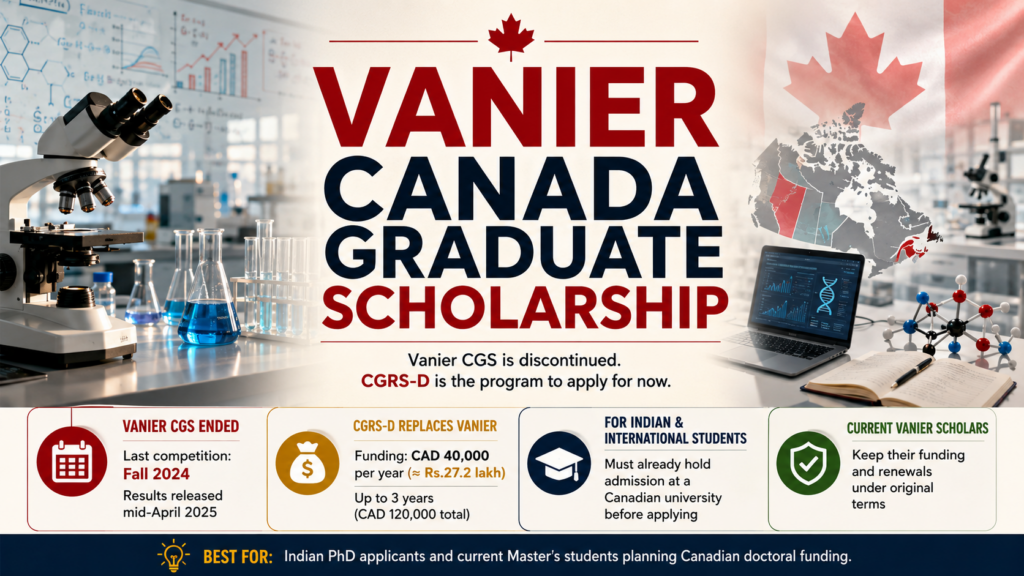
- Vanier Canada Graduate Scholarship ended after its Fall 2024 competition cycle.
- CGRS-D replaced Vanier at CAD 40,000 yearly, about Rs.27.2 lakh.
- Indian applicants must already hold admission at a Canadian university.
- Existing Vanier scholars keep their funding under original terms.
Is the Vanier Canada Graduate Scholarship Still Open in 2027-28?
No. The Vanier Canada Graduate Scholarships (Vanier CGS) program is discontinued.
| Status Check | Detail |
| Last competition | Fall 2024, results released mid-April 2025 |
| Currently accepting applications | No, official Vanier Canada Graduate Scholarship site confirms this |
| Existing Vanier Canada Graduate Scholarship holders | Unaffected; funding and renewals continue under original offer letters |
| What to apply for instead | Canada Graduate Research Scholarship – Doctoral (CGRS-D) |
| What CGRS-D absorbed | Vanier CGS, the older Canada Graduate Scholarships – Doctoral (CGS-D), and separate agency-specific doctoral awards |
| Administered under | The new Canada Research Training Awards Suite (CRTAS) |
If you already hold a Vanier CGS award, nothing changes for you: continue under your original offer letter and existing payment schedule. If you were planning to apply, CGRS-D is the next step for you.
Discontinuation status is confirmed directly on the official Vanier CGS website and by the University of Toronto’s School of Graduate Studies.
Counselor insight: Every week, students still email asking how to get nominated for a Vanier quota at their target university. The honest answer is that no university has a live Vanier quota anymore. The quota system itself moved to CGRS-D, so the real question to ask your prospective supervisor is about their institution’s CGRS-D allocation, not Vanier’s.
Vanier Canada Graduate Scholarship vs Canada Graduate Research Scholarship- Doctoral
CGRS-D is not simply Vanier under a new name. The value, the applicant pool, and parts of the selection process changed. Here’s what changed for Canada Graduate Research Scholarship – Doctoral applications
| Feature | Vanier Canada Graduate Scholarship (Vanier CGS 2026, discontinued) | Canada Graduate Research Scholarship – Doctoral (current program) |
| Annual value | CAD 50,000 (about Rs.34 lakh) | CAD 40,000 (about Rs.27.2 lakh) |
| Total over 3 years | CAD 150,000 (about Rs.1.02 crore) | CAD 120,000 (about Rs.81.6 lakh) |
| Status | Discontinued after Fall 2024 competition | Currently accepting applications |
| Administered by | CIHR, NSERC, SSHRC jointly | CIHR, NSERC, SSHRC jointly (same three agencies) |
| Selection basis | Academic Excellence, Research Potential, Leadership, equally weighted | The same three criteria carried forward under CRTAS |
| Application route | Institutional nomination against a fixed Vanier quota | Institutional nomination against a CGRS-D quota; application via ResearchNet, NSERC Online System, or SSHRC Online System |
| Lifetime application limit | Not capped in the same way | Maximum 3 applications total, counted from the Fall 2025 competition onward |
| International student eligibility | Open to international applicants at Canadian institutions | Open to international students registered in a doctoral program at an eligible Canadian institution by the deadline |
Exchange rate used throughout this article: 1 CAD = Rs.67.99 as of August 2026. Verify the current rate before finalizing your budget.
The value drop from CAD 50,000 (Rs.33,99,500) to CAD 40,000 (Rs.27,19,600) a year is real, but CGRS-D still ranks among the most generous doctoral awards available anywhere, and it now runs as a single, harmonized competition instead of three separate programs a student had to track individually. Official details are published on the Vanier CGS website, which now shows the program’s discontinued status, as well as on the NSERC CGRS-D program page.
CGRS-D Eligibility for Indian and International Students
International students are explicitly eligible for CGRS-D, which was not guaranteed to continue under every possible successor design. The exact clause, confirmed across multiple Canadian university graduate offices, reads: You qualify if you are registered in your doctoral program of study at an eligible Canadian institution by the application deadline and meet the program’s other criteria.
| Requirement | Detail |
| Citizenship / status | Canadian citizen, permanent resident, protected person, OR an international student registered in a doctoral program at an eligible Canadian institution |
| Program stage | Enrolled in or applying to a doctoral program (or joint MD/PhD, JD/PhD, DVM/PhD) |
| Months of study completed | Must not exceed 36 months of full-time doctoral study by the relevant cutoff date |
| Prior awards | Cannot already hold or have held a doctoral-level scholarship from CIHR, NSERC, or SSHRC, including a Vanier CGS |
| Lifetime applications | Maximum 3, counted at the national level from the Fall 2025 competition onward |
| Holding the award abroad | Only Canadian citizens, permanent residents, or protected individuals with a prior Canadian degree may hold up to 20% of doctoral awards outside Canada. International students on a Canadian study permit must complete their CGRS-D-funded program in Canada |
Notes:
- If you are an Indian student on a study permit, you cannot use CGRS-D to fund research time abroad the way a Canadian-citizen labmate might. Your CGRS-D tenure stays tied to your Canadian institution. Official eligibility text is maintained on the NSERC CGRS-D funding opportunity page.
- International students are eligible for up to 15% of CGRS-D awards within each agency, a capped pool, not open competition alongside citizens and PRs.
How to Apply for CGRS-D: Portals and Institution-Mediated Process?
There is no direct-to-agency application path if you are already enrolled at a Canadian institution. The flow works like this:
- Secure PhD admission at a Canadian university with a research profile matching your field, and confirm the institution holds a CGRS-D quota.
- Register with the relevant agency’s portal: ResearchNet for CIHR, the NSERC Online System for NSERC, or the SSHRC Online System for SSHRC, depending on which agency matches your research area.
- Complete your application: a research proposal, a personal statement, a CV in the Canadian Common CV (CCV) format, transcripts, and two referee assessments submitted through the same portal.
- Submit by your institution’s internal deadline, not the national agency deadline. Universities review, rank, and forward their nominated applicants to the agency.
- Wait for the agency-level review. There is no further action required from you between submission and the funding decision.
Read the fuller picture of what a PhD in Canada costs and requires for Indian students if you are still finalizing which university and supervisor to target before this process even starts.
Which Funding Path Fits You? A Decision Framework
- If you are a final-year Master’s student in India planning a Fall 2027 PhD start: Your first move is identifying a supervisor and confirming your target university’s CGRS-D quota before you apply for admission, since the scholarship application depends entirely on that admission going through first. Build your research proposal and CCV in parallel with your admission application, not after.
- If you already hold a Vanier CGS award from an earlier cycle: Nothing changes for you. Continue under your original offer letter and contact your university’s graduate awards office directly for renewal and payment activation questions, not the CGRS-D program.
- If your target university has no CGRS-D quota, or you are not shortlisted internally: You still have options. A supervisor-funded research assistantship, a provincial doctoral scholarship (Ontario Graduate Scholarship, BC Graduate Scholarship, or Quebec’s FRQ), or a private award like the JN Tata Endowment can meaningfully close the gap. Most funded PhD students in Canada, whether Indian or Canadian, stack two or three sources rather than relying on just one.
For a broader look at funding options, see our guide to fully funded scholarships in Canada for international students. If you’re still exploring universities, admissions, costs, and student life before narrowing down scholarships, our complete Study in Canada guide offers a comprehensive overview of the entire application journey.
Documents Checklist for Your CGRS-D Application
| Document | India-Specific Detail |
| Academic Transcripts (all previous degrees) | Include complete and incomplete programs; get English translations attested if your marksheet is in a regional language |
| Canadian Common CV (CCV) | Register on the CCV portal early; formatting it correctly takes longer than most applicants expect |
| Research proposal | Should name your actual supervisor and lab, not a generic research area |
| Personal statement | Address leadership and research potential directly, since these are scored separately from academic excellence |
| Two referee assessments | Submitted by your referees directly through the agency portal, not emailed to you first |
| Proof of admission or enrollment | Required before your institution will nominate you |
| Passport and study permit (if already in Canada) | Needed to confirm your international-student eligibility status |
Read the SOP guidance for Canada study visas and universities if your personal statement and visa SOP are due around the same time, since the two documents serve different audiences and should not be copy-pasted from each other.
CGRS-D 2027-28 Application Calendar for Indian Students
Exact 2027-28 dates were not out from CIHR, NSERC, and SSHRC at the time of publishing. Based on the 2026-27 competition pattern confirmed by multiple Canadian universities, this is the planning calendar to work against.
| Period (Indian academic calendar) | Action |
| January-March 2027 | Finalize your target university and supervisor; confirm their CGRS-D quota status |
| Around July 2027 | Agency application portals typically open (CIHR and SSHRC first, NSERC a day later, based on the prior cycle) |
| August-September 2027 | Universities issue individualized CGRS-D quotas to departments; internal institutional deadlines usually fall in September |
| September-October 2027 | Submit your complete application through your institution’s internal review process |
| October 2027-April 2028 | National-level agency review; no further action required from you |
| Spring 2028 | Results typically announced |
Counselor insight: The biggest single mistake Indian applicants make here is tracking the national agency deadline instead of their own university’s internal deadline, which is almost always earlier. Your university’s graduate office will not accept a late application just because the national deadline hasn’t passed yet.
What to Do If You Don’t Get Nominated or Your University Has No Quota
- Your university has no CGRS-D quota this cycle: Ask your department directly. Quotas shift year to year, and some departments receive an allocation even when the university-wide number looks small. If there is genuinely no quota available, look at supervisor-funded research assistantships, which are common in STEM fields and don’t depend on a national competition.
- You applied but were not shortlisted internally: You can typically reapply the following cycle, since the 3-application lifetime cap is generous. Use the gap year to strengthen your publication record or secure a smaller provincial award first, which also strengthens a future CGRS-D file.
- You are looking at Canada broadly, not just CGRS-D: Yes, there are other fully funded and partially funded routes for international students, including provincial graduate scholarships, university-specific doctoral fellowships, and private foundations.
Counselor insight: Canada has several scholarship opportunities for international students beyond the CGRS-D, and many Indian PhD students fund their studies by combining more than one scholarship. However, it’s worth noting that awards like the CGRS-D and Vanier are meant for thesis-based PhD programs and don’t cover vocational courses, diploma programs, or pilot training at flight schools.
CGRS-D Value in Rupees: What CAD 40,000 a Year Actually Means
| Item | CAD | INR (at Rs.67.99 per CAD) |
| CGRS-D annual stipend | CAD 40,000 | Rs.27,19,600 |
| CGRS-D total over 3 years | CAD 120,000 | Rs.81,58,800 |
| Vanier Canada Graduate Scholarship annual stipend (historical, discontinued) | CAD 50,000 | Rs.33,99,500 |
| Vanier Canada Graduate Scholarship total over 3 years (historical, discontinued) | CAD 150,000 | Rs.1,01,98,500 |
Exchange rate used: 1 CAD = Rs.67.99 as of August 2026. Verify the current rate before finalizing your budget.
Note: CGRS-D is meant to cover tuition, living costs, and research-related expenses together, not tuition alone. For most Indian PhD students, this comfortably clears Canada’s standard proof-of-funds requirement for a study permit, though you should always confirm the exact current threshold on IRCC’s official site before applying.
3 Takeaways on Vanier Canada Graduate Scholarship and CGRS-D
- Vanier Canada Graduate Scholarship is gone. Stop researching it as an active application path and target CGRS-D instead, which carries forward the same three selection criteria at a lower but still substantial CAD 40,000 a year.
- Confirm your target university’s CGRS-D quota before you finalize your PhD application, since the scholarship depends entirely on admission going through first, and track your institution’s internal deadline, not the national one.
- If your university has no quota this cycle, you have real backup options: provincial scholarships, supervisor-funded assistantships, and private awards like the JN Tata Endowment.
Verified by: LeapScholar’s Canada counseling team, with hands-on experience guiding Indian students through Tri-Agency doctoral funding applications.
Have questions about funding your Canadian PhD application? Book a free session with a LeapScholar counselor.
Frequently Asked Questions About the Vanier Canada Graduate Scholarship and CGRS-D
-
Is the Vanier Canada Graduate Scholarship still open for 2027-28?
No. The Vanier Canada Graduate Scholarship program closed after its Fall 2024 competition, with final results released in April 2025. Applications are no longer accepted under this name. Its successor, CGRS-D, is the program currently open to new applicants for doctoral funding in Canada.
-
What replaced the Vanier Canada Graduate Scholarship?
The Canada Graduate Research Scholarship Doctoral (CGRS-D) replaced Vanier CGS, along with the older CGS-D and separate agency-specific doctoral awards. All three were merged into one harmonized program administered jointly by CIHR, NSERC, and SSHRC under the Canada Research Training Awards Suite.
-
How much is CGRS-D worth in rupees?
CGRS-D pays CAD 40,000 per year for up to three years, which converts to approximately Rs.27.2 lakh annually and about Rs.81.6 lakh in total, at a rate of Rs.67.99 per CAD. This is lower than Vanier’s former CAD 50,000 per year but still among the most generous doctoral awards available internationally.
-
Can international students, including those from India, apply for CGRS-D?
Yes. International students are eligible if they are registered in a doctoral program of study at an eligible Canadian institution by the application deadline and meet the program’s other criteria. You must already hold or be finalizing admission before applying, since the scholarship application is institution-mediated. International students are eligible for up to 15% of CGRS-D awards within each agency, a capped pool, not open competition alongside citizens and PRs.
-
Do current Vanier CGS scholars lose their funding now that the program has ended?
No. Existing Vanier Canada Graduate Scholarship award holders continue receiving their funding and renewals under their original offer terms. The discontinuation affects new applications only, not scholars already holding the award.
-
What GPA or academic record do I need for a Canada graduate scholarship like CGRS-D?
There is no single published minimum GPA, but selection committees weigh academic excellence, research potential, and leadership equally. A consistent first-class or near-first-class average across your degrees, rather than one strong semester, is what selection committees are actually looking for.
-
Is Vanier College the same as the Vanier Canada Graduate Scholarship?
No. Vanier College is a CEGEP (a Quebec pre-university and technical college) in Montreal, unrelated to the federal Vanier Canada Graduate Scholarship. If you are researching the doctoral scholarship discussed in this guide, disregard results about Vanier College’s own programs or fees.
-
What happens if my university has no CGRS-D quota this cycle?
Ask your department directly, since quota allocations shift yearly and some departments receive funding even when the university-wide total looks small. If no quota is available, a supervisor-funded research assistantship or a provincial doctoral scholarship can fill the gap for that cycle.
-
Are there other fully funded scholarships in Canada besides CGRS-D?
Yes. Provincial scholarships like the Ontario Graduate Scholarship, university-specific doctoral fellowships, and private awards like the JN Tata Endowment are realistic parallel options. Most funded PhD students in Canada combine more than one funding source rather than relying on a single award.








Have Questions? Get Guidance to reach your Dream University
Connect with India's finest counsellors and biggest study abroad community.
Get Guidance