
Quick Read
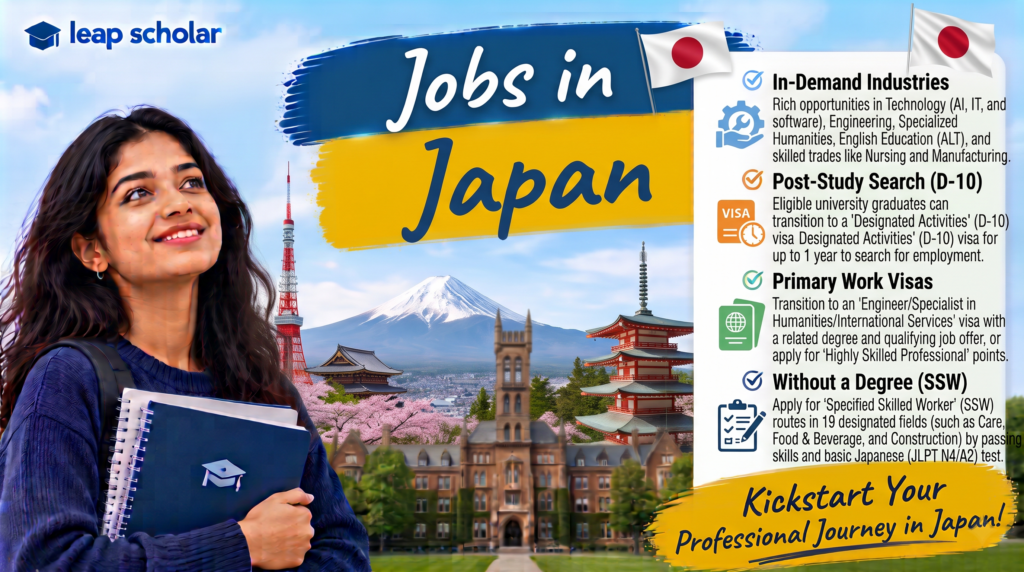
- Jobs in Japan for Indians usually need one visa: Engineer/Specialist in Humanities.
- A job offer comes first; Japan has no points-based immigration route.
- A fresher’s monthly pay in Japan converts to roughly Rs 1.3-1.45 lakh.
- English-only jobs in Japan exist, but most workplaces expect basic Japanese.
Why Jobs in Japan are Opening Up For Indians
Japan’s workforce is aging and shrinking, and the government has steadily widened the entry points for foreign professionals as a result. For Indians specifically, jobs in Japan have become more visible since the India-Japan Memorandum of Cooperation on the Specified Skilled Worker (SSW) framework and the growth of IT, engineering, and caregiving roles that Japanese employers struggle to fill locally.
This has not made Japan an easy market to enter. There is no general points-based immigration system for Indians, unlike Canada or Australia, and no working holiday visa between India and Japan. In practice, this means jobs in Japan for Indians almost always start with a job offer, and the offer decides which visa you apply for.

Choose your dream country
 UK
 USA
 Germany
 Australia
 Ireland
 Canada
 UAE
 France
 Sweden
 Italy
 Other
When do you want to study abroad?
What's your highest level of education?
Have you completed Class 12th?
What was your Class 12 CGPA/percentage?
Are you a student or a parent/guardian?
What do you want to study?
Select your current city
How Leap will help you

Personalised University Shortlist

Express Applications with Quicker Admits

End-to-End Application Support
Which Jobs Are in Demand in Japan Right Now
Jobs in Japan for Indians cluster around a handful of sectors:
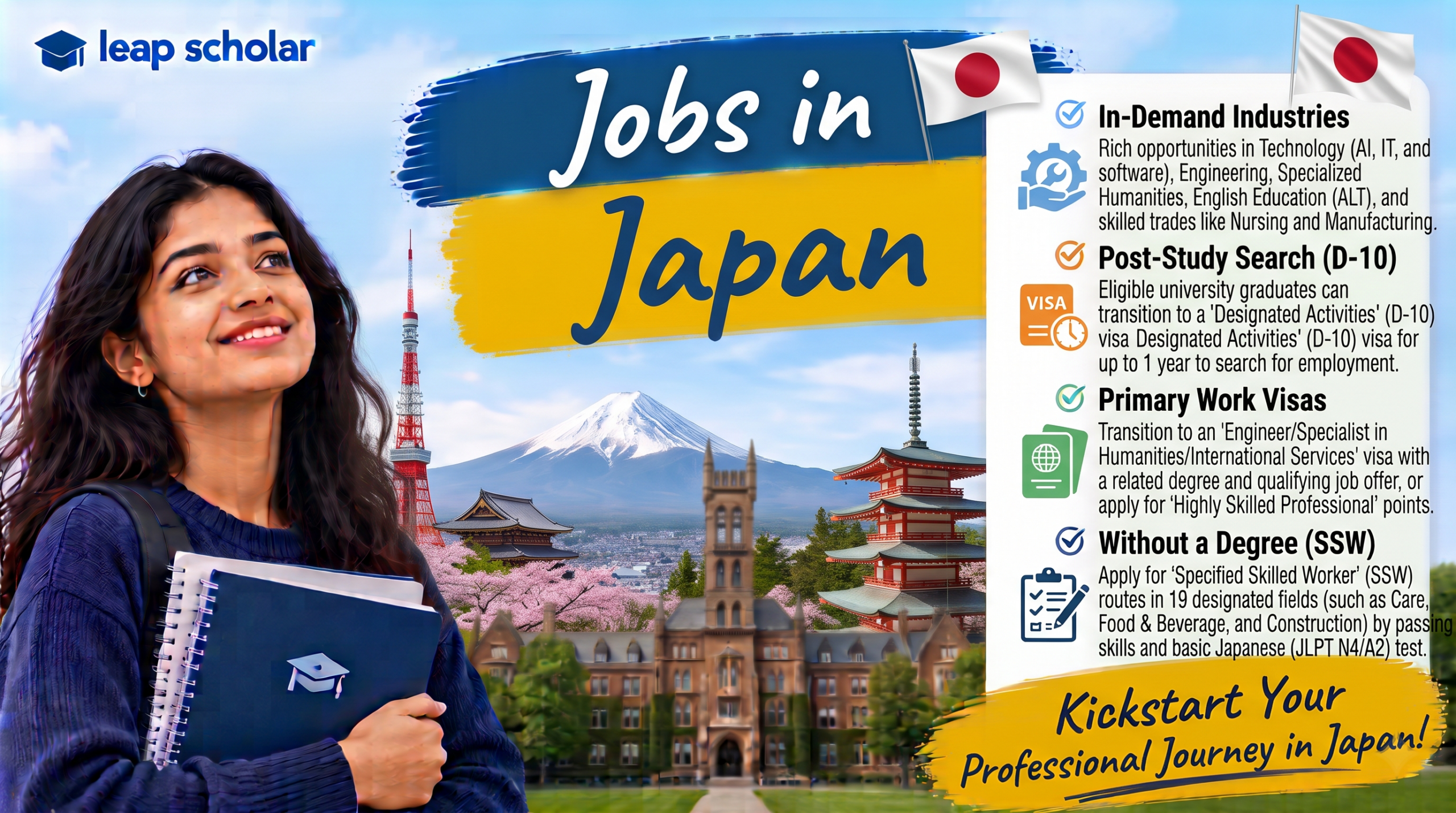
- IT and software development: the field is the largest entry point for Indian graduates, usually through the Engineer/Specialist in Humanities/International Services visa.
- Engineering and manufacturing: mechanical, electronics, and automotive roles, often in regional industrial hubs, not only Tokyo.
- Nursing care: covered under the Specified Skilled Worker (SSW) visa, one of the fastest-growing categories for foreign workers in Japan.
- Hospitality, construction, and agriculture: also SSW-eligible sectors, generally lower-skill entry points with a lower barrier than the engineer visa.
- English teaching: a long-standing route, usually through the Instructor visa for public schools or the Engineer/Specialist in Humanities visa for private language schools.
Counselor insight: students who complete a master's in Japan in a technical subject have an easier time converting to a job than those applying cold from India, since the Engineer/Specialist in Humanities visa accounted for roughly 86% of international-student visa changes in a recent official count. If you are weighing study in Japan as a route into the job market rather than applying directly, this pathway is worth comparing with a direct job search.
Visa Routes For Jobs in Japan: How They Compare
| Visa | Who it suits | Language requirement | Route to PR |
| Engineer/Specialist in Humanities/International Services | IT, engineering, business, or teaching roles with a bachelor's degree (any field) or 10 years' experience | No fixed test, though Japan has proposed requiring proof of Japanese proficiency for roles where Japanese is used | Standard PR track, generally 10 years' residence |
| Specified Skilled Worker (SSW) | Nursing care, construction, agriculture, manufacturing, hospitality | Japanese Foundation Test, or JLPT, usually N4 level, plus a sector skills test | SSW (ii) in some sectors can lead to PR faster than SSW (i) |
| Highly Skilled Professional (J-Skip) | Experienced professionals who score 70+ on a points system covering education, experience, salary, and age | Japanese ability adds points but is not mandatory | Fast-tracked PR, in as little as 1 to 3 years |
| Job-hunting visa (J-Find) | Graduates of top ranked universities (including some overseas) who want to search for a job in Japan without an offer yet | Not specified as a points criterion | Not a work visa itself, it converts to a work visa once a job offer is secured |
For a full breakdown of eligibility and how J-Find and J-Skip interact, see our J-Find and J-Skip visa guide.
Counselor insight: students without a technical degree often assume the Engineer/Specialist in Humanities visa is out of reach, but it also covers business, sales, and international-services roles, so a commerce or humanities background is not automatically ruled out. The harder call is usually SSW versus Engineer/Specialist, since SSW has a lower entry bar but ties you to one sector, while Engineer/Specialist opens more roles but needs a degree or 10 years' experience to qualify at all.
By law, a foreign employee on the Engineer/Specialist in Humanities visa must be paid a salary equal to what a Japanese national doing the same work would earn. This is one reason jobs in Japan for Indians rarely come with a lower "foreigner rate" once the offer is in writing, though the base salary itself depends heavily on sector and city.
Salary For Jobs in Japan: What it Means in INR
Japan's Ministry of Health, Labour and Welfare (MHLW) publishes its Basic Survey on Wage Structure each year, and the survey remains the most reliable source for salary benchmarks, rather than aggregator estimates. Using the 2025 survey (released March 2026) and an exchange rate of 1 JPY to approximately Rs 0.58:
| Category | Annual salary (JPY) | Annual salary (INR, approx.) |
| Average across all occupations (NTA, 2024 income) | ¥4,775,000 | Rs 27.7 lakh |
| New graduate starting range (before bonuses) | ¥2,700,000 to ¥3,000,000 | Rs 15.7 to Rs 17.4 lakh |
| Systems consultants and designers (IT) | ¥8,890,000 | Rs 51.6 lakh |
| Management, finance, and insurance | ¥11,350,000 | Rs 65.8 lakh |
| Highest paid occupation overall: airline pilots | ¥16,320,000 | Rs 94.7 lakh |
| Lowest paid occupation surveyed: building cleaners | ¥2,970,000 | Rs 17.2 lakh |
A few things worth reading in this table rather than past it. The ¥8.89 million IT figure is an average across all experience levels, not an entry-level number, so a fresher should expect to start well below it and work up over several years. New graduates starting pay commonly fall in the ¥225,000 to ¥250,000 per month range before bonuses, which converts to roughly Rs 1.3 to Rs 1.45 lakh a month. Bonuses, usually paid twice a year, can add the equivalent of 2 to 4 months' salary on top of this figure. Exchange rates move, so treat Rs 0.58 per yen as a working assumption and check the live rate before budgeting around it.
Counselor insight: students comparing offers often fixate on the headline annual figure and miss that Japanese salary letters usually quote base pay before the twice yearly bonus, not total compensation. Ask explicitly whether a number you're given is base salary or includes bonuses, since the gap changes your real monthly take-home by a wide margin.
For context on what this salary needs to cover, our cost of living in Japan guide breaks down rent, food, and insurance by city.
Can You Get a Job in Japan Without Speaking Japanese
A narrow but real set of jobs in Japan for English speakers exists: IT roles at companies that operate in English internally, English teaching positions, and some customer-facing roles at multinational firms. These are a minority of listings, not the default.
What is changing: Japan has signaled plans to require proof of Japanese language proficiency for Engineer/Specialist in Humanities/International Services visa applicants whose jobs involve using Japanese, following cases of foreign workers being hired into roles that did not match their visa category. This proposal had not yet been finalized as law at the time of writing, so check the Immigration Services Agency's latest guidance before assuming that an English-only role will remain English-only for the duration of your contract.
How to Apply For Jobs in Japan From India
- Target your sector first. IT, engineering, and English teaching are the most realistic routes without a Japan-based degree; nursing care and hospitality sit under the SSW visa with its skills tests.
- Apply through Japan-facing job boards and campus placements, or complete a relevant degree in Japan, since graduates already in the country convert to a work visa more easily than applicants abroad.
- Get the job offer before the visa. Japanese employers, not a government points system, decide who gets sponsored.
- Match the visa to the role. Most office and technical jobs fall under Engineer/Specialist in Humanities; trades and care roles fall under SSW.
- Budget realistically. Use the INR figures above as a starting point, not a guarantee, since city, employer size, and your experience level move the number significantly.
3 Takeaways on Jobs in Japan
- Jobs in Japan for Indians depend on securing an offer first since there is no points based or working-holiday route into the country.
- Engineer/Specialist in Humanities/International Services covers most IT, engineering, and business roles, while SSW covers nursing care, construction, hospitality, and agriculture.
- Expect a starting salary of roughly Rs 1.3 to Rs 1.45 lakh a month before bonuses for a fresher role, which can rise well beyond that with experience and sector.
Confused about JLPT requirements or visa sponsorship for jobs in Japan? Get a free LeapScholar consultation to map out your next step.
Frequently Asked Questions About Jobs in Japan
-
How can I get a job in Japan?
You generally need a job offer from a Japan-based employer before applying for a work visa, since Japan has no general points-based immigration route. Most Indian applicants get offers through IT and engineering recruiters, campus placements if studying in Japan, or direct applications to multinational employers.
-
Which jobs are in demand in Japan?
IT and software roles, mechanical and electronics engineering, nursing care under the SSW visa, hospitality, construction, and English teaching are the sectors that are currently hiring foreign workers most actively. IT and nursing care currently show the fastest growth in foreign hiring.
-
Is it easy to get a job in Japan as an Indian?
It is not especially easy without a relevant degree or several years of experience, since you need an employer willing to sponsor your visa first. Candidates with IT, engineering, or nursing qualifications, or a degree completed in Japan, generally have an easier path than a cold application from India.
-
How much is a 1 month salary in Japan?
Japan's average monthly wage for full-time workers was about ¥340,600, or roughly Rs 1.98 lakh, per the MHLW's 2025 wage survey. A fresher on an Engineer/Specialist in Humanities visa typically starts lower, around ¥225,000 to ¥250,000 a month before bonuses.
-
What is the highest paying job in Japan?
Airline pilots are the highest paid in Japan, earning an average of ¥16.32 million a year, or about Rs 94.7 lakh, followed by doctors. For foreigners, the most feasible way to get a big salary is to get into IT or finance, with average annual salaries of ¥8.89 million and ¥11.35 million, respectively.
-
Can I get a job in Japan if I don't speak Japanese?
There is some employment for English speakers in Japan in IT, English education, and some multinational corporations, but these are the exception, not the rule. Japan has also proposed that visa applicants demonstrate their ability to speak Japanese if it is required for the job they are applying for.
-
What jobs in Japan are available for English speakers?
English speakers in Japan can work mainly as English teachers, in selected IT positions in organizations that operate in English, and in customer-facing positions in global companies. Most other workplaces require at least basic to conversational Japanese.
-
Which jobs in Japan offer visa sponsorship for Indians?
IT, engineering, and business roles under the Engineer/Specialist in Humanities visa, and nursing care, construction, and hospitality roles under the SSW visa, are the main categories where Japanese employers sponsor Indian applicants. The employer applies for your Certificate of Eligibility once they confirm the offer.
-
Can international students in Japan switch from a study visa to a work visa?
This is the most common route for international graduates in Japan, who typically convert to the Engineer/Specialist in Humanities/International Services visa once they have a job offer. If you are weighing this route, our Japan student visa guide covers how the study-to-work transition works.











Have Questions? Get Guidance to reach your Dream University
Connect with India's finest counsellors and biggest study abroad community.
Get Guidance