
Quick Read
- Google Summer of Code 2027 applications likely open in March.
- India stipends range from Rs.71,250 to Rs.2.85 lakh.
- Contributors must be 18 and new to open source.
- In 2026, 1,141 contributors were selected from 15,245 applicants.
- Coding runs May to August, overlapping Indian summer semester breaks.
- Preparation should begin by August, seven months before applications open.
What Google Summer of Code Is and How the Program Works
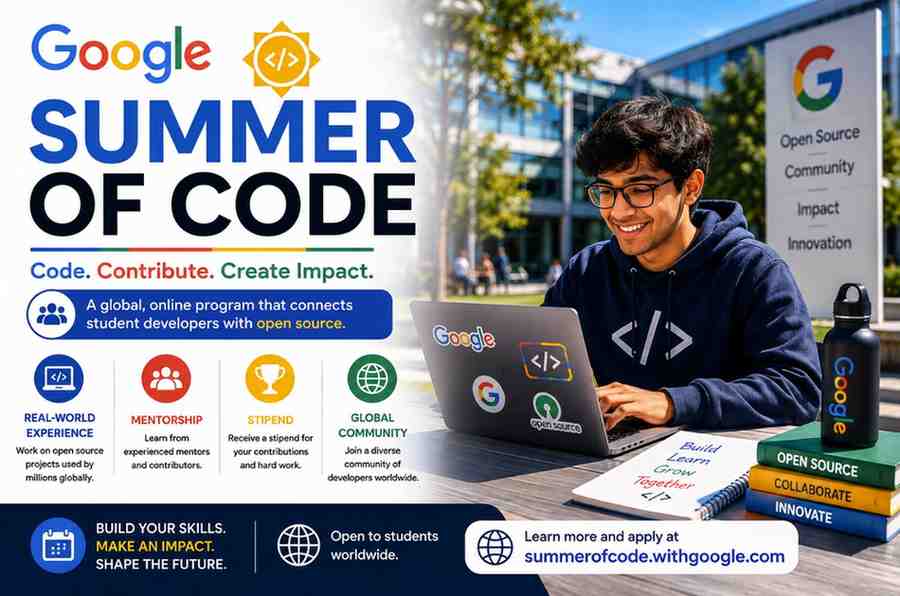
Google Summer of Code is a paid, fully remote program that places beginners into established open-source organizations for a coding project of 8 to 22 weeks, under a volunteer mentor from that organisation. It has run since 2005. Google funds the stipend and administers the program, the open-source organization selects you and mentors you, and you write code that goes into a public repository.
Three parties are involved and only one of them decides your fate. Google does not read your application. Organisations do. Each organisation publishes a list of project ideas, reviews the proposals it receives, and ranks the contributors it wants. Google allocates slots to organisations based on those rankings.

Choose your dream country
 UK
UK
 USA
USA
 Germany
 Australia
 Ireland
 Canada
 UAE
UAE
 France
 Sweden
 Italy
Italy
 Other
Other
When do you want to study abroad?
What's your highest level of education?
Have you completed Class 12th?
What was your Class 12 CGPA/percentage?
Are you a student or a parent/guardian?
What do you want to study?
Select your current city
How Leap will help you

Personalised University Shortlist

Express Applications with Quicker Admits

End-to-End Application Support
The scale is worth knowing before you plan around it. Across the program's history, more than 22,000 contributors from 123 countries have taken part. In the 2026 edition, 15,245 applicants from 131 countries submitted 23,371 proposals, and 1,141 contributors were selected across 184 mentoring organisations. That is roughly a 7% acceptance rate at the applicant level.
The second number changes the picture. Once selected, most contributors finish. Google's own historical data records a 92.91% overall success rate in 2024 and 93.48% in 2023. Getting in is the hard part. Finishing is not.
Counselor insight: The applicant pool tripled after 2022, when the student-enrolment requirement was dropped and self-taught developers and career switchers became eligible. Students still benchmark their odds against pre-2022 numbers they heard from a senior. Plan against a 7% applicant-level rate, not the 20% that was true five years ago.
Google Summer of Code 2027 Timeline: Expected Dates for Indian Applicants
Google has not published the 2027 dates. The program follows a stable annual pattern, and Google's own timeline page states that the timeline can shift slightly each year. The 2026 actual dates below are the correct planning basis until the official 2027 calendar is released, usually in the last quarter of the preceding year.
| Stage | 2026 actual date | Expected 2027 window | What this means in the Indian academic year |
|---|---|---|---|
| Organisation applications open | January 19 | Mid-January | You are in odd-semester end exams or the winter break |
| Accepted organisations published | February 19 | Mid-to-late February | Even semester is underway, mid-term season |
| Discussion period with orgs | February 19 to March 15 | Late February to mid-March | Four weeks, and the busiest month of your semester |
| Contributor applications open | March 16 | Mid-March | Proposal writing collides with practicals and internals |
| Application deadline | March 31 | Late March | No extensions are granted for any reason |
| Results announced | April 30 | Late April | Usually during or just after end-semester exams |
| Community bonding | May 1 to 24 | Early to mid-May | Summer break at most Indian universities |
| Coding begins | May 25 | Late May | Summer break |
| Midterm evaluation deadline | July 10 | Early July | Break ends and odd semester begins mid-July at many colleges |
| Final submissions | August 17 to 24 | Mid-to-late August | Odd semester classes are running |
| Extended project deadline | November 2 | Early November | Odd semester end-exam prep |
Two collisions matter. The application window sits inside the heaviest month of your even semester, so the proposal has to be drafted before March, not during it. And the back half of the coding period overlaps the start of your next semester, which is why the 12-week standard project is more realistic for an Indian student than the 22-week extension.
Counselor insight: Students consistently underestimate the February to March squeeze. The organisation list drops in mid-February and applications close six weeks later, and in those six weeks you are expected to have already been contributing to that codebase. Every accepted contributor we have spoken to started engaging with their organisation before the list was published, using the previous year's list as their shortlist.
Google Summer of Code Stipend for Indian Contributors in Rupees
Google Summer of Code stipends are set by project size and adjusted for each country using Purchasing Power Parity. India sits at the floor of every band. According to Google's official contributor stipend table, the India rates are $750 for a small project, $1,500 for a medium project and $3,000 for a large project.
| Project size | Approximate hours | Coding period | India stipend | Who it suits |
|---|---|---|---|---|
| Small | 90 hours | 8 weeks | Rs.71,250 ($750) | First-time contributors balancing a summer internship or exam backlog |
| Medium | 175 hours | 12 weeks standard | Rs.1,42,500 ($1,500) | The default choice for most Indian applicants, and the largest share of accepted projects |
| Large | 350 hours | 12 to 22 weeks | Rs.2,85,000 ($3,000) | Students with prior merged contributions to that specific codebase |
Exchange rate used: Rs.95 per USD. Verify the current rate before finalising your budget.
Payment is not a lump sum and it is not guaranteed on selection. Google pays 45% after the midterm evaluation and 55% after the final evaluation. If your mentor marks the midterm as a fail, you receive nothing for that half. Your stipend band is fixed by the country you are residing in during the coding period, not your citizenship and not where your college is.
Payouts are routed through Payoneer, which means you need a working account and matching identity documents before the first disbursement window. Treat this as an income event and check your obligations with a tax professional rather than assuming the amount is exempt.
Counselor insight: Aim at the medium project. Students see the Rs.2.85 lakh figure, propose a large project to chase it, and get filtered out because the scope they have promised is not credible from someone with three merged pull requests. Mentors rank realistic scoping highly. An accepted medium project pays more than a rejected large one.
If you are stacking this against other funding for a masters, it also helps to read how scholarships for Indian students to study abroad work alongside stipend income.
Google Summer of Code Eligibility and What You Need Before Applying
Google Summer of Code eligibility is short and strictly enforced. Per the official program FAQ, you must be at least 18 at registration, be a student or a beginner to open source, be eligible to work in your country of residence, not reside in a US-embargoed country, and not have been accepted into GSoC more than twice previously.
| Requirement | What Google asks for | India-specific detail |
|---|---|---|
| Age | 18 or older at time of registration | Class 12 passouts turning 18 mid-year should check their date against the March registration window |
| Status | Student or open source beginner | College enrolment has not been required since 2022. BCA, BSc, diploma and dropout applicants are all eligible |
| Experience level | Beginner, understood as roughly two years or less in open source | Personal projects, class projects and college hackathons do not count against you |
| Prior participation | No more than two previous acceptances | Applies to acceptances, not applications. Rejections do not count |
| Work eligibility | Eligible to work in your country of residence | No employer NOC or college NOC is required |
| Proposals | Up to three, maximum one acceptance | Submitted through the GSoC dashboard, one per organisation |
| Payment setup | Payoneer account | PAN and address proof matching your registration details |
| Academic record | Not assessed | No CGPA cutoff, no college tier filter, no backlog disqualification |
Nothing on this list is a marksheet, a provisional certificate or a bonafide letter. That surprises most Indian applicants, who arrive expecting a document-heavy process and find that the entire evaluation is your proposal and your contribution history.
Counselor insight: The clause students misread is "beginner." It is not a floor, it is a ceiling. If you have been a regular contributor or a maintainer on a serious project for years, you are outside the intended pool. If you have submitted your first four pull requests this semester, you are exactly who the program is for.
How to Apply for Google Summer of Code 2027: A Month-by-Month Plan
Applying for Google Summer of Code is a seven-month process with a two-week paperwork window at the end. Working backwards from a mid-March 2027 deadline:
| Month | What to do | Why it matters |
|---|---|---|
| August to September 2026 | Shortlist two or three organisations from the 2026 list, in a language you can already debug | The 2027 list overlaps heavily with 2026 |
| October 2026 | Build the codebase locally. Join the organisation's Discord, Zulip or mailing list | Build failures are what stall most beginners in March |
| November to December 2026 | Submit your first pull requests. Aim for merged, not opened | Two merged PRs in one codebase beat twenty across twenty |
| January 2027 | Keep contributing through odd-semester end exams, at any pace | Consistency across months is the signal mentors read |
| February 2027 | Organisation list drops. Ask questions in public channels, follow contributor guidance exactly | Unsolicited PRs that ignore guidance get you deranked |
| Early March 2027 | Draft the proposal: problem, approach, week-by-week plan, testing, exam dates | March is your heaviest month of practicals and internals |
| Mid-March 2027 | Revise with mentor feedback if invited, then submit on the GSoC dashboard | No deadline extensions are granted for any reason |
On AI tooling, the rule is set by each organisation, not by Google. Google's contributor guidance on AI tooling states that some organisations do not permit any AI use including in proposal writing, that the contributor retains full responsibility for the work, and that you should not use generated code you cannot explain. Read your organisation's stated position before you use anything.
The proposal is a persuasion document with a technical spine, and the failure modes are the same ones that sink a Statement of Purpose: vague goals, no evidence, and no specificity about why this organisation. If you have written an SOP for an internship application before, the structural logic transfers directly.
Counselor insight: Selection is largely decided before the application window opens. Mentors rank people whose names they already recognise from the issue tracker. A brilliant proposal from a stranger loses to a competent proposal from someone who has been visibly present in the community since October.
3 Takeaways on Google Summer of Code 2027
- Treat August 2026 as your start date rather than March 2027, because selection is decided by the contribution history you build before the application window opens.
- Budget for the medium project at Rs.1,42,500 ($1,500), since India sits at the floor of every stipend band and the 12-week standard track is the realistic target.
- Shortlist two organisations from the 2026 list this month and get one pull request merged before the 2027 organisation list is published in February.
Verified by: LeapScholar's STEM admissions counseling team, with hands-on experience guiding Indian students through computer science applications, profile building and university shortlisting.
Have questions about how open source work fits into your MS application? Book a free session with a LeapScholar counselor.
Frequently Asked Questions About Google Summer of Code
-
Does Google Summer of Code help with MS admissions abroad?
It provides externally evaluated technical work, a verifiable public commit history, and a mentor who can write a specific recommendation letter. Those are meaningful for competitive computer science programs, particularly for applicants without research output. It does not compensate for a weak academic record or missing test scores, and it works best when written up as one concrete technical decision rather than a credential.
-
Is Google Summer of Code an internship at Google?
Contributors are independent developers receiving a stipend, not Google employees or interns, and not employees of the mentoring organisation. Google states directly that the program is not a recruitment channel and that participation does not guarantee employment. You work with an open-source community, not with Google engineers, and there is no office, no travel and no NDA.
-
What should I do if my GSoC proposal is rejected?
Email the mentor in May, once selections are finished, and ask for specific feedback on where the proposal fell short. Keep contributing to the same codebase through the year. Rejections do not count toward the two-acceptance limit, so you can reapply, and returning applicants with a longer contribution history are ranked more favourably.
-
Can I use AI tools to write my GSoC proposal?
Each organisation sets its own policy and you must read theirs before using anything. Some prohibit AI entirely, including in proposals. Google's contributor guidance states that you retain full responsibility for the work and should not submit generated code you cannot explain or verify. Proposal writing in particular should not be handed over to a tool.
-
How hard is it to get selected for Google Summer of Code?
In 2026, 1,141 contributors were selected from 15,245 applicants who submitted 23,371 proposals, which is roughly a 7% acceptance rate. Completion rates are the opposite: Google's published statistics record success rates above 92% in recent cycles. The difficulty is concentrated entirely in selection, and selection is driven by pre-application contributions.
-
Do I need to be a college student to apply for GSoC?
Enrolment has not been required since 2022. The program is open to anyone 18 or older who is a student or a beginner to open source, which includes graduates, self-taught developers and career switchers. You do not need a college ID, a bonafide certificate or any enrolment proof to register or to be paid.
-
Can I apply for Google Summer of Code in my second year?
Second-year students are eligible and are selected every cycle. There is no year-of-study requirement and no CGPA cutoff. Selection depends on your contribution history with the organisation and the quality of your proposal. Second year is arguably the best time to apply, because you have no placement season competing for the summer coding period.
-
How much does Google Summer of Code pay Indian students?
India sits at the base of Google's Purchasing Power Parity bands. Contributors receive Rs.71,250 ($750) for a small project, Rs.1,42,500 ($1,500) for a medium project and Rs.2,85,000 ($3,000) for a large project. Payment arrives in two instalments, 45% after the midterm evaluation and 55% after the final evaluation, and only if both are passed.
-
When will Google Summer of Code 2027 applications open?
Google has not announced the 2027 dates. Based on the 2026 cycle, expect the accepted organisation list in mid-February 2027 and a contributor application window of roughly two weeks in the second half of March. In 2026 the window ran from March 16 to March 31. Confirm on the official GSoC site once the calendar is published.
-
What is Google Summer of Code and how does it work?
Google Summer of Code is a global online program that pairs beginners with open source organisations for a mentored coding project. Google funds the stipend, participating organisations publish project ideas and select contributors from submitted proposals, and accepted contributors code for 8 to 22 weeks under a volunteer mentor. It has run annually since 2005 and is entirely remote.







Have Questions? Get Guidance to reach your Dream University
Connect with India's finest counsellors and biggest study abroad community.
Get Guidance