
Quick Read
- Only 5 Singapore institutions officially confirm Duolingo acceptance.
- NUS, NTU, and SMU do not accept Duolingo as of 2026.
- A Duolingo score of 120 typically converts to an IELTS 6.5 equivalent.
- Singapore’s Student Pass itself has no English test requirement at all.
- DET costs roughly Rs.6,200, far less than IELTS at Rs.17,500.
- James Cook University Singapore accepts DET across most degree programs.
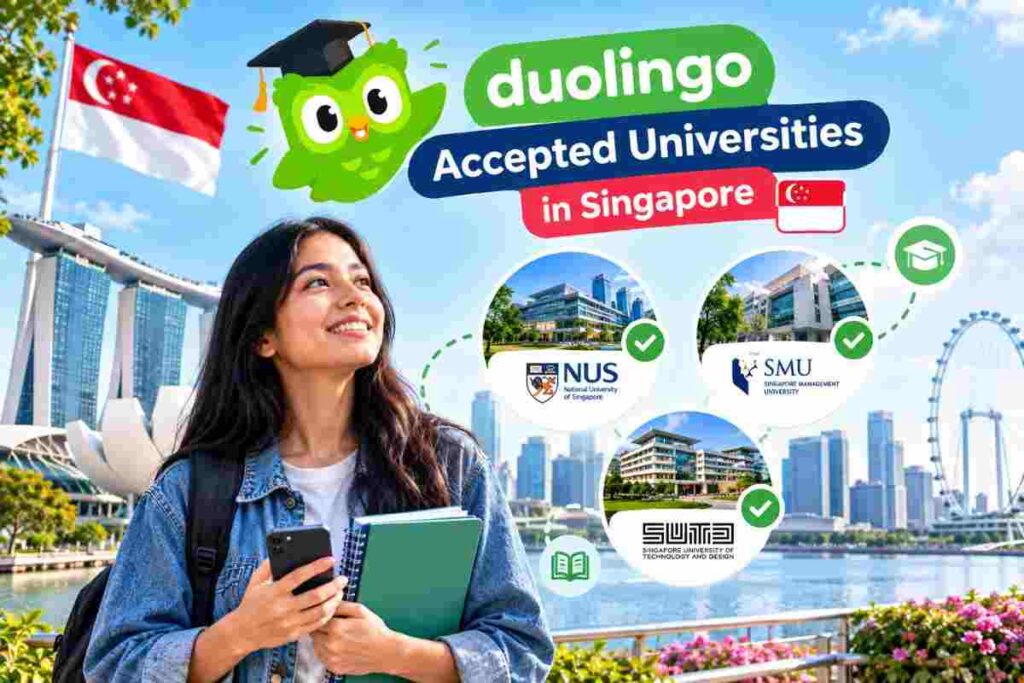
Most “Duolingo accepted universities in Asia” lists lump Singapore in with a dozen other countries and move on. Some go further and imply that NUS accepts it. It doesn’t, and neither does NTU or SMU. Here is the verified, Singapore-specific list, straight from each institution’s own admissions page and Duolingo’s own official records, plus what that means if you’re applying a year out for 2027-28.
A note on timing: every policy in this guide comes from each university’s most recently published document, dated for the 2026 admissions cycle. Universities typically reissue or reconfirm English-test policies before each new intake opens rather than overhauling them, so this is a solid working baseline for 2027-28 planning. Still, don’t treat it as locked. Confirm directly with your target university’s admissions office once you’re within a few months of applying, since a policy can change between cycles even if it rarely does.
What are the Duolingo Accepted Universities in Singapore?
Five institutions in Singapore currently confirm acceptance of the Duolingo English Test (DET), according to Duolingo’s own official list of accepting institutions. All five are private or international campus institutions, not Singapore’s autonomous public universities.

Choose your dream country
 UK
UK
 USA
USA
 Germany
 Australia
 Ireland
 Canada
 UAE
UAE
 France
 Sweden
 Italy
Italy
 Other
Other
When do you want to study abroad?
What's your highest level of education?
Have you completed Class 12th?
What was your Class 12 CGPA/percentage?
Are you a student or a parent/guardian?
What do you want to study?
Select your current city
How Leap will help you

Personalised University Shortlist

Express Applications with Quicker Admits

End-to-End Application Support
| Institution | Type | Popular Programs | Duolingo Status |
|---|---|---|---|
| James Cook University (Singapore campus) | Australian university, Singapore campus | Business, Psychology, Environmental Science | Accepted for most programs |
| Singapore Institute of Management (SIM) | Private institution with overseas university partnerships | Business, Social Sciences | Accepted |
| Nanyang Academy of Fine Arts (NAFA) | Private arts institution | Design, Music, Dance, Theatre | Accepted |
| LASALLE College of the Arts | Private arts institution | Fine Arts, Design, Film, Performing Arts | Accepted |
| Murdoch University (Singapore campus) | Australian university, Singapore campus | Business, IT, Communications | Accepted |
Counselor insight: Don't assume that the "Singapore campus of an Australian university" always has the same admissions rules as the home campus in Australia. James Cook University's Townsville and Singapore campuses run separate admissions systems, and a Duolingo score accepted in Singapore isn't automatically transferable if you later apply to the Australian campus instead.
For program-specific detail on these and other Singapore institutions, top universities in Singapore cover rankings, fees, and courses beyond this English-test list.
Why NUS, NTU, and SMU Don’t Accept the Duolingo English Test
This is the correction most competing guides get wrong. Singapore's three autonomous universities, the ones Indian students usually mean when they say "study in Singapore," do not accept Duolingo as of 2026.
- NUS (National University of Singapore): NUS's own English Language Test Scores document lists IELTS Academic, PTE Academic, TOEFL iBT, TOEFL Essentials, C1 Advanced, MUET, and EL1119 as acceptable. Duolingo is not on this list.
- NTU (Nanyang Technological University): NTU's admission pages for both undergraduate and postgraduate applicants list IELTS, TOEFL, SAT, ACT, PTE Academic, and C1 Advanced. Duolingo does not appear.
- SMU (Singapore Management University): SMU's official international qualifications page lists SAT, ACT, IELTS, C1 Advanced, PTE Academic, and AST. Duolingo is absent here too.
If you've seen a blog claim that "NUS accepts Duolingo for selected programs," that claim doesn't hold up against NUS's own published document, which is dated as current for the 2027 admissions cycle.
Counselor insight: Students sometimes take Duolingo first because it's faster and cheaper, then discover their target NUS or NTU program doesn't accept it. If NUS, NTU, or SMU is anywhere on your shortlist, take IELTS or TOEFL from the start rather than risk a second test closer to your deadline.
For a full breakdown of which test each Singapore university needs and why, exams required for Singapore universities go deeper into GRE, GMAT, and English test requirements by school.
Duolingo Score Requirements: What You’ll Need to Aim For
If you're applying to one of the five DET-accepting institutions, your target score depends on the university's general English benchmark, since none of them publish a Singapore-specific DET cutoff separate from their usual IELTS or TOEFL requirement. Using Duolingo's own official concordance table as a guide:
| Duolingo Score | Approximate IELTS Equivalent | Approximate TOEFL iBT Equivalent | Typical Use Case |
|---|---|---|---|
| 105 | 6.0 | 79-86 | Foundation and diploma-level programs |
| 115 | 6.0-6.5 | 87-92 | Standard undergraduate admission |
| 120 | 6.5 | 93-97 | Most undergraduate and postgraduate programs |
| 130 | 7.0-7.5 | 102-109 | Competitive postgraduate and business programs |
James Cook University Singapore, for instance, generally asks for an IELTS equivalent of 6.0 to 6.5 depending on the program, which maps to a Duolingo score in the 105 to 120 range. Always confirm the exact figure with the specific school and program, since each school sets its own thresholds and can change them between intakes.
Counselor insight: A Duolingo score of 120 is often treated as equivalent to IELTS 6.5 by universities, even though Duolingo's own concordance data places it closer to the 6.5 boundary rather than comfortably above it. If your target program states IELTS 6.5 as a strict minimum, aim for a Duolingo score of 125 rather than exactly 120 to leave yourself a buffer.
For the complete score conversion logic across all major tests, Duolingo score to IELTS conversion breaks down every band in detail.
How to Apply Using Duolingo: Step-by-Step for Indian Students
| Document/Step | India-Specific Detail |
|---|---|
| Duolingo English Test booking | Book online at Duolingo Website; test fee is roughly Rs.6,200 |
| Valid ID for the test | Indian passport is the accepted ID; Aadhaar or PAN card is not sufficient on its own |
| Score report | Results typically arrive within 48 hours and can be sent to multiple institutions directly through your Duolingo account |
| University application | Submit alongside academic transcripts, SOP, and recommendation letters as per each institution's portal |
| Confirmation of acceptance | Email the admissions office directly to confirm your specific program accepts DET before you sit the test, not after |
Planning Calendar:
| Month | What to Do |
|---|---|
| September to November | Shortlist DET-accepting institutions and confirm current-year acceptance directly with admissions |
| December | Book and take the Duolingo English Test |
| January to February | Submit applications with DET score attached |
| March to May | Receive admission decisions |
| June to July | Apply for Student's Pass through the institution's SOLAR+ submission |
| August | Travel and enrollment |
What to do if it goes wrong: If your target program rejects your Duolingo score after you've already taken the test, most institutions will accept IELTS or TOEFL as a follow-up submission without penalizing your application, provided you submit it before the admissions deadline. Contact the admissions office immediately rather than waiting for a second rejection.
Counselor insight: Indian students sometimes assume a Duolingo score sent to one Singapore institution automatically applies to a second application at a different institution. It doesn't. You need to actively select and send your score to each institution separately through the Duolingo portal.
What If Your Target University Doesn’t Accept Duolingo?
If NUS, NTU, SMU, or another autonomous institution is on your list, you have three clear options.
- Take IELTS or TOEFL instead. This remains the most reliable route for Singapore's public universities, and both are accepted across every institution mentioned in this guide.
- Check for a medium-of-instruction waiver. If you completed your entire undergraduate degree in English, some Singapore universities will waive the English test requirement altogether. This is program-specific and not automatic, so confirm directly with admissions.
- Explore Singapore's broader pathways without IELTS. Several institutions accept SAT, PTE Academic, or C1 Advanced as alternatives depending on the program.
Study in Singapore without IELTS covers these alternative routes from university to university.
It's worth remembering that Singapore's Student's Pass itself, issued by the Immigration and Checkpoints Authority (ICA), carries no English test requirement of its own. The English test is entirely an admissions matter set by your university, not an immigration requirement. Once you have an admission offer, the visa's language requirement is already satisfied.
Counselor insight: Don't confuse a university's English test requirement with a visa requirement. Students occasionally delay their visa application, waiting for a language-related step that ICA never actually asks for.
Should You Take Duolingo for Singapore? A Decision Framework
If you are applying to an arts or design program at NAFA or LASALLE, Duolingo is a genuinely efficient choice. Both institutions confirm acceptance, the test is faster and cheaper than IELTS, and your portfolio typically carries more admissions weight than your English score at this stage.
If you are applying to a business program and comparing James Cook University Singapore, SIM, or Murdoch Singapore against NUS or NTU, decide early which tier you're targeting. If NUS or NTU stays on your shortlist even as a backup, take IELTS or TOEFL from the outset rather than sitting two different English tests.
If you are set on NUS, NTU, or SMU specifically, skip Duolingo entirely for this application. None of the three currently accept it, and submitting a DET score to any of them will not fulfill their English proficiency requirement.
3 Takeaways on Duolingo Accepted Universities in Singapore
Singapore's Duolingo acceptance picture is narrower than most guides suggest, but it's also clearer once you know where the line sits.
- Confirm before you test. Check your specific target university's current DET policy directly with admissions before booking the test, since acceptance is limited to five confirmed institutions.
- Don't gamble on NUS, NTU, or SMU. If any of these three are on your shortlist, take IELTS or TOEFL from the start rather than risk a rejected score close to your deadline.
- Remember the visa is separate. Singapore's Student's Pass has no English test requirement of its own, so don't let a university-level English test decision delay your visa planning.
Verified by: LeapScholar's Singapore counseling team, with hands-on experience guiding Indian students through NUS, NTU, SMU, and private-institution applications.
Have questions about Duolingo acceptance in Singapore? Book a free session with a LeapScholar counselor.
Frequently Asked Questions About Duolingo Accepted Universities in Singapore
-
Which universities in Singapore accept the Duolingo English Test?
Five, according to Duolingo's own list: James Cook University Singapore, Singapore Institute of Management, Nanyang Academy of Fine Arts, LASALLE College of the Arts, and Murdoch University's Singapore campus. Notice a pattern there; all five are private or international campus institutions, not the big autonomous names.
-
Does NUS accept the Duolingo English Test?
It doesn't, and their own English Language Test Scores document makes that clear for the 2027 cycle. IELTS, PTE, TOEFL iBT, TOEFL Essentials, C1 Advanced, MUET, and EL1119 are listed, but Duolingo isn't. You may have seen a blog that claims otherwise. It's wrong, so don't build your application timeline around it.
-
Does NTU or SMU accept Duolingo?
Neither one does. NTU's admission pages list IELTS, TOEFL, SAT, ACT, PTE Academic, and C1 Advanced, while SMU's qualifications page runs SAT, ACT, IELTS, C1 Advanced, PTE Academic, and AST. Duolingo simply isn't part of either school's admissions picture in 2027.
-
What Duolingo score do I need for Singapore universities?
There's no single answer, since none of these schools publish a Singapore-specific DET number separate from their usual English benchmark. Going by Duolingo's own concordance table, expect somewhere between 105 and 120 for standard undergraduate entry and 130 or higher if you're eyeing a competitive postgraduate seat.
-
How many universities worldwide accept the Duolingo English Test?
Duolingo puts the figure at over 6,500 programs globally as of mid-2026, which sounds reassuring until you remember it's a worldwide average. Acceptance swings a lot by country and institution, so that big number tells you almost nothing about your specific target school.
-
Is Duolingo accepted in Australia and New Zealand as well?
Plenty of universities in both countries take it, and the list keeps growing. Still, resist the urge to assume Singapore's pattern carries over; each destination sets its own rules, so pull up the dedicated list for wherever you're actually applying rather than guessing from this one.
-
Do I need IELTS if my Singapore university rejects my Duolingo score?
Usually you're not stuck. Most institutions will take a follow-up IELTS or TOEFL score as long as it arrives before the deadline. The key is speed; as soon as admissions tells you Duolingo won't work, start working on the alternative instead of waiting for a formal rejection letter to confirm it.
-
Does Singapore's student visa require an English test score?
It's purely a university matter, not a visa one. The Student's Pass, handled by the Immigration and Checkpoints Authority, doesn't ask for an English test at all. Once you're holding an offer letter, whatever test got you there has already done its job, and the visa process moves on without it.
-
Is Duolingo cheaper than IELTS for Singapore applications?
By a wide margin, Duolingo costs roughly Rs. 6,200, while IELTS costs around Rs. 17,500. That's a significant amount of money if you're applying to one of the five confirmed institutions. Just don't let the savings lure you into choosing Duolingo if you actually want to land at NUS, NTU, or SMU.
-
Will this list still be accurate for the 2027-28 intake?
Most likely, but confirm before you test. Every figure here comes from each university's 2027-cycle document, and English-test policies tend to carry forward largely unchanged between admissions cycles. Still, universities can and do update these pages, so recheck your target institution's admissions site once you're within a few months of applying for 2027-28.








Have Questions? Get Guidance to reach your Dream University
Connect with India's finest counsellors and biggest study abroad community.
Get Guidance