
Quick Read
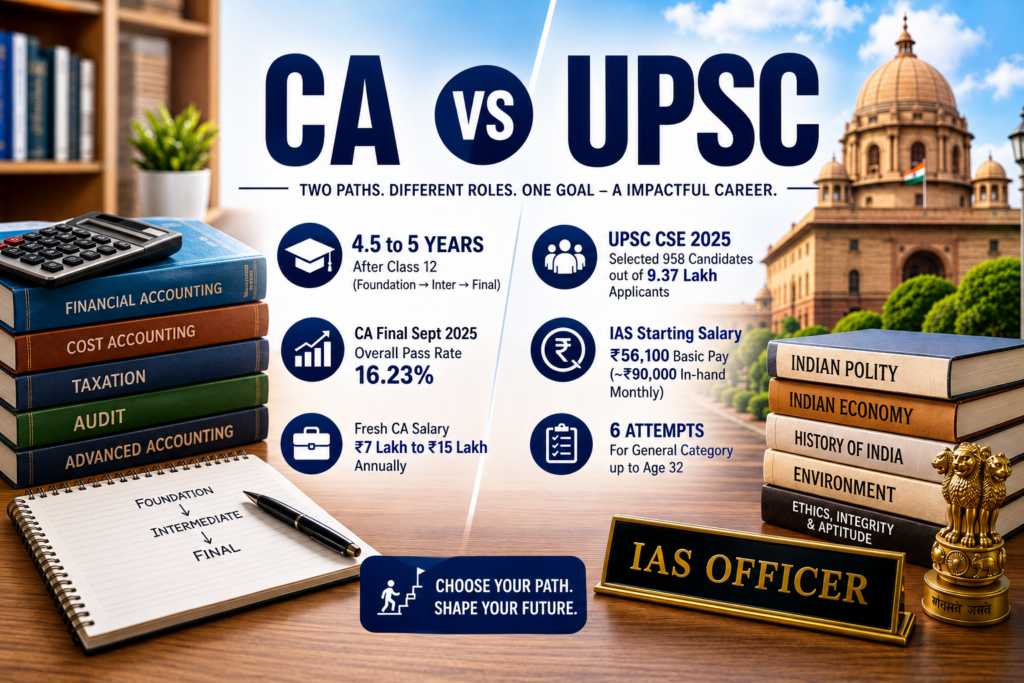
- CA usually takes 4.5 to 5 years after Class 12, across Foundation, Inter, and Final.
- Only 958 candidates made it through UPSC CSE 2025, out of 9.37 lakh who applied.
- ICAI’s September 2025 CA Final attempt had a pass rate of 16.23%.
- Freshly qualified CAs usually land somewhere between Rs.7 lakh and Rs.15 lakh a year.
- An IAS officer’s basic pay starts at Rs.56,100, closer to Rs.90,000 once you add allowances.
- If you’re in the General category, UPSC gives you 6 shots at cracking it, up to age 32.
CA vs UPSC: Why the Comparison Isn’t as Simple as It Looks
CA and UPSC get compared far more often than the two actually have in common. CA is a professional qualification through ICAI. UPSC is a government exam that puts you into administrative service. Before any CA vs UPSC debate about difficulty or salary makes sense, it helps to see the two side by side.
| Factor | CA (Chartered Accountancy) | UPSC (Civil Services Examination) |
|---|---|---|
| Conducted by | ICAI (Institute of Chartered Accountants of India) | UPSC (Union Public Service Commission) |
| Entry point | After Class 12 (Foundation route) or after graduation (Direct Entry) | After graduation, any stream |
| Structure | Foundation, Intermediate, 3-year Articleship, Final | Prelims, Mains, Interview |
| Typical duration | 4.5 to 5 years after Class 12 | No fixed course; most clear it in 2 to 4 years of preparation |
| Sector | Private practice, corporates, Big 4, PSUs | Government service (IAS, IPS, IFS, and other Group A/B posts) |
| Attempts allowed | Unlimited, until you clear each level | 6 for General/EWS, 9 for OBC, unlimited for SC/ST (within age limit) |

Choose your dream country
 UK
UK
 USA
USA
 Germany
 Australia
 Ireland
 Canada
 UAE
UAE
 France
 Sweden
 Italy
Italy
 Other
Other
When do you want to study abroad?
What's your highest level of education?
Have you completed Class 12th?
What was your Class 12 CGPA/percentage?
Are you a student or a parent/guardian?
What do you want to study?
Select your current city
How Leap will help you

Personalised University Shortlist

Express Applications with Quicker Admits

End-to-End Application Support
That structural gap is why "CA vs UPSC, which is better" rarely has one clean answer. The choice is between financial independence in the private sector and administrative authority in government.
My insight: Half the time when students say CA vs UPSC CSE, what they actually mean is CA vs IAS. UPSC CSE isn't just IAS though; it covers IPS, IFS, and a bunch of other services, each with its own postings and pay scale. So clearing UPSC doesn't automatically mean you're becoming an IAS officer.
So, Is CA or UPSC Actually Tougher to Clear?
Here's where most articles on this topic get it wrong. They'll put CA's pass percentage right next to UPSC's success rate like the two numbers mean the same thing. They really don't.
CA Final's pass rate is calculated per attempt, among students who appear for that specific sitting. The September 2025 attempt showed a 16.23% overall pass rate for CA Final, with 11,466 candidates qualifying. Intermediate saw 10.06% clear both groups, and Foundation came in at 14.78%.
CA Final's pass rate only counts people who actually showed up for that specific sitting. In the September 2025 attempt, 16.23% cleared CA Final overall, with 11,466 candidates qualifying. Intermediate came in at 10.06% for both groups combined, and Foundation landed at 14.78%.
| Metric | CA Final (Sept 2025) | UPSC CSE 2025 |
|---|---|---|
| What's measured | Pass rate per attempt, per level | Selection rate across total applicants |
| Candidates in the pool | 16,800 registered for Final | 9,37,876 applied |
| Candidates who cleared | 11,466 | 958 |
| Resulting percentage | 16.23% | Roughly 0.1% of applicants |
So when someone asks UPSC vs CA which is tougher using these two numbers alone, they're comparing a per-sitting pass rate against a lifetime-applicant-pool selection rate. That's not a fair fight. CA demands sustained technical mastery across multiple levels over years, while UPSC demands surviving a funnel where most applicants are filtered out well before the final list is drawn up.
My insight: For a fairer comparison, look at UPSC's Prelims-to-Mains conversion. Roughly 14,000 out of 5.76 lakh who appeared made it to Mains in 2025, about 2.4%, still tighter than any single CA level.
CA vs UPSC Eligibility Checklist: Age, Education, and Attempts
| Requirement | CA | UPSC |
|---|---|---|
| Minimum education | Class 12 pass (any stream) for Foundation route | Bachelor's degree from a recognised university, any stream |
| Age limit | None | 21 to 32 (General/EWS), up to 35 (OBC), up to 37 (SC/ST) |
| Direct entry option | Commerce graduates with 55% or higher and other graduates with 60% or higher can skip Foundation | Final-year graduates can appear for Prelims provisionally |
| Number of attempts | Unlimited at every level | 6 (General/EWS), 9 (OBC), unlimited for SC/ST within age limit |
| Mandatory training | 3-year Articleship before Final | Training at LBSNAA after final selection |
My insight: "Unlimited attempts" for CA sounds reassuring, but it isn't free; each reattempt adds months of fees and delays articleship and placement cycles.
CA vs UPSC Salary: What the Numbers Actually Say
Salary is usually the deciding factor in any “CA vs UPSC, which is better?” conversation, so real numbers matter more than vague claims.
CA salary in India (2026):
| Profile | Typical Annual Package |
|---|---|
| Fresher (regular firm) | Rs.7 lakh to Rs.12 lakh |
| Fresher (Big 4 firm) | Rs.8 lakh to Rs.14 lakh |
| ICAI campus placement average (2025 cycle) | Around Rs.12 lakh to Rs.13 lakh |
| Highest domestic package (ICAI campus, 2025) | Around Rs.26 lakh |
| After 5 to 10 years, senior roles | Rs.25 lakh to Rs.50 lakh+ |
| CFO/Partner level, 15+ years | Rs.50 lakh to Rs.1 crore or more |
IAS salary in India (2026), under the 7th Pay Commission:
| Rank | Basic Pay (monthly) | Approx. Gross In-Hand (monthly) |
|---|---|---|
| Entry-level (Level 10) | Rs.56,100 | Roughly Rs.85,000 to Rs.95,000, with DA, HRA, TA |
| District Collector (Level 12-13) | Rs.78,800 to Rs.1,18,500 | Higher, city and posting dependent |
| Cabinet Secretary (Level 18, after 37+ years) | Rs.2,50,000 | Rs.2,50,000+, plus non-cash perks |
The Dearness Allowance stands at 60% of basic pay (effective January 2026) and is revised twice a year, so the in-hand figure will shift. IAS officers also get an official residence, vehicle, staff, and a pension that CA, as a private-sector qualification, does not offer.
My insight: A newly qualified CA at a Big 4 firm can out-earn an entry-level IAS officer in year one. That flips by years 15 to 20 for senior IAS officers, once non-cash perks and job security are counted alongside basic pay.
CA vs IAS: Who Is More Powerful
This is a different question from who earns more. CA vs IAS: Who is more powerful usually comes down to what kind of power you mean.
- A CA holds financial authority: Signing off on audits, structuring tax positions, and advising boards carries real weight in the corporate world, but it's authority within a client relationship or a company.
- An IAS officer holds administrative and executive authority: A District Collector oversees law and order, disaster response, and government scheme implementation for an entire district, answerable to the state and central government, not to a client.
Neither is "more powerful" in an absolute sense; it's really the “CA vs IAS, which is better?” question framed differently. Two quick ways to see the split:
- Choose CA-style power if you want influence that's domain-specific and negotiated, built through client trust and technical expertise.
- Choose IAS-style power if you want positional authority backed by the machinery of the state over public systems rather than private clients.
CA vs UPSC: Which One Should You Choose
Commerce student who genuinely enjoys accounting, taxation, and financial analysis
CA is the more natural fit. The syllabus rewards technical depth, and the private sector pays for it quickly through Big 4 firms or ICAI's campus placement route.
Drawn to governance and administrative impact on people's lives
UPSC is worth the multi-year commitment, provided you're honest about your attempt count and age limit. Most successful candidates clear it on their second or third attempt, not their first.
Leaning toward "prestige" more than genuine interest in either field
Pause before committing years. An MBA is a milder alternative many overlook, with a shorter entrance-exam timeline.
Comparing GMAT and CAT is worth doing before locking into a multi-year CA or UPSC commitment.
CA vs UPSC CSE: Can You Attempt UPSC After Qualifying as a CA?
Yes, and honestly it happens more than you'd think. Once you're a qualified CA, ICAI's own registration already counts you as a graduate, which is all UPSC asks for on the education front.
- CAs attempting UPSC often have an edge in the Economy section of GS Paper 3, given their taxation and financial background.
- Many choose Commerce and Accountancy or Economics as their optional subject, since it overlaps with CA preparation.
- The reverse rarely happens: UPSC's syllabus doesn't map back onto CA's technical requirements, so IAS officers have no similar shortcut into CA.
This overlap is part of why the CA vs UPSC CSE debate isn't always either-or for finance-background students, several of whom use CA as a fallback while attempting UPSC within their permitted attempts.
CA vs UPSC Exam Cycle Calendar: When Each Path Actually Moves
| Period | CA | UPSC |
|---|---|---|
| January | Foundation, Intermediate, and Final exams (one of three annual sessions) | Interview/Personality Test round for the previous year's Mains qualifiers |
| February to April | Registration window for May/June attempt | UPSC releases the annual CSE notification |
| May to June | Foundation, Intermediate, Final exam session | Preliminary Examination |
| August to September | Foundation, Intermediate, Final exam session (third annual cycle) | Main (written) Examination |
| October to December | Results processing and articleship continue | Mains results, interview shortlisting |
ICAI now conducts Foundation, Intermediate, and Final exams three times a year (January, May/June, and September) under its revised scheme, giving CA students more attempt opportunities per year than UPSC's single annual cycle.
When a CA or UPSC Attempt Doesn’t Go Your Way
Failing an attempt at either of these isn't the disaster it feels like at the time, but what you do next matters.
Didn't clear CA Intermediate or Final?
Re-register for the next session (there are three a year now), and instead of restudying everything, go after the specific paper group that pulled your score down. Articleship keeps running in parallel, so a failed attempt doesn't put your training on hold.
Didn't clear UPSC Prelims or Mains?
Before you commit to another year, check how many attempts you actually have left against your category's limit. Attempts start counting the moment you sit for even one Prelims paper, not from when you finally clear something.
Running low on UPSC attempts and nothing's worked yet?
This is usually the point where people start seriously looking at an MBA or CA as a fallback, rather than burning every remaining attempt on the same route. Some also look at global finance qualifications like ACCA, which covers similar accounting ground but with international recognition, as a way out of the CA vs UPSC frame entirely.
Failed CA Final more than once?
A lot of students use that gap to lean harder into their articleship work instead of just re-reading textbooks, and it tends to show up as better performance on application-based questions the next time around.
Key Takeaways on CA vs UPSC
- CA vs UPSC isn't a difficult contest with one right answer. They measure difficulty differently, and a fair comparison should never put CA's per-attempt pass rate directly against UPSC's total-applicant selection rate.
- CA generally wins on faster earning potential and career flexibility; UPSC wins on administrative authority, prestige breadth, and long-term job security.
- If you're still unsure after comparing both, evaluate why you're drawn to either path before committing years and multiple attempts to one over the other.
Verified by: LeapScholar's career guidance team, with experience helping commerce students evaluate finance, civil services, and study-abroad career paths before committing to a multi-year plan.
Have questions about your career options after Class 12 or graduation? Book a free session with a LeapScholar counselor.
Frequently Asked Questions About CA vs UPSC
-
CA vs UPSC which is better?
There's no universal winner here, honestly. CA gets you to financial independence faster and the earning ceiling is basically uncapped. UPSC gives you administrative authority, real job security, and a pension you'll never get from a private qualification. It really comes down to whether finance or governance pulls at you more.
-
CA vs IAS which is better in terms of respect and prestige?
IAS wins on sheer breadth of respect. District Collectors and Secretaries carry government authority that people across every section of society recognise instantly. CA commands real respect too, but mostly within business and financial circles specifically; step outside those, and it's less universally understood. So CA vs IAS, which is better, really splits into two separate questions: prestige versus earning potential, and they don't point in the same direction.
-
CA vs IAS who is more powerful?
Depends what you mean by powerful. An IAS officer has positional authority handed to them by the state, over entire districts and public systems. A CA's power is financial, built through client relationships and businesses. Neither one beats the other; they're just operating in completely different arenas.
-
UPSC vs CA which is tougher to clear?
Tough in different ways, honestly, and measured differently too. UPSC's selection rate against everyone who applies is brutally low, around 0.1%. CA doesn't have that same brutal filtering, but it demands years of sustained technical mastery across three levels plus a mandatory 3-year articleship. Putting the raw percentages side by side without that context is genuinely misleading.
-
Is CA harder than UPSC CSE prelims specifically?
Not really comparable, since they're testing completely different things. CA Foundation is technical, with a proper written accounting syllabus you can prepare for methodically. Prelims is objective-type but covers such a vast general studies syllabus that most people who've attempted both call it the less predictable one.
-
Can a CA also become an IAS officer?
Yes, absolutely. Being a CA already satisfies UPSC's graduation requirement, so you can appear for the Civil Services Examination just like any other graduate. A lot of CAs actually pick Commerce and Accountancy, or Economics, as their optional subject, since it plays directly to what they've already studied.
-
What is the starting salary difference between CA and IAS?
A fresher CA usually starts somewhere between Rs.7 lakh and Rs.15 lakh a year, depending on the firm. An entry-level IAS officer's basic pay is Rs.56,100 a month, which works out to roughly Rs.85,000 to Rs.95,000 in-hand once you factor in current allowances.
-
How many attempts do I get for CA vs UPSC?
CA technically lets you attempt every level as many times as you need, though each retry costs you time and pushes your training timeline back further. UPSC is stricter: 6 attempts if you're General/EWS, 9 for OBC, and unlimited for SC/ST candidates, all within their respective age limits.
-
Does clearing CA help with UPSC preparation?
Mostly for the Economy portion of GS Paper 3 and if you pick a Commerce-related optional subject. It won't lighten the rest of the syllabus for you though; History, Polity, Geography, and Ethics are completely unrelated to anything CA covers.
-
Is there a global equivalent to CA if I don't want to choose either CA or UPSC?
There is, actually. ACCA, CFA, and US CMA all cover similar accounting and finance ground but come with international recognition, which works well if you're a commerce student who wants a finance career without going through ICAI's specific structure. Worth looking into if global mobility matters more to you than this whole CA vs UPSC debate.CA vs







Have Questions? Get Guidance to reach your Dream University
Connect with India's finest counsellors and biggest study abroad community.
Get Guidance