
Quick Read
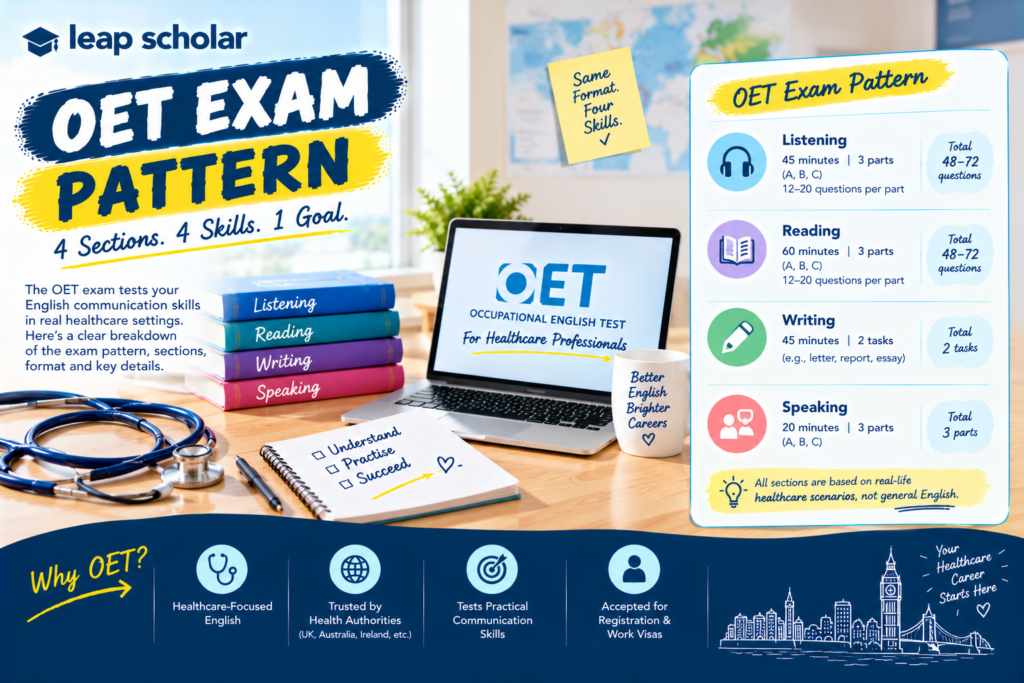
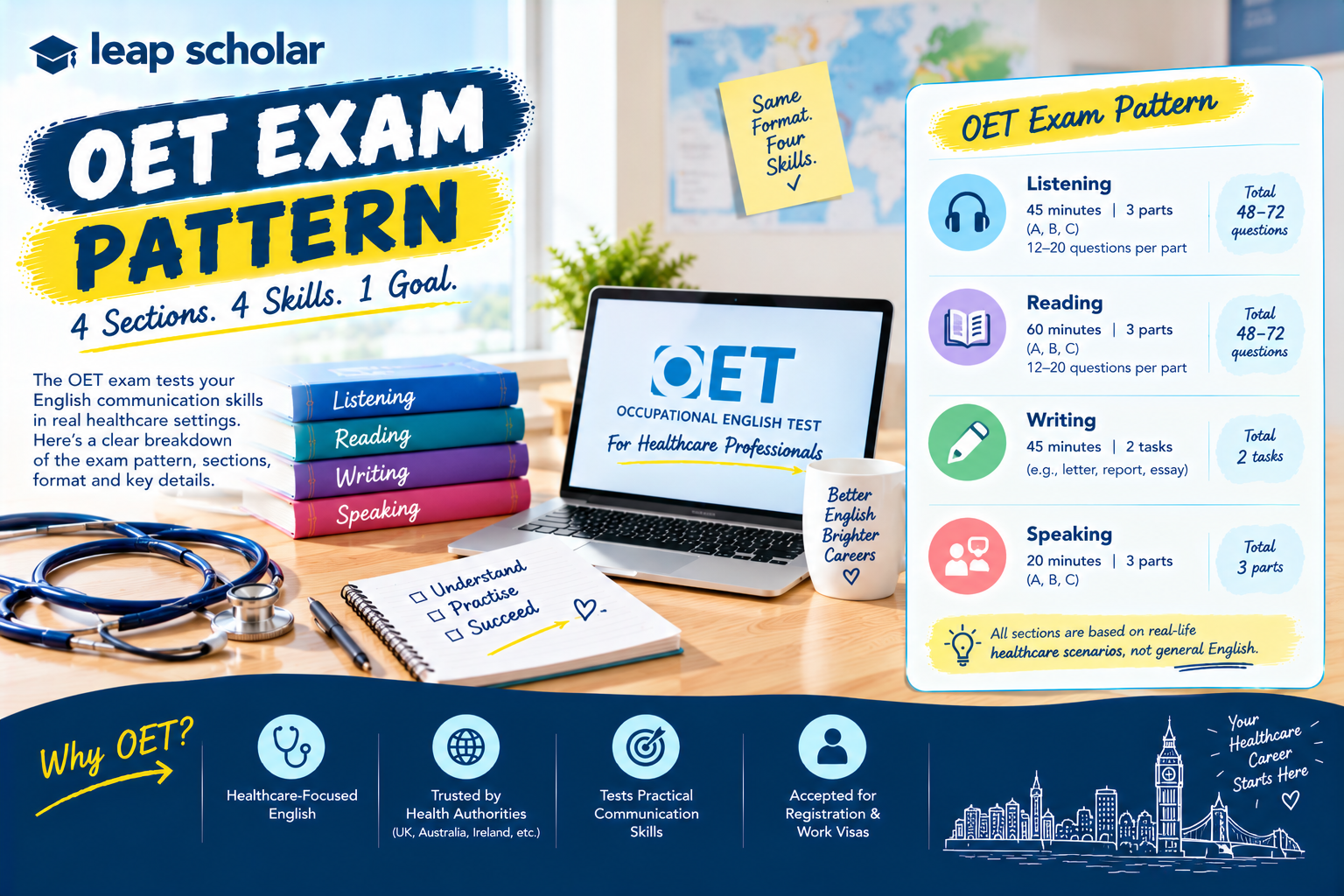
- The OET exam pattern has four sub-tests: Listening, Reading, Writing, and Speaking.
- Indian candidates face 42 questions each in Listening and Reading.
- Indian nurses and doctors sit profession-specific Writing and Speaking tasks.
- Writing takes 45 minutes, and Speaking about 20 minutes.
Is the OET Exam Pattern Hard to Follow? What You Will Be Asked
Worried the OET exam pattern is hard to follow? It’s easier than it looks: OET (the Occupational English Test) checks your English, not your medical knowledge, in four sub-tests. A subtest is one separately timed section: Listening, Reading, Writing, or Speaking. Listening and Reading are the same for every profession.
For fees, dates, registration, and validity, the OET exam guide has the details, so this page stays on the pattern itself.

Choose your dream country
 UK
 USA
 Germany
 Australia
 Ireland
 Canada
 UAE
 France
 Sweden
 Italy
 Other
When do you want to study abroad?
What's your highest level of education?
Have you completed Class 12th?
What was your Class 12 CGPA/percentage?
Are you a student or a parent/guardian?
What do you want to study?
Select your current city
How Leap will help you

Personalised University Shortlist

Express Applications with Quicker Admits

End-to-End Application Support
Below, you'll go through each sub-test part by part: time, questions, marking, and what changes for your profession. Learn the parts first, then practice, and then add the clock. That order keeps the test manageable.
OET Exam Pattern at a Glance: All Four Sub-Tests in One Table
Start with the whole OET exam pattern before you study any single part. Read across each row for one sub-test.
| Sub-test | Time | Questions or tasks | Parts | What it tests | How it is marked |
| Listening | About 40 minutes | 42 questions | 3 parts | Spoken healthcare English | 1 mark per correct answer |
| Reading | 60 minutes | 42 questions | 3 parts | Healthcare texts | 1 mark per correct answer |
| Writing | 45 minutes | 1 letter from case notes | 1 task | A letter for a reader | 6 criteria, scored by assessors |
| Speaking | About 20 minutes | 2 role plays of about 5 minutes | 2 role plays | Talking with a patient | 9 criteria, scored by two assessors |
Sources: OET Test overview
What this means for you: Listening and Reading are the fixed parts of the OET exam pattern, while Writing and Speaking change with your profession. Each sub-test gets a scale score, which is a number from 0 to 500. Grade B is the grade linked to a scale score of 350, and OET's guidance uses it to explain what each part needs. The board or council to which you send your results is the regulator, and it determines the grade it accepts.
OET Writing Task in the Exam Pattern: Letter, Time, and Six Criteria
The Writing part of the OET exam pattern gives you 45 minutes to write one formal letter on a matter from your profession, using case notes. Case notes are the patient details you work from. The letter might be a referral, advice, or a letter of transfer or discharge, which passes a patient's care to another professional.
You get 5 minutes of reading time, then 40 minutes to write. OET's length guide is 180 to 200 words, with no automatic penalty for going over or under. There's no required layout.
Want "recent" Writing questions? Tasks are written for each profession, so practice with OET's free official samples instead. Two trained OET assessors score six criteria, and Grade B needs 2 out of 3 for Purpose and 5 out of 7 for the rest:
- Purpose (out of 3): your reason for writing is clear from the start.
- Content (out of 7): the information the reader needs is there and accurate.
- Conciseness and Clarity (out of 7): what the reader doesn't need is left out.
- Genre and Style (out of 7): register, tone, and abbreviations suit a professional reader.
- Organization and Layout (out of 7): the letter is clearly organized and laid out.
- Language (out of 7): grammar, vocabulary, spelling, and punctuation are accurate.
Sources: OET Writing, OET assessment criteria
My insight: Decide what the reader must do next before you write a word, then drop every case note that doesn't serve it. A short, relevant letter beats one that copies every note.
OET Sample Tests and a Simple Plan for the Exam Pattern
Your next step after learning the OET exam pattern is practice with OET's own sample tests. They're free, cover all four sub-tests, and come in Paper and in Computer or OET@Home versions, where you choose your own profession. OET@Home is the version you take on your computer at home while a supervisor watches online.
- Official first: OET advises care with unofficial materials, so use its samples.
- Mock test: take an official sample under real test conditions.
- Level check: Pulse is OET's 30-minute test that shows your current English level.
Then follow this five-step plan for the OET exam pattern:
- Take Pulse to see where your English stands.
- Do one untimed official sample for each sub-test.
- Read the Writing and Speaking criteria so you know what assessors look for.
- Take a timed sample about every 2 to 3 weeks.
- Between samples, work on the skills behind errors in your weakest sub-test.
Sources: OET sample tests
OET Listening Format: Parts A, B, and C
Hearing each recording only once is the worry in Listening, so know its shape first: about 40 minutes, three parts, 42 questions. Read each row as one part.
| Part | What you hear | Questions | Marks | Task type | Time to read first |
| Part A | 2 consultations of 4.5 to 5 minutes | 12 per recording | 24 marks | Note completion | 30 seconds |
| Part B | 6 workplace extracts of about 45 seconds | 1 per extract | 6 marks | 3-option multiple-choice | 15 seconds |
| Part C | 2 presentations or interviews of 4 to 5 minutes | 6 per recording | 12 marks | 3-option multiple-choice | 90 seconds |
Sources: OET Listening, OET Listening Part A guide
Part A carries more than half the marks, so start your practice there.
- Note completion: this exercise means you fill gaps in notes with the exact words you hear, not a paraphrase.
- Multiple-choice: this means you pick one answer from three options.
- Checking time: paper gives you 2 minutes at the end; computer and OET@Home pause after each question.
- Accents: expect Australian, British, American, and other voices.
My insight: Learn each part's task before you time it, because a clock on an unfamiliar task trains panic, not skill.
OET Speaking Format: Two Role Plays and Nine Criteria
Speaking in the OET exam pattern takes about 20 minutes and has two role plays of about 5 minutes each. A role play is a short practice conversation that copies one from your work. You play your profession, and the interlocutor is the person who plays the patient or carer.
Each conversation comes with a role-play card, which is a card setting out the situation and your tasks. You have 3 minutes to prepare, you can make notes on the card, and you can leave points unfinished. The talk is recorded, and two OET assessors mark nine criteria:
- Linguistic (4 criteria, each out of 6): Intelligibility, Fluency, Appropriateness of language, and Resources of grammar and expression.
- Clinical Communication (5 criteria, each out of 3): Relationship building, Understanding and incorporating the patient's perspective, Providing structure, Information gathering, and Information giving.
For Grade B, you need mostly 5 out of 6 on the linguistic criteria and 2 out of 3 on clinical communication.
Sources: OET Speaking, OET Speaking criteria overview
OET Reading Format: Parts A, B, and C
Reading in the OET exam pattern takes 60 minutes, with three parts and 42 questions, and Part A ends after 15 minutes. You have a strict 15 minutes for Part A, then its papers are collected, and you can't go back. Parts B and C share the other 45 minutes. Each row below is one part.
| Part | Texts | Questions | Marks | Question type |
| Part A | 4 texts on one topic | 20 questions | 20 marks | Matching, short answer, sentence completion |
| Part B | 6 workplace extracts of 100 to 140 words | 1 per extract | 6 marks | 3-option multiple-choice |
| Part C | 2 texts of about 800 words | 8 per text | 16 marks | 4-option multiple-choice |
Sources: OET Reading, OET Reading Part A guide
- Part A types: matching means linking each statement to the right text; sentence completion means finishing a sentence with words from the texts.
- Spelling: copy the exact spelling and word form; American and British spellings are both accepted.
- Abbreviations: use one only if the texts do.
OET Exam Pattern for Nurses, Doctors, and Other Professions
OET is built for 12 healthcare professions, but only half of the OET exam pattern is profession-specific. Listening and Reading are the same for everyone. Writing and Speaking use material from your profession, with the same structure, timing, and marking criteria.
Your regulator, which OET calls a recognizing organization, sets the minimum results and test modes it accepts. Here's how the OET exam pattern fits each route:
- UK nursing: OET is one step on the wider route into nursing in the UK.
- Australia: the same pattern applies if your plan is nursing in Australia, but check your regulator's accepted modes first.
- Dubai: if Dubai is your target, read about moving to Dubai as a nurse before you book any English test.
- Other exams: OET checks your English, not your nursing knowledge; the NCLEX exam is a separate test.
- Doctors: the doctor route to the UK adds exams and a medical register on top of the English test, and the GMC accepts OET scores when you book the PLAB exam part 1.
- Allied professionals: pharmacists, physiotherapists, and others can see which NHS healthcare roles exist for Indian applicants.
- Still choosing: the OET vs IELTS comparison sets the two formats side by side.
How Paper, Computer, and OET@Home Change the OET Exam Format
OET on Paper and OET on Computer share the same structure, content, length, and marking, so the OET exam pattern stays fixed while the test day changes.
- Paper: all four sub-tests on one day at one venue; Writing is handwritten, and Speaking is face to face.
- Computer: Listening at a test center, Reading on screen, and Writing typed; Speaking is usually from home, up to 5 days before or after.
- OET@Home: remote proctoring, which means a supervisor watches online while you test on your computer with a wired headset.
- Before booking: OET@Home runs where venue testing isn't available, and not every regulator accepts it.
Sources: OET on Computer
What the OET Syllabus Means for the OET Exam Pattern
OET describes the test through its sub-tests and parts, so the OET exam pattern itself is what you study. Every task is built around healthcare situations: Listening and Reading use general healthcare topics shared by all professions, while Writing and Speaking reflect your own workplace.
What the OET exam pattern tests is a set of skills: catching detail and gist, finding information quickly, writing for a reader, and speaking with a patient. If you also plan on taking the IELTS, the IELTS syllabus and pattern page show how that test is set out.
How OET Marking and the 0 to 500 Scale Connect to the Pattern
Each correct answer in Listening and Reading is worth 1 mark out of 42, converted to the 0 to 500 scale used across the OET exam pattern. Grade B (350) typically needs at least 30 marks, and the exact number shifts slightly because new tests are written for each session. Writing and Speaking criteria scores are combined and converted to the same scale.
Each sub-test is reported in steps of 10, with letter grades from A (highest) to E (lowest). Listening and Reading Parts B and C are scanned and scored automatically; trained assessors mark Writing and Speaking, and answers are double marked. So your result won't read like the IELTS band scores you may have seen. Your regulator decides the grade it needs, and the OET exam guide covers regulator grades.
Sources: OET results and scoring
What If Something Goes Wrong With the OET Exam Pattern?
Plan your fix before test day, so that one bad moment doesn't cost you a whole sub-test.
- Reading Part A runs out: papers go at 15 minutes, so answer every question before then.
- Writing task misread: use the 5 reading minutes to find out what the reader must do.
- Role play stalls: keep talking; there's no penalty for unfinished card points.
- One weak sub-test: fix it first; the retake rules are in the OET exam guide.
- Disputed mark: ask for a re-mark, which means having a sub-test marked again, within 72 hours of getting results.
- Wrong test for your route: before you rebook, compare English tests to see whether another one fits your plan better.
Who to contact: your regulator, such as the NMC for nurses or the GMC for doctors in the UK, about the results and accepted modes. This is general information, not professional or legal advice; check your regulator's own page before you book.
My insight: Because each regulator sets its minimums, check yours first, then fix the sub-test that sits furthest below it.
3 Takeaways on OET Exam Pattern
- Learn the parts before timing yourself: the OET exam pattern has 42 questions each in Listening and Reading, one letter, and two role plays.
- Use OET's free official samples: take one every 2 to 3 weeks and work on the skills behind each error.
- Check your regulator before you book: confirm the modes and grade it accepts.
Talk to a Leap Scholar counselor to plan your OET preparation around the sub-test you find most difficult.
Frequently Asked Questions About OET Exam Pattern
-
What are the parts of OET Listening?
Listening has three parts and 42 questions. Part A plays two patient consultations with 12 note-completion questions each. Part B contains six short workplace extracts, each with one 3-option question. Part C has two presentations or interviews, each with six 3-option questions. You hear every recording once.
-
What are Parts A, B, and C in OET Reading?
The four sub-tests add up to about 2 hours and 45 minutes of testing, not including breaks. Listening takes about 40 minutes, Reading 60 minutes, Writing 45 minutes, and Speaking about 20 minutes. On Computer, Speaking may fall on a different day, up to 5 days before or after.
-
What is the OET Writing task for nurses?
Nurses write one formal letter in 45 minutes from nursing case notes, such as a referral, transfer, or discharge. The first 5 minutes are for reading. Two assessors score six criteria, from Purpose to Language, and length is a 180 to 200 word guide with no automatic penalty.
-
What happens in the OET Speaking role play?
You play your own profession while the interlocutor plays a patient or carer. You have 3 minutes to prepare with a role-play card, then talk for about 5 minutes. The Speaking sub-test in the OET exam pattern has two role plays, which are recorded and marked by two assessors on nine criteria.
-
Does the OET exam pattern change for doctors and nurses?
Only half of it changes. Listening and Reading are the same for every profession in the OET exam pattern. Writing and Speaking use material from your own field, so a doctor and a nurse get different case notes and role plays, while time, structure, and marking criteria stay the same.
-
Is OET on Computer different from OET on Paper?
The two share the same structure, content, length, and marking, so the OET exam pattern doesn't change. Delivery is on a computer, Reading is on screen, Writing is typed, and Speaking is usually done from home, possibly on a different day. Check that your regulator accepts the mode.












Have Questions? Get Guidance to reach your Dream University
Connect with India's finest counsellors and biggest study abroad community.
Get Guidance