
Quick Read
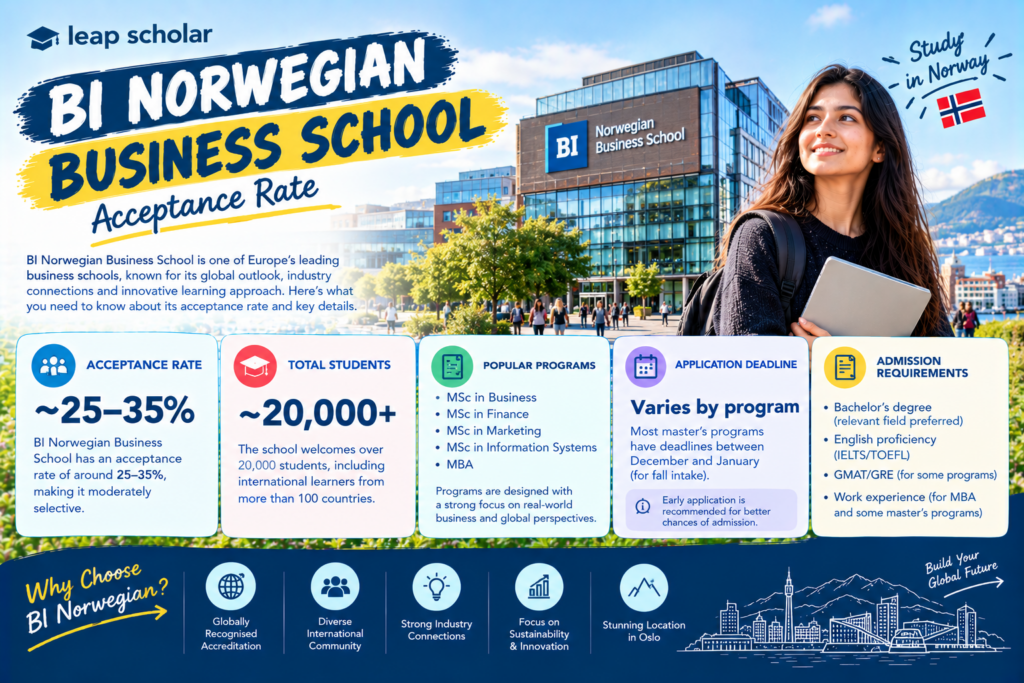
- BI Norwegian Business School has never published an official acceptance rate publicly.
- Admission runs on a GPA and test-score formula, not a fixed percentage.
- MSc fees for Indian students run about Rs. 16.7 lakh a year in 2026-27.
- The 1 March priority deadline is also BI’s scholarship application deadline.
Does BI Norwegian Business School Publish an Acceptance Rate?
No. BI Norwegian Business School acceptance rate was not released for its bachelor’s programs or for the Master of Science. This information is confirmed on BI’s own admissions pages and by independent university-data sites that track the data specifically. A few aggregator sites publish an “estimated” acceptance rate for BI. That estimate is not BI’s own data. It is a number reverse-engineered from other, unrelated business schools with a similar research profile, and it should not be treated as fact.
This information matters more for Indian applicants than it might first seem. Without a published rate, there is no single cutoff percentage to aim for or panic about. The acceptance rate for international students at BI Norwegian Business School, including Indian applicants, is instead determined by a scoring formula applied to your grades and test scores, which is covered in the next section.

Choose your dream country
 UK
UK
 USA
USA
 Germany
 Australia
 Ireland
 Canada
 UAE
UAE
 France
 Sweden
 Italy
Italy
 Other
Other
When do you want to study abroad?
What's your highest level of education?
Have you completed Class 12th?
What was your Class 12 CGPA/percentage?
Are you a student or a parent/guardian?
What do you want to study?
Select your current city
How Leap will help you

Personalised University Shortlist

Express Applications with Quicker Admits

End-to-End Application Support
Counselor insight: Students often ask us to translate "no published acceptance rate" into a rough percentage so they can gauge their odds. We don't do that, because any number we gave you would be a guess dressed up as data. What we can tell you, based on our review of BI applications from Indian students, is that a strong GMAT score often offsets a borderline GPA. Chasing an imaginary cutoff wastes energy that is better spent on your test prep.
BI Norwegian Business School Admission Requirements: GPA, GMAT, and GRE
BI Norwegian Business School's admission requirements for the Master of Science combine your undergraduate GPA with a standardized test score, using a published formula rather than a cutoff percentage:
- Standard admission: (GPA × 200) + 555 GMAT Focus score = 1,255 or higher, OR
- (GPA × 200) + 600 GMAT (10th edition) score = 1,300 or higher
Your GPA is converted to BI's ECTS scale (A to F). The minimum GPA for MSc admission is generally 3.50, but BI allows a GPA as low as 3.30 if you offset it with a strong GMAT result. This is the closest thing BI Norwegian Business School has to an acceptance rate: not a fixed percentage of applicants let in, but a combined score every applicant is measured against.
For bachelor's programs (Business Administration, Data Science for Business, Digital Business), BI Norwegian Business School's admission requirements follow Norway's official higher-education admission rules (set by the Norwegian Directorate for Higher Education and Skills) rather than an internal formula, alongside a mandatory English test and, for some programs, a mathematics requirement.
| Requirement | Master of Science | Bachelor's programs |
| Minimum GPA | 3.30-3.50 (ECTS scale) | Per Norwegian admission regulations |
| Test score | GMAT Focus 555+ or GMAT (10th ed.) 600+, GRE accepted on some programs | Not applicable |
| Mathematics | Not applicable | Mathematics R1/S1+S2 equivalent, or a placement test (OMPT) scoring 60%+ |
| Application documents | Transcripts, CV, letter of motivation, passport copy | Transcripts, English test, passport copy |
If your GMAT or GRE prep is still a question mark, it's worth reading about whether a GMAT score is actually compulsory for an MBA abroad before you commit study hours to it.
Counselor insight: The GPA-plus-GMAT formula is more forgiving than students expect. We've seen Indian applicants with a 3.3 GPA get in comfortably because they crossed 650 on the GMAT. If your undergraduate scores from India don't map neatly to BI's ECTS scale, have your transcript evaluated early rather than guessing at conversion.
BI Norwegian Business School English Proficiency Requirements
Since Indian applicants are non-native English speakers, an English proficiency score is mandatory for every BI Norwegian Business School program. Requirements vary slightly by program:
| Test | Master of Science | Bachelor's programs |
| IELTS (Academic) | 6.0-6.5 | 6.0 |
| TOEFL iBT | 78-90 | 78 |
| TOEFL PBT | 550 | 550 |
Scores must be sent directly from the test centre to BI or uploaded with your online application. If you haven't picked a test yet, this comparison of IELTS vs TOEFL vs PTE vs Duolingo breaks down which one suits your timeline and budget best.
BI Norwegian Business School Fees for Indian Students (2026-27)
As an Indian citizen, you fall outside the EU/EEA/Switzerland category, so the tuition fees at BI Norwegian Business School include the non-EEA differential. For the 2026-27 academic year:
| Program | Fee (INR) | Fee (NOK) |
| Master of Science (standard) | Rs. 16.7 lakh/year | NOK 166,700/year |
| Master in Business Analytics / Data Science for Business | Rs. 13.6 lakh/year | NOK 135,600/year |
| Bachelor's programs (2025-26 rate; 2026-27 not yet published) | Rs. 13.3 lakh/year | NOK 132,600/year |
Living costs in Oslo add roughly NOK 11,700-19,200 a month (about Rs. 1.2-1.9 lakh), covering accommodation, food, transport, and utilities. For a full breakdown of the living expenses at BI Norwegian Business School compared to other Norwegian cities, see this guide to the cost of living in Norway.
There is no separate BI Norwegian Business School application fee. Applications go through BI's own online application portal at no cost, which is one less line item to budget for compared to universities that charge USD 50-100 just to submit an application.
Counselor insight: Indian families often underestimate the living-cost side of this budget because tuition gets all the attention. Oslo is one of Europe's more expensive cities to live in. Build your funding plan around tuition plus 12 months of living costs, not tuition alone, especially since Norway's student visa asks you to show proof of funds for the full year upfront.
BI Norwegian Business School Application Deadline and Portal for the 2027 Intake
BI Norwegian Business School runs a single autumn intake with a priority-then-rolling admissions process:
- 1 March: Priority deadline for both bachelor's and Master of Science applicants (also the scholarship application deadline)
- 15 June: Deadline for non-EEA applicants who need a Norwegian residence permit, including most Indian students
- 1 August: Application portal closes for the Master of Science; bachelor's admission continues on a rolling basis, based on seat availability
At the time of writing, BI has not yet announced the exact priority deadline for the 2027 intake. Based on the school's recurring admissions calendar, it is likely to fall around 1 March 2027, but this is not an officially confirmed date. Check BI's own admissions page closer to the cycle before you plan around it.
The 15 June residence-permit deadline specifically applies to non-EEA applicants, so Indian students should consider it their actual deadline instead of the later 1 August portal close, which primarily benefits applicants who do not require a Norwegian visa.
Counselor insight: We tell every Indian applicant to work backward from 15 June, not 1 March. Missing the priority deadline doesn't disqualify you, since BI offers rolling admission after it. But missing the residence-permit deadline can push your visa processing past the intake start date entirely.
BI Norwegian Business School Ranking and Employment Rate
BI Norwegian Business School's Master of Science in Business placed #88 worldwide in the Financial Times Masters in Management ranking for 2025 and earned the top score on the FT's employability indicator that year. BI is also one of a small group of business schools worldwide, under 1%, to hold all three major international accreditations: EQUIS, AACSB, and AMBA.
On employment rate specifically, BI reports that eight in ten bachelor's students and nine in ten master's students secure a job within six months of graduating, and the FT's own tracking shows a 100% employment rate at three months for the MiM cohort, with a three-year weighted average salary of about USD 72,000. For context on how BI compares to other institutions in the country, this list of top universities in Norway is a useful next read.
Counselor insight: Ranking and employment rate matter more here than acceptance rate does, honestly. Since BI doesn't publish an acceptance rate, employability data is the stronger signal for judging whether the degree is worth the fee, and on that measure BI holds up well against European peers.
Life After BI Norwegian Business School: Jobs, PR, and Cost of Living in Oslo
Norway offers a post-study job-seeker visa that lets international graduates, including those from BI Norwegian Business School, stay back and seek employment after finishing their degree. This is usually the first step Indian graduates take toward longer-term residency in Norway. Full eligibility and duration details are covered in this guide to the Norway job seeker visa.
If you're still comparing Norway against other study destinations on overall cost, this overview of studying in Norway, cost, and universities lays out the bigger picture beyond just BI. And once you've narrowed down your visa route, this guide to the Norway student visa walks through the paperwork Indian applicants specifically need.
3 Takeaways on BI Norwegian Business School Acceptance Rate
- Stop looking for a BI Norwegian Business School acceptance rate percentage; it doesn't exist. Focus your energy on your GPA-plus-GMAT combined score instead.
- Budget for Rs. 16.7 lakh a year in MSc tuition plus roughly Rs. 1.2-1.9 lakh a month in Oslo living expenses, not tuition alone.
- Apply by 1 March for priority and scholarship consideration, but treat 15 June as your real deadline if you need a Norwegian residence permit.
Have a specific question about your BI Norwegian Business School application? Talk to a counselor
Frequently Asked Questions about BI Norwegian Business School Acceptance Rate
-
What is BI Norwegian Business School's acceptance rate for international students?
BI Norwegian Business School does not publish an acceptance rate for international students or for any other applicant group. Admission is determined by a GPA-and-test-score formula rather than by a fixed percentage of applicants admitted.
-
What GPA does BI Norwegian Business School require for admission?
The Master of Science generally requires a minimum GPA of 3.50 on BI's ECTS scale, though a GPA as low as 3.30 can still qualify if paired with a strong GMAT score. Bachelor's admission follows Norway's national higher-education admission rules instead.
-
Is GMAT compulsory for BI Norwegian Business School?
A GMAT or GRE score is required for BI's Master of Science unless you qualify for a specific partner-school waiver. BI combines your GPA and GMAT score using a published formula, so a lower GPA can be offset by a stronger test score.
-
What IELTS score does BI Norwegian Business School require?
BI Norwegian Business School typically asks for an IELTS Academic score of 6.0 to 6.5, depending on the program, since English proficiency is mandatory for all non-native speakers. TOEFL and PTE are also accepted as alternatives.
-
What is BI Norwegian Business School's ranking?
BI Norwegian Business School's Master of Science in Business ranked #88 worldwide in the Financial Times Masters in Management 2025 ranking, and BI holds all three major global business-school accreditations: EQUIS, AACSB, and AMBA.
-
How much are BI Norwegian Business School's fees for Indian students?
For the 2026-27 academic year, Indian students pay around Rs. 16.7 lakh a year for the standard Master of Science and roughly Rs. 13.3 lakh a year for bachelor's programs, based on the last published rate. Living costs in Oslo add further to the total.
-
Is there an application fee for BI Norwegian Business School?
BI Norwegian Business School does not charge a separate application fee. Applicants apply through BI's own online application portal at no additional cost, unlike many universities that charge a processing fee just to submit an application.
-
What is BI Norwegian Business School's employment rate after graduation?
Around nine in ten Master of Science graduates and eight in ten bachelor's graduates find a job within six months of finishing at BI Norwegian Business School. The Financial Times separately reports a 100% employment rate at three months for BI's MiM cohort.
-
Can Indian students get a post-study work visa after BI Norwegian Business School?
Norway's job-seeker visa lets international graduates, including Indian students from BI Norwegian Business School, remain in the country to seek employment after their degree ends. It's a common first step toward longer-term work authorization in Norway.
-
Is BI Norwegian Business School good?
BI Norwegian Business School holds all three major global accreditations (EQUIS, AACSB, and AMBA), a status shared by under 1% of business schools worldwide, and its Master of Science placed #88 in the Financial Times Masters in Management 2025 ranking. For Indian students, it's a strong, employable option, though the fee and Oslo living expenses are worth weighing against your budget.




Have Questions? Get Guidance to reach your Dream University
Connect with India's finest counsellors and biggest study abroad community.
Get Guidance