
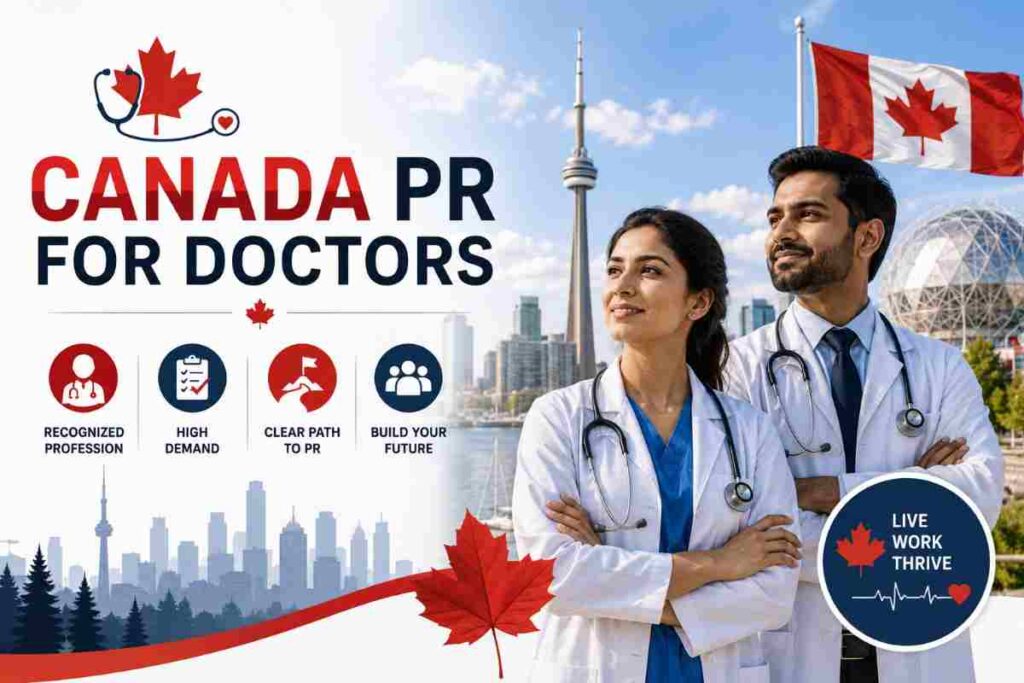
Canada is actively courting foreign-trained doctors with five distinct immigration pathways to permanent residence, as the country leans harder on internationally trained physicians to fill its healthcare workforce. But for Indian doctors specifically, immigration eligibility and permission to actually practice medicine are two separate processes, and the second one is typically the slower, harder part.
The Five Pathways
- Express Entry Physicians with Canadian Work Experience: a dedicated category for doctors with at least 12 months of full-time Canadian physician work experience in the past three years, in an eligible occupation (general/family physicians or clinical/laboratory medicine specialists). Invitations began in early 2026.
- Provincial Nominee Program (PNP): the federal government has reserved 5,000 permanent residence spaces specifically for provinces and territories to nominate doctors with a job offer or letter of support on top of, not instead of, each province’s regular PNP allocation.
- Atlantic Immigration Program: covers Nova Scotia, New Brunswick, Newfoundland and Labrador, and Prince Edward Island for doctors with a qualifying job offer from a designated employer, relevant to those willing to work outside Canada’s largest cities.
- Rural Community Immigration Pilot: a permanent-residence route for doctors with a qualifying job offer in a participating rural community facing labor shortages.
- Francophone Community Immigration Pilot: for French-speaking doctors with a job offer in a participating Francophone minority community outside Quebec.
The Speed Boost, Explained Correctly
Doctors who receive a provincial nomination, whether through the standard PNP or the new 5,000 reserved spaces, get their work permit processed on an expedited 14-day target. This is a genuinely useful measure: it lets a nominated doctor start working in Canada while their permanent residence application is still being finalized on the normal, separate, multi-month timeline. It is not, and does not create, a 14-day path to PR itself; it is worth being precise about this distinction, since it’s an easy point to misread.

Choose your dream country
 UK
UK
 USA
USA
 Germany
 Australia
 Ireland
 Canada
 UAE
UAE
 France
 Sweden
 Italy
Italy
 Other
Other
When do you want to study abroad?
What's your highest level of education?
Have you completed Class 12th?
What was your Class 12 CGPA/percentage?
Are you a student or a parent/guardian?
What do you want to study?
Select your current city
How Leap will help you

Personalised University Shortlist

Express Applications with Quicker Admits

End-to-End Application Support
Why Licensing Is the Real Bottleneck
Government figures cited by IRCC show internationally trained doctors accounted for 31% of family physicians in Canada in 2024, and immigrants made up roughly one in four healthcare workers overall, so Canada already relies heavily on foreign-trained physicians. But qualifying for one of these five immigration pathways doesn't authorize anyone to treat patients. Foreign medical credentials still need to be assessed, and licensing is granted provincially, not federally, so requirements, timelines, and difficulty vary depending on exactly which province a doctor targets.
For Indian doctors specifically, the practical path typically runs through credential verification (via physiciansapply), a language test, Canada's national licensing exams, and then either a residency match through CaRMS or a Practice-Ready Assessment route before a provincial college grants final licensure. This licensing sequence is often the slowest part of the entire process, and no immigration measure, including the ones above, shortens it.
What Indian Doctors Should Check Before Committing
Two separate questions need separate answers:
- Immigration: Which of the five pathways actually matches your qualifications, work experience, and job offer situation?
- Licensing: Can your specific medical credentials be recognized, and can you realistically obtain permission to practice in the particular province you're targeting?
Eligibility criteria for all five programs can change, so anyone seriously considering this route should verify current requirements directly with IRCC and the relevant provincial medical regulator before making career decisions based on these guidelines or any other summary.
Have questions about how the information fits your medical career plans? Book a free session with a LeapScholar counselor.







Have Questions? Get Guidance to reach your Dream University
Connect with India's finest counsellors and biggest study abroad community.
Get Guidance