
Quick Read
- Physics and maths share one 13-question block on the IMAT.
- You won’t get a formula sheet in the exam hall.
- Expect mechanics, fluid mechanics, thermodynamics, and electromagnetism on the paper.
- Nothing’s changed in the 2026 syllabus from 2025 or 2024.
- NEET Class 11-12 physics covers most IMAT topics, not all.
- The 2026 exam registration fee comes to Rs.14,560 (€130).
What’s Actually in the IMAT Physics Syllabus for 2026
MUR’s Decreto Ministeriale n. 1005 of 6 August 2026 confirms that the 2026 IMAT physics syllabus matches exactly those of 2025 and 2024. Nothing has been added, removed, or reworded this cycle. If you studied from a 2025 IMAT physics resource, it still applies.
The IMAT physics syllabus sits inside a combined Physics and Mathematics section, tested alongside general knowledge, logical reasoning, biology, and chemistry. Here’s how the physics portion actually breaks down, area by area:

Choose your dream country
 UK
UK
 USA
USA
 Germany
 Australia
 Ireland
 Canada
 UAE
UAE
 France
 Sweden
 Italy
Italy
 Other
Other
When do you want to study abroad?
What's your highest level of education?
Have you completed Class 12th?
What was your Class 12 CGPA/percentage?
Are you a student or a parent/guardian?
What do you want to study?
Select your current city
How Leap will help you

Personalised University Shortlist

Express Applications with Quicker Admits

End-to-End Application Support
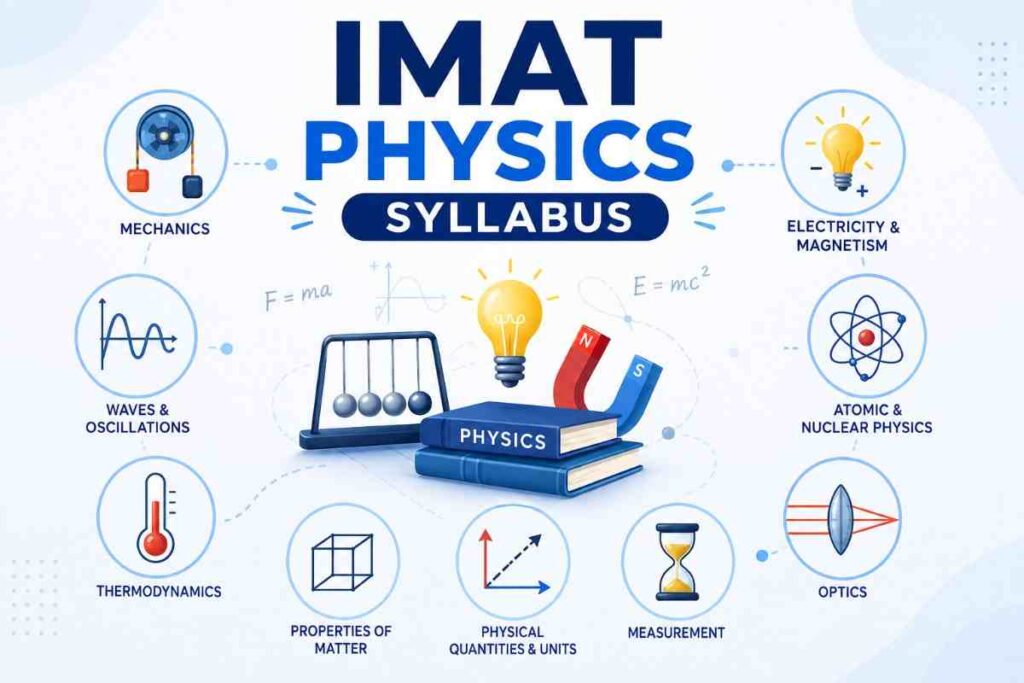
Mechanics covers kinematics (motion in one and two dimensions), Newton's laws of motion, work and energy, power, and the conservation laws for momentum and energy.
Fluid mechanics brings in density and compressibility; hydrostatics (pressure, Pascal's principle, Stevin's law, and Archimedes' principle); fluid dynamics (flow rate and the continuity equation); Bernoulli's equation for ideal fluids; and viscous forces in real ones.
Thermodynamics runs through thermal equilibrium, temperature and thermometers, heat and calorimetry, the different modes of heat transfer, heat capacity and specific heat, phase changes and latent heat, ideal gas laws, and the first and second laws of thermodynamics.
Electricity and electromagnetism are the biggest chunks: electric charges, Coulomb's law, electric field and potential, capacitors and electrostatic energy, current and resistance, Ohm's law, Kirchhoff's principles, series and parallel circuits, the Joule effect, alternating and direct current, magnetic fields, and electromagnetic induction.
Counselor insight: A lot of families walk in assuming IMAT physics is basically a trimmed-down NEET or JEE syllabus. It's not, really. Think of it closer to a Class 11 foundation course. Depth of derivation matters far less here than being able to set up a problem correctly and calculate under time pressure.
Within each area, the IMAT tends to favor questions that combine two related concepts rather than testing a single formula in isolation. A mechanics question might ask you to connect work-energy principles with a conservation-of-momentum setup in the same problem, rather than testing either concept alone. This principle is worth knowing early, since it changes how you revise: working through mixed-concept practice questions matters more here than memorizing each topic as a separate, disconnected unit.
If you want the full picture of how this section fits into the exam's structure and scoring, the IMAT exam pattern and marking scheme covers that separately, so this page stays focused on physics content alone.
IMAT Physics Weightage: How Many Questions and How Much They’re Worth
Physics and Mathematics together form a single 13-question block out of the IMAT's 60 total questions. The exam does not publish a separate physics-only count. Based on past papers, the split between the two subjects has hovered close to even, though MUR reserves the right to weight either subject more heavily in a given year.
Scoring works the same way across every section: 1.5 marks for a correct answer, minus 0.4 for an incorrect one, and zero for a blank, out of a maximum of 90 marks overall. A blind guess on a physics numerical carries a real downside, since four wrong guesses cancel out roughly three correct answers.
Counselor insight: Students who NEET-prepared often over-invest revision hours in biology and chemistry, where they already feel confident, and give physics a rushed final pass. Since physics and maths combined still carry more marks than logical reasoning and general knowledge put together, that trade-off usually costs more than it saves.
The full IMAT preparation timeline breaks down how to split hours across all five sections.
Treat the 13-question block as a marks-protection zone rather than a section to gamble on. A candidate who scores well across biology, chemistry, and physics consistently outranks one who scores brilliantly in two subjects and skips a third, since the final ranking adds every section's marks together rather than weighting any single subject more heavily.
IMAT Physics Syllabus vs. NEET and JEE
| Physics Topic Area | Covered in NEET | Covered in JEE | IMAT-Specific Note |
|---|---|---|---|
| Mechanics (kinematics, Newton's laws, work-energy) | Yes, core topic | Yes, in depth | IMAT tests concept recognition over multi-step derivation |
| Fluid mechanics (Pascal's, Archimedes', Bernoulli's) | Partial, lighter weightage | Yes, in depth | IMAT places more direct emphasis here than typical NEET papers |
| Thermodynamics (heat, calorimetry, gas laws) | Yes, core topic | Yes, core topic | Overlap is close to complete for both backgrounds |
| Electricity and electromagnetism | Yes, core topic | Yes, in depth | IMAT keeps circuit problems simpler than JEE-level questions |
Students coming from a NEET background usually find thermodynamics and basic mechanics familiar territory. Fluid mechanics is where things get shaky, mostly because NEET just doesn't spend as much time there as the IMAT syllabus expects. Flip that around for JEE students: strong on fluid mechanics and circuits, but not always used to IMAT's shorter, more conceptual style over JEE's longer, layered problems.
Which IMAT Physics Syllabus Prep Path Fits You?
Say you're a NEET-background Class 12 student who's solid in biology and chemistry but a bit rusty on electromagnetism. In that case, a focused two-week refresher on circuits and Kirchhoff's principles before you move to full-length physics sections from past papers makes sense. Your biology and chemistry strengths give you room to treat physics as a marks-protection subject rather than a marks-maximization one.
If you are a JEE-background student comfortable with physics numericals but have never touched IMAT's specific fluid mechanics or thermodynamics phrasing, spend your first month rebuilding conceptual fluency in those two areas using NCERT Class 11 chapters rather than JEE-level problem sets, which go deeper than IMAT ever asks.
If you are starting from a Class 12 boards-only foundation with no NEET or JEE preparation behind you, budget the longest runway of the three paths, realistically 6 to 8 months, and work through mechanics and thermodynamics first since they carry the most overlap with your existing board syllabus.
For a wider look at whether an English-taught Italian MBBS is worth this preparation investment compared to other routes, see MBBS in Italy for Indian students.
Why You Can’t Rely on a Formula Sheet for IMAT Physics
No formula sheet, periodic table, or calculator is permitted inside the IMAT exam hall. Every formula in mechanics, fluid mechanics, thermodynamics, and electromagnetism has to live in memory before you sit down for the 100-minute paper.
The fix is not a last-week cram list. Build a hand-written formula bank, one page per topic area, and rewrite it from memory every week during your prep months rather than just rereading it. Students who write formulas out by hand on a recurring basis tend to recall them faster under exam pressure than students who only reread a printed sheet, since the act of writing forces you to notice which symbol or unit you keep getting wrong.
Once your formula bank feels solid, move to IMAT past papers to test recall under real time pressure rather than in isolation.
IMAT Physics Syllabus Study Calendar for Indian Students
| Month | Focus | Notes |
|---|---|---|
| January-March | Mechanics and fluid mechanics concept building | Runs alongside Class 12 board exam prep; overlap works in your favor |
| April-June | Thermodynamics and electromagnetism | Build your hand-written formula bank as you go, topic by topic |
| July | Formula bank consolidation and topic-wise past paper sets | Rewrite the full formula bank from memory at least twice this month |
| August | Full timed past-paper physics sections | Simulate the no-calculator, no-formula-sheet condition exactly |
| 26 August - 9 September | IMAT registration window | Universitaly portal only; confirm university preference before this window opens |
| 29 September | Exam day | 13:30 Italian time, adjusted to your local test center's time zone |
What You’ll Need Alongside Your Physics Prep
Physics revision does not happen in isolation from the administrative side of applying. Keep these ready well before the registration window opens.
| Document | India-Specific Detail |
|---|---|
| Class 12 marksheet and provisional certificate | Required for Universitaly pre-enrollment; keep scanned copies ready in advance |
| Passport | Name and date of birth must match your Universitaly registration character for character |
| Declaration of Value (DoV) | Issued by the Italian Embassy in New Delhi; certifies your Class 12 education is equivalent to the Italian qualification |
| Universitaly account | Created separately from IMAT registration; needed for pre-enrollment at your chosen university |
| English proficiency certificate | Only required by some universities; check your shortlisted university's specific bando |
For the visa and pre-enrollment process that runs parallel to this timeline, see the Italy student visa guide.
What to Do If Your Physics Score Falls Short
If you run out of time on the physics numericals before finishing, stop guessing on the remaining questions rather than rapid-firing answers. The negative marking means an unconsidered guess is more likely to cost you 0.4 marks than gain you 1.5.
If you forget a formula mid-exam, move on immediately rather than losing minutes trying to reconstruct it from first principles. Return to that question only if you have time remaining at the end.
If your physics score ends up weak despite strong biology and chemistry performance, remember that physics and maths combined are only 13 of 60 questions. A strong showing in the 38 combined biology and chemistry questions can still carry your overall rank, and seat allocation through scrolling means your first-round rank is not always your outcome.
Key Takeaways on IMAT Physics Syllabus
- IMAT physics is a fixed 13-question combined block with maths, not a subject to leave for the final week, since it carries real weight toward your overall 90-mark score.
- Your NEET or JEE prep only gets you partway there. Fluid mechanics and a few electromagnetism topics need their own dedicated attention no matter which background you're coming from.
- Get your formula bank down on paper and into memory well before exam day. There's no formula sheet, calculator, or periodic table waiting for you inside the IMAT exam hall.
Verified by: LeapScholar's Italy counseling team, who work with Indian students on IMAT prep and Italian university admissions day in, day out.
Got questions about IMAT physics prep, or about studying medicine in Italy more generally? Book a free session with a LeapScholar counselor.
Frequently Asked Questions About IMAT Physics Syllabus
-
What topics are in the IMAT physics syllabus 2026?
You're looking at four areas: mechanics, fluid mechanics, thermodynamics, and electricity and electromagnetism. Mechanics brings in kinematics, Newton's laws, and conservation laws. Thermodynamics runs through heat, calorimetry, and gas laws, while electromagnetism covers circuits, Ohm's law, and electromagnetic induction. None of this has shifted since the 2024 restructure.
-
How many physics questions are on the IMAT?
Physics does not have a separately published question count. It shares a combined 13-question block with mathematics out of 60 total IMAT questions. Past papers show the split between the two subjects has stayed close to even, though the exact ratio can shift slightly from year to year based on how MUR sets that year's paper.
-
Is IMAT physics based on NEET or JEE syllabus?
It sits closest to Class 11 and 12 NCERT-level physics, the same foundation that both NEET and JEE draw from. Mechanics and thermodynamics overlap with NEET almost completely. Fluid mechanics is the one area that tends to need extra work if you're coming from NEET, since NEET just doesn't weight it as heavily as the IMAT syllabus does.
-
Can I use a formula sheet during the IMAT?
The IMAT exam hall does not permit a formula sheet, calculator, or periodic table of any kind. Every physics formula, from kinematics equations to Kirchhoff's principles, needs to be memorized before exam day. Build a hand-written formula bank during your prep months instead of relying on a printed reference you won't have access to.
-
Is IMAT physics harder than NEET physics?
IMAT physics is not necessarily harder than NEET physics, but it tests concepts differently. NEET rewards familiarity with standard problem formats built from repeated practice. IMAT questions are shorter and more application-based, so recognizing which principle applies matters more than working through a long multi-step calculation.
-
What if I skip physics and focus only on biology and chemistry?
That's a risky bet, since you're giving up a real share of the combined 13-question block along with maths. Yes, biology and chemistry carry 38 of 60 questions between them, and doing well there genuinely helps. But a weak physics and maths score can still drag your overall rank down against candidates who covered every section.
-
Does the IMAT physics syllabus change every year?
It hasn't changed since 2024. MUR's Decreto Ministeriale n. 1005, dated 6 August 2026, confirms the 2026 syllabus lines up exactly with 2025 and 2024. That's good news if you've already been working through past papers from those years: they're still solid practice material for 2026.
-
What books should I use for IMAT physics preparation?
NCERT Class 11 and 12 physics textbooks cover the large majority of the IMAT physics syllabus and are already familiar to most Indian students. Pair this with official IMAT past papers from 2020 onward for timed, application-style practice, since IMAT questions are phrased differently from typical NCERT exercise problems.
-
What happens if I run out of time on the physics section?
If time runs out during the physics portion, avoid guessing rapidly on remaining questions given the 0.4 negative marking penalty. Attempt only the questions you can solve with reasonable confidence in the time left. Practicing full-timed past-paper sections in advance is the most reliable way to prevent this from happening on exam day.








Have Questions? Get Guidance to reach your Dream University
Connect with India's finest counsellors and biggest study abroad community.
Get Guidance