
Quick Read
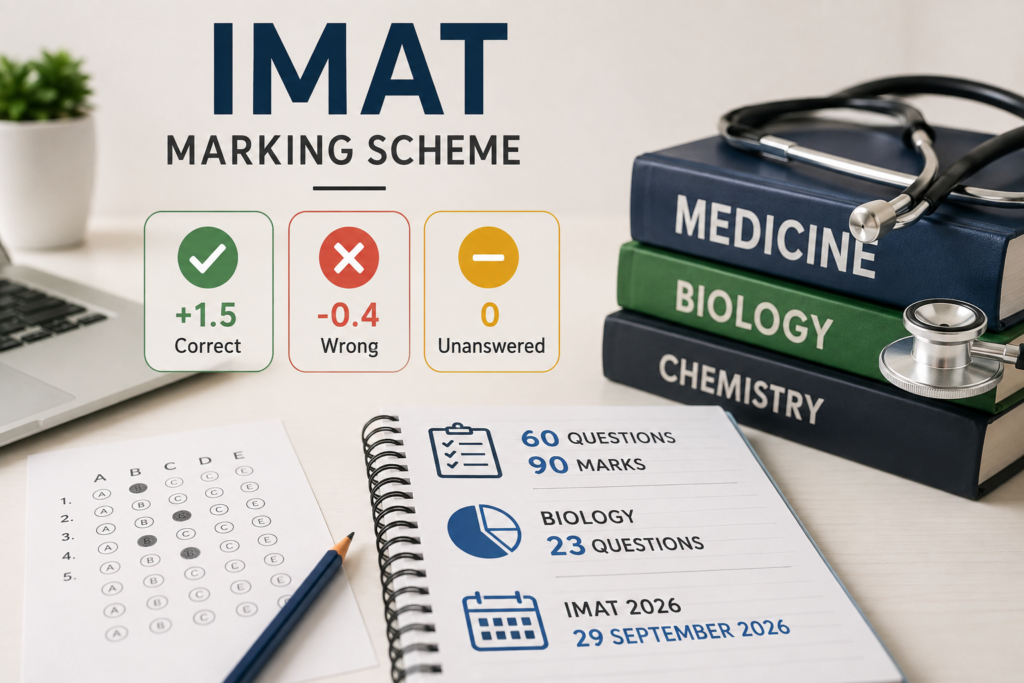
- IMAT marking: +1.5 for correct, -0.4 for wrong, 0 for unanswered.
- IMAT total marks possible: 90, across 60 questions, with Biology the largest section at 23 questions.
- The IMAT marking scheme has not changed since 2024.
- EU candidates need 20+ to enter the ranking; non-EU candidates abroad need a score above 0.
- The 2026 IMAT is confirmed for 29 September 2026.
What Is the IMAT Marking Scheme?
If you’re coming into IMAT prep after years of NEET-style thinking, this is the first thing to unlearn. NEET rewards +4 and punishes -1. IMAT uses a different formula entirely.
The rules for 2026 sit in MUR Decreto Ministeriale n. 1005 del 06-08-2026, issued by Italy’s Ministry of University and Research, the government body that designs and runs the IMAT.

Choose your dream country
 UK
UK
 USA
USA
 Germany
 Australia
 Ireland
 Canada
 UAE
UAE
 France
 Sweden
 Italy
Italy
 Other
Other
When do you want to study abroad?
What's your highest level of education?
Have you completed Class 12th?
What was your Class 12 CGPA/percentage?
Are you a student or a parent/guardian?
What do you want to study?
Select your current city
How Leap will help you

Personalised University Shortlist

Express Applications with Quicker Admits

End-to-End Application Support
| Response | Marks awarded |
|---|---|
| Correct answer | +1.5 |
| Incorrect answer | -0.4 |
| Left unanswered | 0 |
Quick facts on how this scheme works:
- Every question has five options, A through E, with only one correct answer
- No partial credit is given, even for partially correct reasoning
- No bonus points exist for answering faster
- Every question carries the same value, regardless of subject or perceived difficulty
My insight: NEET-prepped students often read "+1.5" as a small number and relax their guard. Relative to the -0.4 penalty, it carries the same weight as 4 marks did on NEET.
IMAT Total Marks and Section-Wise Weightage
IMAT total marks add up to a maximum of 90 points, achieved only if a candidate answers all 60 questions correctly. In practice, candidates rarely reach that ceiling, since even a handful of wrong answers under the negative marking rule pulls their score down quickly.
Here's how the 60 questions break down by subject:
| Section | Number of questions | Maximum marks |
|---|---|---|
| Biology | 23 | 34.5 |
| Chemistry | 15 | 22.5 |
| Physics and Mathematics | 13 | 19.5 |
| Logical Reasoning | 5 | 7.5 |
| Reading Skills and General Knowledge | 4 | 6.0 |
| Total | 60 | 90 |
A few takeaways from this table:
- Biology and Chemistry together account for 38 of the 60 questions, close to 63 percent of the IMAT total marks on offer
- Science subjects (Biology, Chemistry, Physics and Mathematics) make up 51 of the 60 questions
- Some older guides online still list a 22-18-12-8 split. That was the pre-2024 format and no longer applies
This is also why students comparing MBBS in Italy with other destinations tend to plan their prep time around this science-heavy split, not just tuition and rankings.
How IMAT Negative Marking Actually Plays Out
This scenario is where the IMAT marking scheme trips up most first-timers, especially those with a NEET background.
Worked example: attempt 50 of 60 questions and leave 10 blank.
Scenario A: 10 wrong guesses among those attempted
- 40 correct answers: 40 × 1.5 = 60 marks
- 10 incorrect answers: 10 × (-0.4) = -4 marks
- 10 unanswered: 0 marks
- Final score: 56 out of 90
Scenario B: Those same 10 uncertain questions left blank instead
- 40 correct answers: 60 marks
- 20 unanswered: 0 marks
- Final score: 60 out of 90
Same correct answers, but fewer wrong guesses score higher. That's the whole logic behind IMAT negative marking: it punishes blind guessing more than caution.
IMAT Scoring System vs NEET: What Indian Students Need to Unlearn
Most Indian IMAT candidates have already sat for NEET or trained for it, which means their sense of "safe" and "risky" answers is calibrated to a different scoring system entirely. The IMAT scoring system rewards precision over volume, and that single shift changes how every answer should be approached.
| Feature | NEET | IMAT |
|---|---|---|
| Marks for correct answer | +4 | +1.5 |
| Marks for wrong answer | -1 | -0.4 |
| Marks for unanswered | 0 | 0 |
| Total questions | 180 | 60 |
| Maximum marks | 720 | 90 |
| Penalty as share of reward | 25% | 27% |
Key differences to internalize:
- The penalty as a percentage of the reward is close between the two exams, roughly a quarter of what a correct answer earns
- IMAT's smaller absolute numbers, 0.4 instead of 1, can make the penalty feel lighter than it actually is
- NEET rewards volume across 180 questions; IMAT is tighter, with 60 questions in 100 minutes and far less room to recover from early mistakes
Some students weighing the IMAT marking scheme against their options also look at MBBS routes abroad that skip NEET entirely.
For Italy specifically, a valid NEET qualification is still required to get your eventual degree recognized for practice in India, so most IMAT candidates keep both exams in view rather than treating one as a replacement for the other.
My insight: The students who adjust fastest are the ones who stop converting IMAT marks into NEET marks in their head. Thinking "0.4 is basically nothing" is how avoidable marks get lost. Practice with the actual IMAT numbers from day one, not a mental conversion.
3 Indian Student Scenarios Under This Marking Scheme
The IMAT marking scheme plays out differently depending on where a student is starting from. Here is how it applies to three common situations under this marking scheme.
If you're a Class 12 student who just finished NEET and are adding IMAT as a backup:
Your Biology and Chemistry prep carries over almost directly, since those two subjects make up 38 of 60 IMAT questions. What won't carry over is your guessing instinct. NEET's -1 penalty trained you to guess only when truly unsure. IMAT's -0.4 feels lighter, but relative to +1.5, it punishes carelessness almost as hard. Recalibrate that threshold before exam day, not during it.
If you're a repeater who scored low on NEET and is now targeting IMAT as your main route
Your gap is likely Physics and Mathematics, 13 of 60 questions, which rarely gets the same NEET-era attention as Biology. There's no formula sheet and no calculator on the IMAT, so spend real time on mental math rather than assuming your NEET-level Physics revision is enough.
If you're applying from outside the EU and are unsure what score is "safe":
Your eligibility threshold is a score above 0, not 20, a much lower bar than EU candidates face. But the real competition happens above that line, against other non-EU applicants in your university's local ranking. Plan around your target universities' past intake patterns, not the bare minimum score.
Should You Guess on the IMAT?
Given how IMAT negative marking is structured, guessing isn't automatically a bad idea. It depends entirely on how many options you can rule out first.
| Options eliminated | What to do | Why |
|---|---|---|
| Zero | Skip the question | A random guess among five options carries a negative expected value |
| One or two | Use your judgment | The odds sit close to break-even; there's no clear rule here |
| Three or more | Go ahead and guess | Your odds of being right now outweigh the -0.4 penalty |
My insight: Most Indian students underestimate how often they can eliminate at least two options on Biology and Chemistry questions, purely from NEET-level content overlap. The partial knowledge worth using where students are actually losing marks is General Knowledge and Reading Skills, where blind guessing is genuinely closer to a coin toss with no real edge.
What Counts as a Good IMAT Score?
There's no official "good score." Only two thresholds are fixed by decree, both eligibility floors, not targets. Actual university cutoffs are published only after each year's ranking list closes and shifts based on applicant numbers and seats. Treat any past-year cutoff as a historical reference, not a 2026 guarantee.
| Candidate category | Minimum score to be ranked | Below this |
|---|---|---|
| EU and EU-equivalent candidates | 20 or above | Not included in the ranking at all |
| Non-EU candidates residing abroad | Above 0 | A score of exactly 0, or no answers submitted, is not ranked |
Tie-breakers, in order of priority:
| Priority | Tie-breaker |
|---|---|
| 1 | Higher score in Biology |
| 2 | Higher score in Chemistry |
| 3 | Higher scores in Physics and Mathematics |
| 4 | Higher score in Logical Reasoning and Problem Solving |
| 5 | Higher score in Reading Skills and Knowledge Acquired During Studies |
| 6 | Recognised English language certification submitted at registration |
| 7 | Certified disability status, where applicable |
| 8 | Younger age, as the final tiebreaker |
My insight: Students often fixate on the minimum score and stop there. The minimum only gets you into the ranking, not a seat. Your actual result depends on how you rank against every other candidate that cycle, which is why chasing a specific past-year cutoff number is a wasted exercise.
How to Plan Your IMAT Prep Around This Marking Scheme
Understanding the scoring formula is only the first step. Turning it into a study calendar is harder, particularly when board exam preparation overlaps with the same months.
Here is a general timeline for Indian applicants, working backwards from the exam date:
| Period | What to focus on |
|---|---|
| Now to April (Class 12 boards) | Maintain Biology and Chemistry alongside board revision, since these two sections carry most of the IMAT weight |
| May to June | Move into IMAT-specific practice once boards are complete, with particular attention to Physics and Mathematics, a section many candidates underprepare. |
| July | Begin timed, full-length mock tests, scored using the actual -0.4 penalty rather than a simple correct-answer count |
| 26 August to 9 September 2026 | Complete registration on Universitaly within this fixed window, which MUR does not extend |
| Final two weeks before the exam | Shift from new content to speed and to practicing guess-or-skip decisions under time pressure |
| 29 September 2026 | Exam day |
My insight: Candidates who fall short on IMAT rarely lack preparation overall. The more common pattern is treating IMAT prep as secondary to boards, which leaves Physics and Mathematics, the section with no formula sheet, underdeveloped by the time the exam approaches. Starting this section earlier in the year addresses that gap directly.
Has the IMAT Marking Scheme Changed for 2026?
A new decree year often makes students assume the scoring formula changed too. For IMAT, that hasn't been true since 2024.
| Element | Changed for 2026? | Detail |
|---|---|---|
| Marking scheme (+1.5 / -0.4 / 0) | No | Identical to 2024 and 2025 |
| Section-wise question split | No | Same 23-15-13-5-4 structure |
| Total marks (90) | No | Unchanged |
| Exam date | Yes | Revised twice before landing on 29 September 2026 |
The exam date moved from an initial 8 October 2026 to 30 September, to a final errata corrige dated 29 July 2026 confirming 29 September 2026. This date has shifted more than once this cycle, so confirm the final schedule on MUR's official site before locking in plans.
Answer Sheet Rules You Cannot Afford to Get Wrong
The IMAT is a pen-and-paper exam read by an optical scanner, so a clean answer sheet matters almost as much as knowing the content under this marking scheme.
- Mark your answer with a clear X inside the chosen box, not a circle or a tick
- You get one correction per question. To change an answer, black out the old box completely, then mark the new one
- To leave a question blank on purpose and avoid the -0.4 penalty, you must black out a small circle next to that question. This step is irreversible once done
- Fill in your answer sheet as you go. Waiting until the last few minutes to transfer answers is a common and avoidable way to lose marks
Once you've cleared your ranking, the next real deadline on your calendar is the Italy student visa application, so it helps to keep that timeline in view while you're still deep in exam prep.
My insight: A surprising number of strong candidates lose marks to sheet errors, not content gaps. Practice at least one full mock on an actual bubble sheet, not just a digital simulator, so the marking rules become automatic.
3 Key Takeaways on IMAT Marking Scheme
- Know the exact numbers, +1.5, -0.4, and 0, well enough that you're not doing mental math for the first time on exam day
- Guess only when you've genuinely eliminated two or more of the five options, not out of instinct carried over from NEET
- Treat the minimum score of 20 (EU) or above 0 (non-EU abroad) as an eligibility floor, not a target, since actual competitiveness depends on that year's applicant pool and seat count.
Verified by: LeapScholar's Italy counseling team, with hands-on experience guiding Indian students through IMAT preparation and Italian medical admissions.
Have questions about the IMAT marking scheme or studying medicine in Italy? Book a free session with a LeapScholar counselor.
Frequently Asked Questions About The IMAT Marking Scheme
-
What is the IMAT marking scheme for 2026?
You get +1.5 for a correct answer, lose 0.4 for a wrong one, and nothing happens if you skip a question. That's it, no hidden clauses. It's been this way since 2024, and MUR's 2026 decree keeps it unchanged.
-
How many total marks does the IMAT carry?
The ceiling is 90 marks across 60 questions. Almost nobody gets there. A couple of careless wrong answers, and that number slides fast.
-
Is there negative marking in the IMAT exam?
Yes, but milder than most Indian students expect. You lose 0.4 for a wrong answer, not a full mark. Leave it blank, and you lose nothing.
-
What is a decent IMAT score for Indian students?
There's no official number for the score. What is official is the floor: as a non-EU applicant, you need to score above 0 just to be in the running. Beyond that, "good" depends on who else sat the exam that year and how many seats your target university has.
-
What is the minimum IMAT score to get a rank?
EU candidates need 20 or more. If you're applying as a non-EU candidate from India, your bar is lower, just above 0. Score exactly 0, or leave the whole paper blank, and you won't be ranked either way.
-
How is IMAT scoring different from NEET scoring?
NEET gives 4 and takes away 1 over 180 questions. IMAT works on a smaller scale, +1.5 and -0.4, over just 60. The penalty math is surprisingly similar, but IMAT gives you far fewer questions to recover from an early mistake.
-
What happens if I leave an IMAT question unanswered?
Nothing. Zero marks, no penalty. This is exactly why guessing without any real basis usually does more harm than good on this exam.
-
What if I make a marking error on the IMAT answer sheet?
You get one shot at fixing it. Black out the wrong box completely, then mark the correct one with an X. If you're skipping a question on purpose, there's a separate circle you black out for that, and once it's done, it's done.
-
Has the IMAT marking scheme changed from previous years?
No. The IMAT marking scheme has been +1.5, -0.4, and 0 since 2024, and that hasn't moved for 2026 either.








Have Questions? Get Guidance to reach your Dream University
Connect with India's finest counsellors and biggest study abroad community.
Get Guidance