
Quick Read
- TUM, RWTH Aachen, and KIT are Germany’s top-ranked biomedical engineering universities globally.
- Public universities charge zero to Rs.3.2 lakh a year in tuition.
- Indian applicants need an APS certificate before a Germany study visa can be approved.
- A blocked account of Rs.12.98 lakh (11,904 euros) is mandatory for every applicant.
Why a Masters in Biomedical Engineering in Germany Works for Indian Engineers
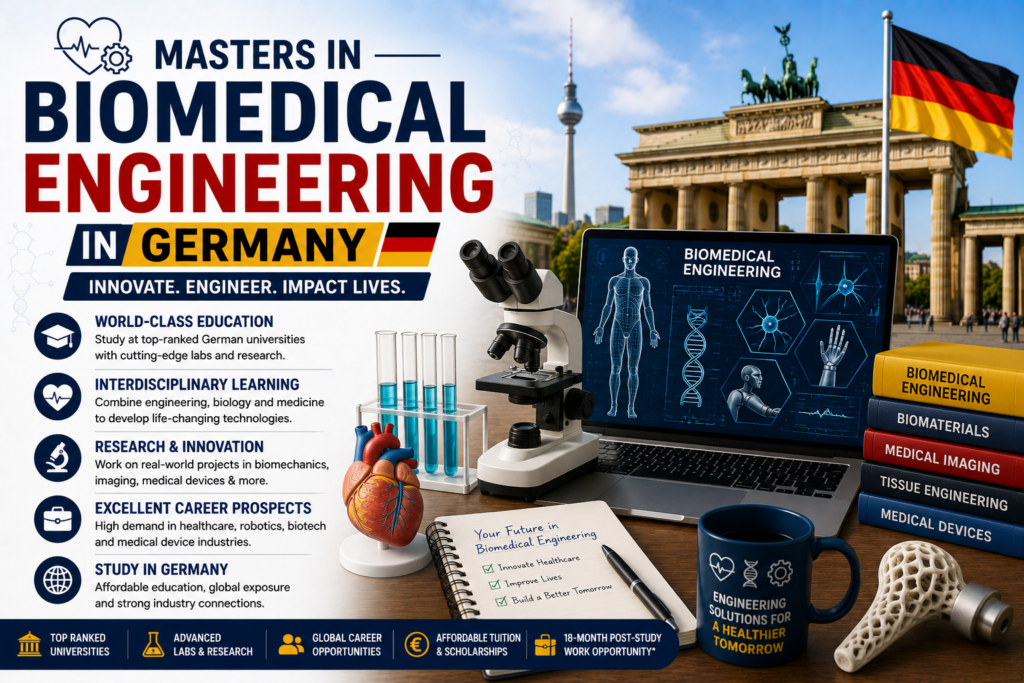
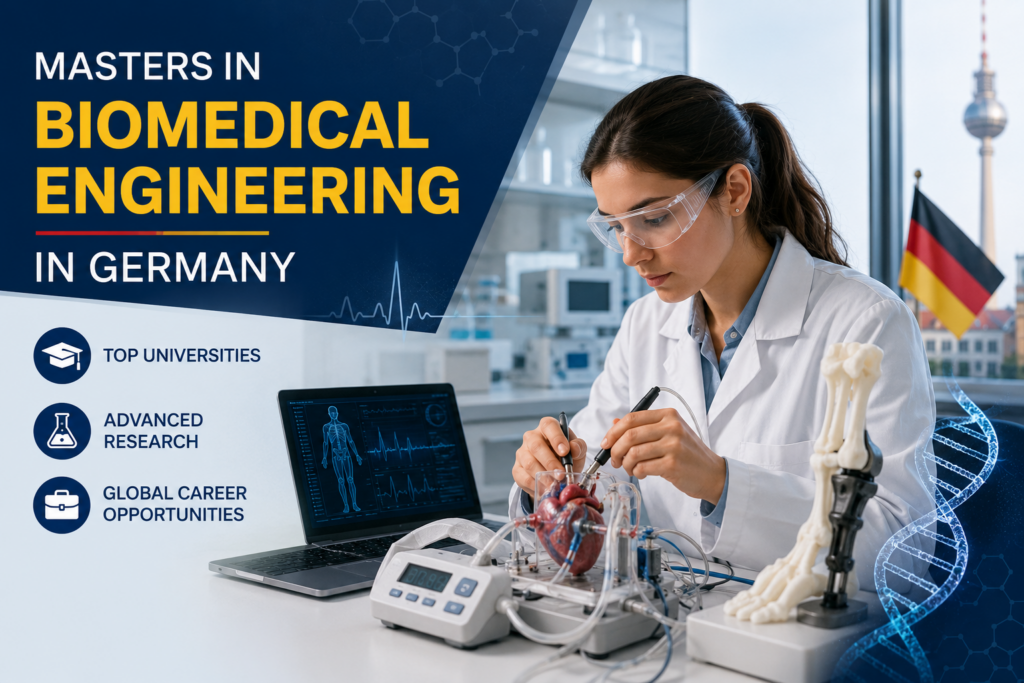
Germany exports more medical technology than almost any other country in Europe, with Siemens Healthineers, Dräger, and B. Braun hiring directly out of university labs. A masters in biomedical engineering in Germany sits at the intersection of electrical/mechanical engineering and clinical medicine, covering medical imaging, biomechanics, and regulatory affairs for devices. Every program in this guide admits someone with an engineering or applied-physics background, not a medical one, and almost all public universities charge little to no tuition.
Counselor insight: Students often assume “biomedical” requires a medical degree. It doesn’t. Medicine is the application area here, not the entry requirement.

Choose your dream country
 UK
UK
 USA
USA
 Germany
 Australia
 Ireland
 Canada
 UAE
UAE
 France
 Sweden
 Italy
Italy
 Other
Other
When do you want to study abroad?
What's your highest level of education?
Have you completed Class 12th?
What was your Class 12 CGPA/percentage?
Are you a student or a parent/guardian?
What do you want to study?
Select your current city
How Leap will help you

Personalised University Shortlist

Express Applications with Quicker Admits

End-to-End Application Support
Top Universities for a Masters in Biomedical Engineering in Germany
Four names come up consistently across official program listings:
- TUM
- RWTH Aachen
- KIT
- HAW Hamburg.
Each sits in a different fee bracket, so pick by budget and Bachelor's background as much as by rank.
| University | QS World Rank 2027 | Program | Duration | Annual Fee (Non-EU) | Intake |
| TUM | #25 (global) | MSc Biomedical Engineering and Medical Physics | 2 years | Rs.13.08 lakh (EUR 12,000/year = EUR 6,000/semester) | Winter only |
| RWTH Aachen | #104 | MSc Biomedical Engineering (BME) | 2 years | Rs.71,700 (EUR 658/year = EUR 329/semester) | Winter only |
| KIT | #110 | MSc Biomedical Engineering | 2 years | Rs.3.27 lakh (EUR 3,000/year = EUR 1,500/semester) | Winter and Summer |
| HAW Hamburg | Not QS-ranked | MSc Biomedical Engineering | 1.5 years | Rs.82,600 (EUR 758/year = EUR 379/semester) | Winter only |
QS ranks per the QS World University Rankings 2027, as cited by the German Federal Foreign Office.
TUM's MSc Biomedical Engineering and Medical Physics is the costliest because TUM is the only one here charging full non-EU tuition. RWTH Aachen runs the only standalone BME degree taught partly inside the university hospital, with no non-EU tuition in NRW, just the semester fee. KIT launched its Biomedical Engineering masters in winter 2025/26 across five focus areas and is the only one of the four offering a Summer intake.
Comparing against adjacent engineering paths first? See MS in Robotics in Germany, MTech in Germany, or the wider guide to top universities in Germany for Master's.
Counselor insight: RWTH Aachen's Education Fund (EUR 300/month) is only open once you're enrolled, not at the application stage. Don't count on it as guaranteed funding.
Application Deadlines for Masters in Biomedical Engineering in Germany, 2027-28 Cycle
Only KIT admits for both semesters; the other three are Winter-only. Deadlines shift by applicant category and year, so confirm on the university's own page before applying.
| University | Winter 2027/28 | Summer 2028 |
| TUM | Typically end of May 2027 | Not offered |
| RWTH Aachen | Typically 15 January to 15 July 2027, by applicant category | Not offered |
| KIT | 15 July 2027 | 30 November 2027 |
| HAW Hamburg | Typically mid-July 2027 | Not offered |
For the full cross-university picture, see Winter Intake in Germany and Summer Intake in Germany.
Eligibility and Documents Checklist for a Masters in Biomedical Engineering in Germany
| Requirement | What It Means for You |
| Bachelor's degree | BTech/BE in Biomedical, Electrical, Electronics, Mechanical, or Instrumentation Engineering, or BSc Physics |
| Academic score | First-division aggregate: RWTH expects a GPA equivalent to 2.5 or better on the German scale |
| APS Certificate | Mandatory before any German university processes your file; see APS Certificate Germany |
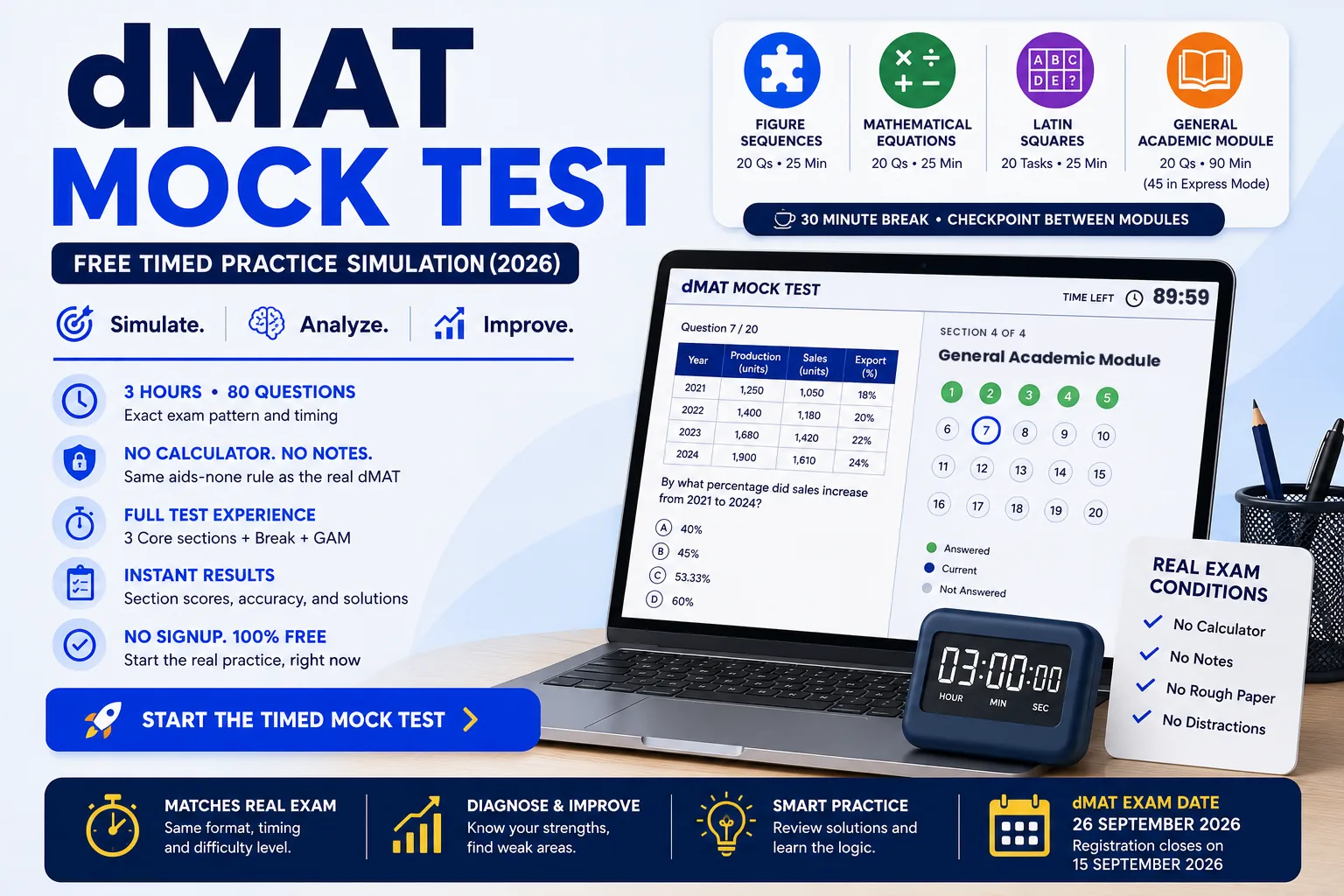
| dMAT Certificate | Mandatory from Summer Semester 2027 onward for engineering-background applicants; see the section below |
| English proficiency | IELTS 6.5 or equivalent TOEFL |
| SOP and LORs | Program-specific SOP; 2-3 LORs from professors who supervised a relevant project |
| Blocked account | Rs.12.98 lakh (EUR 11,904), released as a Rs.1.08 lakh (EUR 992) monthly payout |
| Health insurance | Confirmed public insurance before enrollment |
A missing APS certificate is the single most common reason we see applications delayed past intake deadlines.
Counselor insight: TUM runs a written aptitude test as part of admission, not just a document review. Prepare for it like a GRE, even though it isn't formally called an entrance exam.
The New dMAT Requirement
APS India added the Digital Master Test (dMAT) to its documentation file on 29 June 2026. It applies to Bachelor's degrees in engineering (including CS/IT), commerce, accounting, finance, economics, business, or management, starting Summer Semester 2027 onward, not Winter 2026/27. Since almost every masters in biomedical engineering in Germany applicant holds an engineering Bachelor's, this affects most readers targeting Summer 2027 or Winter 2027/28.
dMAT doesn't replace APS; it's an additional document inside the same file, built by G.A.S.T. with DAAD's support, testing reasoning speed rather than subject recall. It costs roughly Rs.16,350 (EUR 150) on top of the Rs.18,000 APS fee. Seats have historically run first-come, first-served, so register as soon as your window opens rather than waiting for your APS paperwork.
Full mechanics: dMAT Exam 2026 and APS dMAT Guide. If your APS documents were already filed before 29 June 2026, you're exempt from this cycle regardless of your degree field.
Counselor insight: If your Bachelor's is a hybrid (BCA, dual-major, or a biomedical program with a heavy management component), email APS India directly for written confirmation before deciding whether to register.
If dMAT does apply to you, start preparing early: our guide on how to prepare for DMAT covers a study plan you can run alongside your APS paperwork.
Masters in Biomedical Engineering in Germany: Fees and Cost of Living
- Blocked account: Rs.12.98 lakh (EUR 11,904)/year, mandatory for the visa. See the Germany study visa guide.
- Living costs: RWTH's own estimate is EUR 1,100/month (Rs.1.2 lakh); Munich and Hamburg run higher.
- APS fee: Rs.18,000, non-refundable.
- dMAT fee: Rs.16,350 (EUR 150), if applicable to your degree.
- Health insurance: EUR 120-130/month.
Exchange rate used: Rs.109 per EUR.
DAAD and Other Scholarships for a Masters in Biomedical Engineering in Germany
Very few universities offer full-ride scholarships directly; the ecosystem runs on external funding instead. The DAAD scholarship for Germany pays a monthly base of EUR 992 for development-related Master's study, with roughly 40 scholarships awarded each year across all eligible fields. DAAD deadlines fall months before university deadlines, so apply for funding before you finalize your university shortlist. RWTH's Education Fund and foundation-run scholarships like Studienstiftung are open once you're enrolled or admitted but rarely replace the blocked account requirement.
Counselor insight: DAAD reviewers weight research or project experience heavily. A generic SOP rarely clears the shortlist; two paragraphs on a specific biomedical project does more.
Which Path Fits You?
- Final-year BTech graduate (2027): Start your APS application by March 2027, ahead of June university deadlines, and register for dMAT the same month if your degree qualifies.
- 1-2 years of work experience in medical devices: RWTH and KIT weigh such experience heavily in your SOP, and it strengthens a DAAD application.
- Bachelor's in a tangential field (Mechanical, Instrumentation): Expect bridging modules at HAW Hamburg or a stricter module-by-module review at TUM and KIT.
What to Do When Things Go Wrong
- APS running late: APS India doesn't guarantee a fixed timeline; normally 3-4 weeks, but 8-12 weeks between April and July. Apply immediately and ask your university about a late-document allowance.
- Low IELTS score: Retake it. 6.5 is a strict cutoff at most programs here, not a guideline.
- Delayed final-year results: Most universities accept a provisional transcript with an expected-graduation letter, but confirm the details in writing first.
- Visa delayed past intake: Contact the university's international office immediately; some allow late registration in the first two to three weeks, but never assume the same.
Salary and Career After a Masters in Biomedical Engineering in Germany
Salary data on this role varies widely by source, so treat any single number with caution: independent platforms put average biomedical engineer pay in Germany between Rs.39.9 lakh and Rs.89.4 lakh a year (EUR 36,600-82,000), entry-level graduates closer to the lower half. See Average Salary in Germany for comparison against other roles.
Graduates get an 18-month post-study permit to job-search, then an EU Blue Card with a qualifying offer. See Germany Job Seeker Visa for the exact route at each stage.
Get PR in 21 months with the EU Blue Card, no lottery. Read more about it in our exhaustive guide for Software Engineering in Germany.
Counselor insight: Students specializing in regulatory affairs or clinical engineering get hired faster in Germany's Mittelstand medical-device companies, which hire in volume but recruit less visibly than the well-known giants.
3 Key Takeaways on Masters in Biomedical Engineering in Germany
- A masters in biomedical engineering in Germany costs anywhere from near-zero tuition (RWTH Aachen) to Rs.13 lakh a year (TUM); shortlist by fee bracket first, ranking second.
- Your APS certificate and now dMAT, if your degree qualifies, are non-negotiable; start both by March 2027 for a 2027-28 intake.
- DAAD scholarship deadlines fall before university deadlines, so apply for funding first.
Have questions about a masters in biomedical engineering in Germany? Book a free session with a LeapScholar counselor.
Frequently Asked Questions About Masters in Biomedical Engineering in Germany
-
Is it worth doing a Masters in biomedical engineering in Germany?
Yes, if you're targeting Europe's medical-device industry. Tuition is close to zero at most public universities, and you get direct access to Siemens Healthineers, Dräger, and B. Braun's hiring pipelines, plus an 18-month post-study visa.
-
Can I study biomedical engineering in Germany in English?
Yes. TUM, RWTH Aachen, KIT, and HAW Hamburg all teach their Master's programs fully in English. You'll still need basic German for daily life outside class.
-
Is biomedical engineering in demand in Germany?
Yes. Germany's medical-technology export industry is one of the largest in Europe, and demand holds steady across both large manufacturers and mid-sized Mittelstand companies.
-
What is the salary of a Biomedical Engineer in Germany?
Independent salary platforms put average pay between Rs.39.9 lakh and Rs.89.4 lakh a year (EUR 36,600-82,000), with entry-level graduates closer to the lower end.
-
Will AI replace biomedical engineers?
Unlikely soon. AI is being built into imaging and diagnostics tools, but someone still has to design, validate, and get regulatory approval for the hardware those tools run on.
-
Which university is best for Masters in biomedical engineering in Germany?
TUM ranks highest globally (QS #25) but charges full tuition. RWTH Aachen (QS #104) is tuition-free and the only one with a standalone BME degree. "Best" depends on your budget more than rank alone.
-
What is the minimum CGPA for Masters in Germany?
Most programs expect a first-division aggregate, roughly 60%, or a CGPA of 6.5 to 7.0 out of 10. RWTH Aachen specifically looks for a GPA equivalent to 2.5 or better on the German scale.
-
Is a public university better than a private one for this program?
For most Indian students, yes, public universities are better, mainly because of cost. RWTH and HAW Hamburg charge little beyond a semester fee, while private institutions cost EUR 5,000-30,000 a year.







Have Questions? Get Guidance to reach your Dream University
Connect with India's finest counsellors and biggest study abroad community.
Get Guidance