
Quick Read
- MIT ranks #1 in QS World University Rankings 2027; Harvard ranks #5.
- Harvard’s acceptance rate is about 3.5%; MIT’s is about 4.5%.
- Harvard’s total cost of attendance is roughly Rs.99.5 lakh ($104,288) a year.
- MIT accepts CBSE, ISC, IB, and state board marksheets with no conversion required.
- Both schools meet 100% of demonstrated financial need for admitted students, Indian or not.
- MIT leads in engineering and computer science; Harvard leads in law, business, and public policy.
Harvard vs MIT: The Real Difference Indian Students Need to Know
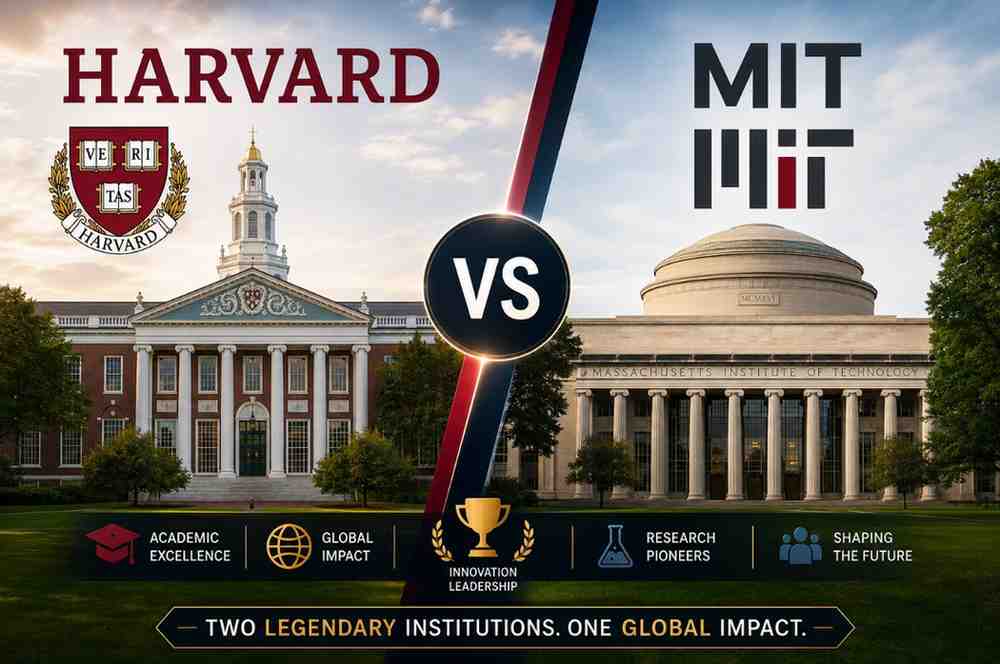
Both are elite. Neither is “better” in the way a ranking table implies. MIT focuses mainly on science, engineering, and technology, while Harvard concentrates on the liberal arts, though both offer 50-plus majors. MIT usually leads the QS rankings, while Harvard tends to score higher on Times Higher Education, because each ranking weighs different things.
| Harvard | MIT | |
|---|---|---|
| Known for | Law, business, humanities, public policy | Engineering, computer science, physical sciences |
| QS World Ranking 2027 | #5 | #1 |
| Founded | 1636 | 1861 |
| Ivy League | Yes | No |

Choose your dream country
 UK
UK
 USA
USA
 Germany
 Australia
 Ireland
 Canada
 UAE
UAE
 France
 Sweden
 Italy
Italy
 Other
Other
When do you want to study abroad?
What's your highest level of education?
Have you completed Class 12th?
What was your Class 12 CGPA/percentage?
Are you a student or a parent/guardian?
What do you want to study?
Select your current city
How Leap will help you

Personalised University Shortlist

Express Applications with Quicker Admits

End-to-End Application Support
Counselor insight: Harvard's own data shows Indian enrollment fell by roughly 31% in Fall 2025, from 788 to 545 students across all schools, even as Harvard's total international enrollment hit a record 28%. Indian students didn't get less qualified. Visa uncertainty and later application decisions likely pushed some toward safer options. If you're applying for Fall 2026-27, build your list wider than just these two names.
Harvard vs MIT Comparison Table: Rankings, Fees, and Admission Stats
Here's the side-by-side an Indian applicant actually needs.
| Metric | Harvard | MIT |
|---|---|---|
| QS World Ranking 2027 | #5 | #1 |
| Undergraduate acceptance rate (Class of 2028-29) | ~3.5% | ~4.5% |
| Total enrolment | ~24,500 | ~12,000 |
| International student share | 28% (6,749 students, Fall 2025) | ~28% (3,430 students) |
| Indian students enrolled | 545 (Fall 2025) | ~261-286 |
| Total cost of attendance (2025-26) | Rs.99.5 lakh ($104,288) | Rs.90.4 lakh ($94,704) |
| Financial aid policy | 100% demonstrated need, need-blind | 100% demonstrated need |
| Standardised test | SAT/ACT, test-optional through 2030 | SAT/ACT required |
| Fall intake only | Yes | Yes |
Exchange rate used: Rs.95.50 per USD, as of July 2026. Verify the current rate before finalising your budget.
Counselor insight: Indian students consistently overweight Harvard's Ivy League label and underweight MIT's #1 QS rank in STEM. If your target is computer science, AI, or core engineering, MIT's rank advantage in these fields is real and shows up in recruiter perception, not just the league table.
See how these compare against other Tier 1 US universities for MS
Which Is Right for You? A Decision Framework for Indian Applicants
Don't pick based on which name sounds more prestigious at a family dinner. Pick based on where your profile and goals actually fit.
If you are a final-year JEE/Olympiad-track student set on core engineering or CS: MIT is built around this. Its holistic process still weighs Olympiad medals, research projects, and technical depth heavily, and it does not convert your board marks to a US GPA scale, so a strong CBSE/ISC transcript stands on its own. Roughly 4-5 Indian students enter MIT's freshman class each year out of an intensely competitive applicant pool, so a technical "spike," not just marks, is what separates admits from rejections.
If you are a CBSE or ISC student drawn to law, economics, public policy, or the humanities: Harvard's broader liberal arts curriculum and its Law School, Kennedy School, and undergraduate concentrations in economics and government give you room most STEM-focused schools don't. Indian students at Harvard are most concentrated in MBA, computer science, data science, law, and public policy programs, so this pull toward policy and business is already established, not a niche choice.
If you are a working professional deciding between an MBA at Harvard Business School vs MIT Sloan: HBS generally ranks above MIT Sloan in most global MBA tables and draws one of the largest international cohorts at Harvard each year. HBS's 2-year MBA costs about Rs.75 lakh ($78,700) a year in tuition alone, with a typical competitive Indian applicant profile carrying 2+ years of work experience and a GMAT average around 740. If your goal is general management or finance leadership, HBS's brand and alumni depth in business carry more weight. If your goal is tech-driven entrepreneurship or product leadership, Sloan's tighter integration with MIT's engineering ecosystem is the stronger bet.
Harvard vs MIT Fees for Indian Students: The Real Cost in Rupees
Sticker price scares families before financial aid even enters the picture. Here's what it actually looks like.
| Cost component | Harvard (2025-26) | MIT (2025-26) |
|---|---|---|
| Tuition | Rs.51.8 lakh ($54,269) | Rs.61.4 lakh ($64,310) |
| Total cost of attendance (tuition + housing + fees) | Rs.99.5 lakh ($104,288) | Rs.90.4 lakh ($94,704) |
| Families earning under $100,000/year | Pay Rs.0 | Pay Rs.0 |
| Families earning under $200,000/year | No tuition charged | Substantial aid, case by case |
| Share of students on need-based aid | 55% | Majority of admitted students |
Exchange rate used: Rs.95.50 per USD. Verify the current rate on a live converter before finalising your family budget, as this shifts weekly.
Counselor insight: MIT's sticker tuition is actually higher than Harvard's, which surprises most Indian families who assume "Ivy League" automatically means costlier. The gap closes further once aid is applied, since both schools are need-blind and meet full demonstrated need for every admitted student, domestic or international.
For Indian students, the application to financial aid is separate from admission:
- Harvard: CSS Profile + Harvard Financial Aid Application (HFAA)
- MIT: CSS Profile only
Explore full Masters in USA cost breakdowns beyond just these two schools
Documents and Eligibility: What Harvard and MIT Expect From Indian Applicants
| Document | Harvard requirement | MIT requirement | India-specific detail |
|---|---|---|---|
| Board marksheet | Class 12 result, ~90-95% typical for competitive applicants | Class 12 result, no minimum GPA published | CBSE, ISC, IB, and state boards all accepted; no conversion needed |
| Standardised test | SAT/ACT, test-optional through 2030 | SAT/ACT required, average SAT ~1500+ | Both accept India test centres |
| English proficiency | TOEFL/IELTS if medium of instruction wasn't English | TOEFL/IELTS recommended if English used less than 5 years | Waived for many CBSE/ISC students schooled fully in English |
| Recommendation letters | 2 teacher recommendations (UG) | 2 teacher recommendations (UG), 3 for graduate | Indian teachers should focus on specific classroom examples, not generic praise |
| Financial aid form | CSS Profile + HFAA | CSS Profile | Required regardless of whether aid is ultimately needed |
| Application fee | $90 (UG) | $75 (UG), Rs.6,285 | Fee waivers available for demonstrated financial need |
Harvard vs MIT Application Calendar for Indian Students (2026-27 Intake)
Both schools admit for fall only. There is no spring or winter intake at either.
| Month | What to do |
|---|---|
| June-July (before Class 12 board exams) | Shortlist programs, start SOP drafts, register for SAT/ACT |
| August-September | Finalise Harvard/MIT-specific essays, request recommendation letters |
| October | Take SAT/ACT if not already done, prep TOEFL/IELTS if required |
| November 1 | Harvard Restrictive Early Action deadline; MIT Early Action deadline |
| December | MIT and Harvard Early Action decisions released |
| January 1 | Harvard Regular Decision deadline |
| January 4 | MIT Regular Action deadline |
| February-March (board exam season) | Submit CSS Profile and financial aid documents; avoid scheduling this against board prep |
| March-April | Regular Decision results released |
| April-May | Accept offer, submit I-20 documents, apply for F-1 visa |
| June-August | F-1 visa interview, book travel, complete pre-departure formalities |
Counselor insight: The CSS Profile deadline routinely lands in the middle of India's board exam season. Students who delay financial aid paperwork until after boards often miss priority consideration, even if their admission is unaffected. Start the CSS Profile in December, not February.
What to Do If Harvard or MIT Rejects You
Rejection from either school is the statistical default, not the exception. Out of roughly 28,000+ applicants, MIT admits about 1,284. Harvard's numbers are similarly steep. A strong profile getting rejected doesn't mean the profile was weak.
- You're waitlisted, not rejected: Neither school guarantees waitlist movement. Don't decline other offers while waiting.
- You're rejected from one, admitted to the other: This happens often, since the two schools evaluate for different strengths. Accept the admit and move forward; don't reapply to the other next cycle unless your profile has materially changed.
- You're rejected from both: Build your list with other Tier 1 US universities from the start, not as an afterthought. A well-rounded list of 8-10 schools protects you from betting everything on two ultra-selective names.
- Deferred from Harvard's Restrictive Early Action: You move into the Regular Decision pool. You can still submit an updated school report or a brief letter of continued interest.
Counselor insight: Indian applicants with strong academics but generic extracurriculars are the most common Harvard rejection pattern. Admissions officers are looking for a documented "spike," something done at a national or international level, not a longer activities list.
Harvard vs MIT After Admission: Visa, Outcomes, and Alumni Network
| Outcome metric | Harvard | MIT |
|---|---|---|
| OPT (standard) | 12 months | 12 months |
| STEM OPT extension | Up to 24 additional months for STEM majors | Up to 24 additional months for STEM majors |
| Median starting salary | Varies by school; HBS grads often exceed $145,000+ | ~$126,841 (Rs.1.21 crore) |
| Global alumni network | 400,000+ worldwide | 140,000+ worldwide |
| Top recruiters | McKinsey, Goldman Sachs, Google, Amazon | Google, Apple, SpaceX, McKinsey, Amazon |
Counselor insight: Both F-1 visa processes are identical in structure, but timing matters more than school choice. Fall 2026 F-1 interview slots resumed in India in early July after a temporary pause, and both Harvard and MIT recommend having your visa approved well before mid-August to meet reporting dates.
3 Takeaways on Harvard vs MIT
- Choose based on academic direction, not the name that sounds more prestigious. MIT's edge in STEM and Harvard's edge in law, business, and humanities are real and consistent across rankings.
- Budget in rupees from day one and start financial aid paperwork before board exam season, not after. Both schools meet full demonstrated need, but the CSS Profile deadline doesn't wait for your Class 12 results.
- Build a list beyond just these two schools. With acceptance rates near 3-5%, even a genuinely excellent profile has better odds spread across 8-10 well-matched Tier 1 universities.
Verified by: LeapScholar's USA counselling team, with hands-on experience guiding Indian students through Ivy League and Tier 1 applications.
Have questions about choosing between Harvard and MIT? Book a free session with a LeapScholar counsellor.
Frequently Asked Questions About Harvard vs MIT
-
Which school has a stronger Indian alumni network?
Harvard's total alumni network (400,000+) is larger in absolute terms than MIT's (140,000+), and Harvard hosts more Indian students currently enrolled (545 vs. roughly 261-286 at MIT). Both networks are active in India through regional alumni chapters, particularly in Mumbai, Delhi, and Bengaluru.
-
What happens if I get rejected from both Harvard and MIT?
Rejection from both is the statistical default given acceptance rates near or below 4-5%. The practical response is to have applied to a broader list of 8-10 universities from the start, including other Tier 1 US schools, rather than treating Harvard and MIT as your only options.
-
Which is better for an MBA, Harvard or MIT Sloan?
Harvard Business School generally ranks above MIT Sloan in most global MBA rankings and draws one of the largest international applicant pools at Harvard annually. HBS suits candidates targeting general management, finance, or consulting leadership. MIT Sloan suits candidates targeting tech-driven entrepreneurship or product roles, given its closer integration with MIT's engineering departments.
-
Does Harvard vs MIT accept CBSE, ISC, or state board marksheets?
Yes, both accept all Indian board marksheets directly, without requiring GPA conversion to the US 4.0 scale. Competitive applicants at both schools typically score 90-95%+ in Class 12 boards, though neither school publishes an official minimum cutoff.
-
Is Harvard vs MIT cheaper for Indian students?
Before aid, MIT's total cost of attendance (around Rs.90.4 lakh, $94,704) is slightly lower than Harvard's (around Rs.99.5 lakh, $104,288). After financial aid, the gap often closes further, since both schools are need-blind and meet 100% of demonstrated need for every admitted student regardless of nationality.
-
What is Harvard's acceptance rate for Indian students specifically?
Harvard does not publish country-specific acceptance rates. What is known: 545 Indian students were enrolled across all Harvard schools in Fall 2025, down about 31% from 788 the previous year, even as Harvard's total international enrolment hit a record 28%.
-
Can I apply to both Harvard and MIT in the same cycle?
Yes. Applying to Harvard does not affect your MIT application or vice versa, since they're evaluated by separate admissions committees. Note that Harvard's Restrictive Early Action policy limits you from applying Early Action or Early Decision to most other private universities in the same round, though MIT's Early Action is non-restrictive and compatible with Harvard's REA.
-
Is MIT better than Harvard for computer science?
MIT's computer science and engineering programs consistently rank #1 globally, including in QS World University Rankings by Subject. Harvard's computer science program is strong but ranks lower in most subject-specific tables. If CS or core engineering is your primary goal, MIT holds a clearer edge, though Harvard's cross-registration with MIT allows students at either school to take some of the other's courses.
-
Which is harder to get into, Harvard vs MIT?
Harvard's acceptance rate has run slightly lower than MIT's in recent cycles, around 3.2-3.6% versus MIT's 4.5-4.8%. For international applicants specifically, MIT's international acceptance rate drops closer to 2%. Neither is meaningfully "easier." Both evaluate holistically, so a strong SAT score alone won't secure admission at either school.







Have Questions? Get Guidance to reach your Dream University
Connect with India's finest counsellors and biggest study abroad community.
Get Guidance