
Quick Read
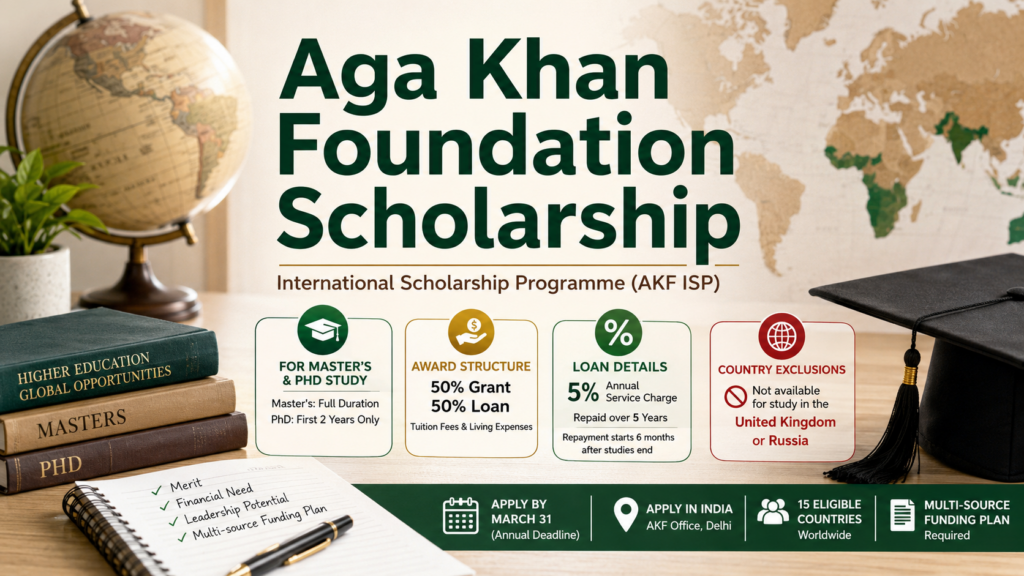
- The Aga Khan Foundation scholarship funds 50% grant, 50% loan for Master’s and PhD study.
- Indian applicants submit forms by March 31 at the Delhi office.
- The loan portion carries a 5% annual charge, repaid over five years.
- The Aga Khan Foundation scholarship does not fund study in the United Kingdom or Russia.
What Is the Aga Khan Foundation Scholarship?
This scholarship is the International Scholarship Programme (AKF ISP), which is run by the Aga Khan Development Network (AKDN). It was established in 1969 by Prince Karim Aga Khan IV and has supported more than 1,500 students worldwide to date, according to the official AKDN scholarships page.
This scholarship is not designed to be your main source of funding. According to AKDN, this scholarship is meant to be a last-resort resource. It is meant to fill the last gap after you have used up savings, family support, and other scholarships, not to cover your degree from the beginning.
Counselor insight: Most students shortlist AKF ISP first because it appears in every scholarship database, then discover midway through the form that they need two or three other funding sources already lined up. Apply for your loan sanction letter or another scholarship in parallel, not after.
In India, the program is administered by the Aga Khan Foundation (India) from its Delhi office, working with local Aga Khan Education Service and Education Board units where relevant.
Aga Khan Foundation Scholarship Eligibility for Indian Students in 2027-28
To qualify for this scholarship, you must meet all of the following, per the official AKDN eligibility criteria:
- Hold a Bachelor’s degree or equivalent professional training.
- Have an excellent, consistent academic record.
- Demonstrate genuine financial need.
- Present a multi-source funding plan covering all years of study, not just a one-line request.
- Be admitted to a reputable postgraduate institution.
- Be entering the first year of your postgraduate program. If you have already started your Master’s or PhD, you are not eligible.
- Show strong leadership potential, professional experience, extracurricular activity, or entrepreneurial achievement.
Note: Preference goes to applicants under 30 years of age, though this requirement is stated as a preference, not a hard cutoff.
AKDN also runs an online eligibility tool to check your fit before you approach the Delhi office, worth using as a first filter before you invest time in paperwork.
Which Countries Can Apply for the Aga Khan Foundation Scholarship?
| Category | Countries |
| Full eligibility (citizens residing in-country) | Afghanistan, Australia, Bangladesh, Egypt, India, Kenya, Kyrgyz Republic, Madagascar, Mozambique, New Zealand, Pakistan, Syria, Tajikistan, Tanzania, Uganda |
| Conditional eligibility | Canada, Portugal, and the USA. Only if you originate from one of the countries listed above |
| Not eligible for study | United Kingdom, Russia |
Five of the fifteen eligible nationalities are African (Kenya, Tanzania, Uganda, Madagascar, Mozambique), alongside South Asian nations like India, Bangladesh, Pakistan, and Afghanistan.
This is the single most missed detail among Indian applicants. If your target destination is the UK, AKF ISP will not fund that plan regardless of profile strength. Indian students set on the UK should instead look at scholarships for a Master’s in the UK, where Chevening and GREAT cover a comparable or larger share of cost.
Counselor insight: Students sometimes assume the UK exclusion only applies if they’re an Indian citizen studying in the UK; it applies regardless of your nationality or the strength of your profile. If your shortlist includes even one UK university, budget for that program separately rather than assuming AKF ISP might still come through.
Aga Khan Foundation Scholarship Value: Grant, Loan and INR Conversion
The award is structured as 50% grant and 50% loan. It covers tuition fees and living expenses only. It does not cover international travel, clothing, furniture, or the living costs of accompanying family members, per the official AKDN award conditions.
There is no fixed scholarship amount published for India. AKF assesses the award based on your remaining financial need after other funding is accounted for. Here is a worked example using a mid-range Master’s funding gap:
| Item | USD | INR (at $1 = ₹95.23) |
| Illustrative award amount (for math purposes only) | $20,000 | ₹19,04,600 |
| Grant portion (50%, not repaid) | $10,000 | ₹9,52,300 |
| Loan portion (50%, repayable) | $10,000 | ₹9,52,300 |
| Annual service charge on loan (5%) | $500/year | ₹47,615/year |
| Total repayable over 5 years (loan + charge) | approx. $12,500 | approx. ₹11,90,375 |
Exchange rate used: $1 = ₹95.23 as of early August 2026. Verify the current rate before finalizing your budget.
Source: Aga Khan Foundation International Scholarship Programme, official AKDN page
AKF does not publish a fixed maximum or minimum for India. Your actual award depends on your assessed need, your university’s cost of attendance, and funds available that cycle, per the official AKDN award conditions. The $20,000 figure above is a working example, not a quoted award amount.
Counselor insight: Students often read “50% loan” and assume it behaves like a bank EMI from day one. It does not. Repayment only starts six months after you graduate, stop studying, or lose the award for falling below academic standards. Budget for that six-month buffer, but don’t spend the grant portion assuming the loan clock hasn’t started ticking.
How the Aga Khan Foundation Scholarship Compares to Other Funding
| Funding option | Structure | Typical INR value | Repayment |
| Aga Khan Foundation scholarship | 50% grant, 50% loan | Varies by need; no fixed cap | 5% annual charge, 5-year term, starts 6 months post-study |
| SBI Global Ed-Vantage education loan | Full loan, secured or unsecured | Up to ₹1.5 crore | Interest from approx. 8.4% p.a.; standard EMI post-moratorium |
| Fulbright-Nehru Master’s Fellowship | Fully funded grant | Tuition, living, travel covered | No repayment |
| Tata Trusts (J.N. Tata Endowment) | Merit-based loan scholarship | Starts from ₹1 lakh | Low-interest, structured repayment |
Sources: Official AKDN page.
For a bank loan to cover the remaining gap, see the best education loan for studying abroad from India, and check if you can get a 100% education loan for studying abroad.
Aga Khan Foundation Scholarship for Master’s vs PhD
AKF ISP treats Master’s and PhD applicants differently, and this is where many Indian PhD aspirants get caught off guard.
- Master’s students: funded for the entire duration of the degree, as confirmed on the official AKDN page.
- PhD students: funded only for the first two years. After that, you are expected to secure funding from another source for the remaining years of your doctorate.
- AKF gives priority to Master’s applications. PhD applications are considered only when the doctoral degree is genuinely necessary for your career goals and you have strong supervisor or institutional backing.
Note: If you are applying for a PhD, plan your years 3 onward funding before you accept the AKF award, not after. Departmental teaching assistantships, research grants, or a PhD scholarship for Indian students can bridge that gap.
Aga Khan Foundation Scholarship Application Process for the India Office
The application is fully decentralized. There is no single global application form or portal. You collect the physical application form and submit it through the AKF office in your country of residence, which is how this scholarship for international students works across all fifteen eligible nationalities.
For India:
Aga Khan Foundation (India) Sarojini House,
2nd Floor, 6 Bhagwan Dass Road,
New Delhi 110001 Tel: 011-47399700
Email: scholarship.esc@djtrust.org
The India office also uses a cycle-specific email that changes yearly (it was 2025.akfisp.india@gmail.com for the 2026-27 cycle). Use the phone and postal address above as your stable contact, and confirm that year’s email once the 2027-28 cycle opens in January 2027.
How to Apply for the Aga Khan Foundation Scholarship
- Check your eligibility using the AKDN online eligibility tool before you approach the office.
- Collect the physical application form from the Delhi office once the cycle opens in January.
- Line up your guarantor and gather all documents from the checklist below.
- Complete the form with your academic, financial, and career-plan details.
- Submit the completed form to the same office you collected it from by the March 31 deadline.
- Attend the local interview if shortlisted.
- Await the international selection panel’s result, typically released in June or July.
Documents Checklist for Indian Applicants
| Document | India-specific detail |
| Academic transcripts and marksheets | Include Class 10, Class 12, and all years of your Bachelor’s degree; get English-translated copies attested if from a regional-language board |
| Provisional or original degree certificate | Required if you have already graduated; provisional certificate accepted if final degree is pending |
| Postgraduate admission or offer letter | Must show you have not yet started the program |
| Multi-source funding plan | List family contribution, any sanctioned education loan amount, and any other scholarship already secured or applied for |
| Proof of financial need | Family income proof, ITR copies, or an income certificate from a local authority |
| Domicile certificate | Confirms your state of residence in India; issued by your local tehsildar or revenue office |
| Caste certificate | Only if applicable to strengthen your financial-need or reservation-linked documentation |
| Age proof | Birth certificate, Aadhaar, or passport, since preference goes to applicants under 30 |
| Guarantor documents | PAN, income proof, and signed consent from whoever co-signs your loan portion |
| Statement of career plans | A written note on your post-study goals and how they align with AKDN’s development focus areas; see what is a Statement of Purpose for structure |
| Passport-size photographs and ID proof | Aadhaar and passport copy, as required by the local office |
Aga Khan Foundation Scholarship Planning Calendar for the 2027-28 Cycle
| Month | Action |
| August-September 2026 | Finalise university shortlist and begin postgraduate applications |
| October-December 2026 | Secure admission offers and start building your multi-source funding plan |
| January 2027 | AKF ISP 2027-28 cycle opens; collect the form from the Delhi office |
| February 2027 | Complete documentation, arrange a guarantor, and finalise financial need proof |
| March 2027 (deadline typically March 31) | Submit completed application to the same office you collected it from |
| April-May 2027 | Local committee interviews for shortlisted candidates |
| June-July 2027 | Results announced by the international selection panel |
| August 2027 onward | Program start: loan repayment clock begins 6 months after study ends |
Note: Internal India-specific deadlines can fall earlier than the global March 31 date. Confirm the exact 2027-28 date with the Delhi office once the cycle opens in January 2027.
Should You Apply for the Aga Khan Foundation Scholarship? A Decision Framework
- If you are a final-year engineering student with no property to pledge for a bank loan: this scholarship’s unsecured, need-based structure can work in your favor, but you still need a guarantor with steady income for the loan half. Line up that guarantor before the form.
- If you are applying for a PhD in a development-related field: AKF ISP only carries you through years one and two. Talk to your department about assistantships or research funding for the years beyond that before you commit.
- If you already have a partial university scholarship or a sanctioned education loan: treat this scholarship as a top-up for the remaining gap, exactly as AKDN intends. Your existing funding strengthens your application, since it demonstrates the multi-source plan AKF explicitly asks for.
Pair it with a government scholarship or a Master’s scholarship search to close the gap.
What to Do If Your Aga Khan Foundation Scholarship Application Goes Wrong
- Missed the March deadline: Local AKF offices do not typically accept late submissions for that cycle. Reapply in the following January-March window with a stronger, earlier-prepared file, and cover this year’s cost through an education loan in the meantime.
- Guarantor falls through: Since the loan half needs a co-signing guarantor, a withdrawal late in the process can stall your application. Identify a backup guarantor early; review guarantor requirements so both of you understand the commitment.
- Application rejected: AKF rarely shares detailed rejection reasons. Common gaps are a thin funding plan or weak financial-need evidence. Rebuild that section before reapplying.
- Admission delayed past the start date: AKF requires you to be entering your first year, so a deferred admit usually means deferring your application too. Confirm this with the Delhi office rather than assuming continuity.
3 Takeaways on Aga Khan Foundation Scholarship for Indian Students
- Confirm you meet all seven Aga Khan Foundation scholarship eligibility criteria, including the “not yet started your program” rule and the UK/Russia exclusion, before you invest time in the form.
- Budget for the real INR repayment on the loan half, including the 5% annual charge, rather than treating the full award as free funding.
- Submit your India application by the March 31 deadline for the 2027-28 cycle, with a multi-source funding plan already in place, since AKF treats this scholarship as a last-resort top-up, not a standalone solution.
Verified by: LeapScholar’s scholarships and financial aid counseling team, with direct experience guiding Indian students through need-based and loan-linked scholarship applications.
Have questions about funding your Master’s or PhD abroad? Book a free session with a LeapScholar counselor.
Frequently Asked Questions About Aga Khan Foundation Scholarship for Indian Students
-
Is the Aga Khan Foundation scholarship a grant or a loan?
It is both. AKF ISP is 50% grant, which you do not repay, and 50% loan, carrying a 5% annual service charge, repaid over five years starting six months after your studies end. A guarantor must co-sign the loan agreement before disbursal.
-
Can Indian students use the Aga Khan Foundation scholarship to study in the UK?
This scholarship is not available for study in the United Kingdom or Russia, regardless of applicant nationality or profile strength. The exclusion applies even to students otherwise fully eligible under the 15-country citizenship rule. Indian students targeting the UK should look at Chevening, GREAT, or university-specific scholarships instead of counting on AKF ISP.
-
What is the age limit for the Aga Khan Foundation scholarship?
There is no strict age cutoff in the eligibility rules, but preference goes to young professionals under 30 at the time of application. Older applicants with strong professional experience, leadership potential, and genuine financial need remain eligible and are still considered alongside younger candidates.
-
How much can I actually receive from the Aga Khan Foundation scholarship in INR?
There is no fixed published amount. Your award depends on your assessed financial need after we factor in other funding sources and on your university’s actual cost of attendance. A $20,000 award, for reference, converts to roughly ₹19,04,600 at current rates, split evenly between grant and loan.
-
Does the Aga Khan Foundation scholarship fully fund a PhD?
AKF ISP funds PhD students for only the first two years, not the full duration. Master’s students, by contrast, get funding for their entire degree. If your PhD runs longer than two years, which most do, arrange alternative funding, such as a research assistantship or departmental grant, for the remaining years before you commit.
-
What documents do I need to apply from India?
You need academic transcripts from Class 10 onward, your postgraduate admission letter, proof of financial need such as income certificates or ITR copies, a multi-source funding plan, guarantor documents, and a career-plans statement. All of this goes to the Aga Khan Foundation (India) office in Delhi.
-
What happens if I miss the Aga Khan Foundation scholarship deadline?
Local offices generally do not accept late applications for that year’s cycle, since the decentralized process runs on a fixed annual timeline with no rolling admissions. Plan to reapply in the following January-March window with a stronger file, and use an interim education loan to avoid delaying your program start.
-
Can I combine the Aga Khan Foundation scholarship with an Indian bank education loan?
Combining the two is often the most realistic path. Many applicants use a bank loan to cover the portion of cost this scholarship’s grant-loan structure does not reach, particularly since AKF explicitly wants to see other funding sources in your application.
-
Who do I contact for the Aga Khan Foundation scholarship in India?
Contact the Aga Khan Foundation (India) at Sarojini House, 2nd Floor, 6 Bhagwan Dass Road, New Delhi 110001, or call 011-47399700, or email scholarship.esc@djtrust.org. This is the office that issues application forms, processes submissions, and conducts local interviews for Indian applicants.
-
Is there an Aga Khan Foundation scholarship for undergraduate studies?
This scholarship funds postgraduate study only, specifically Master’s degrees and, in limited cases, the first two years of a PhD. Undergraduate applicants from India should look at other funding routes, since AKF ISP does not consider Bachelor’s-level applications at all.








Have Questions? Get Guidance to reach your Dream University
Connect with India's finest counsellors and biggest study abroad community.
Get Guidance