
Quick Read
- The UCAS equal consideration deadline for 2027 is 13 January 2027.
- UK student visa fee is GBP 558 (Rs.72,618).
- London maintenance funds required: GBP 13,761 (Rs.17.9L).
- Chevening 2027-28 applications will close on 6 October 2026.
What Is the September Intake in UK?
UK universities run three intakes a year:
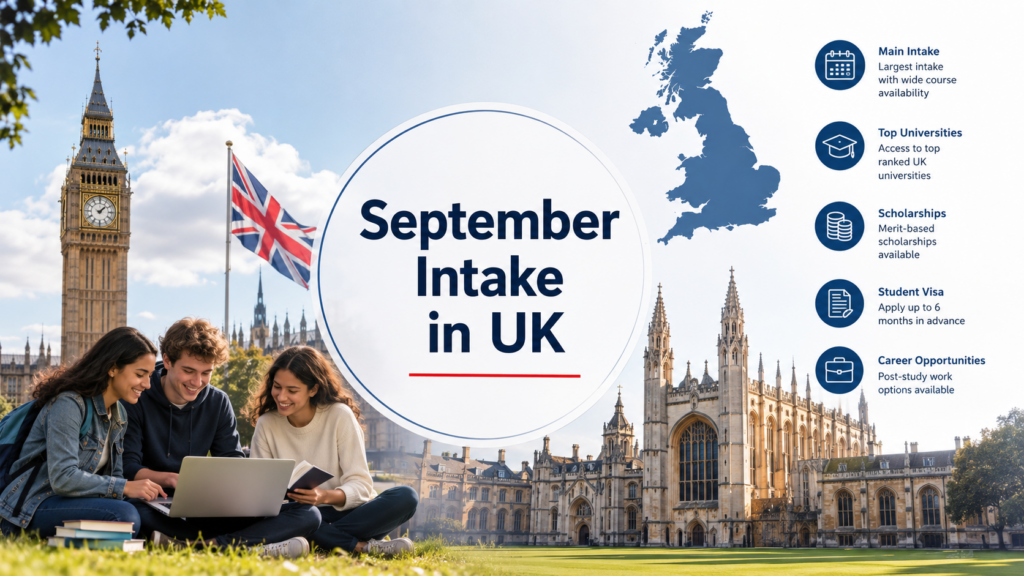
September (also called the Autumn or Fall intake), January, and a smaller May intake at select universities. The September intake in UK is the primary one: the only intake where virtually every course, at every university, is open for admission. Universities themselves usually call it “Autumn term” or “2027 entry” on official pages.

Choose your dream country
 UK
UK
 USA
USA
 Germany
 Australia
 Ireland
 Canada
 UAE
UAE
 France
 Sweden
 Italy
Italy
 Other
Other
When do you want to study abroad?
What's your highest level of education?
Have you completed Class 12th?
What was your Class 12 CGPA/percentage?
Are you a student or a parent/guardian?
What do you want to study?
Select your current city
How Leap will help you

Personalised University Shortlist

Express Applications with Quicker Admits

End-to-End Application Support
For which intake is available for UK universities on your specific course, check the course page directly. January and May exist mainly for postgraduate business, computer science, and engineering programs at a smaller set of universities. Undergraduate entry is almost entirely September-only, run through UCAS.
Counselor insight: Students often ask how many intakes in UK universities actually matter for their profile. For most Indian applicants, UG or PG, the real choice isn't three equal options: it's September first, with January as a genuine fallback for specific PG courses.
September 2026 vs September 2027 Intake in UK: Which One Applies to You
If you're reading this in July 2026, you're in one of two positions. Most searches for "September intake UK" and "UK September intake 2026 deadline" right now come from students in exactly this fork.
- Still chasing September 2026: Standard deadlines have closed, but UCAS clearing stays open for undergrad courses with live vacancies until 18 October 2026. Contact your shortlisted universities directly.
- Planning September 2027 (the main opportunity): UCAS opened registration for 2027 entry on 12 May 2026, so you can build your application now even though submission opens only on 1 September 2026.
Counselor insight: The most common mistake is a student searching "September intake in UK deadline" in July and assuming they've missed it. Usually they're confusing the closing 2026 cycle with the 2027 cycle, which has barely started.
September Intake in UK 2027 Deadlines: The Complete UCAS Timeline
The UCAS deadline for September intake in UK 2027 depends on your course and level of study.
| Stage | Undergraduate (via UCAS) | Postgraduate (direct to university) |
| Registration opens | 12 May 2026 | Varies; most portals open Aug-Sept 2026 |
| Applications submittable from | 1 September 2026 | Rolling, university-specific |
| Oxbridge, medicine, dentistry, vet science deadline | 15 October 2026, 18:00 UK time | N/A |
| Main equal consideration deadline | 13 January 2027, 18:00 UK time | Practical scholarship-consideration window: October-December 2026 |
| UCAS Extra opens | 25 February 2027 | N/A |
| Final UCAS deadline | 23 September 2027, 18:00 UK time | Most PG deadlines: March-June 2027 |
| Clearing | 2 July 2027 onward; last date to add a Clearing choice 18 October 2027 | Ongoing on a seat-available basis |
Source: UCAS official dates and deadlines page.
The UCAS application fee for 2027 entry is GBP 34.50 (Rs.4,490), covering up to five course choices, UCAS Extra, and Clearing at no extra cost.
Counselor insight: "Equal consideration" doesn't mean "last date." Popular Russell Group PG courses in Data Science, Computer Science, and Finance often fill before their stated deadline. Treat 13 January 2027 as your latest date, not your target.
Best Universities for September Intake in UK 2027
Since September is the main intake, nearly every top-ranked university is open for admission. September intake in UK universities spans the full QS top 100, not a limited shortlist. Here's where UK institutions stand in the QS World University Rankings 2027, the current edition.
| UK Rank | Global Rank (QS 2027) | University |
| 1 | 2 | Imperial College London |
| 2 | 4 | University of Oxford |
| 3 | 6 | University of Cambridge |
| 4 | 8 | UCL |
| 5 | 35 | University of Edinburgh |
| 6 | 37 | King's College London |
| 7 | 40 | University of Manchester |
| 8 | 57 | University of Bristol |
| 9 | 62 | LSE |
| 10 | 68 | University of Warwick |
Source: QS World University Rankings 2027.
One-year master's tuition at these universities typically runs GBP 26,000-40,000 (Rs.33.8L-52.1L) a year; confirm exact fees on each university's official admissions page, since figures vary by course.
Counselor insight: A QS rank in the 40-150 range isn't a compromise. Manchester, Glasgow, and Leeds offer strong industry links and lower living costs than London, often improving your real return on a UK degree more than the ranking number does. Several universities open for the September intake in UK 2027 also waive postgraduate application fees, worth checking before you shortlist purely by rank.
How to Apply for September Intake in UK: Step-by-Step
When to apply for the September intake in UK depends on the course level, but the sequence stays the same for UG and PG applicants.
- Shortlist 8-10 universities (6-8 months out): look beyond rankings to course modules and faculty.
- Take IELTS or PTE (5-6 months prior): Most PG programs need 6.0-6.5 overall; Russell Group courses often need 7.0.
- Prepare your SOP and LORs (3-4 months prior): tailor each SOP; don't recycle one draft.
- Submit by your deadline, not on it: Uni-Assist equivalent checks for UK are done by individual universities; PG programs at Russell Group institutions often close days before their stated date when seats fill.
- Prepare for any interview or admissions test: Data Science at UCL and Finance at LSE have additional written components; check the program page, not just the university page.
- Accept your offer within the UCAS deadline and pay your deposit: The deposit triggers your CAS; no deposit, no CAS, no visa.
Counselor insight: Indian students most often lose time at the SOP stage, not the shortlisting stage. Start your SOP the same week you finalize your shortlist, not after.
Source: UCAS official "How do I apply?" guide.
Documents Required for September Intake in UK Admission
| Document | India-Specific Detail |
| Academic transcripts | Provisional marksheet accepted if final year; get it apostilled early |
| Degree certificate | Final-year students submit this once results are declared |
| Statement of Purpose | One SOP per university: no generic copies |
| Letters of Recommendation | Two LORs; give professors at least a month's notice |
| IELTS/PTE score | UK visa requires IELTS UKVI or an approved SELT, not standard IELTS Academic. See IELTS score requirements for UK universities |
| CV/Resume | Most programs require a one-page CV. |
| Passport copy | Ensure at least 12 months' validity remaining |
| CAS (later, for visa) | Issued only after deposit payment |
Counselor insight: If Class 10 and 12 were in English-medium CBSE or ICSE schools, ask about a Medium of Instruction waiver before booking an IELTS retake. It isn't accepted everywhere but saves real time where it is.
Source: GOV.UK: Documents you need to apply for a Student visa.
Month-by-Month Planning Calendar for September Intake in UK 2027-28
| Period | What to Do |
| July-August 2026 | Shortlist universities, register on UCAS Hub, book IELTS/PTE |
| September-October 2026 | Submit UG UCAS application (Oxbridge/medicine by 15 Oct); most PG portals open |
| November 2026-January 2027 | Submit PG applications for scholarship consideration; UG deadline 13 Jan 2027 |
| February-April 2027 | Track offers, respond to conditional/unconditional offers, apply for scholarships |
| May-June 2027 | Pay deposit, receive CAS, begin visa document collection |
| July-August 2027 | Apply for UK student visa, book accommodation, arrange finances |
| September 2027 | Arrival and Welcome Week |
This maps to the Indian academic year: most final-year students get results between April and July, exactly when UK universities expect confirmed transcripts for a September 2027 start.
Which Profile Suits September Intake in UK: A Decision Framework
- Final-year bachelor's student graduating in 2027: September 2027 is your natural first choice. Apply with provisional transcripts, request your degree certificate as soon as results are out, and finish IELTS well before your deadline so a retake doesn't cost you a term.
- Working professional with 2+ years of experience, targeting an MBA or MSc: The UK September 2026 intake deadline for master's programs has already passed at most Russell Group universities, but mid-tier universities still have rolling PG admissions through the summer. If Chevening matters to you, September 2027 is your only option: it funds September-entry courses exclusively, with a 6 October 2026 deadline. If not, January 2027 at Birmingham, Coventry, or Northumbria is a genuine first choice.
Also see the January intake in UK 2027 guide, and read counselor guidance on when to take IELTS for the January 2027 intake if your test timing is still open.
- Backlog, lower CGPA, or IELTS below cutoff: Be transparent about backlogs; some universities issue conditional offers pending clearance, and others won't, so apply to a wider spread. For a borderline IELTS score, book a retake immediately or ask about a pre-sessional English course as a substitute.
Counselor insight: Students rarely fail at the shortlisting stage. They lose the most time by not deciding early which of these three profiles they are, which delays everything downstream, from SOP to visa finances.
Total Cost for September Intake in UK 2027 (Fees in GBP, INR in Brackets)
September intake in UK has fees split into one-time costs (visa, IHS, and UCAS) and recurring costs (tuition and living expenses), both shown below.
| Cost Component | Amount (GBP) | Amount (INR) |
| IELTS/PTE UKVI fee | GBP 150-215 | Rs.19,521-27,980 |
| UCAS application fee (UG) | GBP 34.50 | Rs.4,490 |
| UK student visa fee | GBP 558 | Rs.72,618 |
| Immigration Health Surcharge (per year) | GBP 776 | Rs.1,01,029 |
| Maintenance funds, London (9 months) | GBP 13,761 | Rs.17,90,857 |
| Maintenance funds, outside London (9 months) | GBP 10,539 | Rs.13,71,545 |
| Average one-year master's tuition | GBP 26,000-40,000 | Rs.33.8L-52.1L |
| Estimated total, 1-year master's (outside London) | GBP 38,000-52,000 | Rs.49.5L-67.7L |
Exchange rate used throughout: 1 GBP = Rs.130.14 as of July 2026. Rates fluctuate; verify the current rate before finalizing your budget.
Sources: Visa fee, IHS, and maintenance fund figures are confirmed from GOV.UK's student visa money guidance.
Read our expert answers on UK student visas' financial requirements.
For a city-by-city cost breakdown, see the cost of a master's in UK for Indian students or what our counselors say about living costs in London vs. other UK cities.
Counselor insight: Most students budget tuition and living costs, then forget the IHS entirely. At GBP 776 (Rs.1,01,029) a year, often charged for 16 months on a one-year course, it's a five-figure INR surprise at the visa stage.
Scholarships for September Intake in UK 2027-28
| Scholarship | Benefit | Deadline for September 2027-28 |
| Chevening Scholarship | Full tuition, monthly stipend, return flights | Applications open ~August 2026 and close 6 October 2026, 11:00 UTC. Unconditional university offer due by 8 July 2027 |
| GREAT Scholarships | Minimum GBP 10,000 (Rs.13.01L) toward tuition | The 2026-27 cycle offered 12 named scholarships at select universities. The 2027-28 cycle typically announces around December 2026; confirm on the official 2026-27 page |
| Commonwealth Scholarship | Full tuition, living allowance, travel | September entry only; check current-cycle dates on the Commonwealth Scholarship Commission's official page |
| University-specific scholarships | GBP 3,000-15,000 (Rs.3.9L-19.5L) or % of fees | Varies by university; usually tied to your application round |
Sources: Chevening's official application timeline and the British Council's GREAT Scholarships India page.
Chevening funds autumn-term master's courses only, so if you want it, September is your only intake option.
Full details, including the 2,800-hour work experience rule, are in our Chevening Scholarship eligibility guide, and you can read expert answers on scholarships and application tips for the UK, including SOP and recommendation guidance, alongside your scholarship search.
Counselor insight: You do not need a university offer to start your Chevening application. Most students who win it started drafting essays 3-6 months before the portal opened, not after.
UK Student Visa Process and Timeline for September Intake
Once you accept your offer and pay your deposit, your university issues your CAS (Confirmation of Acceptance for Studies), required before you can apply for your visa. The process: complete the online application, pay the visa fee and IHS, then attend a biometrics appointment. Standard processing takes around 3 weeks; priority services are faster. Apply as soon as your CAS arrives, ideally June-July 2027.
Graduate Route: applications before 1 January 2027 get 2 years of post-study work; from that date, 18 months (3 years for PhD), per GOV.UK's Graduate Visa page. Most September 2027 master's graduates fall under the 18-month rule.
For the full validity timeline, read counselor answers on UK master's duration and visa validity, and if you're starting without prior work experience, see what our counselors say about job prospects in the UK after a master's with no work experience.
Counselor insight: The most common visa refusal reason isn't insufficient funds: it's the 28-day rule. Your maintenance funds must sit at or above the required amount for 28 consecutive days, ending no more than 31 days before you apply. Start consolidating your funds at least 6-8 weeks before your planned application date.
What to Do If You Miss the September Intake Deadline or Face Delays
1. Missed the UCAS 13 January 2027 deadline: UCAS Extra opens 25 February 2027, letting you add one choice at a time. Clearing opens 2 July 2027 for remaining vacancies.
2. IELTS score below requirement: Book a retake immediately, or ask about a pre-sessional English course as a substitute. Many mid-tier universities accept this option.
See 5 ways to study in UK without IELTS.
If you're weighing whether to apply now and submit your score later, see what our counselors say about conditional offers without IELTS for the September intake.
3. Results delayed beyond your deadline: Contact your university, explain the timeline, and request a deferral. If they can't hold your place, a September 2028 application with your final transcript often beats rushing an incomplete one.
4. Visa delayed near your course start date: Email your university's international office the day you notice a delay; most can adjust your enrollment date by a few weeks.
Counselor insight: A missed deadline is rarely the end of the plan. This signals a target of January 2027, or the option to use the extra months for a stronger application in September 2028.
Source: UCAS Clearing guide · GOV.UK: What to do if your visa is delayed · UCAS Extra guidance.
3 Takeaways on September Intake in UK
- Confirm which cycle actually applies to you: the closing September 2026 window via Clearing, or the open September 2027 main cycle. Do this before you plan anything else.
- Lock in the confirmed dates now: UCAS equal consideration on 13 January 2027, and the Chevening 2027-28 deadline on 6 October 2026 if scholarship funding matters to you.
- Budget in GBP and INR together before you apply, not after. Factor in the visa fee, Immigration Health Surcharge, and 9 months of maintenance funds alongside tuition.
Verified by: LeapScholar's UK counseling team, with hands-on experience guiding Indian students through UCAS applications, UKVI documentation, and scholarship processes for the September and January intakes.
Have questions about the September intake in UK? Book a free session with a LeapScholar counselor.
Frequently Asked Questions About September Intake in UK
-
What is the September intake in UK called?
It's officially the autumn or fall term at most UK universities, though "September intake" is the common search term Indian students use. It's the primary intake, when virtually every course and university opens admissions, unlike the smaller January and May intakes that run alongside it.
-
How many intakes are there in UK universities?
UK universities run up to three intakes a year: September (the main one, open at nearly every university), January (mostly postgraduate business, computer science, and engineering courses at select universities), and May (a small intake limited to foundation and pre-Master's programs).
-
Is the September 2026 intake still open in UK?
Standard UG deadlines have closed, but UCAS Clearing remains open for courses with live vacancies until 18 October 2026. Postgraduate portals at several mid-tier universities also stay open on a rolling basis through mid-2026. Contact your shortlisted universities directly to confirm live seats.
-
What is the UCAS deadline for September intake in UK 2027?
The main equal consideration deadline is 13 January 2027, 18:00 UK time, for most undergraduate courses. Oxford, Cambridge, medicine, dentistry, and veterinary science close earlier, on 15 October 2026. Applications submitted after this date can still be considered if universities have seats, through UCAS Extra from 25 February 2027, and later through Clearing.
-
When should I apply for the September intake in UK for a master's?
Postgraduate deadlines are university-specific and often rolling, but the practical window for scholarship consideration at competitive universities is October to December 2026. Popular courses at Russell Group universities can fill months before their official closing date.
-
How much does the September intake in UK cost for Indian students?
A one-year master's outside London typically costs GBP 38,000-52,000 (Rs.49.5L-67.7L) in total, covering tuition, living costs, visa fees, and the Immigration Health Surcharge. London-based courses cost more due to higher maintenance fund requirements.
-
What is the last date to apply for September intake in UK?
For undergraduate courses, the final UCAS deadline is 23 September 2027, after which applications go into Clearing. For postgraduate courses, the last date varies by university. Some close as early as April 2027; others accept applications through summer if seats remain.
-
What documents do I need for the September intake in UK admissions?
You'll need academic transcripts, a degree certificate (or provisional marksheet if still in final year), a Statement of Purpose, two Letters of Recommendation, an IELTS or PTE score report, an updated CV and a valid passport. Additional documents like GMAT/GRE scores or a portfolio apply to specific courses.
-
What happens if I miss the September intake deadline in UK?
You have two realistic options: apply to January 2027 for courses that offer it, especially postgraduate business, computer science, or engineering programs, or use UCAS Extra and Clearing if you're still within the current cycle. Missing one deadline rarely closes off the entire academic year.









Have Questions? Get Guidance to reach your Dream University
Connect with India's finest counsellors and biggest study abroad community.
Get Guidance