
Quick Read
- The F1 visa in USA requires an SEVP-certified school’s I-20.
- Government fees total about Rs.75,046 before travel and documents.
- From September 2026, F1 admission is capped at four years.
- No fixed bank balance applies: your I-20 sets it.
- Interview waivers ended for F1 applicants in September 2025.
- STEM graduates get 36 months of work authorisation after graduation.
What Is the F1 Visa in USA and Who Qualifies
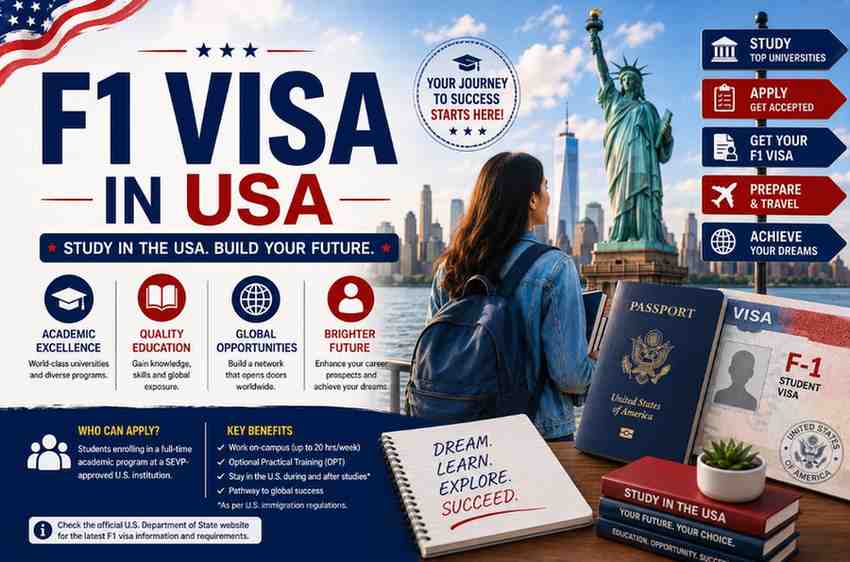
The F1 visa in USA is a non-immigrant visa for full-time academic study at a school certified by the Student and Exchange Visitor Program (SEVP). You cannot apply for it on the strength of an admission letter alone. Your school must issue Form I-20, the Certificate of Eligibility for Nonimmigrant Student Status, and only an SEVP-certified institution can generate one. Your SEVIS ID sits on that form, and every fee and appointment that follows depends on it.
Two rules on timing matter from the start. You may apply for the visa up to one year before your program begins, but you cannot enter the US earlier than 30 days before the start date printed on your I-20. Spouses and children travel on F-2 visas.

Choose your dream country
 UK
UK
 USA
USA
 Germany
 Australia
 Ireland
 Canada
 UAE
UAE
 France
 Sweden
 Italy
Italy
 Other
Other
When do you want to study abroad?
What's your highest level of education?
Have you completed Class 12th?
What was your Class 12 CGPA/percentage?
Are you a student or a parent/guardian?
What do you want to study?
Select your current city
How Leap will help you

Personalised University Shortlist

Express Applications with Quicker Admits

End-to-End Application Support
The scale of the Indian cohort is worth knowing before you plan. Open Doors 2025 recorded 363,019 Indian students in the US in 2024-25, a 10 percent increase and the second consecutive year in which India was the top sending country. The same report shows new international enrollment fell 17 percent in fall 2025, with 96 percent of institutions citing visa application concerns. Approval is not automatic, and preparation is doing more work than it did three years ago.
If you are still deciding whether the US is your destination, start with the broader picture on studying in the USA for Indian students.
Counselor insight: The cost of attendance printed on your I-20 is set by the university and it is not negotiable. That number is the benchmark your financial file has to clear. Students who spend a week emailing the DSO to get it revised downward are spending the week they should be spending on bank statements.
F1 Visa in USA vs J1 and M1: Which Student Visa Applies to You
| Point of difference | F1 visa | J1 visa | M1 visa |
|---|---|---|---|
| Purpose | Full-time academic degree study | Exchange, research, internship, training | Vocational or technical study |
| Sponsoring document | Form I-20 | Form DS-2019 | Form I-20 |
| Who issues it | Your SEVP-certified school | A State Department designated sponsor | Your SEVP-certified school |
| Campus contact | Designated School Official (DSO) | Responsible Officer (RO) | Designated School Official (DSO) |
| SEVIS I-901 fee | Rs.33,460 ($350) | Rs.21,032 ($220) | Rs.33,460 ($350) |
| Work during study | On-campus, 20 hours a week in session | On-campus with RO authorisation | Not permitted |
| Post-study work | OPT of 12 months, plus 24 months for STEM | Academic Training, tied to programme length | Limited practical training only |
| Dependent work rights | F-2 dependents cannot work | J-2 dependents may apply | M-2 dependents cannot work |
| Two-year return rule | Never applies | Can apply, depending on funding and field | Never applies |
The verdict is short. A bachelor's, master's or PhD is an F1 case. A semester exchange or a funded research placement is a J1 case, covered in the J1 student visa guide. A trade or technical qualification is an M1 case.
Counselor insight: A surprising number of Indian applicants select J1 or B1/B2 on the appointment portal because the dropdown does not match how they describe their own plan. Choose "Student Visa (F/M)". Picking the wrong category costs you the slot and the fee, and in June that means losing four to six weeks.
F1 Visa in USA Eligibility and Documents Checklist for Indian Applicants
You must meet all of the following:
- Acceptance at an SEVP-certified school and a Form I-20 issued in your name.
- Full-time enrolment while the academic term is in session.
- English proficiency at the level your institution requires.
- Sufficient funds to cover study and living expenses.
- A passport valid for at least six months beyond your program completion date.
- Non-immigrant intent, meaning you can show you plan to return to India.
- All social media profiles set to public. Since June 2025, the State Department has instructed all F, M and J applicants to adjust their privacy settings to public so consular officers can review their online presence.
| Document | Who issues it | India-specific detail |
|---|---|---|
| Form I-20 | Your university | Check name spelling and order against your passport the day it arrives |
| SEVIS I-901 receipt | fmjfee.com | Pay after the I-20 arrives, before you submit the DS-160 |
| DS-160 confirmation page | You, online | Print it with the barcode visible and legible |
| MRV fee receipt | Bank or payment portal | Required before you can book an appointment |
| Passport | Passport Seva | Carry all old passports, including expired ones |
| Photograph | Photo studio | 2x2 inches, plain white background, US specification |
| Academic records | University or board | Consolidated marksheet, plus provisional certificate if convocation is later |
| Test scores | ETS, IELTS or Duolingo | Carry the original scorecard, not just a screenshot |
| Bank statements | Your bank | Six months, stamped and signed, showing history rather than a single balance |
| Loan sanction letter | Bank or NBFC | Full sanction letter with terms, not the in-principle approval message |
| Sponsor ITRs | Income Tax Department | Last three assessment years, matched to the sponsor's bank activity |
| CA statement | Chartered accountant | Net worth statement covering property, FDs and PPF |
| Affidavit of support | Sponsor, notarised | Include relationship proof such as your birth certificate |
| Previous refusal letters | US consulate | Carry them. Do not leave them at home |
Counselor insight: Applicants who have been refused before often leave the refusal slip out of the file, thinking it hurts them. The officer can already see the prior refusal in the system. Being asked for a document you deliberately did not bring reads as evasive on the one point where you most need to look straightforward.
F1 Visa in USA Fees and How Much Money You Must Show
| Fee | Amount | When you pay |
|---|---|---|
| SEVIS I-901 fee | Rs.33,460 ($350) | After the I-20 arrives, before DS-160 submission |
| MRV visa application fee | Rs.17,686 ($185) | Before booking your appointment |
| Visa Integrity Fee | Rs.23,900 ($250) | At visa issuance, after approval |
| Total government fees | Rs.75,046 ($785) |
Exchange rate used: Rs.95.60 per USD. Verify the current rate before finalising your budget.
The SEVIS I-901 fee for F1 applicants is $350, paid to the Department of Homeland Security and separate from your university's charges. The Visa Integrity Fee is collected only after approval. You also get one free appointment reschedule since January 1, 2025: a second one means paying the MRV fee again.
There is no fixed bank balance for an F1 visa in USA. The benchmark is the cost of attendance on your I-20, and you need at least the first full year covered. Family savings, a sanctioned loan, scholarships, and fixed deposits can be combined.
What sinks financial files is shape, not size. A large deposit landing three weeks before your interview reads as funds parking. Six months of steady balances, with any big credit matched to a documented source, reads as real money. More detail in the guide on how much bank balance is required for a US student visa.
If the gap is genuine rather than documentary, work through scholarships for Indian students in the USA before you file, and see the full cost of studying in the USA for Indian students for the budget these fees sit inside.
Counselor insight: Officers look at the shape of the account, not just the closing figure. Rs.30 lakh that appeared last month is a weaker file than Rs.22 lakh that has been sitting there since October with a loan sanction letter behind it.
How to Apply for the F1 Visa in USA from India, Step by Step
- Accept your admit and receive Form I-20. Confirm the program dates, the major and the cost of attendance before you do anything else.
- Pay the SEVIS I-901 fee at fmjfee.com using the SEVIS ID on your I-20. Print the receipt.
- Complete Form DS-160. Submit it at least three business days before your interview, and earlier in May and June when portal load is heaviest, and make sure the barcode on the confirmation page matches the one used to book the appointment. A mismatch gets the appointment cancelled at the gate. The field-by-field walkthrough is in the guide to filling the DS-160 form.
- Pay the MRV fee and book both appointments.
- Attend biometrics at the Offsite Facilitation Centre.
- Attend the interview at New Delhi, Mumbai, Chennai, Hyderabad or Kolkata.
- Pay the Visa Integrity Fee at issuance and collect your passport.
At the window, the officer is testing four things: whether you are a genuine full-time student, whether your funding is real and documented, whether you intend to return to India, and whether your program choice makes sense against your academic and work history. Work through F1 visa interview questions and answers before you go.
One change has caught many applicants out. Interview waivers ended for most non-immigrant categories including F1 from September 2, 2025, with revised guidance effective October 1, 2025 that also removed the under-14 and over-79 exemptions. Dropbox renewal is no longer available to F1 students. If you go home for a wedding after your visa expires, you need a fresh in-person interview to come back.
Counselor insight: The interview runs two to four minutes and most officers decide on your first two answers. Rehearsing a five-minute career narrative is less useful than being able to state your program, your funding source and the role you intend to take in India in one clear sentence each.
F1 Visa in USA Timeline for the Fall 2027 Intake
| Month | What you do | Why this month for an Indian applicant |
|---|---|---|
| Sep to Nov 2026 | Shortlist universities, sit or resit tests | Before odd-semester exams take your time |
| Dec 2026 to Jan 2027 | Submit applications | Most Fall deadlines fall in this window |
| Feb to Mar 2027 | Admits arrive, accept and pay the deposit | Sits before the February to April exam season peaks |
| Mar to Apr 2027 | Receive Form I-20, pay SEVIS, file DS-160 | Build the six-month bank trail from here backwards |
| Apr to May 2027 | Book biometrics and interview slots | Slots open in batches and fill within hours |
| May to Jun 2027 | Attend the interview | Final results and provisional certificates arrive now |
| Jun to Jul 2027 | Visa issued, book travel, arrange forex | Do not wait for convocation to travel |
| Aug 2027 | Fly out and report to your DSO | Entry permitted no earlier than 30 days before the start date |
Cross-check against F1 visa slots for Fall 2026-2027 and the Fall intake in the USA deadlines.
Counselor insight: The June slot crunch is real and it is worse than it was two years ago, because renewal applicants who used to file through dropbox are now competing with first-time applicants for the same appointments. Treat May as your target month, not your fallback.
Working During and After Your F1 Visa in USA
On-campus employment is capped at 20 hours a week while the academic term is in session and can go full-time during official breaks. Off-campus work needs authorisation and falls into two categories.
Curricular Practical Training (CPT) is work that is part of your curriculum, authorised by your DSO. It carries a trap: under the regulations, 12 months or more of full-time CPT at one educational level makes you ineligible for post-completion OPT at that level. Full-time here means more than 20 hours a week.
Optional Practical Training (OPT) is 12 months of post-completion work authorisation per degree level. If your degree is on the DHS STEM Designated Degree Program List, you may apply for a 24-month STEM OPT extension, taking you to 36 months in total. That extension replaced the earlier 17-month version in May 2016 and comes with conditions: your employer must be enrolled in E-Verify, you must work at least 20 hours a week, and you and your employer must complete a Form I-983 training plan. You may accrue up to 90 days of unemployment during initial OPT and 60 more during the extension.
Counselor insight: The CPT trap catches Indian students at programs that advertise year-round full-time CPT as a selling point. Twelve months of it removes the OPT that made the degree financially worth doing. If a program markets CPT from semester one, ask in writing how that interacts with your OPT eligibility.
When Your F1 Visa in USA Application Goes Wrong
Refused under Section 214(b). This is the most common F1 refusal and it is about non-immigrant intent, not paperwork. The officer was not satisfied you intend to return to India. It is not a permanent bar and you may reapply, but something material has to change: stronger documented ties, a clearer account of your intended role in India, or a better articulated link between the program and your career. Work through 214(b) visa rejection and how to reapply and the broader picture in US visa rejection rate and reasons for Indian students.
A 221(g) slip. This is administrative processing, not a denial. Keep your social media public, respond to any document request the same week, and do not book non-refundable travel. Timelines range from days to several weeks with no reliable way to predict which.
No slot before your program start date. Request an expedited appointment through the portal if your start date is within 60 days and you have not been refused an F1 visa in the previous six months. In parallel, ask your university about a deferral. Most US universities will accommodate one visa-related deferral if you ask formally and early.
DS-160 or barcode mismatch. If you submitted a corrected DS-160 after booking, carry both confirmation pages. Otherwise the appointment is rescheduled and you lose the slot.
Counselor insight: Reapplying after a 214(b) refusal with the same file and the same answers produces the same result. The officer's notes stay on your record, so the second interview effectively starts where the first one ended. Change something real before you rebook.
3 Takeaways on F1 Visa in USA
- Build a six-month financial trail against the cost of attendance printed on your I-20, with every large credit matched to a documented source, rather than parking a lump sum weeks before the interview.
- Budget Rs.75,046 in government fees separately from tuition and travel, and hold Rs.23,900 of that back for the visa integrity fee charged only after your visa is approved.
- If your plan runs beyond four years or depends on a second degree at the same level, redesign it now against the September 15, 2026 rule and check the Admit Until Date on your Form I-94 after every entry.
Verified by: LeapScholar's USA counselling team, with hands-on experience guiding Indian students through I-20 issuance, SEVIS payment, financial documentation and F1 interviews at all five Indian posts.
Have questions about your F1 visa in USA application? Book a free session with a LeapScholar counsellor.
Frequently Asked Questions About F1 Visa in USA
-
What should I do if my F1 visa is refused under 214(b)?
Read the refusal slip, identify what was not established, and change something material before reapplying. Strengthen documented ties to India, tighten your financial trail, or clarify how the program connects to a specific role you intend to take up here. Reapplying with an identical file produces an identical outcome, because your previous interview notes stay on record.
-
Why do F1 visas get rejected for Indian students?
Most refusals fall under Section 214(b) of the Immigration and Nationality Act, where the officer is not satisfied you intend to return to India. Other common causes are financial documents that show a sudden unexplained deposit, inconsistencies between the DS-160 and what you say at the window, and a program choice that does not fit your academic or work history.
-
Can I still use dropbox for my F1 visa renewal?
Interview waivers ended for most non-immigrant categories including F1 from September 2, 2025, with revised guidance effective October 1, 2025 that also removed the age-based exemptions. F1 renewal applicants must now attend an in-person interview. Plan any travel outside the US around appointment availability rather than assuming a quick renewal.
-
What is the difference between an F1 visa and a J1 visa?
The F1 runs on Form I-20 issued by your university, with a designated school official as your campus contact and a SEVIS fee of Rs.33,460 ($350). The J1 runs on Form DS-2019 issued by a State Department designated sponsor, with a Responsible Officer and a fee of Rs.21,032 ($220). F1 offers OPT with a STEM extension. Only J1 can carry a two-year return requirement.
-
Can I work while studying on an F1 visa in USA?
On-campus work is permitted up to 20 hours a week while your term is in session and full-time during official breaks. Off-campus work requires authorisation through Curricular Practical Training or, after graduation, Optional Practical Training. Unauthorised work, including remote freelance work for an Indian client, is a status violation.
-
How long is an F1 visa in USA valid after September 2026?
From September 15, 2026, F1 students are admitted until an admit-until date on Form I-94, set by the program end date on the I-20 and capped at four years, plus 30 days to arrive and 30 days to depart. Extensions beyond that require an application to USCIS with biometrics rather than a DSO recommendation.
-
What is the F1 visa fee for Indian students in 2026?
Government fees total roughly Rs.75,046 ($785). That breaks down as Rs.33,460 ($350) for the SEVIS I-901 fee paid before you submit the DS-160, Rs.17,686 ($185) for the MRV application fee paid before booking, and Rs.23,900 ($250) for the Visa Integrity Fee collected at issuance. Rate used: Rs.95.60 per USD.
-
How much bank balance is required for an F1 visa in USA?
There is no fixed figure. The benchmark is the cost of attendance printed on your Form I-20, and you should be able to cover at least the first full year of it. Funds can combine family savings, a sanctioned education loan, scholarships and liquid assets like fixed deposits. Six months of statement history matters more than the closing balance.
-
What is an F1 visa in USA and who can apply for it?
The F1 visa in USA is a non-immigrant visa for full-time academic study at a school certified by the Student and Exchange Visitor Program. To apply, you need Form I-20 issued by that school, sufficient documented funds, English proficiency at the institution's required level, a passport valid six months beyond your programme end, and evidence that you intend to return to India.





Have Questions? Get Guidance to reach your Dream University
Connect with India's finest counsellors and biggest study abroad community.
Get Guidance