
Quick Read
- The J1 visa in USA requires a designated program sponsor.
- India left the Exchange Visitor Skills List in December 2024.
- Government fees total about Rs.62,600 before sponsor and travel costs.
- Form DS-2019 comes from your sponsor, not your university office.
- From September 2026, J1 admission is capped at four years.
- F1 suits degree study, J1 suits exchange, research and training.
What Is the J1 Visa in USA and Who Needs One
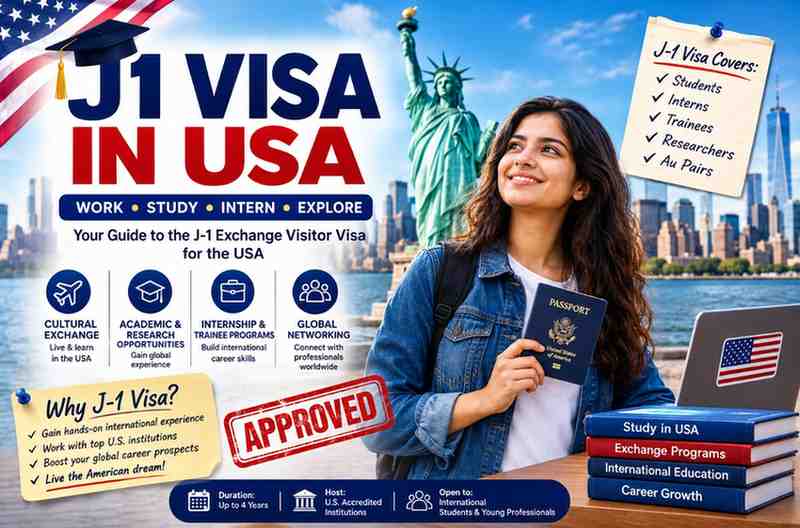
The J1 visa in USA is a non-immigrant visa for people approved to take part in work-and-study-based exchange visitor programs. It is administered by the U.S. Department of State Bureau of Educational and Cultural Affairs, and every applicant must be sponsored by an organisation the Department of State has formally designated. You cannot apply on your own. No sponsor, no visa.
The sponsor issues Form DS-2019, the Certificate of Eligibility for Exchange Visitor Status, signed by a Responsible Officer (RO) or Alternate Responsible Officer (ARO). USCIS confirms that obtaining this form is the first step in the process before any visa application begins. The Department of State reports that the program brings around 300,000 participants a year from about 200 countries.

Choose your dream country
 UK
UK
 USA
USA
 Germany
 Australia
 Ireland
 Canada
 UAE
UAE
 France
 Sweden
 Italy
Italy
 Other
Other
When do you want to study abroad?
What's your highest level of education?
Have you completed Class 12th?
What was your Class 12 CGPA/percentage?
Are you a student or a parent/guardian?
What do you want to study?
Select your current city
How Leap will help you

Personalised University Shortlist

Express Applications with Quicker Admits

End-to-End Application Support
There are 15 program categories. Four matter to most Indian applicants.
| Category | Typical Indian applicant | Usual length |
|---|---|---|
| College and University Student | Semester or year exchange, or a funded degree where the department sponsors on a DS-2019 | Programme duration |
| Research Scholar | PhD scholars, postdocs and lab researchers with a US host | Up to 5 years |
| Intern | Currently enrolled, or graduated within the last 12 months | Up to 12 months |
| Trainee | Graduate with a degree plus one year of relevant work experience | Up to 18 months |
The remaining categories include Au Pair, Camp Counsellor, Teacher, Physician, Professor, Specialist and Summer Work Travel. Indian nationals rarely enter through these, and Summer Work Travel in particular is not practically available through Indian recruitment channels.
If you are still choosing between destinations, start with the broader picture on studying in the USA for Indian students and the list of universities in the USA before you commit to a visa route.
Counselor insight: The sponsor controls the DS-2019, and the sponsor is often not the admissions office. In university-hosted cases it is usually the international scholar services team; in trainee and intern cases it is a private designated sponsor organisation your host company has contracted. Indian applicants routinely lose two to three weeks emailing an admissions inbox that has no authority to issue the form.
J1 Visa in USA vs F1 Visa: Which One Indian Students Actually Need
Most Indian students who search for the J1 visa in USA are actually F1 candidates. The two visas look similar and behave very differently after graduation.
| Point of difference | F1 visa | J1 visa |
|---|---|---|
| Sponsoring document | Form I-20 | Form DS-2019 |
| Who issues it | Your SEVP-certified university | A State Department designated sponsor |
| Your campus contact | Designated School Official (DSO) | Responsible Officer (RO) |
| Work during study | On-campus, up to 20 hours a week in session | On-campus with RO authorisation, similar limit |
| Post-study work | Optional Practical Training, 12 months, extending to 36 months for STEM | Academic Training, tied to programme length and category |
| Dependent work rights | F-2 dependents cannot work | J-2 dependents may apply for work authorisation |
| Two-year return rule | Never applies | Can apply, depending on your funding and field |
| SEVIS I-901 fee | Rs.33,460 ($350) | Rs.21,032 ($220) |
The practical rule is simple. A two-year MS or a four-year bachelor's degree in the US is an F1 case. A semester exchange, a funded research placement, or a structured internship or traineeship is a J1 case. If you are on the F1 track, the process is set out in full in the guide to how to apply for an F1 visa.
Counselor insight: Students offered a funded PhD assistantship are sometimes given a choice between an I-20 and a DS-2019 and pick whichever arrives first. Ask the department which one it defaults to and why. Departments that fund through a fellowship line often prefer J1 because it is administratively simpler for them, not because it is better for you.
J1 Visa in USA Requirements for Indian Applicants
The eligibility bar for the J1 visa in USA is set by your sponsor first and the consulate second.
- Sponsor acceptance. You must be accepted into a program run by a designated sponsor before anything else happens.
- English proficiency. Sponsors verify this through a recognised test score, a documented interview, or a signed attestation from the faculty member supervising you. Not every sponsor demands IELTS or TOEFL, so ask before you book a test.
- Funding proof. Your sponsor must be satisfied you can cover the program and your living costs. Stipends, assistantships, family funding and sanctioned education loans all count if documented properly. If funding is the gap, review the scholarships available to Indian students in the USA.
- Medical insurance. Federal minimum coverage levels apply to you and to any J-2 dependents for the full program.
- Passport validity. Valid to at least six months beyond your program end date.
- Public social media profiles. Since June 2025, the State Department has instructed all F, M and J applicants to set the privacy settings on all social media profiles to public so that consular officers can vet your online presence.
- Address reporting. Once in the US, any change of address must be reported to your sponsor within 10 days.
Counselor insight: Funding cases for the J1 visa in USA rarely collapse at the consular window. They collapse earlier, when the sponsor reviews your documents before issuing the DS-2019. By the time you reach the interview, the financial question has largely been settled on paper, which is why J1 interviews tend to be shorter than F1 interviews.
Documents Checklist for a J1 Visa in USA Application from India
| Document | Who issues it | India-specific detail |
|---|---|---|
| Form DS-2019 | Your designated sponsor | Check the spelling and name order against your passport the day it arrives |
| SEVIS I-901 fee receipt | fmjfee.com | Payable only after the DS-2019 arrives, since the SEVIS ID is printed on it |
| DS-160 confirmation page | You, online | Print it with the barcode visible |
| MRV fee receipt | Bank or online payment portal | Paid before you can book an interview slot |
| Passport | Passport Seva | Six months' validity beyond programme end, and carry old passports too |
| Photograph | Photo studio | US specification, 2x2 inches, plain white background |
| Sponsor acceptance or offer letter | Sponsor or host institution | Should state your category, dates and funding |
| Financial documents | Bank, employer, CA | Six months of statements, sanctioned loan letter, sponsor ITRs for three years, CA net worth statement |
| Academic records | Your university or board | Consolidated marksheet, plus provisional certificate where the degree certificate has not been issued |
| English proficiency evidence | Test body or sponsor | Only if your sponsor requires a test score rather than an attestation |
| Insurance confirmation | Insurer or sponsor plan | Must meet federal minimums, including for J-2 dependents |
Counselor insight: The most common avoidable delay for Indian J1 applicants is a name-order mismatch. Indian marksheets often print surname first, passports print given name first, and single-name applicants have no surname field at all. Get the DS-2019 corrected by your sponsor before you pay the SEVIS fee, because the fee is paid against the SEVIS record and correcting it afterwards is slower than correcting it now.
J1 Visa in USA Cost for Indian Students in 2026-27
| Fee | Amount | When you pay |
|---|---|---|
| SEVIS I-901 fee | Rs.21,032 ($220) | After the DS-2019 arrives, before the interview |
| MRV visa application fee | Rs.17,686 ($185) | Before booking your interview slot |
| Visa Integrity Fee | Rs.23,900 ($250) | At visa issuance, after approval |
| Total government fees | Rs.62,618 ($655) |
Exchange rate used: Rs.95.60 per USD. Verify the current rate before finalising your budget.
Two things about this table surprise Indian families. First, the SEVIS I-901 fee for J1 applicants is $220 against $350 for F1 students, so the J1 is cheaper at the front by Rs.12,428 ($130). Second, the Visa Integrity Fee introduced under the 2025 legislation is collected at issuance rather than before your interview, and it is adjusted annually for inflation.
Sponsor program fees sit on top of all of this and vary widely by category, from nothing for a university-hosted research placement to a substantial charge for a private intern or trainee placement. Ask for the figure in writing before you accept.
Applicants on Department of State, USAID or other federally funded exchange programs are exempt from the visa application and issuance fees, identifiable by a program serial number beginning G-1, G-2, G-3 or G-7 on the DS-2019.
Counselor insight: Families budget the SEVIS and MRV fees and forget the Visa Integrity Fee, because it lands after approval. That is precisely the week the forex is already committed to a tuition deposit or an accommodation advance. Keep Rs.23,900 aside from the start.
How to Apply for a J1 Visa in USA from India, Step by Step
- Secure sponsor acceptance. Confirm in writing which organisation is your designated sponsor and which J1 category you are entering.
- Receive Form DS-2019. Issued and signed by the RO or ARO. Check every field against your passport on the day it arrives.
- Pay the SEVIS I-901 fee. Online at fmjfee.com, using the SEVIS ID on your DS-2019. Print the receipt.
- Complete Form DS-160. The online non-immigrant visa application. Detailed walkthrough here: filling the DS-160 form.
- Pay the MRV fee and book your appointments.
- Attend biometrics, then the interview, at one of the five Indian posts: New Delhi, Mumbai, Chennai, Hyderabad or Kolkata. Preparation overlaps heavily with the F route, so work through the US student visa interview questions.
- Pay the Visa Integrity Fee at issuance and collect your passport.
Counselor insight: You cannot front-load step 3. The SEVIS fee is paid against the SEVIS ID printed on your DS-2019, so paying before the form arrives means paying against nothing or against a superseded record. Applicants who try to save a week here usually lose two.
J1 Visa in USA Timeline: Planning Around the Indian Academic Year
This calendar assumes a Fall 2027 program start. Compress it if you are targeting a Spring start.
| Month | What you do | Why this month for an Indian applicant |
|---|---|---|
| Aug to Oct 2026 | Identify host and sponsor, confirm category | Well before even-semester coursework begins |
| Nov to Dec 2026 | Submit applications, arrange funding evidence | Before end-semester exams take your time |
| Jan to Feb 2027 | Sponsor reviews documents, funding confirmed | Ahead of the February to April exam window |
| Mar to Apr 2027 | Sponsor issues DS-2019 | Ask for issuance against a provisional certificate if your degree is incomplete |
| May 2027 | Pay SEVIS, file DS-160, book slot | Final results and provisional certificates start arriving |
| Jun 2027 | Biometrics and interview | Peak season at all five Indian posts, so book the moment slots open |
| Jul 2027 | Visa issued, travel booked | Convocation often falls later, so do not wait for the degree certificate |
| Aug 2027 | Arrive and report to your RO | Note the fixed admission date on your Form I-94 |
If your host institution follows the standard US calendar, cross-check against the Fall intake in the USA deadlines.
Counselor insight: The tightest squeeze in the Indian J1 calendar is final-year results landing in June against a July or August program start. Sponsors will issue a DS-2019 against a provisional certificate and a consolidated marksheet if you ask in March. They will not do it comfortably if you ask in June.
What Changes for J1 Visa in USA Holders from September 15, 2026
On July 17, 2026, the Department of Homeland Security published a final rule establishing a fixed time period of admission for F students, J exchange visitors and I media representatives. It takes effect on September 15, 2026.
Until now, J1 holders were admitted for duration of status (D/S), an open-ended admission tied to program compliance. From the effective date, you are admitted until a fixed Admit Until Date (AUD) printed on your Form I-94, tied to the program end date on your DS-2019 and capped at four years. J nonimmigrants get 30 days after the program end date to depart, against 60 days for F students.
Three consequences to plan around:
- Extensions move to USCIS. Where your responsible officer previously extended your program, staying beyond the AUD now requires an extension of stay application filed with USCIS, including biometrics.
- Transition treatment. If you are already in the US in valid J1 status on September 15, 2026, you may remain under your existing D/S admission through your current program end date, subject to a four-year ceiling from the effective date.
- Travel converts you. If you are in that transitional group and you leave the US and re-enter after the effective date, you receive a new Form I-94 with a fixed date rather than D/S. A trip home for Diwali is enough to trigger this.
The rule has been classified a major rule subject to congressional review, so the effective date can still move. Check the current position with your responsible officer before you make travel decisions.
Counselor insight: Indian PhD scholars and postdocs in the Research Scholar category are the most exposed group. That category permits up to five years of participation, but the new admission ceiling is four. If your research runs long, the extension filing is now your responsibility rather than your RO's, and it is not a formality.
When Your J1 Visa in USA Application Goes Wrong
You get a 221(g) slip after the interview. Since the expanded vetting guidance of June 2025, many F, M and J applicants are refused under 221(g) specifically so the officer can complete online vetting after the interview. It is a pause, not a denial. Do not delete social media accounts, do not make profiles private, and respond to any document request the same week. Timelines vary from days to several weeks with no way to predict which.
Your programme start date is approaching and you have no visa. Contact your sponsor, not the consulate, first. Sponsors can amend the DS-2019 start date and reissue, which is usually faster and more reliable than an expedited appointment request that may be refused. Ask about a deferred start rather than assuming your place is lost.
Your visa is refused outright. Ask what specifically was not established. Reapplying with the same file and the same answers produces the same result. Something material has to change: clearer funding documentation, a corrected DS-2019, or a better articulated account of what you will do after the program. Reviewing common F1 visa interview questions and answers is useful preparation here, since consular questioning patterns overlap across F and J.
You paid SEVIS against a DS-2019 that was later cancelled or reissued. Contact your sponsor immediately. Depending on the circumstances, the payment may transfer to the new SEVIS record, or you may need to pay again. Do not book an interview until this is resolved, because the officer verifies the payment against the active record.
Counselor insight: The DS-2019 start date is more flexible than most applicants believe and the consular calendar is far less flexible than they hope. When those two collide in June, the answer is almost always to move the program date, not to chase the appointment.
3 Takeaways on J1 Visa in USA
- Run the three-point 212(e) self-check before you accept a DS-2019, and if you plan an H-1B move later, request a State Department advisory opinion in writing now rather than when an employer asks for it.
- Budget Rs.62,618 in government fees separately from tuition and travel, and set aside Rs.23,900 of that for the Visa Integrity Fee, which lands only after your visa is approved.
- If your program runs past September 15, 2026, check the Admit Until Date on your Form I-94 after every entry into the US, and diarise your extension filing well before that date.
Verified by: LeapScholar's USA counselling team, with hands-on experience guiding Indian students through DS-2019 issuance, SEVIS payment and consular interviews at all five Indian posts.
Have questions about the J1 visa in USA and whether it fits your plans? Book a free session with a LeapScholar counsellor.
Frequently Asked Questions About J1 Visa in USA
What should I do if I get a 221(g) slip after my J1 visa interview?
Treat it as administrative processing, not a refusal. Keep every social media profile public, respond to any document request immediately, and do not book non-refundable travel. Contact your sponsor so they know your arrival may slip, and ask whether the DS-2019 dates can be amended. Timelines range from days to several weeks and cannot be reliably predicted.
Can I change from a J1 visa to an H-1B?
It is possible provided you are not subject to the two-year home residence requirement. Since India was removed from the Exchange Visitor Skills List in December 2024, Indian nationals who were subject only on Skills List grounds can now change status from within the US or obtain an H or L visa without a waiver. Government funding and medical training remain blocking grounds.
How long can I stay in the US on a J1 visa after September 2026?
From September 15, 2026, you are admitted until a fixed Admit Until Date on your Form I-94, tied to the program end date on your DS-2019 and capped at four years, plus 30 days to depart. Extensions beyond that date require an application to USCIS with biometrics rather than an extension processed by your Responsible Officer.
Who can sponsor my J1 visa, and can I apply without a sponsor?
You cannot apply without one. Sponsors are organizations formally designated by the Department of State, and they fall into two groups: universities and research institutions that sponsor their own exchange visitors and private sponsor organizations that place interns and trainees with US host companies. Ask your host to name its sponsor in writing before you accept any offer.
Can I work while I am on a J1 visa in USA?
Employment must be authorized by your responsible officer in advance and must relate to your program category. Students in the College and University Student category may work on campus within the standard limits during term. Unauthorized work, including freelance or remote work for an Indian employer, is a status violation and can end your program.
How much does a J1 visa in USA cost for an Indian applicant in rupees?
Government fees total roughly Rs.62,618 ($655). That is Rs.21,032 ($220) for the SEVIS I-901 fee, Rs.17,686 ($185) for the MRV visa application fee, and Rs.23,900 ($250) for the Visa Integrity Fee collected at issuance. Sponsor program fees are separate and vary widely. Rate used: Rs.95.60 per USD.
What is the difference between a J1 visa and an F1 visa?
The F1 runs on Form I-20 issued by your university, and your campus contact is the Designated School Official. The J1 runs on Form DS-2019 issued by a designated sponsor, and your contact is the Responsible Officer. F1 offers Optional Practical Training up to 36 months for STEM graduates. J1 offers academic training, which is shorter. Only the J1 can carry the two-year return requirement.
Do Indian students still have to return to India for two years after a J1 visa?
Most no longer do. The Department of State published a revised Exchange Visitor Skills List effective December 9, 2024, reducing the list from 82 countries to 45 and removing India. The change is retroactive, so it applies even if your DS-2019 or visa stamp says you are subject. Government-funded participants and J-1 physicians in medical training remain subject on separate grounds.
What is a J1 visa in USA and who issues it?
The J1 visa in USA is a non-immigrant visa for people approved to participate in work-and-study-based exchange visitor programs. The Department of State administers it through its Bureau of Educational and Cultural Affairs. Every participant must be sponsored by an organisation the Department of State has designated, and that sponsor issues Form DS-2019, the Certificate of Eligibility for Exchange Visitor Status.





Have Questions? Get Guidance to reach your Dream University
Connect with India's finest counsellors and biggest study abroad community.
Get Guidance