
Quick Read
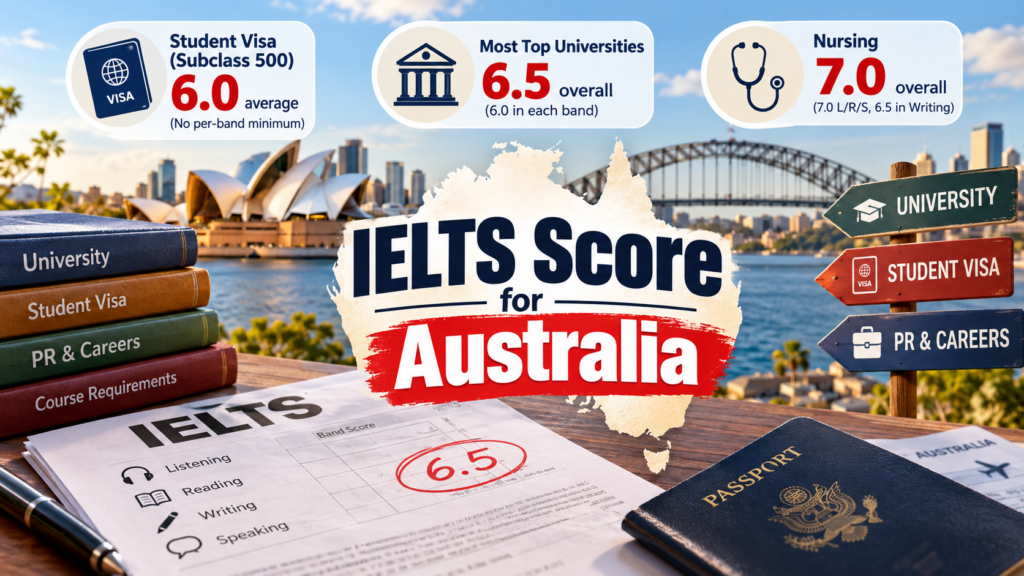
- Student visa: 6.0 average, no per-band minimum
- Most top universities: 6.5 overall, 6.0 per band
- Nursing: 7.0 overall, 6.5 in writing
- IELTS fee in India: ₹19,000
IELTS Score for Australia at a Glance
How much IELTS score is needed for Australia? It depends on three separate gates: the visa, your university and, for some careers, a professional board. This table gives you the full study in Australia picture before you dig into the details below.
| Purpose | Minimum IELTS | Per-band rule |
| Student visa (Subclass 500), direct entry | 6.0 average | None at visa level |
| Student visa with 10+ weeks of ELICOS, foundation, or eligible pathway | 5.5 average | None at visa level |
| Student visa with 20+ weeks of ELICOS | 5.0 average | None at visa level |
| Most Go8 undergraduate and postgraduate coursework | 6.5 overall | 6.0 in each band |
| Nursing (NMBA-aligned) | 7.0 overall | 7.0 L/R/S, 6.5 W |
| Temporary Graduate Visa (Subclass 485) | 6.5 overall | 5.5 in each band |
| PR points test: Competent English | 6.0 in each band | 0 points |
Source: Federal Register of Legislation, LIN 25/090
Counselor insight: Most Indian applicants clear the visa 6.0 comfortably. The offer letter is where they become stuck. A university condition like “no Australia band requirement below 6.0” rejects a 6.5 overall with 5.5 in writing.
IELTS Score for Australian Student Visa (Subclass 500)
The minimum IELTS score for an Australia student visa is an average band score of 6.0 (IELTS Academic or General Training). It drops to 5.5 if your main course is packaged with at least 10 weeks of ELICOS or a recognized foundation or pathway program. It drops to 5.0 with at least 20 weeks of ELICOS.
Four rules decide whether your score counts:
- Average, not per band: the instrument sets an “average band score”, so the visa itself has no 5.5 floor per band. Your university may have one. See how the IELTS band score is calculated.
- 24-month window: you must take the test within 2 years before you lodge the visa. If evidence is requested later, the window runs back from the decision date.
- Test centre only: Home Affairs does not accept IELTS Online or other at-home tests. It does accept IELTS One Skill Retake.
- Exemptions: UK, US, Canada, NZ and Ireland passport holders are exempt. So are students whose only course is ELICOS or a registered postgraduate research course. Holding an Indian school-board qualification does not by itself place an applicant in the listed passport-based English exemption category.

Excel in IELTS with India’s Top Online Coaching
Leap has helped more than 1 Lakh students achieve 7+ IELTS band.
IELTS Band Score for Australia Student Visa vs PTE and TOEFL
| Test | Direct entry | 10+ weeks ELICOS or pathway | 20+ weeks ELICOS |
| IELTS Academic / General | 6.0 | 5.5 | 5.0 |
| PTE Academic | 47 | 39 | 31 |
| TOEFL iBT | 67 | 51 | 37 |
For university-wise PTE cut-offs, compare PTE accepted universities in Australia. Duolingo is not on Home Affairs’ approved list and never covers the visa, though a few universities accept it for admission; see Duolingo accepted universities in Australia.
The dependant restrictions announced on 17 September 2026 target family members on student visas. The English instrument LIN 25/090 is still the one in force.
Counselor insight: IELTS General Training satisfies the visa but not most universities. Book IELTS Academic unless your provider confirms otherwise in writing, or you will pay twice.
Excel in IELTS with India’s Top Online Coaching
Leap has helped more than 1 Lakh students achieve 7+ IELTS band.
IELTS Score for Australia by Level of Study
Your IELTS band requirement for Australia changes by level of study:
- ELICOS (English only): exempt from the visa test; provider sets a placement level.
- Foundation or pathway: 5.5 average for the visa; provider sets its own bar.
- Diploma or VET (direct entry): 6.0 average for the visa; provider sets its own bar.
- Bachelor’s: 6.0 average for the visa; 6.5 overall with 6.0 per band at most Go8 universities.
- Master’s by coursework: 6.0 average for the visa; 6.5 overall with 6.0 per band, higher for some courses. See postgraduate courses in Australia for course-wise fees and intakes.
- PhD or research master’s: exempt from the visa test if it is your sole course; the university still sets its own research English requirement.
Counselor insight: PhD applicants often assume “exempt from the visa test” means “no IELTS needed”. The university still sets a research English requirement. Supervisors rarely issue an offer without it.
IELTS Score for Australia’s Top Universities (QS 2027)
These are the standard bands at Australia’s leading universities, ranked by QS World University Rankings 2027. For the full Go8 list, see Group of Eight universities in Australia.
| University | QS 2027 | Standard UG | Standard PG coursework |
| UNSW Sydney | 19 | 6.5, min 6.0 each | 6.5, min 6.0 each |
| University of Melbourne | =22 | 6.5, no band below 6.0 | 6.5, no band below 6.0 (Master of Management 7.0/6.5; PhD 7.0) |
| University of Sydney | 28 | 6.5, no band below 6.0 | 6.5, no band below 6.0 |
| University of Queensland | 40 | 6.5, 6.0 in all sub-bands | 6.5, 6.0 in all sub-bands |
| University of Western Australia | 77 | 6.5, no band below 6.0 | 6.5/6.0; higher standard 7.0/6.5 |
| UTS | =87 | 6.5 overall, 6.0 writing | 6.5 overall, 6.0 writing |
Source: Ranks from QS World University Rankings 2027
Counselor insight: UTS accepts IELTS Online for admission, but Home Affairs does not. Students who use an online score for the offer then need a centre-based test for the visa. Take one centre-based test for both.
IELTS Score for Australia by Course
Some courses set a higher IELTS score than the university standard, usually because graduates must register with a professional body.
| Course | IELTS requirement |
| Nursing and midwifery (UTS) | 7.0 overall; 7.0 listening, reading, and speaking; 6.5 writing; two sittings within 12 months allowed |
| Teaching (UNSW B Ed, M Teaching) | 7.5 overall; 7.0 reading and writing; 8.0 speaking and listening |
| Social Work (UNSW) | 7.0 in every band |
| Master of Management (Melbourne) | 7.0, no band below 6.5 |
| Most engineering, IT, science, and business | 6.5 overall, 6.0 per band at the universities above |
Read what our counselors say about IELTS for teaching programs in Australia.
Counselor insight: For BSc Nursing graduates from India, writing is most often the band that falls short. The 6.5 writing allowance helps, but listening, reading, and speaking must each still reach 7.0.
IELTS Score for Australia After 12th: Can Class 12 English Replace IELTS?
If you’re wondering how much IELTS band is required for Australia after 12th, it often comes down to whether your university accepts your Class 12 English grade instead. Several universities accept it for admission:
- UNSW: CBSE English Core grade C1 (B2 for business); ISC 70% in English; must be within 2 years of your intended start; not accepted for law, medicine, or education.
- UWA: CBSE English grade B2, or CISCE 60%.
Admission and visa are separate. Indian boards are not a visa exemption, so run the Home Affairs Document Checklist Tool. If it asks for English evidence, you need an approved test score. Read more on studying in Australia without IELTS.
See what our counselors say about whether a CBSE score gives an IELTS exemption and whether an MOI letter works.
Counselor insight: Keep a valid IELTS Academic score ready even with a Class 12 waiver. It stops an English evidence request from stalling your visa close to the intake.
Which IELTS Score for Australia Should You Target?
- CBSE Class 12 student applying for a February 2028 bachelor’s: check whether your English Core grade clears UNSW or UWA. Still take IELTS Academic and target 6.5 with no band below 6.0.
- Final-year BTech student graduating in May 2027 for a July 2027 master’s: target 7.0 overall with 6.5 in writing. This clears most Go8 coursework and leaves room for courses set at 7.0.
- BSc Nursing graduate planning an Australian nursing degree: target 7.5 overall. That gives you room to clear 7.0 in listening, reading, and speaking and 6.5 in writing in one sitting.
- Working professional with 6.0 overall and 5.5 in writing: you meet the visa but not most Go8 offers. Use One Skill Retake for writing, or accept a 10-week packaged UEEC. See what our counselors say about admission chances in Australia or New Zealand with a similar profile.
- Diploma or pathway student with 5.5 overall: you clear the visa’s ELICOS or pathway tier, but check the specific pathway provider’s own English floor before you enrol. Most pathways lead into a degree only once you also clear the university’s direct-entry band, typically 6.0 to 6.5.
Documents to Submit Your IELTS Score for Australia
Once your IELTS score for Australia is locked in, gather these alongside it. The single most common delay for Indian applicants is a name mismatch between the IELTS TRF and the passport, usually from a missing or reordered initial, so check this first:
- IELTS Academic Test Report Form: from a centre-based test; send electronically to universities from your IDP India account.
- Passport: name must match your TRF exactly, including initials.
- Class 12 marksheet: needed for a CBSE or ISC English waiver claim.
- Degree marksheets and provisional certificate: final-year students submit the provisional certificate until the degree certificate is issued.
- Medium of Instruction letter: from your college, only where the university accepts it.
- Confirmation of Enrollment: shows whether you are packaged with ELICOS, which sets the 5.5 or 5.0 visa threshold.
IELTS Score for Australia Planning Calendar (2027-28 Intakes)
This calendar targets the July 2027 and February 2028 intakes. Deadlines vary by university, and UNSW moves to a new flex-semester calendar from 2028, so check its 2028 dates separately.
| Month | Action |
| January 2027 | Take IELTS Academic (budget: ₹19,000 per attempt) |
| February 2027 | Use One Skill Retake within 60 days if one band is short |
| March 2027 | Apply for July 2027 with your final score |
| April to May 2027 | Accept the offer; final-year students clear semester exams |
| June 2027 | Collect provisional certificate; receive CoE; lodge visa; Class 12 students take IELTS after board exams for February 2028 |
| July 2027 | July 2027 intake begins |
| August to October 2027 | Apply for February 2028; confirm scholarship offer cut-offs. |
| November to December 2027 | Receive CoE and lodge visa |
| February 2028 | February 2028 intake begins |
This is a planning guide; confirm exact dates with your university. See all intakes in Australia and deadlines.
What to Do If Your IELTS Score for Australia Falls Short
If your IELTS score for Australia comes in below your target, here is what actually works:
- Short by 0.5 in one band: book IELTS One Skill Retake within 60 days of your computer-delivered test. It costs ₹12,650 in India.
- Think a band was marked harshly: an Enquiry on Results costs ₹14,250 for IELTS on Computer.
- Missed the writing section specifically: this is the most common gap for Indian test-takers. See what our counselors say about writing-section mistakes and your score.
- Short by 0.5 to 1.0 overall: accept a packaged English course. UNSW College lists its 2027 UEEC fees on its fee page:
- AUD 695 (₹46,746) a week
- 10 weeks: AUD 6,950 (₹4,67,457)
- 20 weeks: AUD 13,900 (₹9,34,914)
- Passing UEEC replaces a further test for UNSW. Compare options in our ELICOS guide, and see total costs on the cost of studying in Australia page.
- Score expires before your CoE: the visa counts 24 months back from lodgement. Retest early to avoid a lapse.
- Nursing score split across sittings: you can combine two sittings within 12 months if each sitting meets the overall 7.0.
Currency Conversion Note: All amounts use AUD 1 = ₹67.26. Recheck the rate before you pay any fee.
Counselor insight: IDP India has discontinued IELTS on Paper, so every test is now computer-based (with a Writing on Paper option). That makes One Skill Retake available to almost every Indian test-taker. It is also cheaper than a full ₹19,000 retest.
IELTS Score for Australian Scholarships
Most university merit scholarships need an offer before they assess you, so your IELTS score decides your eligibility date.
In UNSW’s latest published round (Term 2, 2026), the International Scientia Coursework Scholarship paid full tuition or AUD 20,000 (₹13,45,200) a year, and applicants needed an unconditional offer or a UEEC package offer by the round’s cut-off date.
Compare more scholarships in Australia for Indian students, including fully funded research routes on how to study in Australia for free. See what our counselors say about how your IELTS score affects scholarship chances.
Counselor insight: Scholarship offer cut-offs often fall months before the intake. A conditional offer waiting on IELTS can miss the round even if your marks are strong. Finish IELTS before you apply.
IELTS Score for Australian PR and Post-Study Work
Planning to stay after graduation? The Temporary Graduate visa (Subclass 485) needs 6.5 overall with at least 5.5 in each band. The test must be taken within 1 year before you apply. For tests taken on or after 7 August 2025, IELTS One Skill Retake is accepted for the 485. See the full post-study work visa in Australia rules.
For Australian immigration, your IELTS test score for Australia immigration is judged band by band, not on the average. This is often phrased as the IELTS requirement for Australian PR, and your IELTS points for Australia immigration follow three levels:
| English level | IELTS required | Points |
| Competent | 6.0 in each band | 0 |
| Proficient | 7.0 in each band | 10 |
| Superior | 8.0 in each band | 20 |
Source: Home Affairs Competent, Proficient and Superior English pages; points by level from IELTS Australia
Students often ask how many points are required for Australia PR: the pass mark for Subclasses 189, 190 and 491 is 65, set under the Migration (Pool and Pass Marks for General Skilled Migration Visas) Instrument. Read counselor answers on IELTS points for Australia PR.
Counselor insight: The IELTS requirement for Australian PR is tested at invitation, and your study-visa IELTS will likely have expired by then. Plan a fresh test in your final semester and aim for 7.0 in each band. That covers the 485 and lifts your IELTS score for Australia PR points to Proficient level, worth 10 points.
3 Key Takeaways on IELTS Score for Australia
- Check your university’s per-band rule, not only the visa’s 6.0 average.
- Target 6.5 overall with no band below 6.0 for most Go8 courses. Aim for 7.0 in each band if nursing or PR points are your goal.
- Test by January 2027 for July 2027, or by June 2027 for February 2028, so you have time for one retake.
Verified by: LeapScholar’s Australia admissions and visa counselling team, with hands-on experience guiding Indian students through offer conditions, ELICOS packaging and Subclass 500 applications.
Have questions about your IELTS score for Australia? Book a free session with a LeapScholar counselor.
Frequently Asked Questions About IELTS Score for Australia
-
What is the minimum IELTS score for Australia student visa?
For direct entry to your main course, the minimum is an average band score of 6.0 in IELTS Academic or General Training. It falls to 5.5 with at least 10 weeks of packaged ELICOS or a recognized foundation or pathway program. It falls to 5.0 with at least 20 weeks of ELICOS. The visa has no per-band minimum, but your university usually does.
-
How much IELTS band is required for Australia after 12th?
For a bachelor’s at a leading Australian university, plan for IELTS 6.5 overall with no band below 6.0. Some universities accept Class 12 English instead. UNSW takes CBSE English Core at grade C1, and UWA takes CBSE grade B2 or CISCE 60%. You may still need an IELTS score if Home Affairs requests English evidence for the visa.
-
What IELTS score is required for masters in Australia?
Most master’s by coursework at UNSW, Sydney, UQ and UWA ask for 6.5 overall with no band below 6.0. Some courses sit higher. Melbourne’s Master of Management needs 7.0 with no band below 6.5, and teaching at UNSW needs 7.5 overall. Always check the exact course page before booking your test.
-
Can I go to Australia with 5.5 bands?
A 5.5 average meets the student visa only if your main course is packaged with at least 10 weeks of ELICOS or a recognized foundation or pathway program. Direct entry to a degree needs a 6.0 average for the visa and usually 6.5 for the university. A 5.5 score is a starting point for a pathway, not direct degree entry.
-
How much score needed for Australia PR?
The IELTS band score required for Australia PR starts at Competent English, which is IELTS 6.0 in each band and earns 0 points. In short, the IELTS band for Australia PR ranges from 6.0 to 8.0 depending on the level you claim: Proficient English (7.0 in each band) adds 10 points, and Superior English (8.0 in each band) adds 20 points. This IELTS score for Australian immigration sits inside a 65-point pass mark.
-
Is IELTS General Training accepted for an Australian student visa?
Home Affairs accepts both IELTS Academic and IELTS General Training for the Subclass 500 visa at the same 6.0 average. Most universities accept only IELTS Academic for admission. Indian students should book IELTS Academic so one score covers both the offer and the visa.
-
How long is the IELTS score for Australia valid?
For the student visa, you must take the test within 2 years before lodging. For the Temporary Graduate visa (Subclass 485), the window is 1 year. Universities usually accept scores up to 2 years old at the course start date, so a score taken early can expire before your intake. See what our counselors say about how long your English test score stays valid.
-
What if I miss the required IELTS score by 0.5 in one band?
Book the IELTS One Skill Retake for that skill within 60 days of your computer-delivered test. It costs ₹12,650 in India. Home Affairs accepts it for the student visa, and most Australian universities accept it for admission. If more than one band is short, a packaged ELICOS course is usually the faster route.
-
Is a 6.5 IELTS score good for Australia?
A 6.5 overall with no band below 6.0 meets the standard requirement at UNSW, Sydney, UQ and UWA. It also clears the 485 visa’s 6.5 threshold if each band is at least 5.5. It earns no PR points, and it does not meet nursing, teaching, or some management courses, which ask for 7.0 or higher.
-
What is a good IELTS score for Australia?
It depends on what you are using it for. The student visa already accepts 6.0. Most Go8 university offers need 6.5 overall with no band below 6.0. Employer-sponsored work visas such as the Skills in Demand visa (Subclass 482) only ask for 5.0 overall with 5.0 in each band. Anything above 7.0 in each band starts adding real value, since it also unlocks Proficient English PR points.










Have Questions? Get Guidance to reach your Dream University
Connect with India's finest counsellors and biggest study abroad community.
Get Guidance