
Quick Read
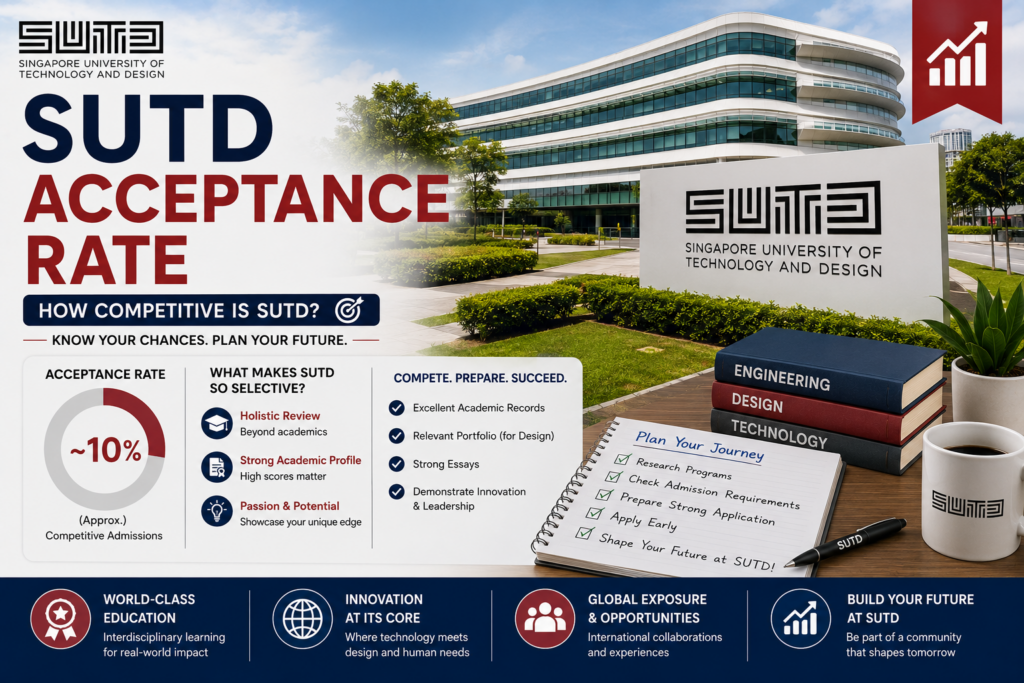
- SUTD does not publish an official numeric acceptance rate, unlike NUS or NTU.
- SUTD jumped from rank 519 to rank 266 globally in QS 2027 rankings.
- Admission is holistic: academics, portfolio (where relevant), and interview.
- Indian applicants need Class 12 marks, English scores, and program-specific documents.
Does SUTD publish an official acceptance rate?
No. If you search for “What is the SUTD acceptance rate?” or the acceptance rate of SUTD more broadly, you will find numbers ranging from 25% to 58% depending on which aggregator you land on. None of these figures come from SUTD itself. SUTD’s own admissions pages describe a full, holistic application review rather than a stated selection ratio, so there is no single, official SUTD acceptance rate you can quote with confidence.
This process is different from what most Indian applicants expect. US universities publish exact admit rates every year. SUTD, like several Singapore autonomous universities, does not release this figure publicly. So when you see a specific percentage for the SUTD acceptance rate for international students on a random blog, treat it as an estimate, not a fact.

Choose your dream country
 UK
UK
 USA
USA
 Germany
 Australia
 Ireland
 Canada
 UAE
UAE
 France
 Sweden
 Italy
Italy
 Other
Other
When do you want to study abroad?
What's your highest level of education?
What do you want to study?
Select your current city
How Leap will help you

Personalised University Shortlist

Express Applications with Quicker Admits

End-to-End Application Support
Counselor insight: Students often ask about the SUTD acceptance rate for Indian students specifically. SUTD does not break down admission data by nationality either, so there is no separate published rate for Indian applicants. What matters more is how your profile compares against the applicant pool for your intended major, especially for Architecture and Sustainable Infrastructure, which draw larger applicant volumes relative to seats.
Is SUTD a good university, and is it hard to get into SUTD?
Is SUTD good? Is SUTD a good university? These are really the same question phrased two ways, and the honest answer depends on what you're optimizing for. If your priority is a large, broad research university, SUTD's small, design-and-tech focused model may not fit. If you want a hands-on, MIT-collaborative curriculum with a tight faculty-to-student ratio, SUTD ranks highly among Singapore's four autonomous universities for that specific profile.
On global rankings, SUTD's trajectory answers most of the "Is it hard to get into SUTD?" question indirectly. SUTD placed 440th in QS World University Rankings 2025, fell to 519th in QS 2026, then climbed 253 places to rank 266th globally in QS World University Rankings 2027, released in June 2026. SUTD called this its first time entering the world's top 300 universities, driven largely by gains in faculty strength, faculty-student ratio, and employer reputation. It now ranks third among Singapore's autonomous universities behind NUS and NTU.
A sharper ranking usually means more applicants chasing the same number of seats, which pushes the effective SUTD university acceptance rate down even without a published number changing. Anyone searching for SUTD Singapore acceptance rate right now should read that ranking jump as the clearest available signal of rising competitiveness. If you're asking whether SUTD is competitive right now, the honest answer is more competitive than it was two years ago and getting more so.
SUTD admission requirements for Indian students (2026 intake)
Since there's no official acceptance percentage to lean on, SUTD admission requirements are the more useful thing to actually verify before you apply. For the 2026 undergraduate intake, SUTD's application windows are (confirmed on SUTD's official application timeline page):
- Singapore-Cambridge GCE A-Level qualification: from the day A-Level results are released until 19 March 2026
- All other qualifications, including Indian Class 12 boards: 2 January to 2 March 2026
Budget for the full cost of applying and studying, not just the admission bar. Our cost of studying in Singapore guide breaks down tuition and living expenses so you can plan alongside your application timeline.
Core requirements confirmed on SUTD's official site:
- Minimum 12 years of general education, or Year 12 national/international examination completed in your application year
- Strong performance in Mathematics and Science subjects (Physics or Chemistry preferred)
- An English proficiency score: IELTS, TOEFL, SAT, PTE Academic, ACT, or C1 Advanced (internet-based scores only)
- Standard 12 marksheet (actual results, or predicted/semester results if final results arrive after the application window, with actual results due within 3 days of official release)
If you're comparing this program against other study in Singapore options, note that SUTD's process leans more heavily on holistic review than a pure marks cutoff, which is a meaningful difference from how NUS and NTU typically screen applicants.
SUTD architecture acceptance rate: why it’s different
If you're applying to Architecture and Sustainable Design, the SUTD architecture acceptance rate question comes up constantly, and for good reason. Architecture is one of the programs where SUTD explicitly considers a portfolio as part of the holistic review, alongside academics and, for shortlisted candidates, an interview.
A portfolio submission isn't required for every SUTD program, but where it applies, it becomes a real differentiator. Two applicants with similar Class 12 marks can have very different outcomes if one submits a thoughtful, original portfolio and the other doesn't. If Architecture is your target major, budget real preparation time for this rather than treating it as a formality.
What actually strengthens an application, since there’s no fixed rate to beat
Practical steps that matter more than chasing a percentage:
- Lock your English test score early. SUTD accepts IELTS, TOEFL, PTE Academic, SAT, ACT, or C1 Advanced, so pick whichever you can prepare for fastest.
- If applying to a portfolio-based major, start the portfolio months in advance, not weeks.
- Prepare for the interview by researching SUTD's actual curriculum structure (its four pillars and interdisciplinary approach) rather than generic responses.
- Track the 2026 application windows closely. Missing the 2 January to 2 March window for non-A-Level qualifications means waiting for the next cycle.
Counselor insight: Students fixate on finding the exact SUTD acceptance rate, but SUTD's own description of its process, academic review, portfolio (where relevant), and interview for shortlisted candidates tells you where to actually spend your effort. A strong Class 12 record in Math and Science gets you considered. What separates borderline applicants is usually the portfolio quality (for design-linked majors) and how well the interview reflects genuine interest in SUTD's project-based, interdisciplinary teaching style, not generic "why study abroad" answers.
SUTD PhD and graduate admissions: a different process
The SUTD PhD acceptance rate isn't published either, and it works on a fundamentally different track from undergraduate admissions. Graduate and PhD applicants are assessed on research fit with faculty, academic transcripts, and (for many programs) standardized test scores like GRE/GMAT where required. If you're exploring MS in Singapore options generally, treat SUTD's graduate route as a separate research-fit conversation with your target department, not an extension of the undergraduate process. If you're weighing a research-focused SUTD graduate degree against a professional path like an MBA, our guide to MBA colleges in Singapore covers how the admissions criteria differ.
Is SUTD open to public visits, and other things applicants ask
Is SUTD open to public is a common side question once students start researching the campus. SUTD's campus in the Changi area does run open house events and campus tours as part of its admissions outreach, alongside official information sessions, so prospective applicants aren't limited to reading the website. Check SUTD's admissions page directly for the current open house calendar since dates change every intake cycle.
3 Takeaways on SUTD Acceptance Rate
- There is no official SUTD acceptance rate; treat any specific percentage you find online as an unverified estimate, not SUTD data.
- SUTD's QS rank jump to 266th in 2027 signals rising competitiveness, so a strong Class 12 profile and, where relevant, a genuine portfolio matter more than ever.
- Confirm your 2026 application window early (2 January to 2 March for non-A-Level qualifications) and lock in your English test score well before then.
Have a specific question about your SUTD application? Talk to a LeapScholar counselor.
Frequently Asked Questions About SUTD Acceptance Rate
-
What is the SUTD acceptance rate?
SUTD does not publish an official acceptance rate for undergraduate, graduate, or PhD programs. Numbers circulating online (25% to 58%) come from third-party aggregators, not SUTD. Admission is based on a holistic review of academics, a portfolio where applicable, and interview performance.
-
Is it hard to get into SUTD?
It has become more competitive. SUTD rose from rank 519 to rank 266 globally in QS World University Rankings 2027, which typically means more applicants for the same number of seats, even without a published acceptance percentage confirming it.
-
Is the SUTD acceptance rate different for international students?
SUTD doesn't publish a separate rate for international applicants or Indian applicants specifically. All applicants go through the same holistic review process regardless of nationality, though English test requirements apply specifically to non-native English education backgrounds.
-
What are the SUTD admission requirements for Indian students?
Indian applicants need a Standard 12 marksheet with strong Math and Science performance, an English test score (IELTS, TOEFL, PTE, SAT, ACT, or C1 Advanced), and for design-linked majors, a portfolio. The 2026 application window for non-A-Level qualifications runs from 2 January to 2 March 2026.
-
Does SUTD's architecture program have a separate acceptance rate?
There's no published separate rate, but Architecture and Sustainable Design does require a portfolio as part of the holistic review, which makes it a meaningfully different evaluation from majors that don't require one.
-
Is SUTD a good university for Indian students?
SUTD suits students who want a small, hands-on, project-based curriculum built around design and technology, developed with MIT collaboration. It's a strong fit if you value close faculty access over a large campus, and its rising QS rank (266th in 2027) reflects growing global recognition.
-
Is SUTD open to public campus visits?
Yes, SUTD holds open house events and information sessions for prospective applicants as part of its admissions cycle. Exact dates change each year, so check SUTD's admissions page closer to your intake.
-
What if I don't have a portfolio ready for SUTD Architecture?
Start immediately if you're past the halfway point of your application window. A rushed portfolio is still generally stronger than no portfolio, but SUTD's review does weigh it, so give yourself several weeks minimum rather than assembling it the week before the deadline.
-
Is the SUTD PhD acceptance rate published anywhere?
No. PhD admissions depend on research fit with a specific faculty member and department, transcripts, and test scores where required, and SUTD does not release a numeric rate for this track either.








Have Questions? Get Guidance to reach your Dream University
Connect with India's finest counsellors and biggest study abroad community.
Get Guidance