
Quick Read
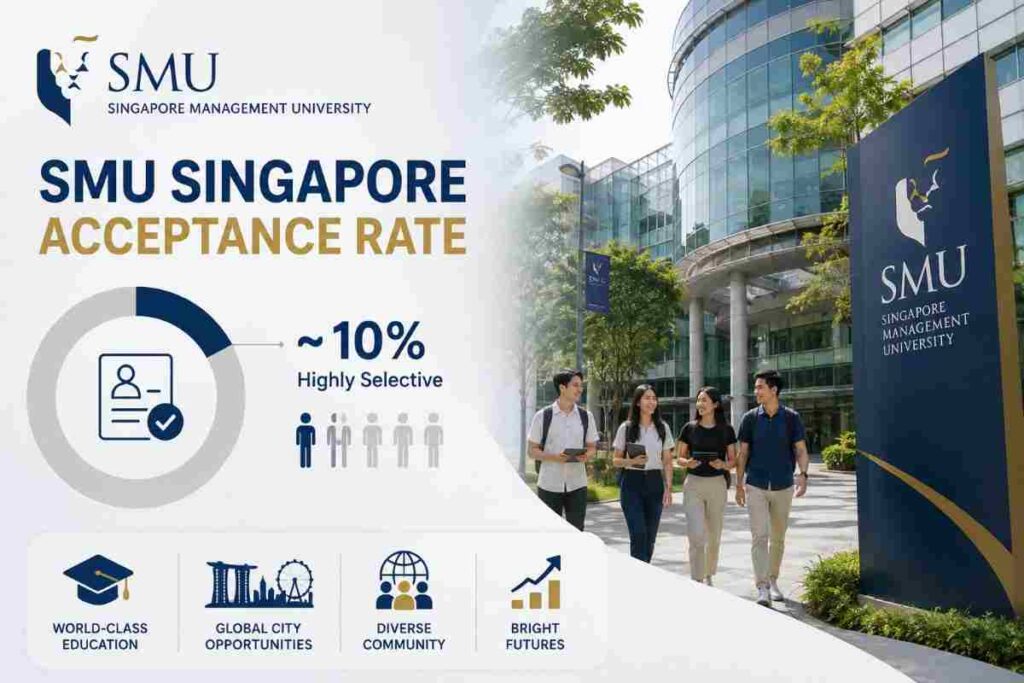
- SMU does not publish an official acceptance rate for any program.
- Figures like 49%, 45%, and 20-25% circulating online are unverified estimates.
- SMU uses holistic admissions: grades, an interview, and sometimes an essay.
- SMU ranks #411 overall in QS 2027 but 5th globally among QS Specialist universities.
- SMU MBA candidates average a 660 GMAT score, with no official minimum score.
- Subsidized annual tuition for eligible international students runs near Rs.13 lakh.
What Is SMU Singapore’s Acceptance Rate? The Real Answer
There isn’t an official one. Search “SMU Singapore acceptance rate” and you’ll find three different numbers repeated across consultancy blogs: 49%, 45%, and 20-25%. None of them link back to anything SMU itself has published. Singapore Management University’s own admissions site publishes an Indicative Grade Profile and describes its process as holistic, but it does not release applicant-to-offer ratios, either overall or by program.
This isn’t unusual for Singapore. NUS and NTU, SMU’s fellow autonomous universities, follow the same practice. Admission committees use interviews and essays to select students instead of just one cutoff score, and publishing one overall percentage would misrepresent how differently the bar moves across law, business, computing, and the social sciences with each intake.

Choose your dream country
 UK
UK
 USA
USA
 Germany
 Australia
 Ireland
 Canada
 UAE
UAE
 France
 Sweden
 Italy
Italy
 Other
Other
When do you want to study abroad?
What's your highest level of education?
What do you want to study?
Select your current city
How Leap will help you

Personalised University Shortlist

Express Applications with Quicker Admits

End-to-End Application Support
Counselor insight: When a student asks us for "the SMU acceptance rate," what they actually need is a way to gauge their odds. That's a different, more useful question, and it's answered below with SMU's real published benchmarks instead of a manufactured percentage.
Is SMU Singapore Hard to Get Into? Signals That Actually Matter
Since there is no official SMU Singapore acceptance rate, please refer to the information that SMU does publish instead.
| Signal | What SMU publishes | Where to check |
|---|---|---|
| Undergraduate grade profile | 10th-90th percentile grades of admitted A-Level/IB/Polytechnic applicants, updated yearly | SMU Indicative Grade Profile |
| Admission process | Holistic: grades, co-curricular record, and a panel interview for shortlisted applicants; essay for some scholarships | SMU Admissions Requirements |
| MBA class profile | Average GMAT 660, no official minimum score, 34+ nationalities, 65% international | SMU MBA admissions page |
| QS World Ranking 2027 | =411 overall; 5th globally among QS "Specialist" universities | QS Top Universities: SMU |
| Employment outcomes | 2,331 graduates surveyed in the 2025 Graduate Employment Survey; historically among the highest starting-salary cohorts of Singapore's autonomous universities | SMU GES 2025 official results |
SMU is classified by QS as a "specialist" university (alongside LSE and St Gallen) because its six schools cluster around business, law, economics, computing, and social sciences, without a medical or full engineering faculty. That narrower scope is precisely why comparing SMU's overall QS rank directly against NUS or NTU (both "Fully Comprehensive," ranked 10th and 12th globally) undersells SMU's actual subject strength.
SMU Singapore MBA and Masters Acceptance Rate: What Class Profiles Show
The SMU MBA has no official minimum GMAT or GRE score. SMU's own admissions page states that candidates are compared on academic performance, GMAT/GRE, and professional background together, not on a single score cutoff.
- Average GMAT of admitted candidates: approximately 660 (consistent across multiple external MBA-tracking sources)
- Academic Excellence Award, Tier 1: GMAT 720+ with outstanding academic record
- Academic Excellence Award, Tier 2: GMAT 700+
- Typical candidate profile: around 30 years old, 5-7 years of work experience, drawn from 22+ industries
For SMU's Masters programs (MiM, Master of Data Science in Economics, and other specialized master's degrees), requirements vary by school. Candidates from SMU, NUS, or NTU with strong CGPAs may use their transcript in place of GMAT/GRE for some programs; other applicants typically submit GMAT or GRE scores alongside transcripts and, where the degree wasn't taught in English, an IELTS or TOEFL score.
Check MBA colleges in Singapore: top schools and fees to compare SMU against NUS's and NTU's postgraduate business programs.
Counselor insight: Students often ask what GMAT score "guarantees" an SMU MBA seat. There isn't one. A 660+ score puts you roughly at the class average; a 700+ mark is what SMU explicitly rewards through its Academic Excellence Award, which is a stronger target if merit-based fee reduction matters to your budget.
SMU Singapore Law School Acceptance Rate: What Makes Yong Pung How Competitive
SMU's Yong Pung How School of Law does not publish a separate acceptance rate either, mirroring the overall acceptance rate at SMU Singapore, but its rising subject ranking is a useful selectivity signal: SMU's Law program was Singapore's most-improved subject entry in the QS World University Rankings by Subject 2026, climbing 45 places to 56th globally, and the school is approaching its 20th anniversary.
Explore LLM in Singapore for international students if you're specifically targeting a postgraduate law route.
SMU Singapore World Ranking: QS 2027 in Context
| Ranking | SMU 2027 position | Note |
|---|---|---|
| QS World University Rankings 2027, overall | 411 | Reflects SMU's narrower Specialist faculty scope |
| QS Specialist universities peer group | 5th globally (of 56 institutions) | Direct-comparison group: LSE, St Gallen, Sciences Po |
| QS Subject: Business & Management Studies | 39th globally | Rose from outside the top 50 |
| QS Subject: Accounting & Finance | 50th globally | |
| QS Subject: Law | 56th globally | Most-improved Singapore subject entry, 2026 |
| QS Subject: Social Sciences & Management (aggregate) | 86th globally | Entered global top 100 for the first time |
SMU was named the world's most-improved university among institutions with 10+ ranked subjects in the QS World University Rankings by Subject 2026, with 8 of its 10 ranked subjects climbing globally that year.
SMU Singapore Admission Requirements and Documents Checklist for Indian Students
Requirements differ depending on whether you're applying with CBSE/ISC/state board Class 12 results, A-Levels, or IB.
| Document | India-specific detail |
|---|---|
| Class 10 and 12 marksheets | Required for undergraduate applications, strong Mathematics performance matters specifically for Economics and Computer Science programs |
| English proficiency score | IELTS Academic 7.0+ (with 7.0+ reading, 6.5+ writing) is the benchmark cited on SMU's admissions pages; check current section-wise minimums directly, as they vary by intake. |
| SAT/ACT scores (undergraduate) | Valid for 5 years; scores from before 19 March 2021 are not considered for the 2026 admissions exercise |
| GMAT/GRE (postgraduate) | Required for MBA/Masters unless you hold a qualifying SMU/NUS/NTU transcript with a high CGPA |
| Personal statement/essay | Required for scholarship consideration; submitted with the main application, not separately |
| Passport | Valid well beyond your intended program end date |
| Application fee | S$15 (undergraduate) or S$100 (postgraduate), non-refundable |
SMU Singapore Fees for International Students
| Fee type | Amount (SGD) | Amount (INR) |
|---|---|---|
| Undergraduate, subsidised (with MOE Tuition Grant) | S$17,000-18,000/year | Rs.12.8-13.5 lakh |
| Undergraduate, non-subsidised (no Tuition Grant) | Higher; SMU-published, not fixed here | Check official page |
| MBA (full program) | S$82,840 | Rs.62.2 lakh |
| Annual compulsory fees | S$290/year | Rs.21,785/year |
Important: Accepting the MOE Tuition Grant (which most international students use to access subsidized fees) comes with a mandatory 3-year bond to work for a Singapore-registered company after graduation. Factor this into your decision if you're weighing SMU against a destination without a work-bond requirement.
Read cost of studying in Singapore and cost of living in Singapore for the full monthly budget breakdown beyond tuition.
SMU Singapore Scholarships
- SMU International Scholarship: covers subsidized tuition for eligible high-achieving international undergraduates.
- SCIS Frontier AI Scholars Program: full tuition, overseas exposure allowance, and mentorship for computing applicants; specifically names India among target citizen groups for at least one of SMU's scholarship tracks.
- MBA scholarships: cover up to 30% of tuition, awarded without a bond, based on GMAT score and academic merit through the Academic Excellence Award tiers described above. Confirm current terms on SMU's MBA admissions page.
Compare India-focused options in scholarships in Singapore for Indian students.
SMU Singapore Application Calendar for Indian Students
MBA (Full-Time and Part-Time)
SMU's MBA runs two intakes a year with published, fixed deadlines. Here's what's actually still open right now:
| Intake | Round | Deadline | Status as of 26 August 2026 |
|---|---|---|---|
| January 2027 | 1st | 15 March 2026 | Closed |
| January 2027 | 2nd | 15 July 2026 | Closed |
| January 2027 | Final | 30 November 2026 | Open now, your only remaining window for January 2027 entry |
| August 2027 | 1st | 30 November 2026 | Open now |
| August 2027 | 2nd | 28 February 2027 | Open |
| August 2027 | Final | 31 May 2027 | Open |
SMU explicitly advises that you apply in an earlier round where possible, since the final deadline can limit MBA seats and scholarships.
Planning it against your Indian academic year
| Month | What to do |
|---|---|
| Now through October 2026 | If targeting January 2027 MBA entry: finalise GMAT/GRE, essays, and referee reports before the 30 November final deadline |
| November 2026 | MBA August 2027 1st round closes 30 Nov; undergraduate AY2027-28 applications likely open this month, watch SMU's site |
| December 2026-February 2026 | Prepare IELTS/GMAT/GRE if targeting undergraduate AY2027-28 or MBA August 2027 2nd round (28 Feb) |
| March 2027 | Likely undergraduate AY2027-28 application close (pattern-based); confirm exact date once published |
| April-July 2027 | Undergraduate interviews and outcomes; MBA August 2027 final round (31 May) |
| August 2027 | Undergraduate and MBA August-intake classes begin |
What to Do If Your Grades or GMAT Fall Short
- Below the Indicative Grade Profile range: Apply anyway if you're within a reasonable margin. SMU's holistic process weighs interview performance and co-curricular record alongside grades; a borderline transcript with a strong interview has a real path forward.
- GMAT below 620 for MBA: Consider whether your professional experience and essays can carry more weight or retake closer to your target intake since scores stay valid for a defined window. Speak with a counselor about whether a GRE score might better reflect your strengths.
- English score below the stated benchmark: Confirm the exact current minimum for your specific program, since these vary; a retake focused on your weakest section (reading or writing, most commonly) is usually more efficient than a full retest.
- Missed the main application round: Postgraduate programs often run multiple intake rounds across the year; check whether a later round is still open before assuming you've missed the cycle entirely.
3 Takeaways on SMU Singapore Acceptance Rate
- There is no official SMU Singapore acceptance rate. Any specific percentage you see online is an estimate, not SMU-published data, and shouldn't be used to judge your chances.
- Use SMU's real published signals instead: the Indicative Grade Profile, MBA GMAT class average (660), and QS 2027 subject rankings give a far more accurate picture of selectivity than a single guessed number.
- Admissions is holistic, not score-only. Your interview performance, essays, and professional experience are important at SMU, especially if your grades or test scores are slightly below the published averages.
Verified by: LeapScholar's Singapore counseling team, with hands-on experience guiding Indian students through university shortlisting and applications for SMU, NUS, and NTU.
Have questions about the SMU Singapore acceptance rate? Book a free session with a LeapScholar counselor.
Frequently Asked Questions About SMU Singapore Acceptance Rate
-
What is the acceptance rate of SMU Singapore?
SMU does not publish an official acceptance rate for any of its programs. Figures like 49%, 45%, or 20-25% that appear on consultancy websites are unverified estimates, not data released by the university. Use SMU's published Indicative Grade Profile and class statistics instead to judge your competitiveness.
-
Is SMU Singapore a good university?
Yes, particularly for business, law, economics, and computing. SMU ranks 5th globally among QS "Specialist" universities in 2027 and holds top-60 global subject rankings in Business & Management, Accounting & Finance, and Law, alongside consistently strong graduate employment outcomes in Singapore's official joint employment survey.
-
What GPA or grades do I need to get into SMU Singapore?
SMU publishes an Indicative Grade Profile showing the 10th-90th percentile grades of admitted applicants each year, varying by program and qualification type (A-Level, IB, or Polytechnic). Admission is holistic, so meeting the grade profile does not guarantee acceptance, and falling slightly below it does not guarantee rejection.
-
What is the SMU MBA acceptance rate?
SMU does not publish an official MBA acceptance rate. Instead, it publishes class profile data: an average GMAT of approximately 660, no official minimum score, and a class typically comprising 65% international students from 34 or more nationalities with 5-7 years of average work experience.
-
What is SMU Singapore's world ranking?
SMU ranks #411 overall in the QS World University Rankings 2027 but 5th globally among QS's "Specialist" university peer group, alongside institutions like LSE and St Gallen. Its individual subject rankings are considerably stronger, including 39th globally for Business & Management Studies and 56th for Law, which matters more for selectivity context than the overall figure alone.
-
Is SMU Singapore harder to get into than NUS or NTU?
This can't be answered with acceptance-rate numbers, since none of Singapore's three autonomous universities publish one. NUS and NTU are classified as "Fully Comprehensive" by QS with broader faculty coverage, while SMU is a "Specialist" institution focused on business, law, economics, computing, and social sciences, making a direct numerical comparison misleading.
-
What GMAT score do I need for SMU's MBA or Masters programs?
There is no official minimum GMAT score for SMU's MBA. The published class average sits around 660, and candidates scoring 700 or above qualify for consideration under SMU's Academic Excellence Award. Masters program requirements vary by school, with some accepting a strong SMU, NUS, or NTU transcript in place of a GMAT score.
-
What happens if my grades or test scores are below SMU's typical profile?
SMU's holistic admissions process weighs your interview performance, co-curricular record, and, for postgraduate applicants, professional experience alongside academic scores. A borderline profile with a strong interview and well-written essays still has a genuine path to admission rather than an automatic rejection.
-
What are SMU Singapore's fees for Indian and other international students?
Subsidized undergraduate tuition under the MOE Tuition Grant runs approximately Rs.13 lakh per year, though accepting the grant carries a mandatory 3-year work bond in Singapore after graduation. MBA tuition runs considerably higher, and exact current figures should always be confirmed on SMU's official tuition fees page before budgeting.








Have Questions? Get Guidance to reach your Dream University
Connect with India's finest counsellors and biggest study abroad community.
Get Guidance