
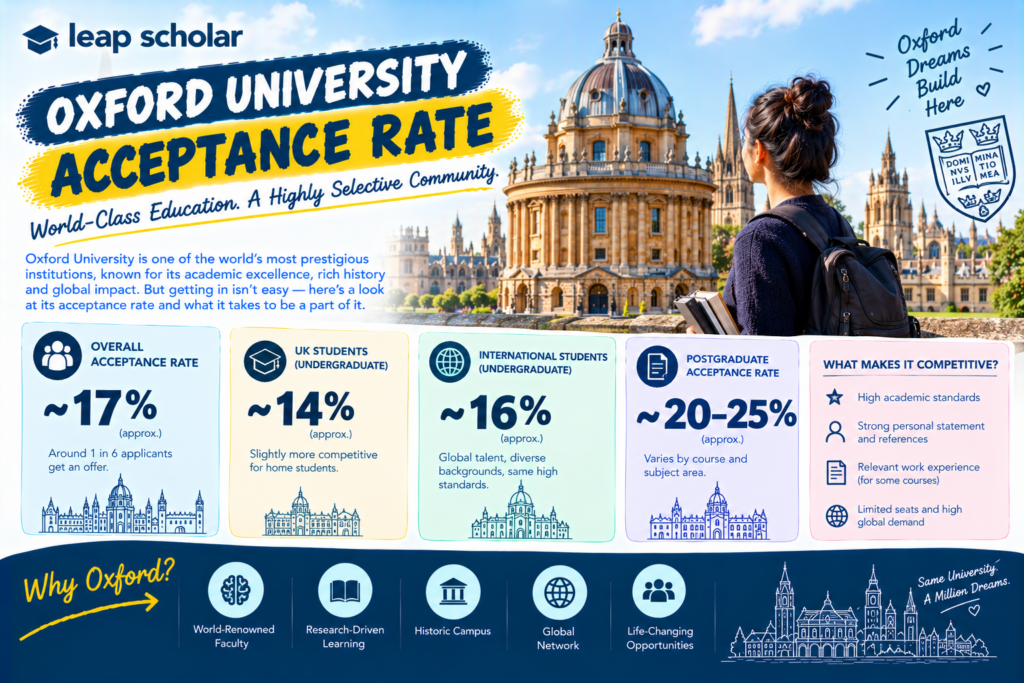
Quick Read
- Oxford admitted 14.2% of applicants in 2025: 3,302 of 23,329.
- Indian applicants fare worse: 70 admitted from 1,719 applications across 2023-25.
- Economics and Management is toughest, with 18.8 applicants per place.
- Undergraduate 2027 entry has closed; masters applicants apply by December or January.
What Is the Oxford University Acceptance Rate in 2025-26?
The Oxford University acceptance rate was 14.2% for the 2025 cycle (entry in October 2025). Oxford received 23,329 undergraduate applications, made 3,891 offers, and admitted 3,302 students. That makes the offer rate 16.7%, which is higher than the acceptance rate because some offer holders miss their grades or decline.
These are the latest Oxford University admissions statistics available. Oxford’s June 2026 report covers the 2025 cycle, so figures for the 2026 cycle are not out yet. Any article quoting an “Oxford University acceptance rate 2026” is using the same 2025-cycle data.

Choose your dream country
 UK
 USA
 Germany
 Australia
 Ireland
 Canada
 UAE
 France
 Sweden
 Italy
 Other
When do you want to study abroad?
What's your highest level of education?
Have you completed Class 12th?
What was your Class 12 CGPA/percentage?
Are you a student or a parent/guardian?
What do you want to study?
Select your current city
How Leap will help you

Personalised University Shortlist

Express Applications with Quicker Admits

End-to-End Application Support
| Entry year | Applications | Offers | Admitted | Offer rate | Admit rate |
| 2025 | 23,329 | 3,891 | 3,302 | 16.7% | 14.2% |
| 2024 | 23,061 | 3,793 | 3,245 | 16.4% | 14.1% |
| 2023 | 23,211 | 3,721 | 3,219 | 16.0% | 13.9% |
| 2022 | 23,819 | 3,645 | 3,271 | 15.3% | 13.7% |
| 2021 | 24,338 | 3,555 | 3,298 | 14.6% | 13.6% |
Oxford has about 7.1 applications for every place. Oxford's own figures also show how it filters: it aims to interview three candidates per place, and around a third of those interviewed receive an offer.
Oxford University Acceptance Rate for Indian Students
The Oxford University acceptance rate for Indian students is far below the headline number. Between 2023 and 2025, Indian applicants submitted 1,719 applications and received 70 offers, for an acceptance rate of about 4.1%. That is roughly 570 applications and 23 admitted students from India in a typical year.
India is the fifth-largest source of Oxford applications (counting the UK) but has one of the lowest admission rates among the top source countries. The table below uses admitted students divided by applications for 2023 to 2025, so every row is measured the same way.
| Applicant group | Applications | Admitted | Admitted per application |
| UK | 43,670 | 7,781 | 17.8% |
| All applicants | 69,601 | 9,766 | 14.0% |
| Singapore | 1,821 | 252 | 13.8% |
| Hong Kong | 1,267 | 150 | 11.8% |
| China | 6,025 | 559 | 9.3% |
| All non-EU applicants | 21,478 | 1,681 | 7.8% |
| France | 560 | 40 | 7.1% |
| United States | 2,891 | 202 | 7.0% |
| Germany | 752 | 51 | 6.8% |
| Malaysia | 593 | 37 | 6.2% |
| Canada | 864 | 52 | 6.0% |
| India | 1,719 | 70 | 4.1% |
Oxford University acceptance rate for international students
The Oxford University acceptance rate for international students is lower than for UK applicants in every year Oxford reports. In 2025, non-EU applicants received 784 offers from 7,600 applications, a 10.3% offer rate. UK applicants received 3,006 offers from 14,340 applications, a 21.0% offer rate. Oxford says it does not run quotas or targets by nationality. The exception is Medicine, where the government caps the number of students with international fee status.
Oxford does not publish an India-specific offer rate or a split of Indian applicants by course, so the report cannot tell us how much of the gap comes from course choice. What it does show is that, for Indian applicants, a strong profile is the starting point and not a differentiator.
Counselor insight: Many Indian applicants arrive with near-identical Class 12 marks. That makes the admissions test, the personal statement, and the interview the stages that separate applications, so start preparing for them months before you open UCAS.
Oxford University Acceptance Rate by Course
The Oxford University acceptance rate varies sharply by course, and your course choice affects your odds more than almost anything else on the application. Oxford publishes applicants per place for its largest courses, aggregated across 2023 to 2025.
| Course | Applicants per place | Roughly one place per... |
| Economics and Management | 18.8 | 19 applicants |
| Computer Science | 14.8 | 15 applicants |
| Biomedical Sciences | 12.0 | 12 applicants |
| Mathematics | 10.4 | 10 applicants |
| Mathematics and Computer Science | 10.3 | 10 applicants |
| Law | 10.0 | 10 applicants |
| Medicine | 9.4 | 9 applicants |
| Physics | 9.0 | 9 applicants |
| Biochemistry | 9.0 | 9 applicants |
| Experimental Psychology | 8.6 | 9 applicants |
A few points matter for Indian applicants:
- Oxford University acceptance rate for Economics and Management: at 18.8 applicants per place, this program is the most competitive course, Oxford reports, which puts the odds at roughly 5% for the average applicant.
- Oxford University acceptance rate for Law and Medicine: Law has 10.0 applicants per place and Medicine 9.4. Medicine has an extra constraint for Indian applicants because of the government cap on international fee status places.
- Oxford University acceptance rate for Engineering: Engineering Science does not appear among the ten most oversubscribed courses, so it sits below 8.6 applicants per place. That does not make it easy, only less crowded than the courses above.
- Oxford University acceptance rate for Psychology: Experimental Psychology is the tenth most competitive course at 8.6 applicants per place.
You can apply to only one course at Oxford, so choose it for the subject and not for the numbers. Tutors interview in that subject, and a course picked for its odds is hard to defend in an interview.
Oxford University Acceptance Rate by College
Oxford has more than 30 colleges, and the college you list does not decide your fate. All colleges use the same Common Framework for Admissions, and they consider applications together before shortlisting.
Nearly a fifth of candidates make an open application, and the system places open applicants in a college with fewer direct applicants for their course. During shortlisting, many courses move candidates between colleges. As a result, around a third of successful candidates get an offer from a college they did not choose.
So which Oxford college has the highest acceptance rate? Oxford's headline report does not publish a league table of overall offer rates by college, and it warns that single-year figures for colleges and courses can be misleading because the numbers are small. The Oxford University acceptance rate by college is available only in pieces (for example, by school type or gender) in the full data at ox.ac.uk/adstats, and it changes every year. Pick a college for its subject provision, location, and accommodation, or make an open application.
Oxford University Acceptance Rate for Masters and Postgraduate
Oxford's annual admissions report covers undergraduate applicants only, so it contains no Oxford University acceptance rate for masters or for postgraduate courses overall. Competition differs from course to course, and Oxford does not publish one graduate figure in the report used here.
What you can check is the course page. Every graduate course page states the minimum degree requirement in UK terms and as a US 4-point GPA, along with the application deadline. Applications go through Oxford's Graduate Admissions portal and not UCAS.
For 2027-28 entry, graduate applications are open, and most courses have a December or January deadline for scholarship consideration. Clarendon Fund consideration is automatic if you apply by that deadline: there is no separate form, so missing your course deadline also means missing Clarendon.
The application fee for a taught course is about ₹9,450 (£75) at £1 = ₹126. Research course applications cost about ₹2,520 (£20). Exchange rates move, so check the current rate before you pay.
See what our counselors say about Oxford for a Masters
Oxford University Admission Requirements for Indian Students
Meeting the requirements only makes you eligible. With an Oxford University acceptance rate of about 4.1% for Indian applicants, this statistic alone does not make you competitive. Here is what each route asks for. For a full walkthrough, read our guide on how to get into Oxford from India.
Undergraduate: how can you get admission to Oxford University after Class 12?
- Board: Oxford considers CBSE (All-India SSC) and CISCE (ISC) Class 12 results for direct entry. State board students should check Oxford's international qualifications page before planning.
- Marks: Oxford sets course-wise grade requirements for CBSE and ISC. LeapScholar counselors treat roughly 90-95% overall, with higher marks in the subjects your course needs, as the realistic range for a competitive profile. For reference, 87.2% of UK students admitted in 2025 had A*AA or better at A-level.
- Admissions test: For 2027 entry, Oxford used the TMUA for maths-based courses, the ESAT for engineering and physics, the TARA for PPE and economics-based courses, the LNAT for Law and the UCAT for Medicine.
- Application: Apply through UCAS by 15 October, with a personal statement and an academic reference.
- Interview: Shortlisted candidates are interviewed in early December, and offers go out in January.
Source for tests and process: Oxford's 2027-entry admissions tests timeline and the Annual Admissions Statistical Report (June 2026).
Postgraduate: how can we get admission to Oxford University for a masters?
Hold a degree that meets the minimum on your course page, apply through the Graduate Admissions portal, and submit before the December or January deadline. Expect to provide a statement of purpose, references, and transcripts, plus an English language test if your course requires one.
Dates and deadlines
| Stage | Status as of 22 October 2026 |
| Undergraduate UCAS deadline for 2027 entry (2027-28) | 15 October 2026: closed |
| TMUA, ESAT, and TARA test window for 2027 entry | 12 to 16 October 2026: closed |
| Undergraduate interviews for 2027 entry | Early December 2026 (shortlisted candidates only) |
| Undergraduate offers for 2027 entry | January 2027 |
| Undergraduate entry for 2028-29 | Dates not yet announced. Check Oxford's undergraduate admissions page for updates. |
| Graduate applications for 2027-28 | Open. Most courses have a December 2026 or January 2027 deadline; check your course page. |
Counselor insight: Do not treat the admissions test as an afterthought. It is Oxford's main shortlisting filter for interviews, so begin test preparation well before the booking window opens, and draft your personal statement around genuine academic reading and not around clubs and awards.
Oxford vs Harvard and Cambridge Acceptance Rates
The Oxford vs Harvard acceptance rate comparison needs care because the two universities publish different measures. Oxford's 14.2% divides admitted students by applications. Harvard's 4.2% divides offers by applicants. The fair comparison is Oxford's 16.7% offer rate against Harvard's 4.2%.
| University | Latest cycle | Applicants | Offers | Rate |
| Oxford | 2025 cycle | 23,329 | 3,891 | 16.7% offer rate (14.2% admitted) |
| Harvard College | Class of 2029 | 47,893 | 2,003 | 4.2% admit rate |
On headline numbers, Harvard is harder to enter, but the Oxford University acceptance rate for Indian students (about 4.1% admitted) sits much closer to Harvard's headline than to Oxford's own. Our Oxford vs Harvard comparison covers cost, funding, and careers.
Cambridge says it receives about six applications per place on average across subjects, against about seven at Oxford. If you are deciding between the two, read about getting into Cambridge from India. Remember that you cannot apply to both Oxford and Cambridge in the same UCAS cycle.
What the Oxford University Acceptance Rate Means for Your Application Plan
Use the numbers to decide how many eggs go in the Oxford basket, not whether to apply at all.
| If your situation is... | Then plan this |
| Class 12 with CBSE or ISC, top marks in your course subjects, real depth in the subject | Apply to Oxford for one course, prepare for the admissions test early, and fill the other UCAS choices with strong UK options such as Russell Group universities |
| Class 12 results below the top band, or a state board | Build a UK undergraduate list that fits your profile, including UK universities with higher acceptance rates, and keep Oxford for a masters |
| Bachelor's degree at first-class level, clear research or career direction | Target an Oxford masters, apply by the December or January deadline, and treat the statement of purpose as the main document |
Fund the plan before you apply. Oxford's course fees and your living expenses are the biggest variable, and our guide to the cost of studying in the UK shows what to budget. Most scholarship decisions depend on getting an offer first.
The Oxford University acceptance rate for Indian students sits at about 4%, so every part of your application has to count. Talk to a LeapScholar counselor to pick the right course and college, strengthen your personal statement, and prepare for the admissions test and interview.
3 Takeaways on Oxford University Acceptance Rate
- Treat 14.2% as the headline and about 4% as your starting odds. The Oxford University acceptance rate for Indian students is far lower than the overall figure, so apply with a realistic backup list.
- Choose your course first and prepare for its admissions test early. Course choice and test performance shape your chances more than your choice of college.
- Match your route to the deadline. Undergraduate 2027 entry has closed, the 2028-29 dates are yet to be announced, and masters applicants should apply by their course's December or January deadline.
Talk to a LeapScholar counselor to see how your marks, test scores, and course choice stack up against the Oxford University acceptance rate before you apply.
Frequently Asked Questions About Oxford University Acceptance Rate
-
Is Oxford harder than Harvard?
On overall numbers, Harvard is harder. It admitted about 4.2% of applicants for the Class of 2029, against Oxford's 16.7% offer rate for 2025 entry. For Indian students, though, the gap is small, since only about 4.1% of Indian applicants made it into Oxford between 2023 and 2025.
-
What GPA do you need for Oxford?
Oxford doesn't use GPA for CBSE or ISC students. It looks for mostly A1 grades (91% and above) in Class 12, plus your admissions test score and interview. Master's courses usually ask for a first-class or strong upper second-class degree.
-
How many Indian students get into Oxford every year?
Around 23 Indian students a year get into Oxford at the undergraduate level. Oxford's 2026 report shows 70 students from India admitted across 2023 to 2025, out of 1,719 applications.
-
Does Oxford need SAT?
If you apply with CBSE or ISC Class 12 results, you don't need to take the SAT. The SAT only applies to students on the US system, who need three APs at grade 5 plus a SAT score of 1470 or 1480, depending on the course.
-
What is the Oxford University acceptance rate for engineering?
Engineering Science made 210 offers from 1,280 applications in the 2024-25 cycle, resulting in an offer rate of about 16.4%. Only 433 applicants were shortlisted, so the admissions test does most of the filtering.
-
What is the Oxford University acceptance rate for law and psychology?
Law has about 10 applicants per place, so roughly 1 in 10 succeeds. Experimental Psychology is slightly easier, with about 8.6 applicants per place, based on Oxford's 2023 to 2025 figures.
-
Which Oxford college has the highest acceptance rate?
Among UK applicants from 2023 to 2025, Regent's Park College had the highest offer rate at about 39%, while Worcester and Magdalen were near 12%. Picking a college for its rate rarely helps, because about a third of offers come from a college the student didn't choose.
-
What is the Oxford vs Cambridge acceptance rate?
Cambridge made offers to 21.7% of applicants in its 2025 cycle, compared with Oxford's 16.7%. You can apply to only one in the same year, so choose based on course fit, not the rate.










Have Questions? Get Guidance to reach your Dream University
Connect with India's finest counsellors and biggest study abroad community.
Get Guidance