
Quick Read
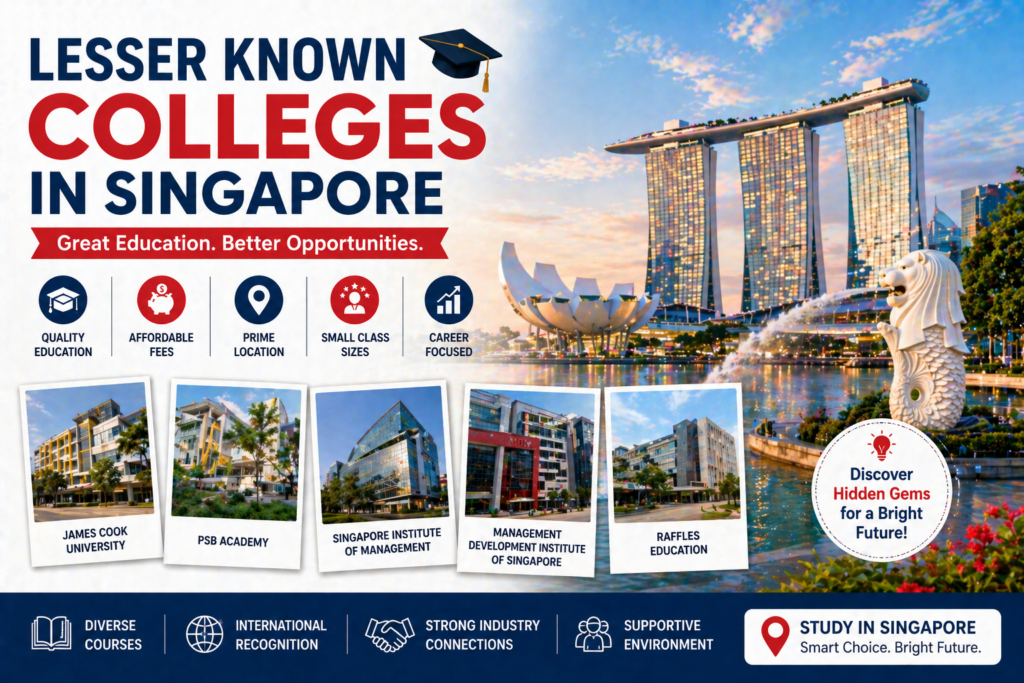
- Singapore has 6 autonomous universities beyond NUS, NTU, and SMU worth considering.
- Annual tuition at lesser known colleges in Singapore ranges from Rs. 9,40,000 to Rs. 28,20,000 ($10,000 to $30,000).
- Indian students need an ICA Student’s Pass; apply at least 2 months before the course starts.
- SUTD, SIT, and SUSS offer industry-linked programs with lower entry competition.
The 10 Lesser Known Colleges in Singapore Worth Applying To in 2026-27
All fees for AY 2026 were verified for non-ASEAN international students (India is non-ASEAN) from official sources.
| # | Institution | Type | Annual Tuition (INR) | Annual Tuition (SGD) | Intake | Best For |
| 1 | SUTD | Autonomous University | Rs. 23,38,400 | SGD 31,600 | August | PCM students with design or engineering interests |
| 2 | SIT | Autonomous University | Rs.10,84,000–Rs.17,82,000 | SGD 14,641–24,041 | August | Engineering, ICT, Food Tech; employment-first students |
| 3 | SUSS | Autonomous University | Rs.22,20,000–Rs.25,90,000 | SGD 30,000–35,000 | January and July | BCom/BBA graduates; HR, Law, Supply Chain, Counselling |
| 4 | SIM Global Education | MOE-Registered Private | Rs.9,62,000–Rs.15,54,000 | SGD 13,000–21,000 | Jan, Apr, Jul, Oct | Business, Finance, Computing; UK/US degree seekers |
| 5 | PSB Academy | MOE-Registered Private | Rs.8,88,000–Rs.20,64,000 | SGD 12,001–27,900 | Multiple | Credit-transfer students; working professionals |
| 6 | Kaplan Singapore | MOE-Registered Private | Rs.8,87,000–Rs.18,80,000 | SGD 11,984–25,401 | Multiple | Commerce graduates; ACCA + degree combination |
| 7 | MDIS | MOE-Registered Private | Rs.10,36,000–Rs.18,52,000 | SGD 14,000–25,000 | Multiple | Students wanting on-campus hostel accommodation |
| 8 | JCU Singapore | International Branch Campus (Australia) | Rs.15,78,000–Rs.22,80,000 | SGD 21,329–30,816 | Mar, Jul, Oct | Psychology, Business, Data Science; faster completion |
| 9 | ESSEC Asia-Pacific | International Branch Campus (France) | Rs.12,62,000–Rs.55,56,000 | SGD 17,052–75,157 | September | MBA/Master’s; consulting, luxury, finance careers |
| 10 | Singapore Polytechnics | Government Polytechnic | Rs.6,18,000–Rs.7,40,000 | SGD 8,350–10,000 | Multiple | Students building an entry profile for SIT (diploma pathway) |

Choose your dream country
 UK
UK
 USA
USA
 Germany
 Australia
 Ireland
 Canada
 UAE
UAE
 France
 Sweden
 Italy
Italy
 Other
Other
When do you want to study abroad?
What's your highest level of education?
Have you completed Class 12th?
What was your Class 12 CGPA/percentage?
Are you a student or a parent/guardian?
What do you want to study?
Select your current city
How Leap will help you

Personalised University Shortlist

Express Applications with Quicker Admits

End-to-End Application Support
Notes:
- SUTD, SIT, SUSS, and Singapore Polytechnics fees shown are subsidized rates under the MOE Tuition Grant; a 3-year Singapore work bond is required. Students who do not take the grant pay a significantly higher unsubsidized fee.
- SIT fees vary by program: 180-credit programs cost SGD 14,641/year; 240-credit and joint-degree programs (Newcastle, Glasgow, and TUM) cost up to SGD 24,041/year.
- SIM GE fees are annual equivalents derived from total program fees, which vary significantly by partner university. Confirm exact fees on the SIM program listing page.
- ESSEC fees range from the BBA (lower end) to the Executive MBA (upper end). MiM full programme cost: €40,000 (Rs. 36,20,000) Intensive / €52,000 (Rs. 47,06,000) Flexible track for non-EU students.
- Singapore Polytechnics award 3-year diplomas only, not degrees. Diploma holders can apply to SIT with credit recognition.
Eligibility and Admission Requirements for Indian Students
Autonomous universities (SUTD, SIT, SUSS):
- Class 12: 70% and above in relevant subjects; SUTD expects strong PCM
- English: IELTS 6.0 to 6.5 (varies by programme)
- Portfolio required for SUTD design programmes
- SOP and 2 recommendation letters required
MOE-registered private institutions (SIM GE, PSB, Kaplan):
- Class 12 or polytechnic diploma accepted
- English: IELTS 5.5 to 6.0; some programmes accept Duolingo scores
Counselor Insight: Always verify the awarding university's AIU recognition before paying the admission fee. Degrees from SIM GE, PSB Academy, and Kaplan Singapore are issued by their overseas partner universities, not by Singapore. If you plan to return to India for a government job, PSU, or higher education, that degree must be recognised by the Association of Indian Universities (AIU) and not all partner universities on these institutions' current programme lists hold AIU recognition. Email the partner university's registrar to confirm before submitting any fee.
Documents Checklist for Indian Students
| Document | India-Specific Details |
| Class 10 and 12 marksheets | Original and attested; CBSE/ICSE/State Board accepted |
| Degree transcripts (PG applicants) | University-attested; provisional certificate accepted if final pending |
| English proficiency scorecard | IELTS, TOEFL, or DET; some institutions accept Class 12 English scores |
| Statement of Purpose | 600 to 800 words; prompts vary by institution |
| Letters of Recommendation | 2 academic or professional references |
| Passport copy | Valid for at least 6 months beyond course start |
| Passport-size photographs | As per ICA specifications |
| Portfolio (SUTD only) | 10 to 15 pages of design or engineering project work |
| Financial proof | Bank statements covering at least 1 year of tuition and living costs |
| ICA Student's Pass application | Via SOLAR+ system; apply after receiving Conditional Acceptance Letter |
Application Deadline Windows by Institution
| Institution | Primary Intake(s) | Application Window | Strategic Notes |
| SUTD | August | October – February | Requires portfolio; early application is critical for scholarships. |
| SIT | August, January | Oct – Mar (Aug); Jul – Oct (Jan) | Jan intake is typically less competitive; excellent fallback option. |
| SUSS | January, July | Sep – Nov (Jan); Mar – May (Jul) | Very flexible; ideal for mature students or working professionals. |
| SIM GE | Jan, Apr, Jul, Oct | Rolling (4–6 weeks prior) | Most flexible; quarterly starts allow for quick enrollment. |
| PSB Academy | Multiple | Rolling (4–8 weeks prior) | Credit transfer students should apply at least 8 weeks out. |
| Kaplan SG | Multiple | Rolling (6 weeks prior) | Ensure your application aligns with the ACCA exam cycles. |
| MDIS | Multiple | Rolling (4–6 weeks prior) | On-campus hostel fills up instantly; apply early for housing. |
| JCU Singapore | Mar, Jul, Oct | Jan–Feb (Mar); Apr–May (Jul) | July is the peak intake; October is often less crowded. |
| ESSEC AP | September | November – April | Standard MBA rounds apply; GMAT/GRE scores required early. |
| Polytechnics | Multiple | Rolling | Check individual sites; part of a 1-year bridge to SIT degrees. |
Singapore Student Visa: What Indian Students Must Know
All Indian students studying full-time at lesser known colleges in Singapore need a Student's Pass from Singapore's Immigration and Checkpoints Authority (ICA).
Application process:
- Receive a Conditional Acceptance Letter from your institution
- The institution submits your Student's Pass application via SOLAR+
- ICA processing: 4 to 6 weeks
- Collect the In-Principle Approval (IPA) letter on arrival and pick up the Student's Pass in Singapore
Key details:
- Fee: Rs. 1,480 (SGD 20) issuance; Rs. 7,400 (SGD 100) for passes issued beyond 1 year.
- Part-time work: up to 16 hours per week during the semester; full-time during official vacations
- Official reference: ICA Singapore
Full visa timeline and cost guide: Singapore Study Visa for Indian Students
Cost of Living in Singapore: What an Indian Student Actually Spends
Monthly expenses (approximate):
| Expense | INR | SGD |
| On-campus hostel | Rs. 29,600 to Rs. 49,580 | SGD 400 to 670 |
| Off-campus HDB room (shared) | Rs. 37,000 to Rs. 59,200 | SGD 500 to 800 |
| Food (self-cooked + hawker centre) | Rs. 22,200 to Rs. 37,000 | SGD 300 to 500 |
| Transport (MRT + bus) | Rs. 5,920 to Rs. 8,880 | SGD 80 to 120 |
| Mobile and internet | Rs. 2,220 to Rs. 3,700 | SGD 30 to 50 |
| Miscellaneous | Rs. 7,400 to Rs. 14,800 | SGD 100 to 200 |
| Total | Rs. 67,120 to Rs. 1,72,680 | SGD 1,010 to 1,640 |
Sources: Mastersportal, Stubard, Numbeo.
A hawker center meal costs Rs. 370 to Rs. 592 (SGD 5 to 8). Indian food is readily available in Little India (Tekka Centre) and Geylang.
Full cost breakdown: Cost of Studying in Singapore for Indian Students 2026
Scholarships at Lesser Known Colleges in Singapore
| # | Institution | Key Scholarship(s) | Coverage & Benefits | Bond Requirement |
| 1 | SUTD | Design & Engineering; Trailblazers (Intl) | Subsidised tuition + living allowance + housing + airfare. | Yes (3-year work bond) |
| 2 | SIT | SIT Scholarship; ASEAN Freshmen | Full tuition fees + living allowance for duration of degree. | No (Bond-free) |
| 3 | SUSS | World Scholars Fellowship; PhD Scholarship | S$5,000 partial tuition/year (UG); full funding for PhD. | Varies by award |
| 4 | SIM GE | SIM Global Education Merit Scholarship | S$15,000 for degree; full coverage for diploma courses. | No (Bond-free) |
| 5 | PSB Academy | PSB Merit; Coventry University Intl | Partial tuition fee waiver based on academic merit. | No |
| 6 | Kaplan SG | Kaplan Merit; UCD Kaplan Scholarship | Up to 50% of diploma fees; merit-based awards for degrees. | No |
| 7 | MDIS | MDIS Merit Scholarship (International) | S$3,000 (Bachelors) / S$3,800 (Masters) fee offset. | No |
| 8 | JCU SG | JCU Merit Scholarship (International) | Up to S$20,000 offset against total tuition fees. | No |
| 9 | ESSEC AP | Diversity; Women in Leadership; Eiffel | Partial to Full tuition; automatic consideration at entry. | No |
| 10 | Polytechnics | MOE Tuition Grant | Not a scholarship, but subsidises ~70% of tuition fees. | Yes (3-year work bond) |
In addition, two government-level scholarships are available to Indian students regardless of institution:
- Singapore International Graduate Award (SINGA): fully funded; for research Master's and PhD students at NUS, NTU, SUTD, A*STAR, or IMCB
- Singapore International Pre-Graduate Award (SIPGA): for final-year Indian undergrads to intern at A*STAR research institutes; covers a research stipend, not tuition
Full list: Scholarships in Singapore for Indian Students 2026
What to Do When Things Go Wrong
Low IELTS score: SIM GE and PSB Academy accept Duolingo scores and, in some cases, Class 12 English marks above 75%. Check the specific program requirement before assuming you are ineligible.
Rejected by SUTD or SIT: Neither institution shares rejection reasons. Email the admissions office to inquire about a waitlist or the possibility of reapplying for the next intake. SIT has a January intake for several programs that is less competitive than the August intake.
Student's Pass delayed beyond 8 weeks: Contact your institution's international student office directly. They have an ICA liaison and can follow up more effectively than you can independently.
Missed the application deadline: SIM GE, PSB Academy, and Kaplan Singapore all offer January and April intakes. A missed August window does not mean a full year's wait.
Conclusion
Three specific takeaways for Indian students considering lesser known colleges in Singapore in 2026-27:
- SUTD and SIT are autonomous universities with government funding and strong employment outcomes. They are specialist institutions, not fallback options, and suit specific student profiles better than NUS does.
- Check January and July intake windows. SUSS, SIM GE, PSB Academy, and Kaplan Singapore all have multiple intakes annually. A missed August deadline is not a year-long setback.
- For private institutions, the overseas partner university awards your degree, not the Singapore campus. Confirm the awarding body and MOE registration status before you apply.
Planning to apply to lesser known colleges in Singapore? Book a free session with a LeapScholar Singapore specialist.
Frequently Asked Questions About Lesser Known Colleges in Singapore for Indian Students
-
Q1. Which lesser known colleges in Singapore are government-funded?
A) SUTD, SIT, and SUSS are the three publicly funded autonomous universities. They receive MOE subsidies and hold the same government recognition as NUS, NTU, and SMU. SIM GE, PSB Academy, and Kaplan Singapore are MOE-registered private institutions that offer degrees awarded by their overseas partner universities.
-
Q2. Are lesser known colleges in Singapore recognized in India?
A) The Association of Indian Universities (AIU) recognizes SUTD, SIT, and SUSS. Degrees from SIM GE and PSB Academy are awarded by partner overseas universities such as the University of London or Coventry University, and those credentials are recognized separately on their merit.
-
Q3. Which lesser known college in Singapore is easiest for Indian students to get into?
A) Among autonomous universities, SUSS has the most flexible entry requirements, accepting applicants with polytechnic diplomas and mature student profiles. Among private institutions, SIM GE and PSB Academy have rolling admissions with lower IELTS thresholds.
-
Q4. What is the minimum IELTS score for lesser known colleges in Singapore?
A) Autonomous universities (SUTD, SIT, SUSS) require IELTS 6.0 to 6.5. MOE-registered private institutions (SIM GE, PSB, Kaplan) require IELTS 5.5 to 6.0. Some programs accept a Class 12 English score of 75% or above in place of IELTS.
-
Q5. Can Indian students work part-time at lesser known colleges in Singapore?
A) Student's Pass holders can work up to 16 hours per week during the academic semester and full-time during official holidays. This applies to both autonomous universities and MOE-registered private institutions.
-
Q6. What is the difference between an autonomous university and a private institution in Singapore?
A) Autonomous universities (SUTD, SIT, SUSS, NUS, NTU, and SMU) are publicly funded and award their own Singapore degrees. MOE-registered private institutions (SIM GE, PSB, Kaplan) are privately operated and award degrees through their overseas partner universities, not Singapore-issued degrees.
-
Q7. How much does it cost to study at lesser known colleges in Singapore?
A) Annual tuition at autonomous universities (SUTD, SIT, SUSS) ranges from approximately Rs. 10,84,000 to Rs. 25,90,000 (SGD 14,641 to SGD 35,000) depending on program and institution. MOE-registered private institutions charge Rs. 7,05,000 to Rs. 18,80,000 ($7,500 to $20,000). Monthly living costs are approximately Rs. 67,000 to Rs.1,73,000.
-
Q8. Is it hard for Indian students to get a Student's Pass for lesser known colleges in Singapore?
A) Pass approval rates are high for students admitted to autonomous universities (SUTD, SIT, and SUSS). For MOE-registered private institutions, rates are also strong, but ICA may request additional financial documentation. Always apply through your institution's official SOLAR+ channel; do not use third-party agents.
-
Q9. Is NTU or NUS cheaper for Indian students?
A) For most undergraduate programs, NTU is marginally cheaper. NTU's annual tuition for international undergraduates typically ranges from SGD 17,950 to SGD 29,350 (approximately Rs. 13,28,000 to Rs. 21,72,000), while NUS undergraduate fees for international students range from SGD 17,000 to SGD 40,000 per year (approximately Rs. 12,58,000 to Rs. 29,60,000). The difference is small for most programs, but NUS charges significantly more for Medicine and Law, which it offers exclusively. For engineering, computing, and business, the two universities charge comparable prices. Your choice should be based on program fit, not cost.







Have Questions? Get Guidance to reach your Dream University
Connect with India's finest counsellors and biggest study abroad community.
Get Guidance