
Quick Read
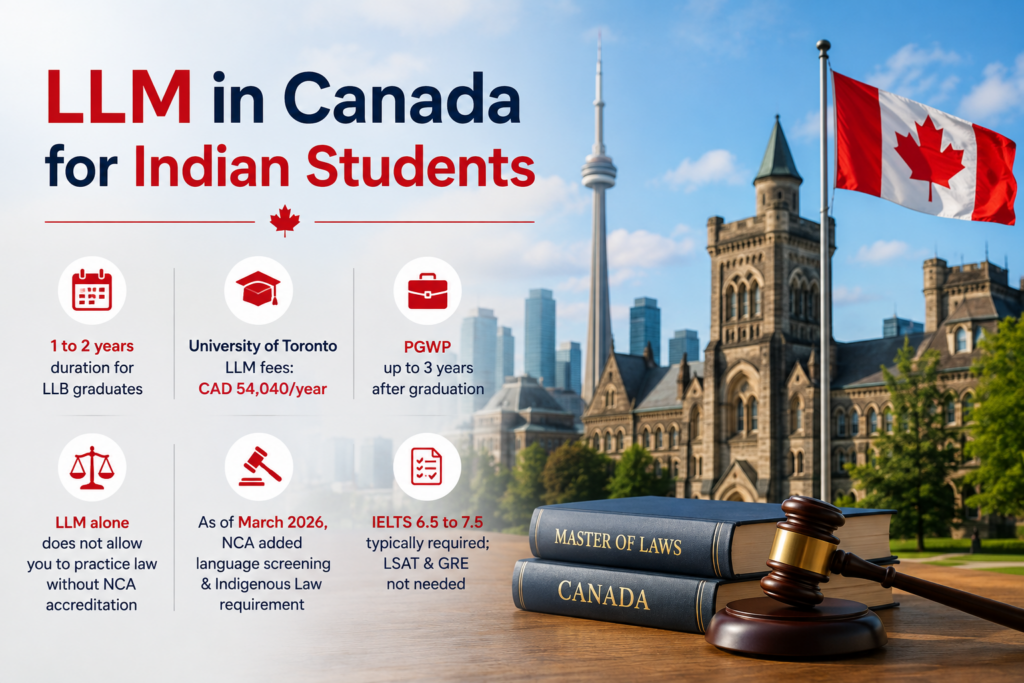
- Most LLM in Canada programs for Indian students run 1 to 2 years for those who already hold an LLB.
- University of Toronto’s LLM costs CAD 54,040 a year for international students.
- LLM graduates can apply for a post-graduation work permit of up to 3 years.
- An LLM alone does not let you practice law in Canada without NCA accreditation.
- As of March 2026, the NCA added a language screening and an Indigenous Law requirement.
- IELTS 6.5 to 7.5 is typically required; LSAT and GRE are not needed.
What Is an LLM in Canada for Indian Students?
An LLM in Canada is a 1- to 2-year postgraduate law degree for students who already hold an LLB or JD. It’s not the same track as a JD, Canada’s entry-level law degree; it’s built for specialization, commonly in corporate law, international law, or intellectual property.
Quick facts for an LLM in Canada for Indian students:

Choose your dream country
 UK
UK
 USA
USA
 Germany
 Australia
 Ireland
 Canada
 UAE
UAE
 France
 Sweden
 Italy
Italy
 Other
Other
When do you want to study abroad?
What's your highest level of education?
Have you completed Class 12th?
What was your Class 12 CGPA/percentage?
Are you a student or a parent/guardian?
What do you want to study?
Select your current city
How Leap will help you

Personalised University Shortlist

Express Applications with Quicker Admits

End-to-End Application Support
- Duration: 1 to 2 years, full-time
- Entry requirement: LLB (3 or 5-year) or JD; no LSAT or GRE needed
- Format: Course-based, thesis-based, or both, depending on the university
- Real question to ask first: Does this degree need to lead to practicing law in Canada, or just to a stronger legal specialization?
That last point matters more than any ranking list of the top law schools in Canada. If you're chasing a Canadian legal career, the LLM is just step one of a longer process, not the finish line, because the NCA process we cover further down is what actually determines licensing.
My insight: We regularly meet students who assume an LLM in Canada is functionally the same as a JD when it comes to practicing law. It isn't. The LLM builds expertise; it's the NCA process that determines whether you can be licensed.
Source: Osgoode Hall Law School, LLM Program Overview
Top Universities for an LLM in Canada for Indian Students
The QS World University Rankings 2027, released in June 2026, shows Canada's strongest law schools sitting inside globally recognized, research-heavy universities. If you're comparing the best law schools in Canada by overall institutional strength, this table is your starting point.
| University | City | QS World Rank 2027 | LLM Format |
|---|---|---|---|
| McGill University | Montreal | 30 | Thesis- and course-based, bijural (common law + civil law) |
| University of Toronto | Toronto | 32 | Course-based and thesis-based, 1-year full-time |
| University of British Columbia | Vancouver | 45 | Thesis-based and course-based options |
| York University (Osgoode Hall Law School) | Toronto | 322 | Professional (course-based) and research LLM |
Worth flagging separately: In the QS World University Rankings by Subject 2026 for Law and Legal Studies specifically, McGill's Faculty of Law placed 30th worldwide, the highest position of any Canadian law school in that subject table. If you're specifically searching for the top law schools in Canada rather than the top universities overall, that subject-level ranking matters more than the general institutional one.
My insight: Students often shortlist purely by overall QS rank and skip Osgoode entirely because York University's institutional rank sits lower. That's a mistake if your goal is corporate law in Toronto. Osgoode places graduates directly into Bay Street firms and carries a reputation in Canadian legal practice that its general university ranking doesn't reflect.
Eligibility and Documents Required for an LLM in Canada for Indian Students
Admission requirements are fairly consistent across Canadian law schools, though English test thresholds and GPA cutoffs vary by institution.
| Requirement | Typical Standard | India-Specific Note |
|---|---|---|
| Prior law degree | LLB (3- or 5-year) or JD | Both are accepted; a 3-year LLB from a recognised Indian university is standard |
| Academic performance | B+ average or equivalent in final year | Requirements vary; top schools like Toronto ask for a strong final-year average |
| English proficiency | IELTS 6.5 to 7.5, or TOEFL equivalent | Check the specific program; McGill's threshold is lower than Toronto's |
| Statement of purpose | Program-specific, focused on specialisation | Be specific about which area of law you want to study, not generic career goals |
| Letters of recommendation | 2, usually academic | Ideally from law faculty who taught you directly |
| LSAT / GRE | Not required for LLM admission | Only JD applicants need the LSAT |
For a deeper breakdown of IELTS bands by country, LeapScholar's guide to IELTS scores required for Canada covers the topic in more detail.
Thesis-Based vs. Course-Based LLM in Canada for Indian Students
This distinction gets glossed over in most guides, but it shapes both your experience and your next step.
| Detail | Thesis-Based LLM | Course-Based (Professional) LLM |
|---|---|---|
| Structure | Faculty-supervised research project | Structured coursework, no thesis |
| Best suited for | PhD track, academic career, research-focused legal roles | Corporate or commercial law specialisation, practice-focused careers |
| Where it's common | McGill (default), Osgoode's research stream | Osgoode's Professional LLM (via OsgoodePD) |
| NCA relevance | No automatic advantage | May overlap with NCA-assigned subjects if taken at a Canadian school, never guaranteed |
Neither track alone qualifies you to practice law in Canada. That depends entirely on the NCA process below.
My insight: Students sometimes pick the thesis option because it sounds more prestigious, then find themselves in a program that doesn't match how they actually want to spend the year. If you're not planning further academic study, the course-based route usually serves a corporate law career better.
Which LLM Path Fits You? A Decision Framework
The right LLM in Canada for Indian students really depends on what you're using it for. Here's how the choice tends to play out for three common situations.
If you're aiming for corporate law in Toronto
A course-based Professional LLM at Osgoode or Toronto is the more direct route. Both feed into Bay Street firms, and the coursework format lets you specialise in areas like M&A, securities, or banking law without committing a year to a research thesis. You'll still need NCA accreditation afterward, but a course-based degree from a Canadian school sometimes overlaps with NCA-assigned subjects.
If you're aiming for academia or a PhD
A thesis-based LLM, McGill's default track or Osgoode's research stream, is the stronger fit. It gives you faculty supervision and a research output you can build on for doctoral applications, which a coursework-only degree doesn't offer in the same way.
If you're unsure whether you even want to practice in Canada
Don't lock into a track based on NCA alone. A course-based LLM keeps more options open, since it's shorter to complete and doesn't require the same long-term commitment to one supervisor or research question. Use the year to test the waters, work part-time if your permit allows it, and decide on NCA once you have a clearer sense of direction.
Does an LLM in Canada for Indian Students Let You Practice Law? The NCA Process
Completing an LLM in Canada does not, by itself, license you to practice law anywhere in the country. Here's what actually determines that.
Who assesses you: The National Committee on Accreditation (NCA), a standing committee of the Federation of Law Societies of Canada, reviews foreign legal education for anyone wanting to practice in a common law province (everywhere except Quebec).
What the process involves:
- NCA assigns you between one and eight subjects based on your existing legal education
- You clear these through NCA challenge exams or equivalent courses at a Canadian law school
- Once cleared, you receive a Certificate of Qualification
- That certificate is what lets you enter a provincial law society's licensing process
What changed recently: As of March 1, 2026, the NCA added two new requirements for all foreign-trained applicants: a mandatory language screening (unless you hold an accepted exemption test result younger than two years old) and a standalone Indigenous Law and Peoples knowledge requirement. Both can apply even to applicants who submitted before that date, depending on their file status.
My insight: We've had students assume their LLM coursework automatically satisfies NCA requirements. It sometimes overlaps, particularly with a course-based LLM at a Canadian school, but it's never a guarantee. Confirm your NCA subject assignment before assuming your degree covers everything.
Sources: Federation of Law Societies of Canada, NCA Overview, CIC News, NCA 2026 Rule Changes
Cost of an LLM in Canada for Indian Students
Budgeting for an LLM in Canada for Indian students comes down to three numbers: tuition, monthly living costs, and how much a scholarship can realistically offset. Here's each one broken down.
1. Tuition Fees
| University | Program | Total Tuition (CAD) | Approx. INR |
|---|---|---|---|
| University of Toronto | LLM, course or thesis (~1 year) | 54,040/year | Rs. 37.41 lakh |
| Osgoode (York University) | Professional LLM (~1 year) | 50,972/year | Rs. 35.28 lakh |
| McGill University | LLM, non-thesis route (45 credits, ~1 year) | approx. 49,249 total | Rs. 34.10 lakh |
| McGill University | LLM, thesis route (3 terms, ~1 year) | approx. 32,023 total | Rs. 22.17 lakh |
| UBC, Allard School of Law | LLM (~1 year) | 10,082/year | Rs. 6.98 lakh |
Sources: McGill Graduate Studies Tuition Rates 2026-27, UBC Allard School of Law, LLM Tuition and Fees, University of Toronto Faculty of Law, OsgoodePD
Two quick notes on the numbers above: McGill bills per credit, not a flat annual fee: the non-thesis total comes from 45 required credits at CAD 1,094.42 each, while the thesis route uses a cheaper flat per-term rate instead. UBC's CAD 10,082 a year is precisely what Allard School of Law publishes; it's genuinely that much lower than Toronto or Osgoode, not an error.
2. Cost of Living
| City | Monthly Cost, Excl. Rent (CAD) | Approx. INR |
|---|---|---|
| Toronto | 1,497 | Rs. 1,03,650 |
| Montreal | 1,317 | Rs. 91,190 |
Source: Numbeo Cost of Living Index, updated August 2026.
3. Scholarships
| Scholarship | Offered By | What It Covers |
|---|---|---|
| Ontario Graduate Scholarship (OGS) (common, Ontario schools only) | Government of Ontario, jointly with the university | CAD 15,000 a year; a set number of awards are reserved for international students on a valid study permit |
| Law Foundation and Graduate Fellowships | University of Toronto Faculty of Law | Merit-based fellowships for LLM students; amounts vary by fellowship |
| Entrance Scholarships and Bursaries | McGill University | Renewable and non-renewable awards: check current amounts on McGill's official page |
| OsgoodePD Entrance Awards | Osgoode Hall Law School (York University) | Early applicants to the Professional LLM are automatically considered for awards |
Note the OGS is Ontario-specific, so it applies to Toronto and Osgoode but not McGill, since McGill sits in Quebec.
For a broader look at law-specific funding beyond Canada, our guide to law scholarships for Indian students abroad covers options across multiple countries.
My insight: Students often budget tuition and rent but forget mandatory health insurance, which is a real cost in Canada for international students and isn't optional. Factor it in before you finalize your loan amount.
Work and PR Pathways After an LLM in Canada for Indian Students
| Step | What It Means |
|---|---|
| Post-Graduation Work Permit (PGWP) | Up to 3 years for eligible master's graduates, even if the program ran under 2 years, as long as it was at least 8 months long |
| Language requirement for PGWP | CLB 7 in all four English ability areas (effective since November 2024) |
| Bridge to PR | PGWP work experience typically counts toward Express Entry's Canadian Experience Class |
| NCA and PGWP, are they linked? | No. You can work on a PGWP while completing NCA requirements separately |
For the full mechanics of this permit, check our blog on the PGWP guide for Canada, and for what comes after, the Canada PR requirements guide breaks down the Express Entry side in depth.
My insight: A PGWP doesn't require you to have completed NCA accreditation first. Plenty of LLM graduates use the PGWP period to work in a law-adjacent role, like compliance or legal research, while completing NCA requirements on the side.
Application Process and Timeline for the Next LLM in Canada Intake
Most Canadian LLM programs run a single intake in September, with application deadlines typically falling between November and February. Since students researching an LLM in Canada today are past most deadlines for a September 2026 start, this calendar outlines preparation for the September 2027 intake, the next realistic cycle.
| Period | What to Do |
|---|---|
| August-October 2026 | Shortlist universities, request program details, start IELTS preparation |
| November 2026-January 2027 | Submit applications; most September 2027 deadlines fall in this window |
| February-March 2027 | Respond to offers and arrange financial documents and LORs |
| April-June 2027 | Apply for your Canadian study permit |
| July-August 2027 | Finalise travel, accommodation, and mandatory health insurance |
| September 2027 | The program begins |
For visa specifics, see LeapScholar's guide on Canada student visa requirements, and for a wider view of intake patterns across programs, Canada intakes cover the full calendar year.
3 Key Takeaways on LLM in Canada For Indian Students
If you take nothing else away from this guide on LLM in Canada for Indian students, take these three:
- An LLM in Canada is a strong academic credential, but it's the NCA process, not the degree itself, that determines whether you can practice law there.
- Budget using the actual fee page for your specific university and program, since the commonly quoted "average" tuition range understates what the best law schools in Canada actually charge.
- Decide between a thesis and course-based LLM based on where you want to end up, research or practice, before you shortlist universities, not after.
Verified by: LeapScholar's Canada counseling team, drawing on direct experience guiding Indian law graduates through LLM admissions, NCA planning, and post-study work permit applications.
Considering an LLM in Canada but unsure if it aligns with your career goals? Speak with a LeapScholar counselor for a free session focused on your specific situation.
Frequently Asked Questions About LLM in Canada for Indian Students
-
Is an LLM enough to practice law in Canada?
Honestly, no, and this requirement catches a lot of applicants off guard. An LLM builds your legal knowledge and looks strong on a resume, but practicing law in a common law province means going through the NCA process separately and earning a Certificate of Qualification. Treat the LLM as preparation, not the license itself.
-
What is the NCA, and do I actually need it?
The National Committee on Accreditation looks at your foreign legal credentials and tells you which Canadian law subjects you still need to complete before you can enter a provincial licensing process. If you trained outside Canada, an Indian LLB included, and want to practice in any common law province, yes, the NCA applies to you.
-
How much does an LLM in Canada for Indian students actually cost?
It really depends on the university. Toronto and Osgoode both sit above CAD 50,000 a year for international students, while McGill bills per credit rather than a flat rate. Skip the averaged numbers you see floating around online and check the specific program's current fee page instead.
-
Do I need the LSAT or GRE for an LLM in Canada?
No. The LSAT is for JD applicants, Canada's entry-level law degree, not LLM admission. What matters for an LLM application is your existing law degree, academic record, and English proficiency.
-
What's the real difference between a thesis-based and course-based LLM?
A thesis-based LLM is research-supervised and suits students aiming for a PhD or academic path. A course-based LLM runs on coursework and tends to suit students chasing a practical specialization for corporate or commercial legal work. Neither one hands you an NCA Certificate of Qualification on its own.
-
Can I get a PGWP after an LLM in Canada?
Yes. Master's graduates currently qualify for a 3-year post-graduation work permit even if the program itself ran under two years, as long as it was at least 8 months and you meet the language requirement.
-
Is Quebec different for practicing law after an LLM?
It genuinely is. Quebec runs on a civil law system, not common law, so if you study at McGill and want to practice there specifically, you'd go through the Barreau du Québec instead of the NCA, and French becomes practically necessary for daily legal work.
-
Are there scholarships specifically for Indian LLM students in Canada?
Not a single Canada-wide one reserved just for Indian students, no. But Ontario's OGS is open to international students on a study permit, and most law faculties run their own entrance scholarships and bursaries on top of that. Check each university's official funding page rather than assuming one blanket amount applies everywhere.
-
How does an LLM in Canada compare to an LLM in the UK?
Canada's post-study work permit tends to run longer than most UK equivalents, and the PR pathway through Express Entry is more clearly mapped out. That said, it really comes down to where you eventually want to practice. LeapScholar's guide to LLM in the UK for Indian students is worth reading side by side if you're still torn between the two.





Have Questions? Get Guidance to reach your Dream University
Connect with India's finest counsellors and biggest study abroad community.
Get Guidance