
Quick Read
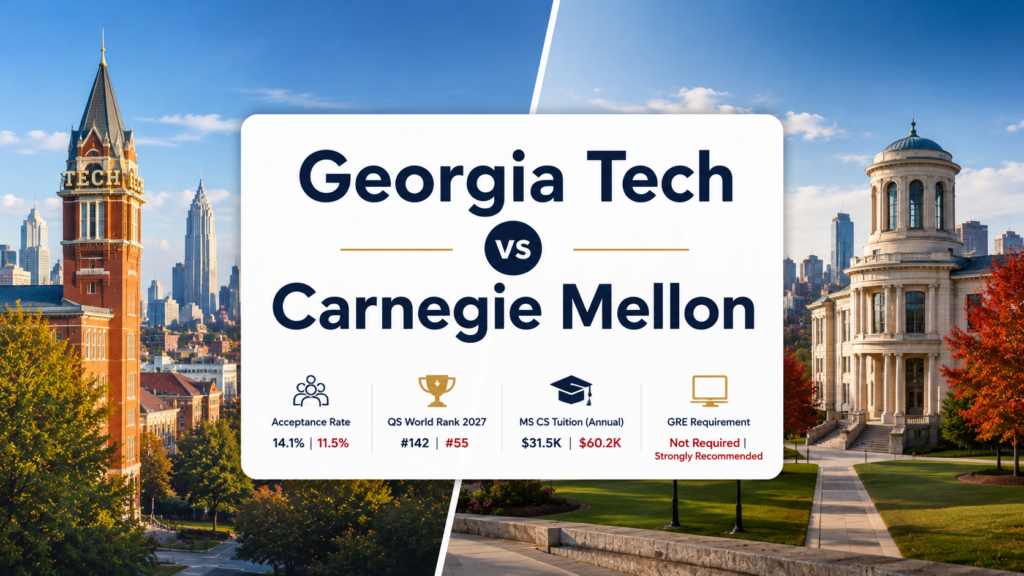
- Carnegie Mellon ranks #55 globally; Georgia Tech ranks #142 in QS World University Rankings 2027.
- Carnegie Mellon’s MSCS costs $60,176 (₹57,84,719) a year in tuition and fees for 2026-27.
- Georgia Tech’s on-campus MS costs about $31,500 (₹30,28,095) a year in tuition.
- Georgia Tech’s OMSCS costs under $7,000 (₹6,72,910) for the entire degree, no GRE needed.
Georgia Institute of Technology vs Carnegie Mellon University: College Snapshot
- Georgia Institute of Technology is a large public research university in Atlanta, split across six colleges, with a big undergraduate and graduate population and a heavy engineering and co-op culture.
- Carnegie Mellon University is a smaller private research university in Pittsburgh, organized into seven distinct colleges, including a standalone School of Computer Science, with a much lower student-to-faculty ratio.
Counselor insight: The size difference matters more than students expect. Georgia Tech’s scale means bigger class sizes but also a bigger recruiter footprint on campus. Carnegie Mellon’s smaller cohort means closer faculty access but fewer sections if a required course fills up.

Choose your dream country
 UK
UK
 USA
USA
 Germany
 Australia
 Ireland
 Canada
 UAE
UAE
 France
 Sweden
 Italy
Italy
 Other
Other
When do you want to study abroad?
What's your highest level of education?
Have you completed Class 12th?
What was your Class 12 CGPA/percentage?
Are you a student or a parent/guardian?
What do you want to study?
Select your current city
How Leap will help you

Personalised University Shortlist

Express Applications with Quicker Admits

End-to-End Application Support
Georgia Tech vs Carnegie Mellon: Quick Comparison Table
| Factor | Georgia Institute of Technology | Carnegie Mellon University |
| QS World Rank 2027 | #142 | #55 |
| THE World Rank 2026 | #41 | #24 |
| THE Computer Science Rank 2026 | #28 | Top 3 globally (QS Subject 2026) |
| UG acceptance rate (Class of 2028) | 14.1% | 11.5% |
| MSCS GRE requirement | Not required | Strongly recommended |
| MSCS annual tuition (international) | $31,500 (₹30,28,095) | $60,176 (₹57,84,719) |
| Campus type | Large public, urban Atlanta | Mid-size private, urban Pittsburgh |
Exchange rate used: 1 USD = ₹96.13. Verify the current rate before finalizing your budget.
Counselor insight: Every Indian family I counsel fixates on the overall QS number first. It matters less for CS than the subject rank does. Georgia Tech's overall QS 2027 position does not accurately reflect its strength in computer science, where THE still ranks it at #28 globally.
Georgia Tech vs Carnegie Mellon Rankings for Engineering and Computer Science
Georgia Institute of Technology
- QS World Rank 2027: #142
- THE World Rank 2026: #41
- THE Computer Science Rank 2026: #28
- Engineering: global top 15, frequently named the top-value public engineering school in the US
- Is Georgia Tech a good engineering school? Yes, on all three counts above.
Source: TopUniversities.com, Georgia Institute of Technology QS Profile
Carnegie Mellon University
- QS World Rank 2027: #55
- THE World Rank 2026: #24
- Computer Science and Information Systems: global top 3 (QS Subject Rankings 2026, alongside MIT and Stanford)
- Engineering: US top 10 (College of Engineering, ranked separately from its School of Computer Science)
- Known for: computer science, robotics, electrical and computer engineering, and fine arts
Source: TopUniversities.com, Carnegie Mellon University QS Profile
THE has not released its 2027 rankings yet, so the 2026 figures above are the latest available for both schools; QS's 2027 edition is already live and used for the overall ranks.
Source: Times Higher Education, Georgia Institute of Technology and Times Higher Education, Carnegie Mellon University
Counselor insight: Students ask me if Carnegie Mellon is an engineering school, assuming it's a pure tech school like Georgia Tech. It isn't. Your admission odds and curriculum differ sharply depending on whether you apply to its School of Computer Science or its College of Engineering.
Georgia Tech vs Carnegie Mellon Programs for AI, Robotics and Data Science
This aspect is where the two schools diverge most, and it's the part most comparisons skip.
Georgia Institute of Technology
- MS in Computer Science with a Machine Learning specialization (residential and OMSCS)
- OMSCS specializations in Machine Learning, Interactive Intelligence (AI), and Robotics, all under $7,000 (₹6,72,910) total
- MS in Robotics, a 36-credit, cohort-based program across six schools including AI, mechanics, and human-robot interaction
- MS in Analytics, a 36-credit, one-year program covering data science, machine learning, and business analytics tracks
Source: Tech AI, Georgia Tech's AI Hub, Degree Programs
Carnegie Mellon University
- MS in Artificial Intelligence and Innovation (MSAII), under the Language Technologies Institute, built around applied AI product development
- MS in AI Engineering (MS AIE), under the College of Engineering, embedding AI into specific engineering domains
- MS in Robotics (MSR), a 24-month research-focused degree, and MRSD, a 21-month industry-focused robotics degree, both from the Robotics Institute
Source: Carnegie Mellon School of Computer Science, Master's Programs
Counselor insight: If AI or robotics is your actual goal rather than general CS, don't just compare the two universities; compare the specific program. Georgia Tech's OMSCS robotics specialization costs a fraction of Carnegie Mellon's MSR, but CMU's Robotics Institute has a longer track record and deeper faculty bench in the field.
Georgia Tech vs Carnegie Mellon Admission Requirements for Indian Students
Georgia Institute of Technology MSCS
- GRE: Not required
- English proficiency: TOEFL 100 (5.0 on the revised 2026 scale) or IELTS 7.5 overall
- Application deadline: February 1 for Fall admission (no Spring intake)
Source: Georgia Tech College of Computing, MS CS Admission Requirements
Carnegie Mellon MSCS
- GRE: Strongly recommended, especially without a directly relevant degree
- English proficiency: TOEFL or IELTS, mandatory for F-1/J-1 applicants
- Application deadline: Historically mid-January (Fall 2026 entry closed January 15, 2026); confirm the exact Fall 2027 date closer to the cycle, since it wasn't published at the time of writing
Source: Carnegie Mellon School of Computer Science, Graduate Admissions
Documents Checklist for Georgia Tech vs Carnegie Mellon
| Document | Georgia Tech MSCS | Carnegie Mellon MSCS | India-specific note |
| Transcripts | Required | Required, uploaded before submission | WES evaluation not mandatory, but helps |
| GRE | Optional | Strongly recommended | Aim 320+ combined if submitting |
| TOEFL/IELTS | 100 / 7.5 | Program-specific, mandatory for F-1/J-1 | Duolingo accepted at CMU, not at GT |
| SOP | Required | Required | The visa SOP is a separate document from your university SOP |
| LORs | 2 to 3 | 2 to 3 | Academic referees preferred over managers |
Counselor insight: I've seen strong Indian applicants get rejected from Carnegie Mellon's MSCS purely for weak SOPs, not weak GPAs. Georgia Tech weighs GPA and prior coursework rigor more heavily since it doesn't ask for the GRE at all.
Georgia Tech vs Carnegie Mellon Cost for Indian Students
Annual cost
| Cost item | Georgia Institute of Technology | Carnegie Mellon University |
| On-campus MSCS tuition | $31,500 (₹30,28,095) | $60,176 (₹57,84,719) |
| Living costs | $13,000 (₹12,49,690) | $19,000 (₹18,26,470) |
| Total per year | $44,500 (₹42,77,785) | $79,000 (₹75,94,270) |
| Fully online alternative | OMSCS: under $7,000 (₹6,72,910) total, no OPT | Not offered |
Source: Georgia Tech Office of the Bursar, Tuition and Fees, Georgia Tech OMSCS, Cost and Payment Schedule, and Carnegie Mellon Student Financial Services, School of Computer Science Tuition
Georgia Tech vs Carnegie Mellon Scholarships and Waivers
| Scholarships and waivers | Georgia Institute of Technology | Carnegie Mellon University |
| Merit aid at master's level | No merit aid is offered by the MSCS program directly (confirmed by the CMU CS Department admissions page); external fellowships and TA opportunities after semester 1 are the primary routes. | Very limited, competitive |
| Notable waiver | Out-of-state tuition waiver for specific residency cases | None specific to master's applicants |
Source: Georgia Tech Catalog, Out-of-State Tuition Waivers and Carnegie Mellon Student Financial Services, Graduate Financial Aid
Counselor insight: Families often ask me to pick "the cheaper one" without factoring OMSCS into the comparison. If your goal is a US job and OPT, OMSCS doesn't get you there since it's remote. If your goal is the CMU or GT brand at the lowest possible cost and you're not chasing a US visa route, OMSCS is the best value degree in this entire comparison.
STEM OPT and Post-Study Work: Georgia Tech vs Carnegie Mellon
Computer science, robotics, and most engineering degrees at both schools fall under DHS's STEM Designated Degree Program List, which qualifies F-1 graduates for a 24-month STEM OPT extension on top of the standard 12-month OPT, for up to 36 months of US work authorization after graduation.
Source: Study in the States, U.S. Department of Homeland Security, STEM OPT Hub
Both Georgia Tech's on-campus MSCS and Carnegie Mellon's MSCS qualify. Georgia Tech's OMSCS does not lead to OPT at all, since it's a fully online, non-resident program and doesn't carry F-1 status. If your priority is working in the US after graduation, that single distinction matters more than any ranking gap between the two schools.
Counselor insight: I've had students choose the cheaper OMSCS route without realizing it completely rules out US employment. Confirm your visa and career goals before you compare price tags.
Which Should You Choose? A Decision Framework
- If you are a final-year B.Tech. student with no work experience, applying for Fall 2027: Georgia Tech is the more forgiving path since it doesn't require the GRE and weighs your transcript directly. If your profile is strong (8.5+ CGPA, relevant projects), apply to both, since Carnegie Mellon's SOP-driven review can work in your favor if you write it well.
- If you are a working professional with 3+ years of experience considering OMSCS: Georgia Tech's OMSCS at under $7,000 (₹6,72,910) total is very hard to beat for pure ROI, provided you don't need OPT right now.
- If you are a parent evaluating which investment pays back faster: Georgia Tech's on-campus MS costs roughly $44,500 (₹42,77,785) a year versus Carnegie Mellon's roughly $79,000 (₹75,94,270), a gap of over $34,000 (₹32,68,420) annually. Unless your child specifically needs CMU's research access, Georgia Tech's lower cost with a comparable engineering vs Carnegie Mellon rank gap makes it the safer bet.
Counselor insight: I always ask parents one question: is the extra ₹65 lakh over two years buying a meaningfully different career outcome or just a more famous name? For most software engineering roles, recruiters care more about your GPA, projects, and interview performance than which of these two logos is on your degree.
Georgia Tech vs Carnegie Mellon Application Timeline for 2026-27
| Period | Action |
| Jul to Sep 2026 | Shortlist programs and book GRE (if targeting CMU) and IELTS/TOEFL slots |
| Oct 2026 | Draft the SOP and request LORs from professors |
| Nov 2026 | Finalize transcripts, complete GRE/English tests |
| Dec 2026 | Submit CMU application ahead of its early deadline window |
| Jan 2027 | Confirm and meet CMU's final deadline (historically mid-January) |
| Feb 1, 2027 | Georgia Tech MSCS deadline |
| Mar to Apr 2027 | Track decisions and prepare financial documents for I-20 |
| May to Jun 2027 | Pay deposit, receive I-20, book visa slot |
| Jul 2027 | F-1 visa interview |
| Aug 2027 | The fall 2027 semester begins |
Counselor insight: Indian applicants consistently underestimate how early CMU's deadline lands relative to Georgia Tech's. Start your SOP draft in October, not December, if Carnegie Mellon is on your list.
What to Do If Your Georgia Tech vs Carnegie Mellon Application Goes Wrong
A missed deadline usually means waiting for the next Fall cycle, since neither program admits for Spring. A low GRE or GPA hurts less at Georgia Tech (GRE is optional) but more at CMU, where a strong SOP can partially offset it. If waitlisted, respond with a genuine new update rather than staying silent.
A 214(b) visa refusal is not permanent. It usually means the officer wasn't convinced of your ties to India or your funding plan.
LeapScholar's F-1 visa guide covers rebuilding a stronger visa SOP before reapplying.
Counselor insight: Most visa refusals I see aren't about the university choice at all; they're about a vague answer to "What are your plans after graduation?" Whether you choose Georgia Tech or Carnegie Mellon, have a specific answer ready.
Georgia Tech vs Carnegie Mellon: Career Outcomes and ROI
Georgia Institute of Technology: Its Career Survey Report shows an average starting salary of $93,704 (₹90,08,306) across undergraduates in AY 2024-25, with Computer Science graduates earning above that average. Georgia Tech's large co-op and internship program gives Indian students more chances at pre-graduation US work experience.
Source: Georgia Tech Office of Academic Effectiveness, Career Survey Salary Report AY 2024-25
Carnegie Mellon University: Its Career and Professional Development Center tracks strong first-destination outcomes for CS graduates, most placed at major tech employers within three months of graduation.
Source: Carnegie Mellon Career and Professional Development Center, Outcomes
Counselor insight: I've placed students from both schools into nearly identical roles at the same companies. The ranking gap between #55 and #142 rarely shows up in an actual interview loop. What does show up is whether you did a real internship, and Georgia Tech's co-op culture gives you more chances to get one.
3 Takeaways on Georgia Tech vs Carnegie Mellon
- Carnegie Mellon ranks higher overall (#55 vs #142, QS 2027) and holds a global top 3 computer science reputation but costs nearly double Georgia Tech's on-campus MS for Indian families.
- Georgia Tech's GRE-optional MSCS and OMSCS's under $7,000 (₹6,72,910) total cost make it the stronger ROI choice unless you specifically need CMU's CS research profile.
- Your career outcome depends far more on internships and interview preparation than on the ranking gap between Georgia Institute of Technology vs Carnegie Mellon University, so budget your energy accordingly.
Verified by: LeapScholar's USA counseling team, with hands-on experience guiding Indian students through Georgia Tech and Carnegie Mellon applications.
Have questions about Georgia Tech vs Carnegie Mellon for your profile? Book a free session with a LeapScholar counselor.
Frequently Asked Questions About Georgia Tech vs Carnegie Mellon
-
Is Carnegie Mellon better than Georgia Tech for computer science?
Carnegie Mellon ranks in the global top 3 for computer science (QS Subject 2026), ahead of Georgia Tech's #28 THE computer science ranking (2026). For pure CS research reputation, CMU has the edge; for value and co-op access, Georgia Tech is very competitive at a fraction of the cost.
-
Which is easier to get into, Georgia Tech or Carnegie Mellon?
Georgia Tech admitted 14.1% of its Class of 2028, while Carnegie Mellon admitted 11.5%. Georgia Tech is somewhat easier at the undergraduate level, though its MSCS program is still highly selective.
-
Is Carnegie Mellon prestigious?
Yes, particularly in computer science, robotics, and AI, where it consistently ranks among the world's top 3 programs alongside MIT and Stanford in QS Subject Rankings 2026.
-
Is Georgia Tech a highly regarded engineering school?
Yes. Georgia Tech ranks in the global top 15 for engineering and is frequently ranked as the top-value public engineering school in the US.
-
Is Carnegie Mellon a good engineering school?
Yes, its College of Engineering consistently ranks among the US top 10, separate from its more famous School of Computer Science.
-
What majors is Carnegie Mellon known for?
Carnegie Mellon is best known for computer science, robotics, electrical and computer engineering, and fine arts, an unusually strong combination of technical and creative programs under one university.
-
Is Carnegie Mellon a good school for mechanical engineering?
Yes, though it's smaller in scale than its computer science program. Georgia Tech's mechanical engineering program is comparably strong and significantly larger, with more course options.
-
How much does an MS in Computer Science at Georgia Tech or Carnegie Mellon cost for Indian students?
Georgia Tech's on-campus MS costs roughly $31,500 (₹30,28,095) a year in tuition, while Carnegie Mellon's MSCS costs $60,176 (₹57,84,719) a year for 2026-27. Georgia Tech's online OMSCS costs under $7,000 (₹6,72,910) for the entire degree but does not offer OPT.
-
What happens if my Georgia Tech or Carnegie Mellon application is rejected or waitlisted?
Neither school admits for Spring, so a rejection typically means reapplying for the next Fall cycle. If waitlisted, submit a meaningful update rather than waiting silently.










Have Questions? Get Guidance to reach your Dream University
Connect with India's finest counsellors and biggest study abroad community.
Get Guidance