
Quick Read
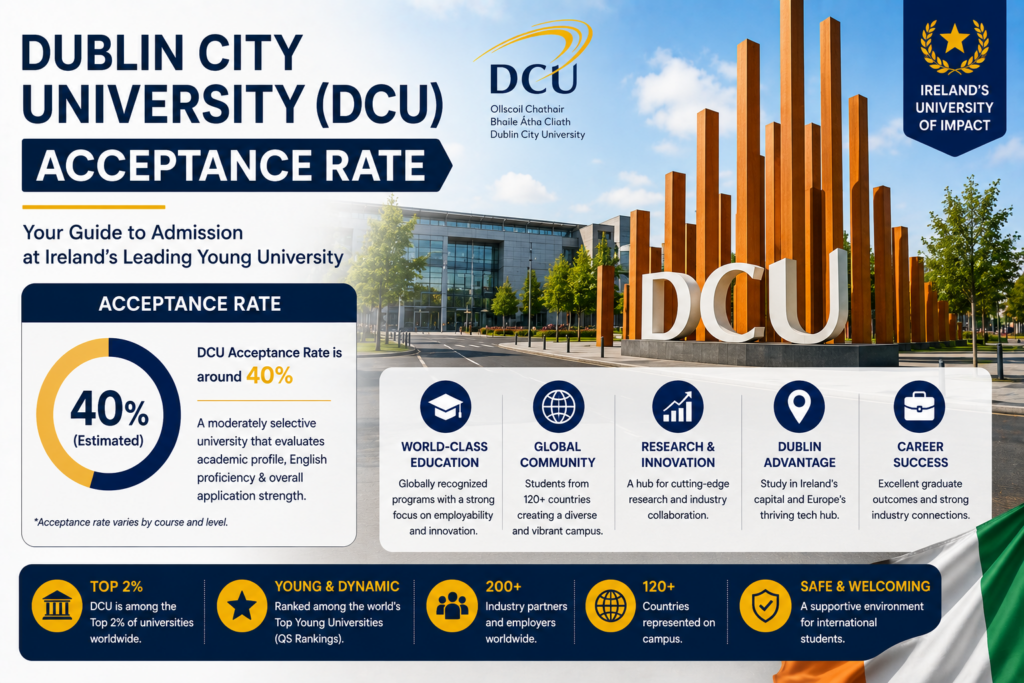
- DCU never publishes an acceptance rate; every online figure is a guess.
- QS World University Rankings 2027 places DCU at #408 globally.
- Standard entry needs IELTS 6.5, Duolingo 120+, or 80%+ in Class 12 English.
- Non-EU September 2026 applications closed 1 July 2026 via DCU’s own portal.
Why You Can’t Find a Real Dublin City University Acceptance Rate
Search “Dublin City University acceptance rate,” and you’ll get a different number from almost every result: 12.5%, 20%, 30%, 50%, 52%, and 63%. None of these come from Dublin City University. None come from Ireland’s Central Applications Office (CAO) either. They are calculated guesses published by study-abroad aggregator sites, and they contradict each other because there is no shared methodology behind any of them.
This practice isn’t unique to DCU. Irish universities, unlike US institutions, don’t release a consolidated “applicants admitted ÷ applicants received” figure for their international intake. DCU’s own admissions pages are explicit that non-EU applications are assessed individually, case by case, based on the specific application and supporting documents submitted. That is exactly why a single clean percentage doesn’t exist to report in the first place.

Choose your dream country
 UK
UK
 USA
USA
 Germany
 Australia
 Ireland
 Canada
 UAE
UAE
 France
 Sweden
 Italy
Italy
 Other
Other
When do you want to study abroad?
What's your highest level of education?
Have you completed Class 12th?
What was your Class 12 CGPA/percentage?
Are you a student or a parent/guardian?
What do you want to study?
Select your current city
How Leap will help you

Personalised University Shortlist

Express Applications with Quicker Admits

End-to-End Application Support
Counselor insight: When a student asks us, "What's my chance at DCU," we don't quote a percentage from a blog. We compare their Class 12 or degree percentage, English test score, and target program against DCU's published minimums. That comparison is more useful than any number you'll find on an aggregator page.
What DCU’s Ranking Tells You Instead
Since the Dublin City University acceptance rate isn't available, DCU's global ranking position is a more reliable signal of where it sits competitively. As of the QS World University Rankings 2027, Dublin City University holds rank #408, an improvement on its #410 position the year before, having moved between roughly #366 and #439 over the past decade of QS rankings. On the Times Higher Education World University Rankings, DCU sits in the 301–350 global band.
For context, Ireland's other well-known universities rank quite differently. Trinity College Dublin, Ireland's oldest university, holds its strongest QS position in a decade at #75 globally for 2027, remaining comfortably the country's top-ranked institution. University College Dublin entered the QS top 100 for the first time in over 15 years, landing at #100. DCU sits in a different tier altogether: younger, more industry-focused, and considerably more accessible on paper than Trinity or UCD. But "more accessible" isn't the same as "easy." DCU still has real, published entry minimums you need to clear.
| University | QS World Ranking 2027 | Founded | Known for |
| Trinity College Dublin | #75 | 1592 | Ireland's oldest, most selective |
| University College Dublin | #100 | 1854 | Large, research-intensive |
| Dublin City University | #408 | 1980 (university status 1989) | Industry links, INTRA placements |
Dublin City University Entry Requirements for Indian Students
DCU splits its admissions into two separate routes, and this is where the real Dublin City University acceptance rate question actually hides: not in a percentage, but in whether you clear the published minimum for your route.
Undergraduate Requirements
Indian Class 12 students applying with CBSE, CISCE, or a state board apply directly through the DCU Student Application Portal as non-EU applicants, not through CAO, which only handles EU/EEA/UK qualifications.
| Requirement | Minimum for DCU |
| Class 12 academic score | Program-specific, competitive courses expect well above the general entry floor |
| English proficiency (school route) | 80%+ in English at Class 12, CBSE or CISCE |
| IELTS Academic | 6.5 overall, no band below 6.0 |
| Duolingo English Test | 120+ |
| TOEFL iBT | 92+ |
| PTE Academic | 63+ |
DCU's Registry confirms Indian applicants can meet English requirements through an 80% score in English at Class 12 (CBSE or CISCE) instead of sitting a separate English test, a detail most aggregator pages skip entirely.
Postgraduate Requirements
The general Bachelor's degree floor for DCU postgraduate programs is reported inconsistently across secondary sources: a 2.2 honors result (roughly GPA 2.5/4.0) as the general minimum, with many programs asking for a 2.1 (roughly GPA 3.0/4.0). Neither DCU's own registry pages nor its program pages state one single university-wide GPA figure, so treat any single number, including this range, with caution and confirm on your specific program's own admissions page before applying. Alongside the degree result, most programs ask for the same English test minimums as undergraduate (IELTS 6.5, Duolingo 120+, TOEFL 92+, PTE 63+). Some programs ask for more. DCU Business School's postgraduate taught programs, for instance, publish higher English minimums on their admissions page for certain courses: up to IELTS 7.0, a Cambridge Proficiency pass, TOEFL 600 (paper-based)/250 (computer-based), or a Duolingo score of 130 overall with at least 120 in every subscore. Always check the specific program page; DCU is explicit that individual courses can set requirements above the university-wide floor.
Counselor insight: Students often assume "Business School" means one blanket requirement. In reality, some MSc Finance and MSc Business Analytics intakes have historically asked for stronger English scores than, say, an MA in Humanities. Check your exact target program page before you lock in an English test date.
How to Apply as a Non-EU (Indian) Applicant
- Create an account on the DCU Student Application Portal (the non-CAO route for Indian applicants).
- Pay the non-refundable application fee: Rs.5,550 EUR 50, the same for both undergraduate and postgraduate applications. A second or third-preference course on the same portal doesn't cost extra.
- Upload transcripts, English test scores, SOP, and any program-specific documents.
- Wait for a decision; DCU typically responds within a few weeks of a complete submission.
- If offered a place, accept within two weeks and pay a Rs.55,000 EUR 500 deposit to confirm your seat.
For September 2026 entry, non-EU applications closed 1 July 2026, while EU/Irish applicants had until 31 July 2026 through CAO. Some individual DCU courses close earlier, or once places fill, so always check the specific program page rather than relying on the general date.
DCU Tuition Fees: What to Actually Budget For
Per DCU's official profile on the QS platform, international (non-EU) tuition starts from Rs.17.49 lakhs (EUR 15,500) a year, but the amount is a floor, not an average. Fees vary sharply by faculty and program: Business School and Engineering & Computing Master's programs typically sit well above this starting figure, while some Humanities and Arts programs sit closer to it. DCU's own Fee Schedule 2026–2027 (on dcu.ie/fees) is the only reliable source for your specific course's exact figure. Treat any aggregator-quoted range with caution until you've cross-checked it there.
For living expenses, a full year in Dublin covering accommodation, food, transport, and utilities typically works out to roughly INR 12–16 lakh a year for most Indian students, depending on lifestyle and whether you're in university-managed or private housing. (Exchange rate used: EUR 1 ≈ Rs. 110; verify the live rate before finalising your budget.)
Counselor insight: Don't anchor your budget to the "starts from" figure quoted everywhere. Pull up your exact program's fee page on dcu.ie before you commit. The gap between DCU's cheapest and most expensive Master's programs is Rs. 8.8–11 lakh (EUR 8,000–10,000) a year.
DCU vs Other Irish Universities: Where It Actually Sits
| Factor | DCU | UCD | Trinity |
| QS World Rank 2027 | #408 | #100 | #75 |
| Relative selectivity | More accessible on paper | Competitive | Most competitive in Ireland |
| Known strength | Industry links, INTRA placements | Broad research base | Prestige, oldest university |
| Application route (non-EU) | Direct DCU portal | Direct UCD portal | Direct TCD portal |
If DCU's requirements still feel like a stretch for your current profile, our guide to universities in Ireland with higher acceptance rates covers more accessible options, and our public universities in Ireland guide gives you a wider shortlist to compare against.
How to Strengthen a Weak Profile Before Applying to DCU
- If your Class 12 English score is below 80%, plan for IELTS, Duolingo, or PTE well ahead of the deadline. Don't assume the waiver applies to you by default.
- For competitive PG programs (Business, Computing, Engineering), a strong degree result paired with a strong SOP is important, since admissions are assessed case by case rather than against one confirmed university-wide cutoff. Confirm your target program's own GPA or degree-class requirement directly on its DCU admissions page.
- Apply to your first-preference course as early as possible. DCU allows free second and third-preference applications on the same portal, so use that instead of leaving your options thin.
- If your undergraduate percentage sits at the edge of DCU's general entry floor, our guide on SOP for Ireland covers how to frame academic gaps or weaker semesters honestly.
- Not sure your 12th-grade score meets the requirement? See how LeapScholar has answered this exact question for Irish university eligibility with a 12th-grade score, or book a free counseling session for a profile-specific read.
3 Key Takeaways on Dublin City University Acceptance Rate
- DCU has no official acceptance rate. Treat every online percentage as an unverified estimate, and focus instead on clearing DCU's published entry minimums for your specific program.
- DCU's QS World Ranking of #408 (2027) and its case-by-case non-EU admissions process matter more for planning than any guessed percentage ever will.
- Indian applicants have a real English-proficiency shortcut (80%+ Class 12 English) that most competitor content never mentions. Check it before booking an unnecessary IELTS slot.
Ready to build your DCU application? Talk to a LeapScholar Ireland counselor about your Dublin City University acceptance rate and get a profile-specific entry assessment before you apply.
Frequently Asked Questions About Dublin City University Acceptance Rate
-
Is it hard to get into Dublin City University?
There's no official acceptance rate to measure this against. DCU's QS rank of #408 (2027) sits well below Trinity and UCD, so entry is comparatively more accessible on paper. Competitive courses like Business and Computing still expect strong grades and English scores.
-
What is Dublin City University's ranking in Ireland?
DCU is Ireland's 6th-ranked university in the QS World University Rankings 2027, behind Trinity College Dublin, University College Dublin, University College Cork, the University of Galway, and the University of Limerick.
-
Is Dublin City University tier 1?
Not in the way Trinity or UCD are viewed globally. But DCU Business School holds the "triple crown" accreditation (AACSB, EQUIS, and AMBA), a status held by only about 1% of business schools worldwide and unique to DCU within Ireland.
-
Which is better, UCD or DCU?
UCD ranks far higher globally (#100 vs #408 in QS 2027) and has a stronger overall research reputation. DCU stands out for industry links, its INTRA work-placement program, and a triple-accredited Business School. The better fit depends on whether you value prestige or hands-on career readiness.
-
What is Dublin City University's reputation?
DCU is known as "Ireland's University of Enterprise," valued for close industry ties, its INTRA placement scheme, and strong graduate employment outcomes, even though it ranks below Trinity and UCD on global league tables.
-
Is Dublin City University public or private?
DCU is a public university. It began as the National Institute for Higher Education in 1980 and gained university status by statute in 1989.
-
What is DCU famous for?
DCU is best known for pioneering INTRA work placements within undergraduate degrees, its triple-accredited Business School, and consistently strong graduate employability.
-
Can I get into DCU without IELTS?
Yes, for undergraduate applicants: an 80%+ score in English at Class 12 (CBSE or CISCE) can substitute for a separate English test. Duolingo (120+), TOEFL (92+), and PTE (63+) are also accepted alternatives to IELTS.
-
What is the DCU application fee?
EUR 50, non-refundable, for both undergraduate and postgraduate applications. A confirmed offer then requires a further EUR 500 deposit.
-
How much does it cost to study at DCU as an Indian student?
International tuition starts from EUR 15,500 a year, though most Business, Computing, and Engineering Master's programs cost more. Always confirm your exact program fee on DCU's official Fee Schedule before budgeting.







Have Questions? Get Guidance to reach your Dream University
Connect with India's finest counsellors and biggest study abroad community.
Get Guidance