
Quick Read
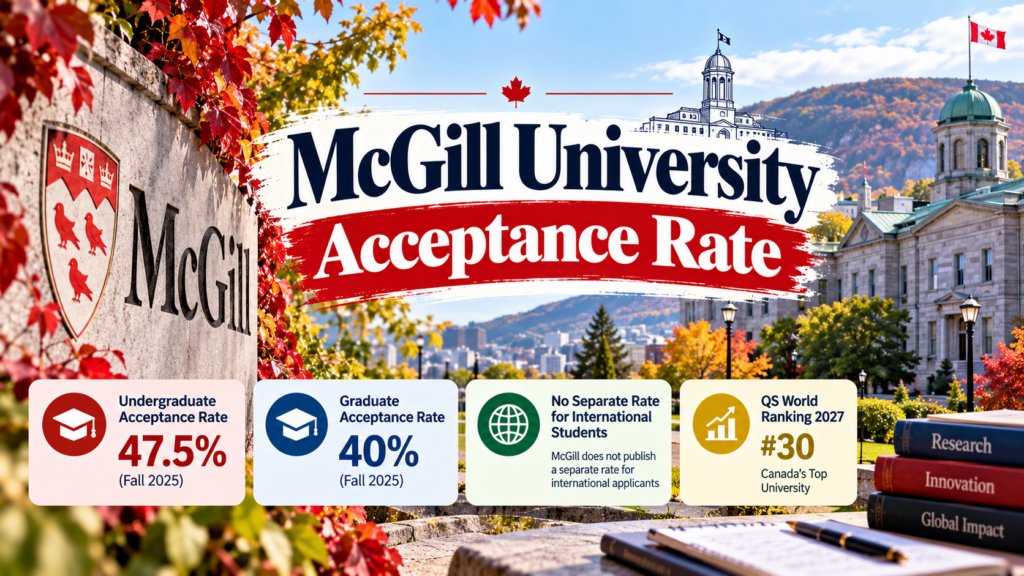
- McGill’s official Fall 2025 rate is 47.5% undergraduate and 40% graduate.
- McGill does not publish a separate rate for international applicants.
- Minimum IELTS 6.5 overall; many Indian applicants qualify for exemption.
- McGill ranks 30th globally, Canada’s top university, QS 2027 rankings.
What McGill’s Official Acceptance Rate Actually Is
McGill is unusual among the universities Indian students research: it genuinely publishes real admissions numbers every year, through its Enrolment Services Admissions Profile. For Fall 2025, McGill received 38,135 undergraduate and professional applications and made 18,132 offers, an official rate of 47.5%. At the graduate level, it received 12,538 applications and made 5,024 offers, an official rate of 40%.
These are genuine, traceable figures, unlike the guessed percentages common for many universities. But two things matter before you use them to judge your own chances.

Choose your dream country
 UK
 USA
 Germany
 Australia
 Ireland
 Canada
 UAE
 France
 Sweden
 Italy
 Other
When do you want to study abroad?
What's your highest level of education?
Have you completed Class 12th?
What was your Class 12 CGPA/percentage?
Are you a student or a parent/guardian?
What do you want to study?
Select your current city
How Leap will help you

Personalised University Shortlist

Express Applications with Quicker Admits

End-to-End Application Support
- No breakdown by nationality. McGill's own data shows where its entering class comes from (Quebec, the rest of Canada, the USA, and overseas) but does not publish a separate applications-to-offers rate for international or Indian applicants specifically. Any "international acceptance rate" quoted elsewhere is not an official McGill figure.
- University-wide, not program-specific. The 47.5% and 40% figures blend every faculty and department together. Individual programs, Medicine especially, run far more competitive numbers than the university-wide average suggests, as the sections below show.
- A different application culture shapes the number. Canadian applicants typically apply to fewer universities than their US counterparts, so a comparatively higher blended offer rate does not mean McGill is easy to get into.
Counselor insight: when a student quotes McGill's 47.5% rate as reassurance, the useful follow-up is always which faculty and which applicant category they fall into, since that is where the real variation sits.
Source: McGill Enrolment Services: Admissions Profile
McGill Admission Requirements by Degree Level
| Level | Academic benchmark | English requirement | Who assesses |
| Undergraduate | Class 10 results, Grade 11, and mid-year Class 12 results reviewed per program; McGill does not publish one fixed percentage cutoff, and subject prerequisites vary by program (for example, Maths, Chemistry, and Physics for Engineering) | IELTS 6.5 overall or TOEFL 90+; applicants with 4+ years of schooling in English may be exempt | Program-specific admissions review within each faculty |
| Postgraduate coursework (Masters) | Bachelor's degree; departments set their own minimum CGPA, commonly around 3.0 on a 4.0 scale as a university floor, though competitive departments expect well above this | Same English requirement; many Indian applicants qualify for exemption | Each department's graduate admissions committee |
| PhD | Master's degree or equivalent research background; minimum CGPA around 3.0 on a 4.0 scale; a supervisor is required before applying | Same English requirement | Supervisor and department graduate committee |
A few things worth knowing before you assume you fall short:
- McGill is grades-based, not essay-driven. Unlike UK or US applications, strong extracurriculars rarely compensate for a weak Class 12 percentage at McGill; your board results carry most of the weight.
- Predicted grades matter less than you'd think. McGill reviews your actual Class 11 and mid-year Class 12 results, not just predicted or positional grades, so a consistent academic record across both years matters.
- The English exemption is real but conditional. It applies only if you attended school in English for at least four years; most Indian applicants will still need to check whether they qualify or must submit a test score.
Counselor insight: this table, not the university-wide 47.5% figure, is what we actually walk students through when assessing their real chances at a specific McGill program.
Source: McGill: India Senior School Certificates (admission requirements)
McGill University Acceptance Rate for International Students
McGill does not publish an acceptance rate specifically for international or Indian applicants. Its Admissions Profile breaks the entering class down by region only (Quebec, rest of Canada, USA, and overseas), not by individual country or by domestic-versus-international status at the application stage. Figures claiming a precise "international acceptance rate" or an exact Indian-student count by year, seen on several third-party sites, cannot be verified against anything McGill itself publishes.
What McGill does confirm officially for Indian applicants:
- Accepted credentials: the Higher Secondary School Certificate, All India Senior School Certificate, or Indian School Certificate.
- Admission is reviewed on Class 10 results plus Grade 11 and mid-year Class 12 results; the final Class 12 certificate is required once available.
- Applicants who have lived and attended school for at least four years in a country where English is the primary language are not required to submit further proof of English proficiency.
- Key deadlines for the next intake: application for admission, January 15; supporting documents, March 1; Major Entrance Scholarship application, January 21.
For how your own CGPA or percentage is likely to be read by a Canadian admissions office, see what our counsellors say about converting your CGPA for study-abroad applications.
Source: McGill: India Senior School Certificates (admission requirements)
Is McGill Hard to Get Into for International Students?
Yes, in the sense that matters for your own application, even though the headline 47.5% rate looks comparatively high. It means:
- The blended rate hides real competition. A 47.5% university-wide rate says little about your actual faculty, especially for Medicine, Law, or Management, where demand is far higher than the average suggests.
- Grades carry almost all the weight. McGill's review is based squarely on your board results and subject prerequisites, with far less room to compensate through essays or activities than UK or US applications allow.
- The international quota is real for professional programs. Medicine admits only a handful of international applicants each year, a fact confirmed by McGill's own admissions data later in this article.
- Documentation deadlines are strict. McGill reviews applications as supporting documents arrive, so a complete, early file matters as much as your grades.
McGill's standing reinforces this: it ranked 30th globally in the QS World University Rankings 2027, Canada's top university for a fourth consecutive year, and 9th globally for sustainability. That reputation, not the blended offer rate, is the more reliable signal of how selective McGill really is.
Source: McGill Reporter: McGill remains Canada's top university in 2027 QS World University Rankings
McGill University Acceptance Rate for Engineering, Management, and Medicine
McGill's Admissions Profile reports applicants and registered students by faculty, which shows real volume even though it is not the same as an applications-to-offers rate (some students who receive offers choose not to enrol). Medicine is the exception: McGill's own medical admissions office publishes applicants and admits by category directly.
McGill University Acceptance Rate for Engineering
For Fall 2025, the Faculty of Engineering had 8,188 applicants against 1,028 registered students university-wide, across all engineering programs combined. McGill's Admissions Profile does not break this figure down by specific major, so there is no officially published separate rate for Mechanical Engineering or Computer Engineering; both fall under the same faculty-wide figure. Subject prerequisites do vary by program: Chemical Engineering requires Maths, Chemistry, and Physics, while other engineering programs have their own specific combinations.
McGill University Acceptance Rate for Management
The Desautels Faculty of Management had 7,278 applicants against 736 registered students for Fall 2025, making it one of McGill's highest-volume faculties alongside Arts and Science.
Counselor insight: when a faculty's applicant-to-registered ratio looks tight, remember it is not a true offer rate; many admitted students from other countries or Canadian provinces choose different universities, so a low enrolled count does not by itself mean a low admit rate.
McGill University Acceptance Rate for Medicine
Medicine is where McGill publishes precise, genuinely comparable admit rates by applicant category, not just enrolled-student volume. For Fall 2025 entry into the MDCM program: 149 admitted out of 1,263 Quebec university applicants (about 11.8%), 92 admitted out of 1,101 Quebec Med-P applicants (about 8.4%), 5 admitted out of 338 Canadian (non-Quebec) applicants (about 1.5%), and just 1 admitted out of 62 international applicants (about 1.6%). This confirms what competitor estimates of "under 5%" for Medicine were gesturing at, with the exact official numbers behind it.
Sources: McGill Enrolment Services: Admissions Profile; McGill Undergraduate Medical Admissions: 2025 Admissions statistics
McGill University Acceptance Rate for Graduate School
McGill's official graduate offer rate for Fall 2025 was 40% (5,024 offers against 12,538 applications), but this blends master's and PhD admissions across every department, from highly selective research groups to departments with far more available spots than qualified applicants.
The university sets a minimum CGPA floor, commonly around 3.0 on a 4.0 scale, but individual departments routinely expect higher, and a department may still consider an application below this floor if the candidate shows strong research potential. Grading scales also differ meaningfully between India and Canada, so check how your specific university's CGPA is likely to be read before assuming you fall short.
Many graduate departments do not require GRE scores, and several, per their own FAQ pages, do not require English proficiency proof from Indian applicants at all, since Indian secondary and undergraduate education is typically conducted in English. This varies by department, so confirm the exact requirement before applying.
Source: McGill Enrolment Services: Admissions Profile. Department-specific GPA and English-exemption details above are drawn from individual McGill graduate program FAQ pages and may vary; confirm with your specific department. [Needs verification before publishing]
McGill Admission Scenarios for Indian Students
| Your profile | What it means for McGill |
| Class 12 (CBSE), 90%+, IELTS 7.0, applying to Management or Computer Science | Competitive for high-demand programs, which typically expect well above McGill's general floor; a strong, consistent Class 11 and 12 record matters more than any single test score. |
| Bachelor's degree, CGPA 7.5/10 (India), applying for a Master's coursework program | Convert your CGPA to a 4.0 scale before assuming eligibility; most departments expect comfortably above the university's 3.0 floor, and requirements vary sharply by department. |
| Strong academic record, applying to MDCM (Medicine) as an international applicant | Treat this as the most competitive pathway in this article: McGill's own Fall 2025 data shows roughly 1 in 62 international applicants admitted, so a backup plan matters. |
If your profile doesn't match one of these cleanly, that's expected: McGill's requirements vary enough by faculty and department that a general rule, or the blended acceptance rate, rarely applies to every applicant. LeapScholar's counsellors can assess your specific visa chances and profile for Canada.
Document Checklist for Your McGill Application
| Document | When it's needed |
| Class 10 board exam results | All undergraduate applicants |
| Class 11 and mid-year Class 12 results (continuous assessment, term, and exam results; numeric, not positional) | All undergraduate applicants |
| Final Class 12 Certificate | Once available, in place of school-issued results |
| Proof of English proficiency (IELTS, TOEFL, or equivalent) | Unless exempt under the 4-year English-medium schooling rule |
| Statement of purpose, references, or additional documents | Program-dependent; required for select programs and all scholarship or financial aid applications |
| Supervisor confirmation | PhD and most research-based Master's applicants |
| Proof of funds | Student visa (study permit) stage, not the university application itself |
Not every document applies to every applicant: a strong but incomplete file submitted early is generally treated better by McGill than a complete file submitted at the deadline. Confirm the exact list for your program on McGill's own admissions site before you apply.
McGill Application Timeline for Indian Students
Because McGill's published rate is university-wide and not something you can plan your own timeline around, plan by deadline instead. For Indian applicants to undergraduate programs, McGill's own dates are:
| Milestone | Deadline |
| Application for admission | January 15 |
| Supporting documents | March 1 |
| Major Entrance Scholarship application and documents | January 21 |
| McGill Financial Aid application | 30 days from your acceptance date |
Music, Religious Studies, and Social Work run separate deadlines within the same cycle, so check your specific program before relying on the general dates above. McGill's undergraduate and MBA programs admit primarily in the Fall intake; most graduate programs run on a rolling, department-specific schedule instead.
Source: McGill: India Senior School Certificates (admission requirements)
What If You Don’t Meet McGill’s Requirements?
Falling short of McGill's expectations on one measure usually means a specific gap, not an automatic rejection.
- Subject prerequisites not met: Check whether a different program within the same faculty has prerequisites that better match your Class 11 and 12 subject choices, since McGill's requirements vary meaningfully even within one faculty.
- English proficiency unclear: If you are not certain you qualify for the four-year schooling exemption, sit a recognized test (IELTS or TOEFL) well ahead of the supporting-document deadline rather than assuming you are exempt.
- CGPA below a department's stated floor for graduate study: Some departments will still consider strong research potential or relevant experience; reach out to the department directly before ruling it out.
- Documentation incomplete: McGill allows preference to applicants who submit all supporting documents early, so an incomplete file is a timing problem more often than a rejection.
3 Takeaways on McGill University Acceptance Rate
- McGill genuinely publishes an official acceptance rate, 47.5% for undergraduate and 40% for graduate programs in Fall 2025, unlike many universities that leave this figure unverified.
- That rate does not cover international applicants separately and blends every faculty together; Medicine's real international admit rate (about 1.6% in Fall 2025) shows how far individual programs can sit from the university-wide average.
- McGill's actual standing, 30th globally in the QS World University Rankings 2027 and Canada's top university for a fourth straight year, is a more reliable signal of its selectivity than the blended offer rate alone.
Verified by: LeapScholar’s Canada counselling team, who have guided Indian applicants through McGill’s grades-based admissions review, CGPA-to-GPA conversions, and Canadian study permit applications.
Have a specific question about your McGill application or study permit for Canada? Book a free session with a LeapScholar counselor.
Frequently Asked Questions About McGill University Acceptance Rate
-
What is McGill University's acceptance rate?
McGill's official Fall 2025 Admissions Profile reports 47.5% for undergraduate and professional programs (18,132 offers out of 38,135 applicants) and 40% for graduate programs (5,024 offers out of 12,538 applicants). These are genuine, published figures, not estimates.
-
What is McGill University's acceptance rate for international students?
McGill does not publish one. Its data shows where the entering class comes from by region, not a separate applications-to-offers rate for international or Indian applicants specifically.
-
What is McGill University's acceptance rate for 2026?
McGill has not yet published Fall 2026 figures in its Admissions Profile at the time of writing. The most recent confirmed data is Fall 2025: 47.5% undergraduate, 40% graduate.
-
What is McGill University's acceptance rate for Canadian students?
Not published separately. McGill's official rate blends domestic and international applicants together; it reports where admitted students come from by region, not a Canada-only offer rate.
-
What is McGill University's acceptance rate for graduate school?
McGill's official Fall 2025 graduate rate was 40% university-wide, but this varies sharply by department; some are far more competitive than this average suggests.
-
What is McGill's acceptance rate for international students applying for a Masters?
Not published as a separate figure. The 40% graduate rate is blended across domestic and international students and across every master's and PhD program.
-
What is McGill University's acceptance rate for Engineering?
McGill does not publish an applications-to-offers rate for Engineering specifically. Its Admissions Profile shows 8,188 applicants against 1,028 registered students for Fall 2025, across all engineering programs combined.
-
What is McGill University's Mechanical Engineering acceptance rate?
Not published separately from the wider Faculty of Engineering figure; McGill's Admissions Profile does not break engineering applicants down by individual major.
-
What is McGill University's Computer Engineering acceptance rate?
Same answer as Mechanical Engineering: McGill reports Engineering as one combined faculty figure, with no separate rate published by major.
-
What are McGill's admission requirements for international students?
Undergraduate applicants are assessed on Class 10, Grade 11, and mid-year Class 12 results against program-specific subject prerequisites, plus English proficiency (IELTS 6.5 or equivalent, with exemptions for 4+ years of English-medium schooling). Graduate applicants need a relevant prior degree meeting a department-set CGPA floor, commonly around 3.0 on a 4.0 scale.
-
Is McGill hard to get into for international students?
The blended 47.5% rate looks accessible, but Medicine admitted only about 1 in 62 international applicants in Fall 2025, and McGill's grades-based review leaves little room to compensate for a weak academic record, so yes, for competitive programs specifically.







Have Questions? Get Guidance to reach your Dream University
Connect with India's finest counsellors and biggest study abroad community.
Get Guidance