
Quick Read
- Subclass 500 visa fee is AUD 2,500, about Rs. 1.65 lakh.
- Median processing time for Indian applicants is 23 days in 2026.
- GTE is now Genuine Student (GS); your SOP must answer GS questions.
- You need AUD 29,710 in living funds plus full tuition.
Australia Student Visa Fee in 2026
The fee for an Australia student visa increased from AUD 2,000 to AUD 2,500 on 1 July 2026, a 25% hike that now makes subclass 500 one of the most expensive student visa charges among major study destinations. At the exchange rate used in this article (Rs. 66/AUD), that works out to roughly Rs. 1.65 lakh for the primary applicant.
A few things worth knowing about the australia student visa fee before you pay it:

Choose your dream country
 UK
 USA
 Germany
 Australia
 Ireland
 Canada
 UAE
 France
 Sweden
 Italy
 Other
When do you want to study abroad?
What's your highest level of education?
Have you completed Class 12th?
What was your Class 12 CGPA/percentage?
Are you a student or a parent/guardian?
What do you want to study?
Select your current city
How Leap will help you

Personalised University Shortlist

Express Applications with Quicker Admits

End-to-End Application Support
- The fee is non-refundable, even if your application is refused.
- Applicants holding ASEAN-member passports pay a lower AUD 2,050.
- If you lodged before 1 July 2026, the older AUD 2,000 fee still applies to that application.
- The fee does not include Overseas Student Health Cover (OSHC), English test fees, or medical examination charges, so budget for those separately.
Add the Temporary Graduate visa (subclass 485) fee of AUD 5,750 to your post-study planning if you intend to work in Australia after your course, since that charge also rose sharply in the same round of increases.
Australia Student Visa Eligibility
To meet australia student visa eligibility for the subclass 500, you generally need to:
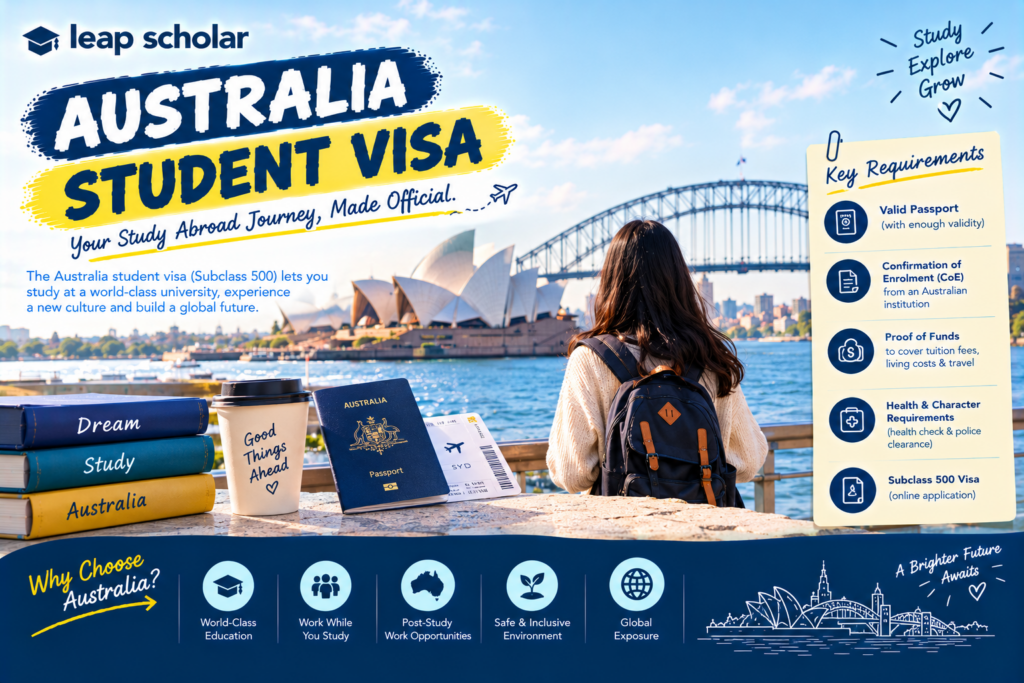
- Hold a valid Confirmation of Enrolment (CoE) from a CRICOS-registered Australian education provider.
- Satisfy the Genuine Student (GS) requirement (more on this below).
- Meet the English language threshold, currently a minimum IELTS score of 6.0 overall (or an equivalent PTE/TOEFL score) for most subclass 500 applications. See the full IELTS score breakdown by course level.
- Show evidence of Overseas Student Health Cover (OSHC) for your full intended stay.
- Meet health and character requirements, including any required medical examinations and police clearance certificates.
- Show financial capacity to cover tuition, living costs, and travel (detailed in the next section).
There is no fixed upper age limit for the student visa itself, but your Genuine Student responses need to credibly link your course to your study and career history, which becomes harder to argue the larger the age gap.
The GS (Genuine Student) Requirement: What Changed From GTE
If you have been researching this topic using older articles, you will see constant references to the "Genuine Temporary Entrant" or GTE statement. That requirement no longer exists. From 23 March 2024, the Australian Department of Home Affairs replaced GTE with the Genuine Student (GS) requirement, and GS rules continue to apply through the 2026 intakes.
The practical difference: GTE asked you to prove you intended to return home after your studies. GS instead asks you to answer a structured set of questions that evaluate whether your chosen course genuinely fits your academic background and career plan, your knowledge of the course and provider, your potential circumstances in Australia, and the value the course adds to your future. Read the full GS requirement breakdown, including sample question categories.
Your Statement of Purpose (SOP) is where you address GS directly, so treat it as a visa document, not just an admissions formality. See how to structure an SOP that answers the GS questions.
Australia Student Visa Documents Required
Here is the core australia student visa documents required checklist for a subclass 500 application:
| Document | Why it matters |
|---|---|
| Valid passport | Must be valid for your intended stay |
| Confirmation of Enrollment (CoE) | Mandatory before you can lodge the visa; also required for onshore applications since 1 January 2025 |
| Genuine Student (GS) responses / SOP | Core of your GS assessment |
| English test score (IELTS/PTE/TOEFL) | Minimum IELTS 6.0 overall for most subclass 500 applicants |
| Financial documents | Bank statements, education loan sanction letter, or sponsor documents |
| Overseas Student Health Cover (OSHC) | Proof of cover for your full visa duration |
| Academic transcripts and certificates | Supports your genuine student assessment |
| Passport-size photographs and completed visa application form | Standard lodgement requirements |
Counselor insight: Students from India most often get held up on financial documents, not academics. A degree certificate rarely triggers a request for more information; an unexplained bank deposit almost always does.
Financial Requirement: How Much You Need to Show
For 2026, single applicants must show evidence of at least AUD 29,710 per year for living expenses, about Rs. 19.6 lakh at this article's exchange rate, in addition to your full first-year tuition fee as shown on your CoE and your return airfare (roughly AUD 2,000, or about Rs. 1.32 lakh).
Accepted proof of funds includes:
- Bank statements (usually the last 3 to 6 months), held and genuinely available, not just deposited days before lodging
- Education loan sanction letters from an approved bank
- Fixed deposit certificates at least 3 months old
- Official scholarship or sponsor letters, backed by the sponsor's own financial documents
A note on living costs: your actual budget may run higher than the AUD 29,710 government threshold, particularly in Sydney and Melbourne. See a full city-by-city breakdown of living costs in Australia.
OSHC: The Health Cover You Cannot Skip
Overseas Student Health Cover (OSHC) is mandatory for the entire length of your student visa, and you need to arrange it before you lodge your application since the policy details go into the visa form. For a single student, OSHC typically costs AUD 500 to 750 per year (about Rs. 33,000 to Rs. 49,500), depending on the provider and the length of cover you purchase. Government-approved providers include Bupa, Medibank, Allianz Care Australia, AHM, and NIB; prices and inclusions vary enough between them that it is worth comparing before you buy a multi-year policy.
How to Apply for Australia Student Visa: Step-by-Step
- Accept your university offer and pay any required deposit to receive your Confirmation of Enrolment (CoE).
- Take your English test and arrange your Overseas Student Health Cover (OSHC).
- Prepare your financial documents and your Genuine Student responses or SOP.
- Create an ImmiAccount and complete the online application (Form 157A).
- Upload all documents, including your CoE, financial proof, OSHC policy, and academic records.
- Pay the AUD 2,500 visa application fee.
- Complete biometrics and any requested medical examination.
- Track your application through ImmiAccount until you receive your visa grant notice.
One rule to check carefully: since 1 July 2024, holders of a Visitor visa (subclass 600) or a Temporary Graduate visa (subclass 485) can no longer apply for a student visa while they are inside Australia. If this rule applies to you, you will need to lodge your application from offshore.
Australia Student Visa Processing Time in 2026
According to Department of Home Affairs data for July 2026, the median australia student visa processing time for Indian applicants in the Higher Education sector is 23 days, with 90% of applications decided within a broader window that can stretch to several weeks depending on individual circumstances. Processing time varies by:
- Education sector (Higher Education, VET, ELICOS, and postgraduate research each move at different speeds)
- Whether your application and documents are complete on first submission
- Whether a medical examination or additional document request is needed (this alone can add 2 to 3 weeks)
- Your individual case history and nationality-level processing patterns
The single biggest lever you control is submitting a complete, consistent application the first time. Lodging online through ImmiAccount rather than on paper also tends to move faster.
Work Rights on a Subclass 500 Visa
While your course is in session, you can work up to 48 hours per fortnight (24 hours per week). There is generally no cap on work hours during official course breaks. Working beyond this limit while classes are running is a visa condition breach and can affect future immigration applications, so track your hours carefully rather than estimating them.
Why Applications Get Refused
The most common refusal triggers for Indian applicants are not complicated paperwork gaps; they are credibility gaps. A sudden large deposit from a property sale or an informal family loan, without a paper trail, is the single most frequent flag reviewers raise. GS responses that read like a generic template rather than a specific answer about your course and career plans are the second most common issue. Start building clean financial documentation and a genuinely specific SOP at least six months before you plan to apply, not six weeks.
3 Takeaways on Australia Student Visa
- Budget for the full cost, not just the fee: AUD 2,500 for the visa plus OSHC, English test fees, and medical costs on top.
- Treat your SOP as a Genuine Student document, not an admissions formality, since GS responses are now the main credibility check.
- Start your financial documentation at least six months ahead so that every deposit has a clean, explainable paper trail by the time you apply.
Planning your Australia student visa application? Talk to a LeapScholar counselor to have your documents, financials, and genuine student statement reviewed before you lodge.
Frequently Asked Questions About Australia Student Visa
-
How can I get a student visa in Australia?
Secure a confirmed offer and Confirmation of Enrolment from a CRICOS-registered institution, then lodge your subclass 500 application online with proof of funds, OSHC, your English test score, and Genuine Student responses. Pay the AUD 2,500 fee and track your application through ImmiAccount until a decision comes through.
-
Can I get PR in Australia in 3 years?
Three years is possible only in rare cases; the realistic timeline runs closer to 4 to 6 years. Most Indian students move from the student visa (500) to a 2 to 4-year Temporary Graduate visa (485), then apply for PR through a points-based or employer-sponsored route, so PR is never automatic just because you studied in Australia.
-
How much money is required for a student visa in Australia?
Single applicants need to show AUD 29,710 a year for living expenses, about Rs. 19.6 lakh, on top of your full first-year tuition as shown on your CoE and roughly AUD 2,000 for return airfare. These funds have to be genuinely held, not deposited right before you apply.
-
Is Australia rejecting 40% of Indian student visa applications?
Department of Home Affairs figures put India's rate of student visa rejections at around 40% for FY 2025-26, among the highest in a decade, though the monthly figure has swung between roughly 32% and 51% through 2026. Most refusals trace back to weak Genuine Student statements or shaky financial documentation rather than academic eligibility.
-
How long can I stay in Australia with a student visa?
Your subclass 500 visa generally runs for the length of your course plus a short buffer, often around two months after course completion, with a maximum validity of 5 years for longer programs. Your exact expiry date is on your visa grant notice, so check that rather than assuming a standard period.
-
What is the Australia student visa processing time?
The median processing time for Indian applicants in the Higher Education sector was 23 days as of July 2026, according to Department of Home Affairs data. Incomplete documents, a requested medical exam, or sector-specific backlogs can push individual cases well past that median.
-
What is the age limit for an Australia student visa?
There is no official upper age cap on the subclass 500 visa itself. Genuine Student assessments do get harder to argue the wider the gap between your age, your study history, and your chosen course, so older applicants need a sharper career narrative in their SOP.
-
Can I convert my student visa to a working visa in Australia?
You cannot convert a student visa directly, but you can apply for the Temporary Graduate visa (subclass 485) once you complete a qualifying course, which gives Indian graduates 2 to 4 years of full work rights. A skilled or employer-sponsored visa is typically the next step after that toward longer-term work status.
-
Can I work in Australia with a student visa?
A subclass 500 visa lets you work up to 48 hours per fortnight while your course is in session, with no fixed cap during official breaks. Going over that limit breaches your visa conditions and can affect future Australian visa applications, so it is worth tracking your hours closely.
-
Can I study in Australia without IELTS?
Some universities accept alternative English proof such as a medium-of-instruction certificate or other recognized tests, but your visa officer still assesses English proficiency independently during the GS review. See which pathways and risk levels apply if you are considering skipping IELTS.





Have Questions? Get Guidance to reach your Dream University
Connect with India's finest counsellors and biggest study abroad community.
Get Guidance