
Quick Read
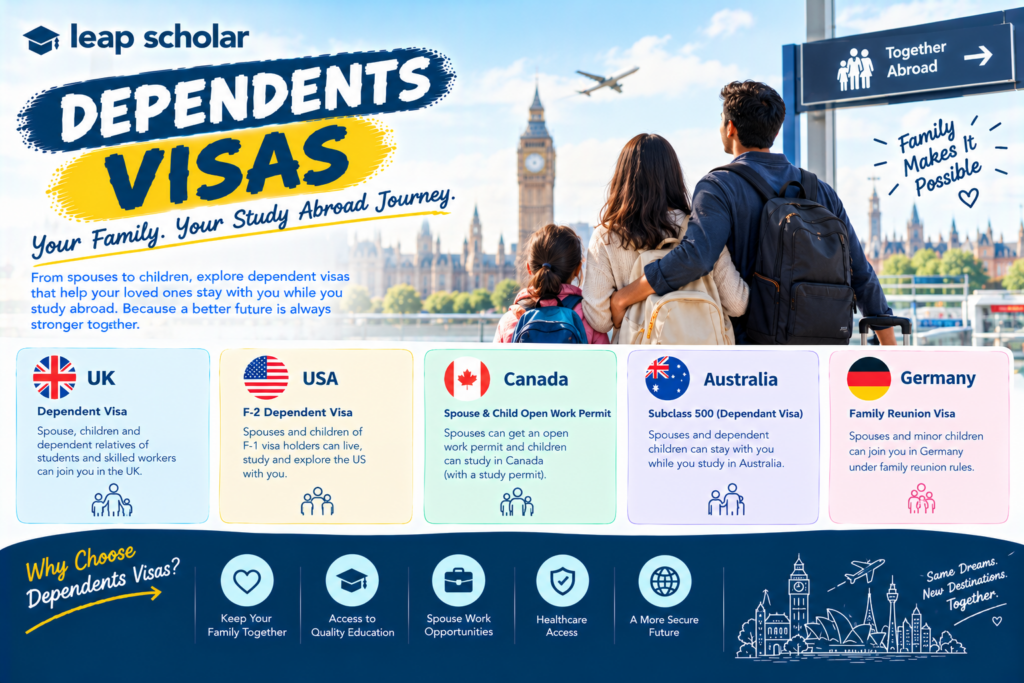
- Canada, Australia, and Germany allow the widest dependent visa access for spouses.
- UK and Canada now limit dependent visas to research and Master’s students.
- Visa fees and financial proof needed for dependents vary widely by country.
- Spouses can work full-time in Canada, UK and Germany on dependent visas.
What Is a Dependent Visa and Who Is Eligible
Dependent visas let the spouse, partner, or children of an international student join them in the country where they are studying. It is issued alongside, or soon after, the student’s own study visa, and it usually runs for the same length as that visa.
Eligibility depends entirely on the destination country and the student’s course level. Some countries, such as Germany and the Netherlands, open dependent visas to every international student. Others, including the UK and Ireland, now restrict them to PhD, research-based, or government-sponsored students. A country can also set its definition of “dependent”: most accept a legally married spouse and unmarried children under 18 or 21, while a few, such as Canada, extend the definition to common-law partners and children up to 22.

Choose your dream country
 UK
 USA
 Germany
 Australia
 Ireland
 Canada
 UAE
 France
 Sweden
 Italy
 Other
When do you want to study abroad?
What's your highest level of education?
Have you completed Class 12th?
What was your Class 12 CGPA/percentage?
Are you a student or a parent/guardian?
What do you want to study?
Select your current city
How Leap will help you

Personalised University Shortlist

Express Applications with Quicker Admits

End-to-End Application Support
Before applying for a dependent visa, check your course level and intended country against the current rules, since several destinations changed their policy in the past two years.
Which Countries Have Dependent Visas for Students
Dependent visa eligibility, duration, and the people covered differ sharply from one country to the next. Use this table to compare the eight most common study destinations for Indian students.
| Country | Who Can Apply | Dependent Visa Validity | Eligible Family Members |
| Canada | Master's (16+ months) and doctoral students | Matches the study permit (16-48 months) | Spouse/common-law partner, children under 22 |
| Australia | All Subclass 500 student visa holders | Matches the Subclass 500 visa (2-5 years) | Spouse/de facto partner, children under 18 |
| UK | PhD, research-based and government-sponsored students | Matches the student visa (often 3-4 years for PhD) | Spouse/civil partner, unmarried partner, children under 18 |
| USA | All F-1 student visa holders | Matches the F-1 visa (1-5 years) | Spouse, unmarried children under 21 |
| Germany | All international students | 1-4 years, renewable | Spouse (18+), children under 18 |
| New Zealand | Most tertiary-level students | 1-4 years | Spouse/partner, dependent children |
| Ireland | PhD and government-sponsored students | Up to 4 years (PhD duration) | Spouse/civil partner, de facto partner, children under 18 |
| Netherlands | All international students | Matches the student's residence permit | Spouse/partner, minor children |
Students on bachelor's or diploma courses have the narrowest options: Canada and the UK no longer accept them for dependent visas, while Germany, the Netherlands, and New Zealand still do.
Dependent Visa Eligibility and Documents Required
Every country asks for broadly similar proof, even though the exact dependent visa requirements and checklist differ in format. For most applications, keep these ready:
- Marriage certificate (for a spouse) or birth certificate (for a child)
- Primary applicant's valid study visa, I-20, CAS, or equivalent admission document
- Passport copies of every dependent, valid well beyond the intended stay
- Proof of relationship, such as joint bank accounts or cohabitation records, where a country asks for it
- Financial proof covering the dependent's stay, in the format the destination specifies
- Passport-size photographs matching each country's visa photo specifications
- Accommodation proof, required by some destinations such as Australia and the Netherlands
A dependent visa application is usually rejected for incomplete financial proof or a mismatch between the relationship documents and the visa form, so cross-check every document against the embassy's checklist before submitting.
Dependent Children and Schooling
Most countries that issue a dependent visa also let dependent children attend local school, though the fee structure varies. In Canada, dependent children of a Master's or PhD student can usually attend public K-12 school at the domestic rate, depending on the province. In the UK, children on a current dependent visa (tied to a PhD or research program) get access to state schools. In Australia, dependent children can enrol in public school, but some states charge international student fees even for dependents. F-2 children in the USA can attend public or private school, while Germany and the Netherlands generally extend the same public schooling access as to resident children.
If schooling is a major factor in your decision, confirm the exact fee and enrollment process with the state or local education authority, since the fee sits outside the dependent visa rules themselves and is set separately by each region.
Dependent Visa Cost and Financial Requirement
Costs are rarely a flat "dependent visa fee." Most countries instead set a financial proof amount you must show for each dependent, on top of your course and living cost funds. Based on the latest published figures, converted at Rs. 94/USD, Rs. 106/EUR, Rs. 126/GBP, Rs. 67/CAD, and Rs. 66/AUD (verify the live rate before you transfer funds):
| Country | Financial Requirement for Dependents |
| UK | Rs. 1.06 lakh per dependent per month (GBP 845), roughly Rs. 9.58 lakh for a 9-month course |
| USA | Rs. 5.64 lakh to Rs. 6.58 lakh per dependent per year (USD 6,000-7,000) |
| Canada | Rs. 19.56 lakh total financial requirement for a student + spouse (CAD 29,192, effective September 1, 2026) |
| Australia | Rs. 6.86 lakh extra for a spouse (AUD 10,394), on top of the student's own AUD 29,710 |
| Germany | Rs. 1.27 lakh per month for a couple (EUR 1,200), plus Rs. 32,000 per additional dependent |
| Netherlands | Rs. 13.78 lakh a year for the student, plus about Rs. 1.15 lakh a month per dependent |
| Ireland | Rs. 10.6 lakh per year for the student |
| New Zealand | No fixed figure; you must show you can support yourself and your dependents |
These are financial proof thresholds, not application fees. Visa and biometric fees are charged separately and are usually a small fraction of this amount.
Can You Work on a Dependent Visa? Spouse Work Rights Compared
Spouse work rights are usually the single biggest factor in choosing where to study with family, and they vary just as much as eligibility does.
| Country | Spouse Work Rights on a Dependent Visa |
| Canada | Full-time open work permit for spouses of Master's and doctoral students; spouses of bachelor's and diploma students get a visitor visa only, with no work rights |
| UK | Full-time work, including self-employment, with no hour restrictions |
| Australia | Up to 48 hours per fortnight for spouses of bachelor's and coursework Master's students; unlimited for spouses of researchers Master's and PhD students |
| USA | None; F-2 dependents cannot take up paid work |
| Germany | Unrestricted once the Family Reunion Visa converts to a residence permit |
| New Zealand | Full open work rights for spouses of Level 9 and 10 students |
| Ireland | Not automatic; it depends on whether the spouse receives Stamp 3 (no work) or Stamp 1G (full-time work) |
| Netherlands | Unrestricted once the residence permit carries the "work freely permitted" endorsement |
If your spouse plans to work, Canada, the UK, Germany, and the Netherlands currently offer the clearest path, while the USA offers none at all on the dependent visa itself.
Countries Tightening Dependent Visa Rules for Students
Dependent visa policy has moved fast in the past two years, and most of the movement has been toward tighter rules:
- The UK closed dependent visas to undergraduate and taught master's students from January 2024, keeping them only for PhD, MPhil, MRes, and government-sponsored courses.
- Canada limited the spousal open work permit to Master's (16+ months) and doctoral students from January 21, 2025; bachelor's and diploma students' spouses now get only a visitor visa.
- Ireland tightened family reunification rules in November 2025, raising financial requirements and accommodation checks.
- Australia introduced stricter, risk-based scrutiny of Indian applicants from January 2026, making complete and consistent documentation across the student and dependent visa more important than before.
If a destination's dependent visa rules matter to your decision, confirm the current policy on the official immigration portal before you finalize your course, since these conditions can change between intakes.
How to Apply for a Dependent Visa From India
Most countries let you apply for your dependent's visa alongside your own student visa, and the process is almost always faster than applying separately later.
- Confirm that your course and visa category qualify for dependents under the destination's current rules.
- Collect the dependent's documents (marriage or birth certificate, passport, photographs, financial proof) alongside your visa file.
- Submit the dependent visa application together with your study visa where the country allows it; for destinations such as the Netherlands, dependents must file a separate application through the immigration authority, which can add 60 to 90 days.
- Pay the dependent visa and biometric fees, and attend an interview if the embassy requires one.
- Track your dependent visa processing time separately from your own, since the two are not always decided on the same date.
Applying together, where possible, is the single biggest factor in avoiding delays to a dependent visa from India.
Dependent Visa Extension and Converting to a Work Visa
A dependent visa is tied to the primary applicant's status, so it generally extends or changes only when the student's own visa does. If you move from a study visa to a post-study work permit, such as Canada's PGWP or Australia's post-study work visa, your dependent's visa typically needs to be renewed or reclassified alongside it, with fresh financial proof in most cases.
Some countries also let a dependent build their own path to a work visa over time. In Canada, a spouse's Canadian work experience on an open work permit can count toward permanent residence applications. In Germany, a dependent who completes recognized qualifications or secures a skilled job offer can move to their own residence permit, including the EU Blue Card route. Converting is never automatic. It requires a separate application once the dependent independently meets that visa's requirements.
Choosing a Destination When Bringing Family
Students often shortlist a country on tuition fees alone, then discover the dependent visa rules late in the process. Run the full comparison earlier: add the dependent's financial requirement to your cost of study, then weigh it against your spouse's work rights in that country. A destination with a slightly higher course fee but full spouse work rights, such as Canada for Master's students, often works out cheaper over the full program than a country with lower fees but no spouse income, such as the USA. If your spouse's income is part of your funding plan, confirm their work rights before you pay any deposit, not after.
It also helps to separate a one-time policy restriction from a permanent one. The UK's and Ireland's current limits apply only to course type, so a PhD or research Master's applicant from India can still bring a spouse even though a taught Master's applicant cannot. Re-checking the course category against the latest dependent visa rules, rather than assuming last year's policy still holds, is worth the extra ten minutes before you commit to an offer.
3 Takeaways on Dependent Visas
- Check whether your target course level still qualifies for a dependent visa, since the UK, Canada, and Ireland have all tightened eligibility since 2024.
- Compare spouse work rights, not just tuition fees, before shortlisting a country if your dependent's income is part of your funding plan.
- Apply for your dependent's visa together with your study visa wherever the country allows it to avoid separate processing delays.
Not sure if your spouse or child qualifies for a dependent visa? Talk to a LeapScholar counselor to get your document checklist sorted before applying.
Frequently Asked Questions About Dependent Visas
-
Which countries have dependent visas?
Canada, Australia, the UK, the USA, Germany, New Zealand, Ireland, and the Netherlands all offer dependent visas for international students, but eligibility now depends heavily on your course level and destination.
-
Who is eligible for a dependent visa?
Your legally married spouse or registered partner and, in most countries, your unmarried children under 18 or 21 can apply. A few destinations, including Canada, also accept common-law partners and children up to 22.
-
What does a dependent visa mean?
A dependent visa allows a student's spouse, partner, or children to join and stay with them in the country where they are studying, usually for the same duration as the student's own visa.
-
How much does a dependent visa cost?
There is no single dependent visa fee. Instead, you must show financial proof per dependent; ranging from around Rs. 32,000 a month in Germany, you can earn over Rs. 1 lakh a month in the UK and Netherlands, in addition to visa and biometric charges.
-
How much time does it take for a dependent visa?
Processing time usually matches your study visa when you apply together. If you file separately, as in the Netherlands, it can take an additional 60 to 90 days.
-
How long is a dependent visa valid?
A dependent visa is typically valid for the same period as the primary applicant's study visa, ranging from 1 year in some countries to the full 4-5 years of a PhD program elsewhere.
-
How to get a dependent visa?
Confirm your course qualifies, gather your dependent's documents and financial proof, and apply together with your study visa wherever the country permits a joint application.
-
Can we do a job on a dependent visa?
It depends on the country and your course level. Spouses get full-time work rights in Canada (Master's/PhD only), the UK, Germany, and the Netherlands; limited hours in Australia; and no work rights at all in the USA.
-
How do I apply for a dependent visa extension?
A dependent visa extension is filed alongside the primary applicant's own visa extension or status change, with updated financial proof, rather than as a separate standalone process.
-
Can I convert a dependent visa to a work visa later?
In some countries, a dependent who independently meets a work or skilled-migration visa's requirements, such as a job offer or qualification recognition, can apply to convert. This is never automatic and needs a fresh, separate application.






Have Questions? Get Guidance to reach your Dream University
Connect with India's finest counsellors and biggest study abroad community.
Get Guidance