
Quick Read
- Chemistry accounts for 15 of the 60 IMAT questions.
- The official syllabus sits in Allegato A of the 2026 decree.
- Chemistry is the second tie-breaker after biology scores.
- Organic chemistry is listed as fundamentals, not reaction mechanisms.
- Several full NCERT Class 12 chapters fall outside the scope.
- No consultation material is permitted inside the exam hall.
Where the official IMAT Chemistry Syllabus Comes From
The IMAT chemistry syllabus lives in Allegato A of Decreto Ministeriale n. 1005, issued by Italy’s Ministry of University and Research on 6 August 2026 and published the following day.
That document matters more than any coaching summary of it, because Article 2, paragraph 2 of the decree states that the exam questions are prepared on the basis of the programs set out in Allegato A. The annex is not a suggestion about what might come up. It is the scope boundary for what can be asked.

Choose your dream country
 UK
UK
 USA
USA
 Germany
 Australia
 Ireland
 Canada
 UAE
UAE
 France
 Sweden
 Italy
Italy
 Other
Other
When do you want to study abroad?
What's your highest level of education?
Have you completed Class 12th?
What was your Class 12 CGPA/percentage?
Are you a student or a parent/guardian?
What do you want to study?
Select your current city
How Leap will help you

Personalised University Shortlist

Express Applications with Quicker Admits

End-to-End Application Support
Allegato A covers all five areas of the paper. Chemistry is section 4, and it runs to thirteen topic blocks.
Two things to check before you trust any syllabus PDF you have downloaded. First, the date. At least two older versions circulate widely in Indian IMAT study groups, and material from the Cambridge Assessment era, which ended in 2023, is now several cycles out of date. Second, the source. If it does not trace back to mur.gov.it, treat it as someone's interpretation rather than the program.
If you are new to the exam as a whole, start with our explainer on what is IMAT exam.
Counsellor insight: Check the publication date on any syllabus file before you build a plan around it. Students lose whole weeks preparing topics that were dropped two cycles ago, and the only way to catch that is to open the ministry PDF yourself once.
How Many Chemistry Questions Are in the IMAT, and What Are They Worth?
Chemistry accounts for 15 of the 60 questions, which is a quarter of the paper and the second-largest block after biology.
| Section | Questions | Maximum marks | Tie-break rank |
|---|---|---|---|
| Biology | 23 | 34.5 | 1st |
| Chemistry | 15 | 22.5 | 2nd |
| Physics and Mathematics | 13 | 19.5 | 3rd |
| Logical Reasoning and Problems | 5 | 7.5 | 4th |
| Reading Skills and General Knowledge | 4 | 6 | 5th |
| Total | 60 | 90 |
Marking runs at +1.5 for a correct answer, -0.4 for a wrong one and zero for a blank, giving a ceiling of 90 marks.
Now the part almost no other page mentions. Under Article 3, paragraph 6(a) of the decree, when two candidates finish on the same total score, the ranking is decided by section scores in a fixed order: biology first, then chemistry, then physics and mathematics, then logic, then reading. Language certification and other criteria only come into play after that.
In a ranking where two or three marks separate an offer from a rejection, your chemistry section score is the second thing the ministry looks at. That changes how much time the subject deserves. Our guide to the IMAT exam 2026 pattern and marking covers the full scoring mechanics.
Counsellor insight: Most students allocate revision time by how much they dislike a subject, and chemistry is usually the first thing squeezed out. It is worth 22.5 marks and it is the second tie-breaker. Give it a quarter of your subject hours as a floor, not a ceiling.
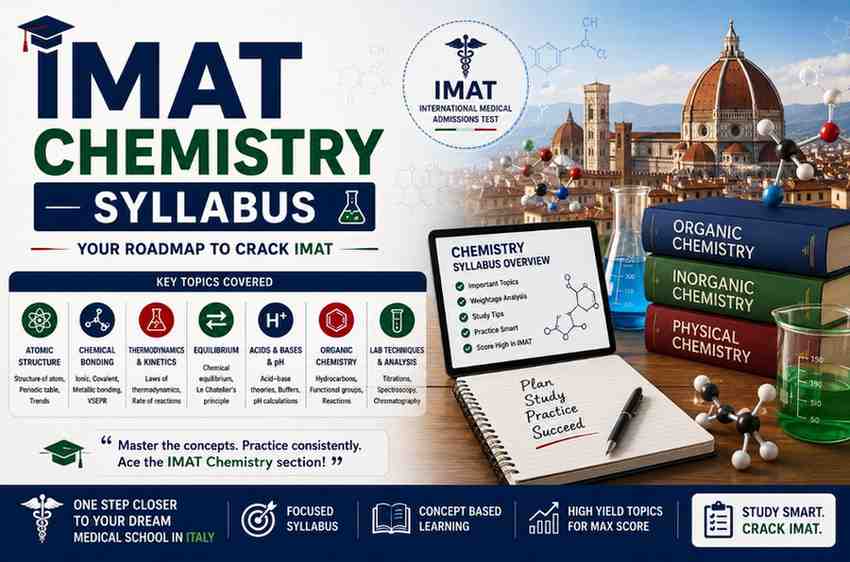
Full IMAT Chemistry Syllabus 2026: All Topics
The official list runs to thirteen blocks. Grouped for readability, here is what is examinable.
Physical and general chemistry
- Constitution of matter. States of aggregation, homogeneous and heterogeneous systems, the distinction between compounds and elements.
- Gas laws. The behaviour of ideal gases. The annex uses the phrase "perfect gases," which is the same thing your NCERT calls ideal gases.
- Atomic structure. Subatomic particles, atomic number and mass number, isotopes, and the electronic structure of the atoms of the various elements.
- The periodic table. Groups and periods, transition elements, and the periodic properties: atomic radius, ionisation potential, electron affinity and metallic character. Also the relationships between electronic structure, position in the table and the properties that follow from it.
- Chemical bonding. Ionic, covalent and metallic bonding, bond energy, bond polarity, electronegativity and intermolecular forces.
- Reactions and stoichiometry. Atomic and molecular mass, Avogadro's number, the mole concept and its application, elementary stoichiometric calculations, balancing simple equations, and the different classes of chemical reaction.
- Solutions. The solvent properties of water, solubility, and the main ways of expressing concentration.
- Equilibria in aqueous solution.
- Kinetics and catalysis, at an introductory level.
- Oxidation and reduction. Oxidation number, the concepts of oxidising and reducing agent, and balancing simple redox equations.
- Acids and bases. The acid and base concepts, acidity, neutrality and basicity of aqueous solutions, pH, hydrolysis and buffer solutions.
Inorganic chemistry
- Fundamentals of inorganic chemistry. Nomenclature and the main properties of oxides, hydroxides, acids and salts.
Organic chemistry
- Fundamentals of organic chemistry. Bonding between carbon atoms, empirical and structural formulae, the concept of isomerism, aliphatic, alicyclic and aromatic hydrocarbons, the functional groups (alcohols, ethers, amines, aldehydes, ketones, carboxylic acids, esters and amides), and elements of nomenclature.
That is the whole of it. Thirteen blocks, one of which is organic and one of which is inorganic.
Counsellor insight: The annex tells you the boundary of the syllabus, not the depth at which each line is tested. Use past papers to calibrate depth. The list tells you what to open; previous papers tell you how far to read.
IMAT Chemistry Topics Mapped to Your NCERT Chapters
If you have prepared for NEET, you have already covered most of this. Here is the mapping.
| IMAT chemistry topic | Your NCERT source | What changes for IMAT |
|---|---|---|
| Constitution of matter | Class 11: Some Basic Concepts | Straight overlap |
| Gas laws | Class 11: States of Matter | Terminology differs, content does not |
| Atomic structure | Class 11: Structure of Atom | Straight overlap |
| Periodic table and properties | Class 11: Classification of Elements | "Ionisation potential" here means ionisation enthalpy |
| Chemical bonding | Class 11: Chemical Bonding | Straight overlap, including intermolecular forces |
| Stoichiometry and the mole | Class 11: Some Basic Concepts | Heavier calculation weighting than you expect |
| Solutions and concentration | Class 12: Solutions | Basic concentration only, not full colligative treatment |
| Aqueous equilibria | Class 11: Equilibrium | Straight overlap |
| Kinetics and catalysis | Class 12: Chemical Kinetics | Introductory level only |
| Redox and oxidation numbers | Class 11: Redox Reactions | Redox yes, electrochemical cells no |
| Acids, bases, pH, buffers | Class 11: Equilibrium | Straight overlap, heavily tested |
| Inorganic nomenclature | Class 11 basics | Compound classes only, not descriptive block chemistry |
| Organic fundamentals | Class 11: Organic Basics, Hydrocarbons | Far shallower than your Class 12 organic |
What is not in the official IMAT chemistry syllabus
Working from the annex, the following NCERT material does not appear in the chemistry program:
- Thermodynamics and thermochemistry (enthalpy, entropy, Gibbs free energy)
- Electrochemistry beyond redox basics, meaning galvanic cells, the Nernst equation and electrolysis
- Coordination compounds
- The solid state
- Surface chemistry
- Polymers
- Chemistry in everyday life
- Descriptive p-block, d-block and f-block chemistry
- Organic reaction mechanisms and named reactions
Biomolecules are not absent from the exam, but they sit under the biology program rather than the chemistry one, so revise them with biology.
One important caveat. "Not listed in the program" is the correct way to read this, not "banned forever." And if you are also sitting NEET, do not delete any of these chapters from your NEET preparation. This list tells you where to spend your marginal IMAT hour, not what to forget.
Counsellor insight: The single most common preparation mistake I see is a NEET student spending all of September grinding named organic reactions. They are not in the program. That time belongs to stoichiometry, pH and buffers, which are.
An IMAT Chemistry Study Plan for Indian Students
The 2026 exam is on 29 September, and registration closes on 9 September. If you are reading this in late August, you have roughly five weeks, not eight.
| Week | Focus |
|---|---|
| 1 | Stoichiometry, the mole, concentration. Rebuild manual calculation speed. |
| 2 | Atomic structure, periodic properties, bonding. Learn the trends cold. |
| 3 | Equilibria, acids and bases, pH, buffers, hydrolysis. The heaviest scoring block. |
| 4 | Redox and oxidation numbers, kinetics and catalysis, gas laws, inorganic nomenclature. |
| 5 | Organic fundamentals, functional groups, isomerism, nomenclature. Fast drilling only. |
| 6 to 8 (if available) | Full-length timed mocks in English, no aids. Review by section, not by paper. |
Registration details are in our IMAT exam registration guide, and the cost picture is in our breakdown of IMAT exam fees.
Counsellor insight: Revise chemistry in the same sitting as biology rather than on separate days. Because of the tie-break order, those two sections are effectively judged together, and your brain should treat them that way.
3 Takeaways on IMAT Chemistry Syllabus
The IMAT chemistry syllabus is smaller than the one you already know, and that is the opportunity in it.
Three things to act on:
- Open Allegato A of the 2026 decree yourself. It is the scope boundary the ministry sets questions against, and a third-party summary of it is not the same thing.
- Redirect, do not restart. Most NEET-prepared students have already covered the chemistry topics and are simply spending time on chapters that are not in the programme.
- Give chemistry a quarter of your subject hours as a minimum. It is 22.5 marks and it is the second tie-breaker after biology, which makes it the most under-rated section on the paper.
Verified by: LeapScholar's Europe counselling team, with hands-on experience guiding Indian students through IMAT preparation, Universitaly pre-enrolment and MBBS admissions in Italy.
Have questions about the IMAT chemistry syllabus or studying medicine in Italy? Book a free session with a LeapScholar counsellor.
Frequently Asked Questions on the IMAT Chemistry Syllabus
-
How many chemistry questions are there in the IMAT?
Fifteen of the sixty questions are chemistry, making it the second-largest section after biology's twenty-three. At +1.5 per correct answer, chemistry is worth up to 22.5 of the 90 available marks. Wrong answers cost 0.4 and unanswered questions score zero.
-
How much time should I give chemistry compared to biology?
Biology carries 23 questions and chemistry 15, so a rough four-to-three split of subject hours is sensible. Weight chemistry higher if you are close to a cut-off, because the ministry uses chemistry as the second tie-breaker after biology when total scores are level.
-
I have been revising the wrong syllabus. What now?
Open the current Allegato A and mark each of your revised topics as in scope or out. Most NEET-trained students find they have over-prepared rather than under-prepared, so the fix is usually redirection rather than starting again. Prioritise stoichiometry, acids and bases, and periodic trends with whatever time remains.
-
Does the IMAT chemistry syllabus include physical chemistry?
Yes, and it forms most of the section. Stoichiometry, the mole concept, solutions and concentration, aqueous equilibria, kinetics and catalysis, redox, and acids, bases, pH and buffers are all listed. Thermodynamics and electrochemical cells are the notable physical chemistry topics that are not.
-
Is a periodic table provided in the IMAT exam?
No. The decree prohibits consultation material inside the hall, which covers a printed periodic table, and nothing in the decree provides one. You will need periodic trends and common atomic masses committed to memory, so revise without a table from the beginning.
-
Which NCERT chapters can I skip for the IMAT chemistry syllabus?
Thermodynamics, electrochemistry beyond redox basics, coordination compounds, solid state, surface chemistry, polymers, chemistry in everyday life and descriptive block chemistry do not appear in the chemistry program. Do not remove them from NEET preparation if you are also sitting that exam.
-
Is IMAT chemistry easier than NEET chemistry?
The content is narrower and shallower, so a NEET-prepared student starts well ahead. The conditions are tougher: the paper is in English, calculations are done by hand, and with only fifteen questions each mistake carries a larger share of your section score.
-
Is IMAT organic chemistry the same as NCERT Class 12 organic?
No, and it is considerably shallower. The program lists carbon bonding, formulae, isomerism, the hydrocarbon families, nine functional groups and basic nomenclature. Reaction mechanisms, named reactions and multi-step synthesis are not listed, so the emphasis falls on recognising and classifying rather than predicting reactions.
-
Where can I download the official IMAT chemistry syllabus PDF?
Allegato A of Decreto Ministeriale n. 1005, published on the Italian Ministry of University and Research website on 7 August 2026. Chemistry is section 4 of that annex. Any version not traceable to mur.gov.it, or dated before August 2026, should not be used to plan your revision.







Have Questions? Get Guidance to reach your Dream University
Connect with India's finest counsellors and biggest study abroad community.
Get Guidance