
Quick Read
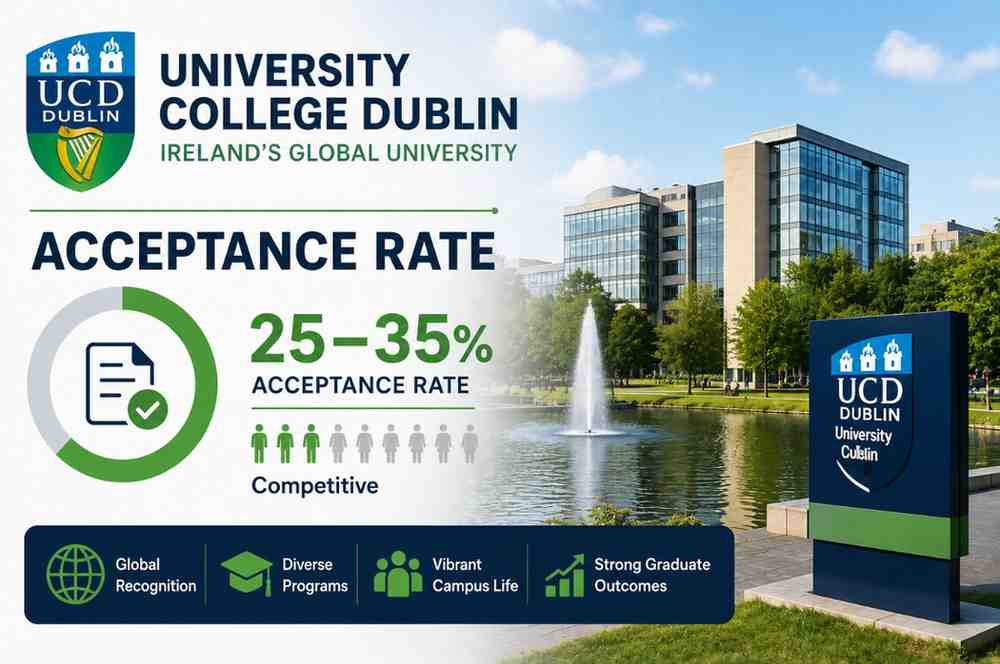
- UCD does not publish an official acceptance rate.
- A 13% acceptance rate applies only to CAO applicants.
- UCD ranks #100 in the QS World Rankings 2027.
- Indian applicants need course percentages from 70% to 90%.
- Trinity College Dublin is a separate university from UCD.
- UCD’s Quinn Business School reports 99% graduate employment.
Does University College Dublin Have a Published Acceptance Rate?
No. Online sources quote “University College Dublin acceptance rate” figures anywhere from 20% to 86%, none traceable to UCD or an Irish government source. UCD itself does not release a single acceptance rate.
What UCD does confirm is its standing: UCD ranks #100 in the QS World University Rankings 2027, placing it among the world’s top 100 universities, with particular strength in business, law, and life sciences, which is a far more reliable signal of quality than any of the invented acceptance-rate figures circulating online.

Choose your dream country
 UK
UK
 USA
USA
 Germany
 Australia
 Ireland
 Canada
 UAE
UAE
 France
 Sweden
 Italy
Italy
 Other
Other
When do you want to study abroad?
What's your highest level of education?
Have you completed Class 12th?
What was your Class 12 CGPA/percentage?
Are you a student or a parent/guardian?
What do you want to study?
Select your current city
How Leap will help you

Personalised University Shortlist

Express Applications with Quicker Admits

End-to-End Application Support
One outlier is worth naming: Dukes Plus calculated a real figure from UCD's own published data, not a guess. Their working:
| Metric | Figure |
|---|---|
| CAO applications (2024) | 26,376 |
| CAO offers made | 5,000 (estimated share of 6,000 total offers) |
| CAO acceptances | 3,500 |
| Offer rate | 19% |
| Acceptance rate | 13% |
This 13% figure applies only to the CAO route: Irish, UK, and most European applicants. It has no bearing on Indian applicants, who apply through UCD's direct international admissions process, an entirely separate pool with no published application or acceptance count.
The Real UCD Acceptance Rate Picture: CAO Route vs. Indian Direct-Entry Route
| CAO Route | Indian Direct-Entry Route | |
|---|---|---|
| Who uses it | Irish, UK, and most EU applicants | Indian and other Non-EU/Non-EEA applicants |
| Application system | Central Applications Office (CAO) | UCD's own international application portal |
| Selection basis | Points-based ranking against capped places | Course-specific percentage thresholds |
| Published applicant data | Yes (26,376 in 2024) | No |
| Calculated acceptance rate | 13% (Dukes Plus estimate) | Not calculable; no published applicant count |
| What determines admission | CAO points cut-off, competitive ranking | Meeting the published percentage minimum for your board and course |
Since there's no applicant pool to calculate a rate from on the Indian side, the only meaningful answer to "University College Dublin acceptance rate for international students" is the course-specific percentage table below, published directly by UCD.
University College Dublin Entry Requirements for Indian Students (CBSE/ISC)
UCD's official India entry requirements page publishes exact percentage thresholds for CBSE and CISCE (ISC) students, calculated based on your best five recognized subjects. This is the real answer behind "University College Dublin business school acceptance rate," "University College Dublin engineering acceptance rate," and similar course-specific searches.
| Faculty | Course | 2026 Entry Requirement |
|---|---|---|
| Business | Commerce, BSc Business, Commerce International | 80% average |
| Business | Economics & Finance | 90% average |
| Law | Law, Business & Law, Law with History/Philosophy/Politics/Economics | 80% average |
| Liberal Arts & Sciences | Liberal Arts and Sciences | 70% average |
| Sustainability | BSc Sustainability | 75% average |
| Social Sciences | Philosophy, Politics & Economics (PPE) | 75% average |
| Social Sciences | BSc Psychology | 85% average |
| Social Sciences | BSc Economics | 75% average (Maths XII 85%) |
| Engineering | Engineering Omnibus | 80% average (Maths XII 85%) |
| Architecture | Architecture | 80% average |
| Architecture | Landscape Architecture | 70% average |
| Science | Computer Science | 80% average |
| Science | Actuarial and Financial Studies | 85% average + SAT 1160 |
| Health Science | Biomedical, Health & Life Sciences | 85% average |
| Health Science | Medicine | 90% average + SAT 1200 + interview |
| Health Science | Physiotherapy | 90% average |
| Health Science | Radiography | 80% average |
| Veterinary Medicine | Veterinary Medicine | 90% average + SAT 1000 + 60 hours animal-handling experience |
| Veterinary Medicine | Veterinary Nursing | 80% average |
If your marksheet reports CGPA rather than a direct percentage, convert it first so you're comparing against UCD's stated thresholds accurately.
English language requirement: CBSE/ISC students need 80% in English or an accepted IELTS/TOEFL score instead, per UCD's Minimum English Language Requirements.
If you're comparing test options, IELTS vs TOEFL vs PTE vs Duolingo breaks down cost and format differences relevant to Irish admissions.
Counselor insight: Students often meet the overall average but miss a subject-specific sub-requirement, like the Maths threshold for Engineering or Economics. UCD's table lists these separately for a reason: an 85% overall average with 70% in Maths still fails the Economics & Finance requirement, which needs 90% overall.
Is Trinity College Dublin the Same as University College Dublin?
No, and this confusion drives a real share of "Trinity College Dublin, the University of Dublin acceptance rate" searches. These are two entirely separate institutions:
| Trinity College Dublin | University College Dublin | |
|---|---|---|
| Formal name | The University of Dublin | University College Dublin |
| Founded | 1592 | 1854 |
| Structure | A single constituent college that is itself the entire university | A standalone university with six colleges |
| QS World Ranking 2027 | Approximately #75 | #100 |
Trinity College Dublin is called "The University of Dublin" because it is the sole surviving college of a university structure dating to the 16th century, similar in naming logic to Oxford or Cambridge colleges, but Trinity has no sister colleges the way UCD has faculties. The two universities have entirely separate applications, entry requirements, and CAO codes. Don't assume a UCD rejection or offer says anything about your Trinity application, or vice versa.
UCD Smurfit and Quinn Business School: Acceptance Rate and Requirements
UCD's business education splits into two distinct schools, which is why "University College Dublin business school acceptance rate" searches often mix up two different admissions processes:
- UCD Lochlann Quinn School of Business (undergraduate): entry via the percentage table above (80-90% depending on the specific Commerce/Business/Economics course). No separate acceptance rate is published.
- UCD Michael Smurfit Graduate Business School (MBA, MSc): triple-accredited by AACSB, EQUIS, and AMBA, a distinction held by a small number of business schools worldwide. No acceptance rate is published; admission is assessed per program against a 2:1 bachelor's degree (or equivalent) and, for the MBA, relevant work experience, with GMAT-optional pathways available for several programs.
For MBA-specific guidance including GMAT-free routes, see MBA in Ireland for Indian Students and MBA in Ireland Without GMAT.
UCD Acceptance Rate for Master’s, Engineering, and Graduate Programs
There is no single "University College Dublin acceptance rate for masters" or "University College Dublin acceptance rate graduate" figure. UCD Graduate Admissions states the general graduate requirement plainly:
- Taught master's: normally a bachelor's degree at second-class honors, grade one (2:1), or equivalent. Program-specific requirements may be higher.
- Research master's/PhD: minimum upper second-class bachelor's degree; some PhD programs also require a master's degree.
- Engineering (undergraduate, Indian applicants): 80% average with a specific 85% Maths requirement in Class 12, per the table above.
- No fixed minimum academic standard for applicants: a year-long qualifying course, such as a Higher or Graduate Diploma, may be available in some cases.
Since UCD does not publish graduate applicant or offer counts, treat the 2:1-equivalent threshold and your program's specific requirement as the real benchmark, not a percentage that doesn't exist.
If You Are Applying to UCD: 3 Student Scenarios
If you are a 12th-grade CBSE/ISC student with an 85% aggregate targeting Commerce or BSc Business, you clear the 80% threshold comfortably. Your English score and any subject-specific Maths requirement become the deciding factors, not your overall percentage.
If you are a bachelor's graduate with a 2:1-equivalent degree applying for a Smurfit MSc or MBA for Autumn 2027, focus on program fit, relevant work experience for the MBA, and whether your target program is GMAT-optional, since there's no published acceptance rate to benchmark against.
If you are targeting Medicine or Veterinary Medicine with a 90%+ aggregate: budget extra time for the SAT component (1200 for Medicine, 1000 for Veterinary Medicine) and, for Veterinary Medicine, the 60-hour animal-handling experience requirement, must be completed within three years of your application and documented in detail.
UCD Fees and Scholarships for Indian Students
Important note on year: UCD's official fees pages confirm the 2026/27 Non-EU fee schedule; the 2027/28 schedule had not been published at the time of writing. UCD states fees are published exclusively on its Registry fee pages and explicitly warns that figures quoted elsewhere, including by individual schools, are for guidance only.
| Fee type | Fee* | Fee in INR |
|---|---|---|
| Non-EU undergraduate | €17,885 - €66,360 per year | Rs.19.79 lakh - Rs.73.45 lakh |
| Non-EU postgraduate taught | €9,520 - €31,780 per year | Rs.10.54 lakh - Rs.35.17 lakh |
| Application fee | €60 (typical, confirm per program) | Rs.6,640 |
Source: UCD International (Non-EU) Program Fees, the only official fee publication point per UCD's own notice on that page. Individual program fees are published via UCD's interactive fee lookup tool linked from that page.
Scholarships confirmed for Indian applicants:
- UCD Global Excellence Scholarship: 100% or 50% tuition fee waivers for outstanding Non-EU applicants. For the 2026/27 cycle, the South Asia graduate-taught deadline was 28 February, and the undergraduate/all-other-regions closing date was 31 March; confirm the equivalent 2027/28 dates once UCD publishes them.
- International Student Scholarship (ISS): automatic 10-35% tuition discount assessed at the point of offer, no separate application needed.
- Aryabhata Science Scholarship: exclusively for Indian undergraduate Science applicants, offering a 50-100% tuition waiver, administered by the UCD College of Science.
- Government of Ireland International Education Scholarship (GOI-IES): HEA-administered, typically a €10,000 fee waiver (Rs.11.07 lakh) plus a €2,000 stipend (Rs.2.21 lakh) for eligible postgraduate applicants nominating UCD as host.
For the broader Ireland scholarship landscape, see Government of Ireland Postgraduate Scholarship Program.
Documents Checklist for UCD Admission
| Document | Applies to | India-specific detail |
|---|---|---|
| Class 10 and 12 marksheets | UG applicants | CBSE/ISC average calculated on best 5 subjects |
| Bachelor's degree transcript and certificate | PG applicants | 2:1-equivalent classification confirmed against UCD's grade conversion guidance |
| English test score or English marksheet | All applicants | 80% in Class 12 English, or IELTS/TOEFL/equivalent |
| SAT score | Medicine, Veterinary Medicine, Actuarial and Financial Studies applicants | 1200 (Medicine), 1000 (Vet Medicine), 1160 (Actuarial) |
| Statement of Purpose | PG applicants | See SOP for Ireland: Format & Sample |
| Letters of Recommendation | PG applicants | Typically 2-3 |
| Resume/CV | PG applicants | Standard requirement for graduate applications |
| Animal-handling experience record | Veterinary Medicine only | 60 hours across at least 2 of 4 animal categories, within the last 3 years |
UCD Application Deadlines: 2027-28 Planning Calendar
Note on dates: UCD operates rolling admissions for most programs, with applications for the September intake typically opening around 1 October of the prior year. The specific 2027-28 scholarship deadlines had not been published at the time of writing; the dates below apply UCD's confirmed multi-year pattern and should be confirmed on the university page closer to the cycle.
| Period | Action |
|---|---|
| Around 1 October 2026 | Applications open for most undergraduate and graduate taught programs for Autumn 2027 |
| Within 3 years of application | Veterinary Medicine animal-handling experience must be documented |
| Around late February 2027 (expected, based on prior-cycle pattern) | Global Excellence Scholarship deadline for South Asia graduate-taught applicants |
| Around late March 2027 (expected, based on prior-cycle pattern) | Global Excellence Scholarship deadline for undergraduate applicants and all other regions |
| Rolling | Most programs assessed on a rolling basis as complete applications are received |
| Fixed deadline (confirm per cycle) | Medicine, Veterinary Medicine, and Physiotherapy applications, which are not rolling and require interview scheduling |
| September 2027 | 2027-28 academic year begins |
For deadlines across Ireland more broadly, see Ireland Intakes: Application Deadlines & Guide.
What to Do If You Don’t Meet UCD’s Percentage or English Requirement
- Below the course-specific percentage: UCD's International Foundation Year is designed for international students who don't yet meet direct-entry requirements, offering a pathway into the same degree the following year.
- English score below 80% or IELTS/TOEFL threshold: retake before your program's deadline; UCD does not publish a universal pre-sessional English waiver, so check your specific program page for what's accepted.
- Missed the Veterinary Medicine experience window: the 60-hour animal-handling requirement has a strict 3-year lookback; if you're short, plan your gap year or final school year around completing it before your intended application cycle.
- Visa delayed after an offer: for guidance on this stage, see Ireland Student Visa Rejection Rate, which covers common rejection reasons and how to avoid them.
UCD Employment Rate for Graduates
UCD's own Careers Network runs the annual Graduate Outcomes Survey (GOS) on behalf of the Higher Education Authority. The most specific, officially confirmed figure available is for the UCD Lochlann Quinn School of Business: 99% of graduates were either employed (83%) or in further education (16%) within 6 months of graduation, per UCD's own published GOS data.
3 Takeaways on University College Dublin Acceptance Rate
- There is no official University College Dublin acceptance rate. The 13% figure calculated online applies only to CAO (Irish/EU) applicants; Indian applicants should instead refer to UCD's published course-specific percentage thresholds, which range from 70% to 90%.
- Trinity College Dublin and UCD are entirely separate universities. Don't let one application's outcome inform assumptions about the other; check each institution's requirements independently.
- Meet your course's exact percentage and sub-requirement, not just the overall average. Subject-specific Maths or English thresholds can disqualify an otherwise-strong application, and Medicine, Veterinary Medicine, and Actuarial Studies also require a specific SAT score on top of your board percentage.
Verified by: LeapScholar's Ireland counseling team, with hands-on experience guiding Indian students through University College Dublin and other Irish university applications.
Have more questions about the University College Dublin Acceptance Rate? Book a free session with a LeapScholar counselor.
Frequently Asked Questions About University College Dublin Acceptance Rate
-
What is the acceptance rate at University College Dublin?
UCD does not publish an official acceptance rate. A calculated figure of approximately 13% exists for CAO (Irish/EU/UK) applicants, based on UCD's own published application and offer data. This figure does not apply to Indian applicants, who are assessed against course-specific percentage thresholds instead.
-
Is University College Dublin hard to get into for Indian students?
It depends on the course rather than a single difficulty level. Most undergraduate courses require 70-85% in Class 12, which well-prepared CBSE/ISC students regularly clear. Medicine, Veterinary Medicine, and Economics & Finance are considerably more demanding, requiring 90% averages plus additional SAT scores or interviews.
-
Is University College Dublin good?
UCD ranks #100 in the QS World University Rankings 2027, placing it among the world's top 100 universities, with particular strength in business, law, and life sciences. Its Michael Smurfit Graduate Business School holds triple accreditation (AACSB, EQUIS, AMBA), a distinction shared by a small percentage of business schools globally.
-
Is Trinity College Dublin the same as University of Dublin, and is its acceptance rate related to UCD's?
Trinity College Dublin is formally named The University of Dublin, but it is a completely separate institution from University College Dublin, with its own admissions process, requirements, and ranking. Trinity ranks approximately #75 globally in QS 2027, while UCD ranks #100; neither institution's acceptance figures apply to the other.
-
What is University College Dublin's acceptance rate for Business School programs?
No acceptance rate is published for either the UCD Quinn School of Business (undergraduate) or the Michael Smurfit Graduate Business School (MBA/MSc). Undergraduate Commerce and Business courses require 80-90% for Indian applicants, while graduate business programs assess a 2:1-equivalent degree plus program-specific criteria.
-
What is University College Dublin's acceptance rate for Engineering?
UCD does not publish an Engineering acceptance rate. For Indian CBSE/ISC applicants, the Engineering Omnibus program requires an 80% overall average with a separate 85% requirement specifically in Class 12 Mathematics, confirmed on UCD's official India entry requirements page. Meeting the overall average without the Maths threshold is not sufficient for admission.
-
What is the employment rate at University College Dublin?
UCD's Lochlann Quinn School of Business reports that 99% of its graduates were employed or in further education within 6 months of graduation, based on UCD's own Graduate Outcomes Survey. UCD as a whole is ranked in the global top 100 for graduate employment outcomes in the QS World University Rankings 2027.
-
What is UCD's admissions email for Indian applicants?
For India-specific entry requirement queries not covered on UCD's official India page, UCD directs applicants to india@ucd.ie. General international applicants can also reach UCD Global through the contact channels listed on the UCD Global website or through UCD's regional Global Centre in Delhi for in-person guidance.
-
How much does University College Dublin cost for Indian students?
Non-EU undergraduate fees for the confirmed 2026/27 cycle range indicatively from €17,885 to €66,360 per year (Rs.19.79 lakh to Rs.73.45 lakh at Rs.110.67/EUR), and postgraduate taught fees from €9,520 to €31,780 (Rs.10.54 lakh to Rs.35.17 lakh). The 2027/28 schedule was not yet published at the time of writing; confirm exact figures on UCD's official fees page.







Have Questions? Get Guidance to reach your Dream University
Connect with India's finest counsellors and biggest study abroad community.
Get Guidance