
Quick Read
- TU Delft does not publish one official overall acceptance rate, unlike US universities.
- Only a handful of bachelor’s programs use numerus fixus (capped, competitive seats).
- Most master’s programs admit anyone who clears fixed academic prerequisites.
- Indian applicants are judged on GPA equivalence, English scores, and motivation letter fit.
What Is the TU Delft Acceptance Rate?
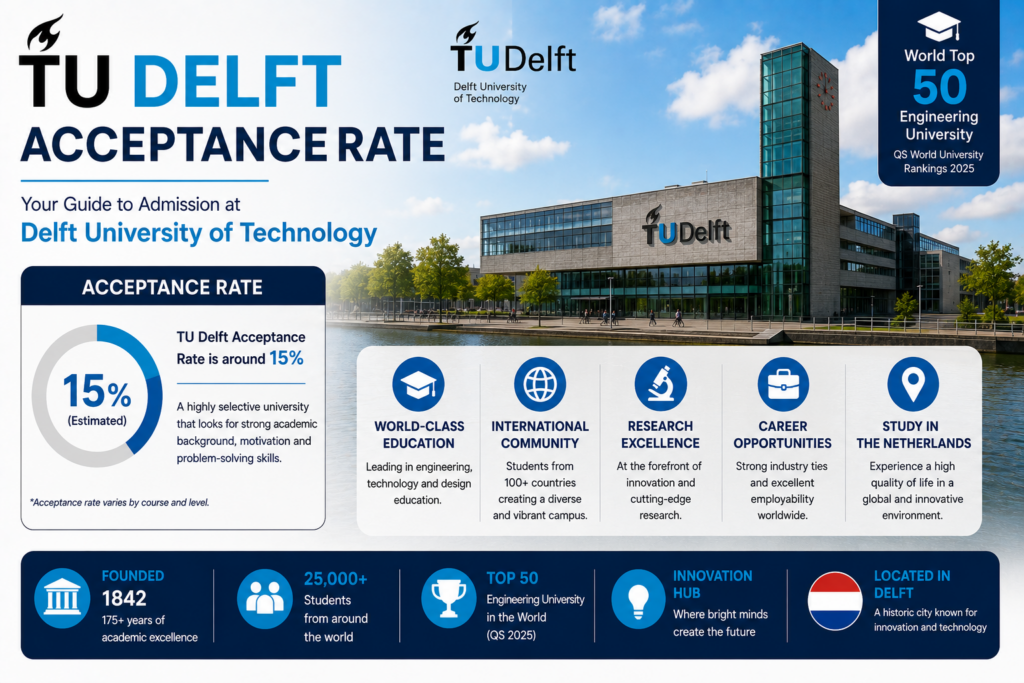
If you’ve been searching for the TU Delft acceptance rate, you’ve probably already noticed the problem: every website quotes a different number. One page says 82%. Another page on the same website says 50%. A third source says 60 to 69%. None of them link back to TU Delft or to QS or THE.
Here’s the actual reason the number keeps changing: TU Delft does not publish a single official acceptance rate, and it doesn’t calculate admissions the way many US universities do. Most TU Delft programs, especially at the master’s level, work on a prerequisite-based system. If you meet the published academic requirements, English score, and prior coursework for a specific program, you’re eligible for admission. There’s no fixed number of seats you’re competing against.

Choose your dream country
 UK
UK
 USA
USA
 Germany
 Australia
 Ireland
 Canada
 UAE
UAE
 France
 Sweden
 Italy
Italy
 Other
Other
When do you want to study abroad?
What's your highest level of education?
Have you completed Class 12th?
What was your Class 12 CGPA/percentage?
Are you a student or a parent/guardian?
What do you want to study?
Select your current city
How Leap will help you

Personalised University Shortlist

Express Applications with Quicker Admits

End-to-End Application Support
The exception is a small set of bachelor's programs under the Dutch numerus fixus system, where the government or the university caps the number of places and selection genuinely gets competitive. This is where "TU Delft acceptance rate" as a single figure breaks down completely, because a numerus fixus bachelor's program and an open master's program don't operate on the same logic at all.
This isn't unique to TU Delft. Several European technical universities run admissions the same way; the Technical University of Munich acceptance rate faces the identical problem of aggregator sites quoting numbers the university itself never published.
So instead of repeating an unverified percentage, here's what the TU Delft acceptance rate actually depends on for you.
TU Delft Acceptance Rate by Program: Numerus Fixus vs Open Admission
| Program type | Selection basis | Numerus fixus? | What decides admission |
| Most Bachelor's programs | Meet fixed entry requirements | No | Subject prerequisites (e.g. Maths B), diploma equivalence |
| Computer Science & Engineering (BSc) | Matching & Selection procedure | Yes | Capped seats, competitive selection |
| Aerospace Engineering (BSc) | Matching & Selection procedure | Yes | Capped seats, competitive selection |
| Most Master's programs | Prerequisite-based | No | GPA threshold, relevant bachelor's, English score |
| PhD | Application + interview per position | No fixed quota | Research fit, funding availability, supervisor match |
Which TU Delft bachelor's programs have numerus fixus?
TU Delft currently runs numerus fixus on a small number of bachelor's programs, including Computer Science & Engineering and Aerospace Engineering, where more students apply than there are places. Spots are filled through a Matching & Selection procedure rather than a simple GPA cutoff, so your application, motivation, and any required assessment all factor in. The exact list and seat counts can shift each admission cycle, so always confirm the current numerus fixus status for your specific program on TU Delft's own program page before you apply.
Are TU Delft master's programs competitive?
Most TU Delft master's programs aren't quota-driven, but "not quota-driven" doesn't mean easy. The bar is the prerequisite list itself: a required GPA, specific prior coursework (linear algebra, thermodynamics, or programming, depending on the program), and an English score. If your academic background has gaps against a program's prerequisites, you may need a bridging course before you're even eligible to apply, which is a much more common reason for Indian applicants to be turned away than raw seat competition.
Counselor insight: Don't ask "what's my chance against other applicants." Ask "do I meet every listed prerequisite for this exact program." For TU Delft master's programs, that second question is the one that actually decides your outcome.
TU Delft Acceptance Rate for Indian Students: What Actually Matters
For Indian students, the TU Delft acceptance rate question usually hides a more specific worry: will my CBSE, ISC, or state board background hold up, and is my GPA good enough. Since TU Delft doesn't publish a rate broken out by nationality, here's what genuinely moves the needle for Indian applicants:
- Academic equivalence: Your board certificate needs to be assessed as equivalent to a Dutch VWO diploma for bachelor's programs, or your undergraduate degree needs to match the subject prerequisites for a master's.
- English proficiency score: Since Indian secondary and undergraduate education is rarely conducted entirely in English by TU Delft's definition, most Indian applicants will need to submit IELTS or TOEFL scores (see the requirements table below), unless your prior degree was fully English-medium and TU Delft accepts that as a waiver.
- Motivation letter: For programs without a hard cutoff, the substance of your motivation letter often determines whether a borderline application is accepted, particularly for competitive master's tracks.
- Timing: Applying close to a numerus fixus deadline with an incomplete document set is one of the most common reasons Indian applicants lose a place that their academics would otherwise have qualified them for.
TU Delft Admission Requirements (Bachelor’s, Master’s, PhD)
| Level | Academic requirement | English requirement |
| Bachelor's (VWO-equivalent) | Relevant Standard XII subjects (e.g. Maths B equivalent) | IELTS or TOEFL, or accepted waiver |
| Master's | Relevant bachelor's degree meeting program prerequisites | IELTS 7.0 overall (6.5 per section) or TOEFL iBT 100 (22 per section minimum) |
| PhD | Research proposal fit, supervisor match | IELTS 7.0 overall (6.5 per section) or TOEFL iBT, position-dependent |
A detail worth flagging if you're testing soon: TOEFL score reports dated from 21 January 2026 require an overall band score of 5 with a minimum of 4.5 per section, confirmed verbatim on TU Delft's official PhD admission page (TOEFL reports before that date still use the 100 overall / 22 per section scale), which is different from the older scale still quoted on most third-party guides. Check which scale applies to your test date before submitting.
If your undergraduate degree was taught entirely in English, some Dutch universities including TU Delft accept a Medium of Instruction (MOI) certificate instead of IELTS or TOEFL, though this is program-specific and not guaranteed. See what our counselors say about MOI acceptance at Dutch universities before assuming it applies to your program.
Counselor insight: Book your IELTS or TOEFL slot the moment you shortlist TU Delft. Numerus fixus deadlines fall as early as 15 January, and a delayed English score is a completely avoidable reason to miss it.
TU Delft Application Deadlines for the 2026-27 Intake
| Program type | Deadline |
| Bachelor's, numerus fixus (e.g. CSE, Aerospace Engineering) | 15 January |
| Bachelor's, no numerus fixus | 1 April |
| Master's | Varies by program; typically earlier for non-EU applicants needing a visa |
| PhD | Rolling, tied to individual position postings |
TU Delft Ranking 2027 and What It Means for Your Admission Odds
TU Delft placed 48th globally and 13th in Europe in the QS World University Rankings 2027, published in June 2026, retaining its position as the highest-ranked Dutch university. That rank explains why TU Delft is competitive for popular programs: strong global reputation drives strong application volume, and application volume is exactly what pushes numerus fixus programs toward tighter selection.
But rank and acceptance rate aren't the same signal. A high QS rank tells you about research output, employer reputation, and academic standing. It doesn't tell you how many people apply to your specific program this cycle. Use the ranking to judge the degree's long-term value, not as a proxy for how hard it will be to get in.
If you're still comparing TU Delft against other Dutch options, our guide to top universities in the Netherlands breaks down where each one stands.
Counselor insight: When a student asks me if TU Delft's ranking means it's "harder to get into than last year," I point them to the program's own prerequisite page, not the QS table. Ranking movement and admission difficulty don't move together in any predictable way.
How Indian Students Can Strengthen Their TU Delft Application
- Match your motivation letter to the exact program, not to TU Delft in general. Admissions committees can tell the difference between genuine program-specific interest and a generic "I want to study engineering in Europe" letter.
- Check subject-level prerequisites early. If a master's program lists a specific course (say, a linear algebra requirement) that your undergraduate transcript doesn't clearly show, reach out to the program coordinator before you apply, not after rejection.
- Register on Studielink well ahead of the deadline. The portal-to-visa pipeline for non-EU applicants takes longer than a single-university application system typically does.
- Budget for the correct fee category. Non-EU/EEA students pay TU Delft's institutional fee, which is higher than the EU statutory fee often quoted in generic cost articles, so don't plan your budget off the wrong number. If the institutional fee changes your calculations, check TU Delft scholarships for Indian students before you rule the university out on cost alone.
- Start your Netherlands student visa process only after you have a confirmed offer. Review the Netherlands student visa guide early so the paperwork doesn't become the bottleneck once you're admitted.
- For numerus fixus programs, treat 15 January as a hard deadline, not a target. Late or incomplete documentation is one of the most preventable reasons Indian applicants lose a place.
Counselor insight: The single biggest gap I see in Indian applications isn't academics, it's timeline. Students start their English test prep and document collection in November for a 15 January numerus fixus deadline, which leaves almost no room for a retake if the first IELTS attempt falls short.
3 Key Takeaways on TU Delft Acceptance Rate
- A single "TU Delft acceptance rate" number doesn't exist officially, so treat any specific percentage you find online as unverified until you check the program's own admissions page.
- The real dividing line isn't nationality or overall selectivity, it's whether your specific program runs numerus fixus (capped and competitive) or is prerequisite-based (open to anyone who qualifies).
- For Indian applicants, timeline discipline (English test scores, document equivalence, Studielink registration) eliminates more risk than trying to estimate your odds against other applicants.
Not sure what your TU Delft acceptance rate actually depends on? Talk to a LeapScholar counselor for a program-by-program review of your TU Delft admission odds.
Frequently Asked Questions About TU Delft Acceptance Rate
-
Is getting into TU Delft hard?
It depends entirely on the program. TU Delft's five numerus clausus bachelor's programs are genuinely competitive with capped seats, while most master's programs are prerequisite-based, meaning meeting the academic and English requirements matters more than competing against a quota.
-
What is the TU Delft acceptance rate for Architecture?
TU Delft's Architecture programs don't have a single published acceptance rate either. Selection weighs academic background and, at the master's level, portfolio strength alongside standard prerequisites, so check the Architecture faculty's own admissions page for the current process.
-
What is the TU Delft acceptance rate for international students?
TU Delft does not publish a single official acceptance rate for international students. Admission depends on whether the specific program is numerus fixus (capped and competitive) or prerequisite-based (open to anyone who meets the requirements).
-
Is TU Delft better than MIT?
"Better" depends on what you're optimizing for. MIT ranks #1 globally on QS 2027 against TU Delft's #48, but TU Delft offers a comparable engineering education at a fraction of the cost and is the top-ranked university in the Netherlands.
-
Does TU Delft require IELTS?
Most non-native English speakers need IELTS (7.0 overall, 6.5 per section minimum) or TOEFL iBT for master's and PhD admission. Some applicants with a fully English-medium prior degree may qualify for a waiver or MOI certificate instead, depending on the program.
-
What is the tuition fee for TU Delft?
For the 2026-27 academic year, non-EU/EEA students pay an institutional fee of Rs. 21.90 lakh (€19,906) for bachelor's programs and Rs. 28.20 lakh (€25,633) for master's, at Rs. 110/EUR (verify the live rate before budgeting). EU/EEA students pay the statutory rate of Rs. 2.96 lakh (€2,694).
-
Is TU Delft government or private?
TU Delft is a public university, funded and regulated by the Dutch government, not a private institution. It is the oldest and largest technical university in the Netherlands.
-
How many students attend TU Delft?
TU Delft has approximately 27,000 students enrolled across its bachelor's, master's, and PhD programs, making it the largest university of technology in the Netherlands.
-
What is the TU Delft acceptance rate for Electrical Engineering?
Electrical Engineering has no numerus fixus, so there's no capped acceptance rate to speak of. It does require a mandatory Study Choice Check before enrolment, and the international application deadline is 1 April.
-
What is the TU Delft PhD acceptance process like?
PhD admission is tied to individual funded positions rather than a general application pool. You're evaluated on research fit, supervisor match, and funding availability for that specific position, not against an overall acceptance rate.






Have Questions? Get Guidance to reach your Dream University
Connect with India's finest counsellors and biggest study abroad community.
Get Guidance